
01Summary
In a paragraph
If you only have 30 seconds.
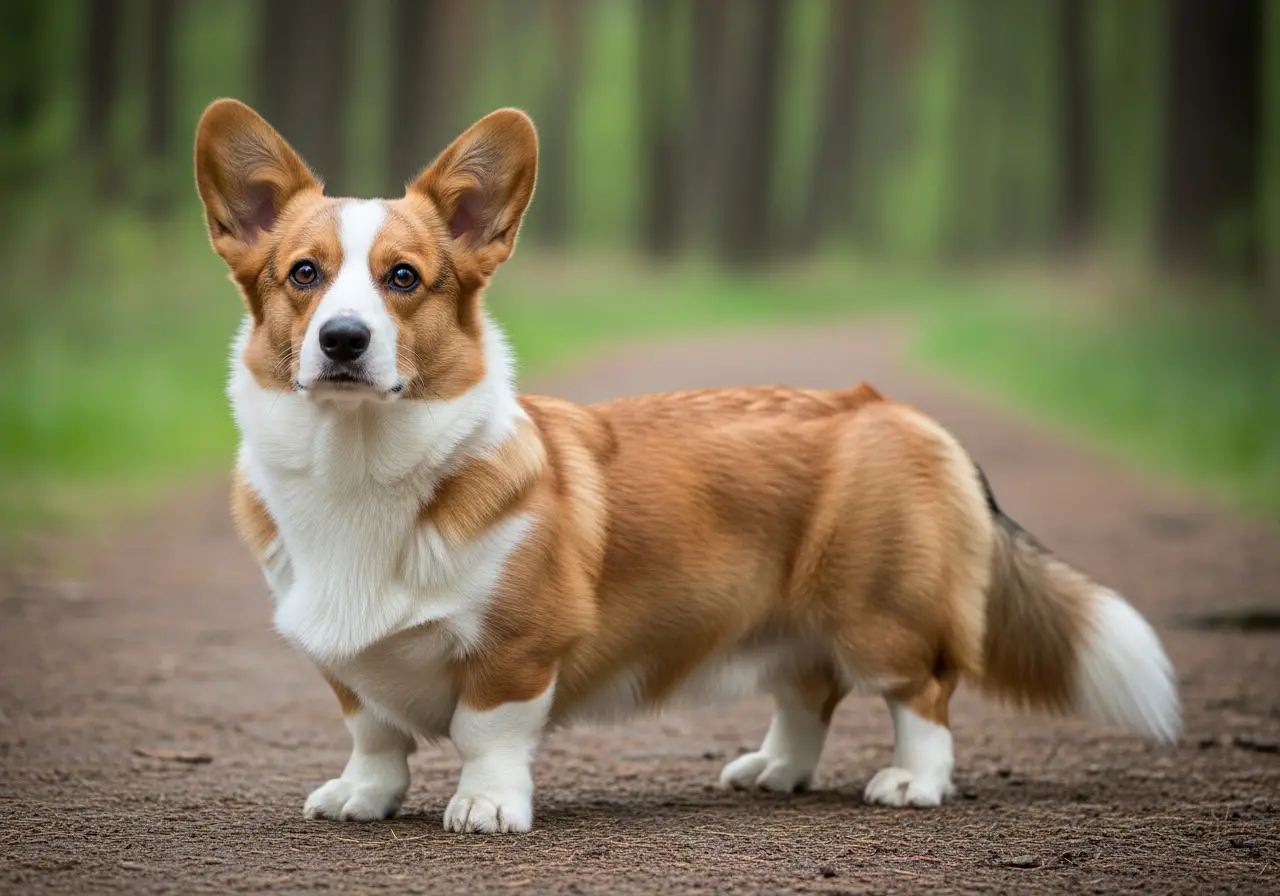
The Welsh Corgi Cardigan is the older of the two Corgi types, recognisable by its bushy tail and sturdier build. As an original cattle-driving dog, it brings pronounced work motivation, independence and an alert temperament. Owners plan 60 to 90 minutes of active exercise plus structured mental work daily. Without clear leadership and consistent training, it develops stubbornness that burdens everyday life.
02Introduction
What makes the Welsh Corgi Cardigan special
Welsh Corgi Cardigan: the older of the two Corgi types, slightly calmer than the Pembroke due to its tail and very eager to learn
03Profile
Key facts and suitability
- Origin
- Wales
- Original purpose
- Driving dog for cattle
- FCI
- No. 38 · Group 1 · Section 2
- height at the withers
- 27–32 cm
- Weight
- 11–17 kg
- Life expectancy
- 12–15 Years
- Coat type
- Doppel
- Minimum exercise
- 60 min/day
- Puppy price
- 1'500–2'500 CHF
- Waiting period
- 5 months
- Sports
- Agility Herding work Obedience
04Temperament
How the Welsh Corgi Cardigan shows up in everyday life
When returning home, the Cardigan greets its key people attentively and actively; it observes who is coming and reports unknown persons with distinct barking. It registers unfamiliar visitors immediately and keeps them in sight until it can assess them. Overly enthusiastic greetings towards strangers are not its pattern.
Here, the separation of the two behavioural axes becomes clearly apparent: Internally, the Cardigan bonds closely with its family and requires closeness, enrichment and integration into daily life (need for social contact: high). Externally, it reacts to strangers with reserve or in a waiting manner; this restraint is not a deficiency, but rather the breed character of the former guarding and driving dog.
On the walk, it shows interest in its surroundings, reacts to movement stimuli and tends to "monitor" people or other animals in its field of vision. Herding behaviour can manifest in daily life as circling around children or nudging at the heels. This behaviour requires early guidance, not suppression, but clear rules regarding when it is desired and when it is not.
In household daily life, the Cardigan is present and alert. It follows its key people through the apartment, but also independently seeks its own place. Long phases without enrichment it marks with restlessness or barking. Anyone who offers it structured training sessions, nose work or trick training daily will experience a focused, eager-to-learn dog. Anyone who does not do this will end up with a dog that finds its own entertainment, rarely to the delight of the household.
05Needs
What this breed needs daily
The Cardigan requires at least 60 to 90 minutes of active exercise daily. This includes not only walks, but also sessions with changes of direction, search tasks or training sequences. Pure leash walks without a mental component are not sufficient for this breed.
Mental work is not an optional extra, but a daily basic need. Suitable forms include: structured obedience training, nose work, trick training, fetching tasks or herding sports (e.g. treibball). The need for mental work is at 4 on a scale of 1–5, corresponding to a dog that develops behavioural problems without mental stimulation.
The need for social contact is high. The Cardigan requires regular contact with its key people and tolerates long periods alone poorly. A maximum of four hours alone is considered a guideline, with structured preparation and sufficient prior stimulation. Anyone who is regularly away from home for longer than four hours requires a reliable care solution.
Its herding drive requires active guidance in training. Impulse control exercises, calm waiting and learning a reliable recall signal are part of the essential programme. An accompanying dog training school with experience in herding dogs is recommended for the first few months.
Keeping in an apartment is possible if exercise, mental work and clear rules are implemented consistently. A garden makes daily life easier, but does not replace active enrichment. The Cardigan requires structure and reliability; spontaneous, irregular living conditions will overwhelm it in the medium term.
Exercise
Medium
mental work
A lot
Social needs
High
training
Medium
06Sport & Mental and Physical Stimulation
What sports the Welsh Corgi Cardigan is suited for
Realistic in terms of physiology and genetics – not every breed suits every sport.
Structurally and physiologically suitable: no jumping sports (risk of slipped disc) · Suitable for herding work, treibball and coursing.
07Quick Check
08Suitability
Who this breed is suitable for – and who it isn't
✓Matches
The Cardigan suits owners with prior experience in dog training who can plan 60 to 90 minutes of active exercise plus structured mental work daily. Anyone who enjoys training, nose work or herding sports will find a focused partner in it.
Families with children from about 8 years old are suitable if herding behaviour at the heels is addressed and trained early on and if children handle the dog respectfully. A calm basic household with clear daily structures supports ownership.
Active individuals or couples who integrate the dog into sporting activities (such as hikes, bike tours with leash running or dog sports) benefit from its endurance and working motivation.
Owners living in an apartment can keep a Cardigan if daily stimulation and regular training sessions are guaranteed and barking behaviour is actively trained. Quiet neighbourhood conditions or sound-insulated apartments make daily life easier.
Those who have already gained experience with herding dogs or other independent breeds and appreciate communication through clear body language and consistent rules will find in the Cardigan a breed with high learning potential and long-term bonding depth.
×Doesn't match
The Cardigan is not suitable for owners who are away from home for more than four hours daily and cannot organise reliable care. Its high need for social contact and tendency to bark intensify considerably during long periods of solitude.
Those who regard herding behaviour (circling around people, nudging at the heels, controlling movements) as cute or negligible underestimate the consequences in everyday life. This behaviour requires active guidance; those who ignore it reinforce it.
Households keeping a dog for the first time and not planning support from an experienced dog training school face a steep learning curve. The Cardigan tests boundaries and responds to inconsistency with stubbornness.
Households with very young children under 5 years of age, in whom herding behaviour at the children's heels cannot be consistently prevented, should be viewed critically. The driving behaviour is instinctively directed at fast, small movement stimuli.
Those looking for a calm, quiet dog that is content with minimal enrichment make the wrong choice with the Cardigan. Its fondness for barking is typical of the breed and can be trained, but not bred out. Those living in an apartment building with noise-sensitive neighbours and not planning active bark training should assess this breed realistically.
10Line reality
Show line, working line, breeder market
The Welsh Corgi Cardigan is today predominantly kept as a companion dog and selected for exterior and temperament traits in breeding. A pronounced working line in the sense of active herding dog breeding hardly exists in Central Europe anymore; the Cardigan is not bred for practical herding use.
In Great Britain and the USA, there are isolated efforts to use Cardigans in herding trials. These dogs show significantly more pronounced herding behaviour and higher drive intensity than typical companion and show lines. For those interested who are looking for a dog for herding sports or treibball, it is worth specifically asking the breeder about herding experience in the line.
Show lines, which are bred for FCI shows, are aligned with exterior conformity to the standard. The temperament remains breed-typically alert and willing to work, but drive intensity varies considerably between lines.
Anyone planning a Cardigan for active dog sports should specifically ask the breeder about the drive intensity of the parent animals and about experience in nose work, agility or herding. A puppy from a pure show line may bring less working motivation than expected. Conversely, a puppy from a high-drive line can be too intense for a calmer household.
11Health · Reality
What you need to plan for medically with your Welsh Corgi Cardigan
The life expectancy of the Welsh Corgi Cardigan is 12 to 15 years, an above-average value for medium-sized dogs, which however depends on weight, exercise and breeding quality.
Disc diseases (Intervertebral Disc Disease, IVDD) represent the most significant breed-specific health risk. Chondrodystrophic breeds like the Cardigan carry a genetically determined increased risk of disc herniation. Studies from the University of Bern (Vetsuisse Faculty) show that chondrodystrophic breeds are up to 10 times more likely to be affected by IVDD than normomorph-built dogs. Preventive measures recommended include: no uncontrolled stair climbing in puppyhood, avoidance of overweight, ramps instead of jumping from furniture.
Hip dysplasia (HD) occurs in the breed but is less prevalent than in large breeds. Reputable breeders provide HD X-ray results of the parent dogs (grade A or B according to FCI scheme). This proof should be requested when buying a puppy.
Degenerative Myelopathy (DM) is a progressive spinal cord disease that can be genetically confirmed in Cardigans. A DNA test for the SOD1 gene is available and is conducted by responsible breeders. Dogs with two risk copies (homozygous) are highly likely to develop the disease in old age.
Progressive Retinal Atrophy (PRA) can occur in the breed. Eye examinations of breeding dogs are recommended.
Overweight is a significant risk for Cardigans: their body shape tempts owners to underestimate their condition. Every additional kilogram places disproportionate strain on the spine and joints. Regular weight checks with the vet, at least once a year, are mandatory.
12Structured data
Health by the numbers
Prone to diseases
Hip dysplasia Eye problems MDR1 mutation
Recommended health tests
Hip X-ray Eye examination MDR1 genetic test
13Myths ↔ Reality
What is often said incorrectly about this breed
Five myths, five realities, five sources.
„The Cardigan is a small lapdog that requires little stimulation.
The Cardigan is a working drive dog with genetically anchored herding behaviour. It requires 60 to 90 minutes of active movement daily as well as additional mental work. Anyone who denies it this stimulation risks behavioural problems such as excessive barking, herding family members, or destructive behaviour.
„Corgis are beginner dogs because they look small and friendly.
The Cardigan has a pronounced sense of independence and differentiated learning ability. It tests boundaries and needs consistent, clear guidance. Inexperienced owners often underestimate its herding drive and love of barking; both are among the most common reasons for rehoming this breed.
„The Cardigan and Pembroke are practically the same breed.
Both types were only separated as distinct breeds by the Kennel Club in 1934. The Cardigan has a long tail, is more robustly built and is temperamentally considered somewhat more independent. The FCI lists both under separate standards (Cardigan: No. 38, Pembroke: No. 39). Breeding lines and health profiles also differ.
„The Cardigan is easy on the joints to keep because of its short legs.
The combination of a long back and short limbs increases the risk of intervertebral disc problems (due to chondrodystrophy) and hip dysplasia. Overweight significantly exacerbates this strain. Joint-friendly exercise for this breed means: no uncontrolled stair climbing in puppyhood, no overweight, regular veterinary checks.
„A Cardigan that barks is poorly trained.
Exuberant barking is a breed-typical trait of the Cardigan, stemming from its function as a guarding and driving dog. It can be guided and reduced through early training, but not completely eliminated. Anyone living in a rented apartment with thin walls should realistically factor this aspect into their decision before getting a dog.
14animal welfare
The animal welfare perspective
Breeder market, designer versions, animal shelter reality — what no one writes in the puppy ad.
The Welsh Corgi Cardigan has experienced a rise in popularity in recent years, fuelled by social media presence and the enduring appeal of both Corgi types. This trend has consequences for animal welfare that prospective owners should be aware of.
Backyard breeders and unreliable sources: With rising demand, supply from unreliable sources grows. Puppies from backyard breeding are often sold without health tests of the parent dogs, without socialisation and without affiliation to a breeding association. Missing DM tests, no HD results and inadequate early education are typical characteristics. Price alone is not an indicator of quality; cheap puppies of unknown origin often incur higher follow-up costs due to health problems.
Problems related to keeping: Corgis are among the breeds most frequently surrendered due to underestimated training requirements. Herding behaviour, a tendency to bark and independence overwhelm owners who envisioned an uncomplicated companion dog. Animal welfare organisations and breed rescue groups regularly report Cardigans and Pembrokes being rehomed for precisely these reasons.
Overweight as a keeping problem: The cute body shape of the Cardigan tempts owners into overfeeding, leading to overweight. Overweight Cardigans suffer more frequently from disc problems and joint diseases. This keeping problem is avoidable; it requires consistent food discipline and regular weight monitoring.
Rehoming as an equivalent option: Adult Cardigans from rehoming are a serious alternative to buying a puppy. Breed rescues such as the Club für Britische Hütehunde e.V. or the Schweizerische Welsh Corgi-Klub SWCK occasionally rehome dogs with known character and health status. An adult dog from rehoming has the advantage that temperament and behaviour can already be assessed, which is a genuine benefit for a breed with a pronounced working type.
15Costs · Transparency
What this breed realistically costs
A puppy from reputable association breeding costs between 1,500 and 2,500 EUR in Germany and CHF in Switzerland. Offers significantly below this often come from backyard breeding without health tests, where follow-up costs due to illnesses regularly exceed the savings.
The annual living costs for a Cardigan are approximately 1,800 to 3,000 EUR depending on the keeping conditions. Of this, high-quality food (dry or wet food, raw feeding) accounts for around 600 to 1,200 EUR annually. Grooming is moderate for the Cardigan: regular brushing during coat change, occasional bathing: high personal effort, low groomer costs (0 to 200 EUR/year).
Veterinary costs for basic care (vaccinations, parasite prevention, annual check-up) are 300 to 600 EUR annually. In addition, possible costs arise for X-ray checks of the spine or joints in case of symptoms; individual examinations cost 150 to 400 EUR. A disc operation can cost 3,000 to 6,000 EUR.
A dog health insurance with surgery cover costs 40 to 100 EUR monthly for a Cardigan, depending on the provider and scope of benefits. Given the IVDD risk, surgery insurance is a serious option for this breed. Dog liability insurance is mandatory in several federal states and costs 50 to 120 EUR annually.
16Puppy search
What you need to consider when choosing a breeder
- Reputable Welsh Corgi Cardigan breeders can be found via the Club für Britische Hütehunde e.V.
- (Germany) or the Schweizerischen Welsh Corgi-Klub SWCK (Switzerland).
- Both associations maintain breeding registers and require member breeders to conduct health tests.
- The following documentation should be available when purchasing a puppy: hip dysplasia (HD) X-ray results for both parent dogs (grade A or B), DNA test for Degenerative Myelopathy (SOD1 gene) for both parent dogs, eye examination report.
- Breeders who cannot or will not provide these documents should be viewed critically.
- A reputable breeder asks counter-questions regarding the living situation, experience and daily routine.
- Those who sell puppies without interest in the buyer prioritise sales over animal welfare.
- Puppies should not be given away before 8 weeks of age and must demonstrably have been raised in a social environment with everyday noises, people and preferably conspecifics.
- Adopting adult Cardigans through breed-specific rescue organisations is an equally valid option.
- Breed rescues of the Club für Britische Hütehunde e.V.
- or the SWCK place dogs with known backgrounds.
- Platforms such as rundum.dog link to verified entries.
- Purchase offers on general classifieds portals without affiliation to a breeding association should be treated with increased caution.
FAQ
Frequently asked questions about the Welsh Corgi Cardigan
Is Welsh Corgi Cardigan suitable for beginners?
Welsh Corgi Cardigan is considered suitable for first-time dog owners.
Is Welsh Corgi Cardigan a family dog?
Welsh Corgi Cardigan is considered suitable for families with good socialisation and species-appropriate care.
How much exercise does Welsh Corgi Cardigan need?
At least around 60 minutes of exercise per day.
Does Welsh Corgi Cardigan suit an apartment?
With enough exercise and enrichment, Welsh Corgi Cardigan can also be kept in an apartment.
What is the size and weight of Welsh Corgi Cardigan?
Fully grown, Welsh Corgi Cardigan reaches about 27–32 cm at the withers and weighs around 11–17 kg.
What is the life expectancy of Welsh Corgi Cardigan?
The life expectancy of Welsh Corgi Cardigan is approximately 12–15 years.
Which diseases are common in Welsh Corgi Cardigan?
Hip dysplasia Eye problems MDR1 mutation
17Breed clubs
Official breed clubs in DACH
19Related
Similar breeds – and their differences
You might also be interested in


Participate
Do you have a good photo of your Welsh Corgi Cardigan?
We are looking for expressive images for our breed profiles. Submit yours; the editorial team reviews every submission before publication.
Does this breed suit you?
Rarer than the Pembroke – slightly calmer and with a tail