
01Summary
In a paragraph
If you only have 30 seconds.
The Bouvier des Ardennes is not a companion dog with a rustic appearance. It is a functionally bred drover dog from the Belgian Ardennes, whose genetics demand daily enrichment, clear leadership, and mental stimulation. Anyone who cannot provide this will end up with a dog that seeks out its own tasks, and rarely to the owner's delight.
02Introduction
What makes the Ardennes special
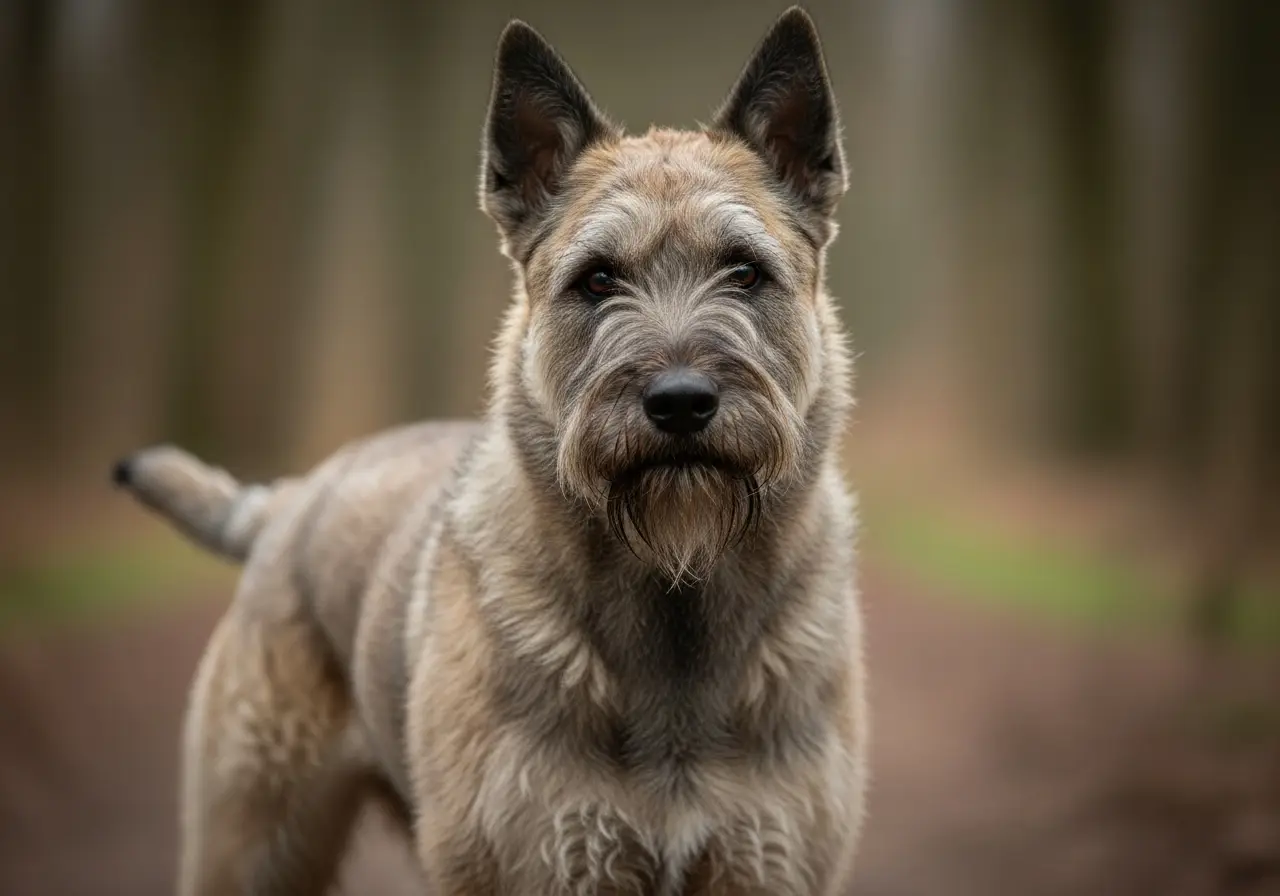
The Bouvier des Ardennes is a Belgian herding dog from the Ardennes, FCI Group 1, a robust working dog with a rough coat, standing 56–62 cm at the withers.
03Profile
Key facts and suitability
- Origin
- Belgien
- Original purpose
- Herding livestock in the Ardennes
- FCI
- No. 171 · Group 1 · Section 2
- height at the withers
- 51–63 cm
- Weight
- 22–35 kg
- Life expectancy
- 11–13 Years
- Coat type
- Wire-haired
- Minimum exercise
- 90 min/day
- Puppy price
- 800–1'500 CHF
- Waiting period
- 6 months
- Sports
- Agility · Schutzhund · Scent work · Herding work
04Temperament
How the Ardennes shows up in everyday life
The morning run shows what makes the Bouvier des Ardennes unique: It does not simply walk alongside you. It scans the terrain, registers every stimulus, changes position – a dog that works permanently, even if no task has been assigned. This is not hyperactivity, but genetics.
Internal axis, what the dog needs: The need for social contact is high. The Ardennes herding dog is strongly oriented towards its primary caregiver and seeks active collaboration. Being left alone for several hours without prior training leads to stress behaviour. The need for mental work is equally pronounced: Scent work, obedience or structured search tasks are not extras, but basic care. The exercise requirement is at least 90 minutes daily, a considerable part of which in an active, demanding form.
External axis, how the dog reacts: Towards strangers, the Bouvier des Ardennes behaves reservedly to watchfully. This is not an aggression problem, but guarding instinct. It observes, assesses and decides. Anyone who expects this dog to be open and sociable because it is closely bonded to the family confuses the two axes. High family bonding does not mean openness towards every visitor.
In everyday life with children, the Ardennes herding dog works well with clear rules and firm children. The herding instinct can transfer to children, a behaviour that must be consistently channelled. With other dogs, it shows tolerance with early socialisation, but remains self-confident and sets boundaries. A quiet evening on the couch is possible, but only after the day has met its demands.
05Needs
What this breed needs daily
The Bouvier des Ardennes needs at least 90 minutes of active exercise daily. Walks at a walking pace do not fulfil this quota. Jogging, cycling, cross-country runs or structured dog sport units correspond better to its exercise profile.
Mental stimulation is equivalent to physical exercise. The herding instinct demands tasks with clear structure: Scent work, nose work, obedience at an advanced level or herd work, if accessible. Without this stimulation, the dog seeks enrichment independently, with results that are rarely desirable.
The need for social contact is high. The Ardennes herding dog is not a dog that can easily spend eight hours alone. Being left alone must be trained early and systematically. The maximum time alone is about four hours for a well-trained adult; the quality of bonding and the well-being of the dog suffer below this.
Training requires consistency and clarity. Positive reinforcement works well when combined with clear boundaries. The dog tests hierarchies, not out of malice, but because it has learned in work to make decisions independently. An accompanying dog training school with experience in herding or working dogs is recommended for most owners.
The coat requires weekly brushing and trimming twice a year. Bathing needs are low; the coat regulates itself largely on its own. The ears and paws should be checked regularly, especially after field use.
Exercise
High
mental work
A lot
Social needs
High
training
Medium
06Sport & Mental and Physical Stimulation
What sports the Ardennes is suited for
Realistic in terms of physiology and genetics – not every breed suits every sport.
Structurally and physiologically suitable: Suitable for herding work, treibball and coursing · CaniCross / bikejoring possible.
07Quick Check
08Suitability
Who this breed is suitable for – and who it isn't
✓Matches
The Bouvier des Ardennes suits owners with proven experience in handling strong-drive working or herding dogs. Anyone who has already handled a dog with pronounced herding or guarding instinct and knows the dynamics will find a reliable partner in this breed.
The breed is suitable for active individuals or couples who can plan at least 90 minutes of structured exercise daily and enjoy dog sport, scent work or obedience. A rural or suburban environment with access to open terrain significantly facilitates keeping the dog.
Families with children from about ten years old, in whom clear rules for dealing with the dog are established, are also an option, provided that at least one adult person takes over the consistent leadership and stimulation of the dog.
Owners who are willing to permanently accompany an experienced dog training school with a focus on working or herding dogs can also be successful with less prior experience, provided there is a willingness for intensive engagement with the dog.
Anyone who works from home or has flexible working hours and can integrate the dog into everyday life benefits from the strong bonding orientation of the Ardennes herding dog. The breed thrives when it is part of daily life, not as a marginal figure, but as an active companion with a clear task.
×Doesn't match
The Bouvier des Ardennes is not suitable for owners who are keeping a dog for the first time and do not wish to seek professional guidance from an experienced dog training school. The combination of herding instinct, guarding instinct, and self-confidence overwhelms owners who do not set boundaries consistently.
Anyone who is away from home for more than four hours a day and cannot organise reliable care should not choose this breed. The high need for social contact and the dog's attachment orientation are incompatible with long periods of solitude without training.
Households looking for a calm, adaptable companion dog that adjusts to the family's pace of life will not be happy with the Ardennes drover dog. Anyone who perceives the external axis (reserve towards strangers, pronounced guarding instinct) as a problem rather than as a breed characteristic should choose a different breed.
Urban owners without access to open land and without involvement in dog sports can hardly meet the exercise and mental stimulation needs of this breed. Families with very young children under six years of age should also factor in the pronounced herding instinct, which can be transferred to toddlers and requires consistent supervision.
Anyone who expects the dog to be open and sociable towards strangers because it bonds closely within the family is confusing internal bonding with external social openness, a misunderstanding that leads to conflicts in everyday life.
10Line reality
Show line, working line, breeder market
The Bouvier des Ardennes does not exist in clearly defined show and working lines, such as the Belgian Shepherd Dog. The breed is too rare for independent breeding lines with different performance profiles to have established themselves.
Nevertheless, two historically developed lines exist within the small breeding population, which are documented in the FCI standard: On the one hand, the dogs that were deliberately reconstructed according to the standard from around 1990, and on the other hand, a breeding line from northern Belgium that has been quietly continued by cattle drovers and shepherds since the 1930s, without connection to official cynology, only becoming known in 1996. This line is considered particularly work-oriented and strong in drive.
In practice, this means for the search for a puppy: The origin of the litter and the working trial history of the parent animals are relevant information. Dogs from lines with documented herd work or working trials generally bring a more intense drive than dogs whose ancestors were exclusively presented at shows.
As the total population is small, direct communication with the respective breeder about the temperament profile of the parent animals is recommended. General line assignments are less informative for this breed than for larger populations; the individual breeding background counts more.
11Health · Reality
What you need to plan for medically with your Ardennes
The Bouvier des Ardennes is considered a robust, functionally bred breed with a life expectancy of approximately 12 to 14 years. This range is based on breeder information and breed club documentation, as no large-scale epidemiological studies on the breed exist; the small population size makes representative surveys hardly possible.
Hip dysplasia (HD) is documented in the breed. Reputable breeders X-ray the parent dogs before breeding and provide HD certificates. Eye problems occur occasionally; an ophthalmological examination of the breeding animals is recommended. Specific HD prevalence figures for the Bouvier des Ardennes are not available in the form of published studies due to the small population; owners should actively ask breeders about the health screening results of the parent dogs.
The small stud book poses a structural risk: with a small gene pool, the inbreeding rate increases, which can raise susceptibility to hereditary diseases. The VDH and the FCI recommend careful mating planning for rare breeds to maintain genetic diversity (VDH, Breeding and Health).
Preventive examinations recommended for every Bouvier des Ardennes: HD X-ray at 12 to 18 months of age, ophthalmological examination, annual dental check-up with the vet. The rough coat should be checked for ticks and injuries after field work. Overweight is rare in sufficiently stimulated individuals but can develop quickly with lack of exercise and additionally burden the joints.
12Structured data
Health by the numbers
Prone to diseases
Hip dysplasia, eye problems, generally robust breed
Recommended health tests
Hip X-ray, eye examination
13Myths ↔ Reality
What is often said incorrectly about this breed
Five myths, five realities, five sources.
The Ardennes Sheepdog is a high-maintenance dog due to its shaggy coat, requiring extensive grooming.
The rough, tousled coat of the Bouvier des Ardennes is functionally designed for weather protection and does not require elaborate care. Regular brushing and occasional trimming are sufficient. The coat mats less than that of many other rough-coated breeds, as it is naturally structured and robust.
As a working dog, the Ardennes Cattle Dog is automatically compatible with children and strangers.
Working dogs are not necessarily socially open. The Bouvier des Ardennes shows a reserved to watchful attitude towards strangers; this is typical of the breed and not a training error. The guarding instinct is genetically anchored. Early and consistent socialisation reduces undesirable reactions, but does not override the basic character.
The Ardennes Cattle Dog is particularly healthy and free from hereditary diseases due to its rarity.
Rarity does not protect against hereditary diseases; on the contrary. In small gene pools, the risk of inbreeding depression and the fixation of unfavourable alleles increases. Hip dysplasia and eye problems are documented in the breed. Reputable breeders carry out appropriate preventive examinations and provide health certificates.
A garden replaces the daily enrichment of the Ardennes Cattle Dog.
A garden offers the Bouvier des Ardennes space to move, but does not replace structured stimulation. The herding instinct demands tasks, not area. A dog left to its own devices in the garden often develops undesirable behaviours such as excessive barking, digging or fixation on stimuli behind the fence.
The Ardennes Cattle Dog is suitable for first-time owners due to its robustness, provided they are willing to learn.
Robustness refers to physical resilience, not trainability. The Bouvier des Ardennes is self-confident, quick-reacting and has pronounced instincts. It tests boundaries and reacts to inconsistent handling with increasing stubbornness. Owners without prior experience with high-drive working dogs absolutely require professional support from an experienced dog training school.
14animal welfare
The animal welfare perspective
Breeder market, designer versions, animal shelter reality — what no one writes in the puppy ad.
The Bouvier des Ardennes is one of the rarest dog breeds in Germany, Austria, and Switzerland. It practically does not appear in animal welfare contexts, neither in shelters nor on rehoming portals. Anyone looking for an Ardennes drover dog will most likely only find one through one of the few specialised breeders in Belgium or neighbouring countries.
This rarity has so far protected the breed from the mass-breeding phenomenon that leads to massive, health-unccontrolled production in popular breeds. Nevertheless, it applies: anyone who acquires a Bouvier des Ardennes from a source without health certificates, without access to the parent dogs, and without stud book affiliation contributes to the erosion of the already small gene pool. The dog bears the consequences.
Designer versions or crosses under the name "Ardennes Mix" exist on the market. These dogs have no connection to the FCI standard and no documented health history. The name alone says nothing about temperament, health, or suitability.
A specific breeding and keeping problem of the breed is under-stimulation: The Bouvier des Ardennes was selected over generations for endurance, drive and independence. A dog of this breed in a household without adequate enrichment suffers, not dramatically visible, but continuously. Chronic stress from under-stimulation manifests as stereotypies, excessive barking or destructive behaviour. This is not a character flaw, but a keeping problem.
Since animal welfare rehoming for this breed is hardly a realistic option, the responsibility lies entirely with the purchase decision. Anyone deciding on a Bouvier des Ardennes should contact the breed club, visit breeders in person and take time to make the decision. The breed forgives poor preparation less than many others.
15Costs · Transparency
What this breed realistically costs
A puppy from a reputable breeder with VDH/FCI papers costs between 1,200 and 1,800 euros. Offers significantly below this without stud book affiliation are a warning signal. Imported puppies from Belgium can reach 2,000 euros and more due to transport and placement costs.
The annual living costs range between 1,500 and 2,500 euros depending on the form of keeping. High-quality dry food for a dog of this size costs approximately 60 to 100 euros per month. In addition come care (trimming twice yearly, approx. 80 to 120 euros per session), accessories, dog training school and dog sport membership.
The annual veterinary costs average between 300 and 600 euros for routine care (vaccinations, parasite prevention, annual examination). Unforeseen treatments can quickly reach 1,000 to 3,000 euros. Dog health insurance costs between 40 and 100 euros monthly depending on the provider and scope of benefits and is a sensible safeguard for a breed with a small gene pool and corresponding health risk.
Dog sport membership and training costs for an accompanying dog training school should be budgeted at 300 to 600 euros annually, not an optional item for this breed.
16Puppy search
What you need to consider when choosing a breeder
- The Bouvier des Ardennes is extremely rare in the DACH region.
- Reliable points of contact are the VDH and its member clubs as well as the Belgian breed club.
- Waiting lists of one year or more are not an exception for this breed, but the norm.
- A reputable breeder allows visits to the litter, shows both parent dogs, or at least provides health certificates for the absent parent.
- HD X-ray results and ophthalmological findings of the parent dogs should be available.
- The breeder asks questions about the living situation and rejects buyers who do not meet the breed's requirements; this is a quality feature, not an obstacle.
- Warning signs: no pedigree entry, no access to the parent dogs, puppies under eight weeks old, sale without contract, prices significantly below 1,200 euros without a comprehensible justification, offers via general classifieds portals without affiliation to a breed club.
- Since animal welfare rehoming for this breed is hardly realistic, this option is largely eliminated in practice.
- For those who still search: breed club contacts can occasionally point to dogs that need to be rehomed due to the dissolution of their living arrangements.
- Contact with the VDH member club or directly with the Belgian breed club is the most reliable starting point for searching for a puppy.
FAQ
Frequently asked questions about the Ardennes
Is Ardennes a family dog?
Ardennes is considered suitable for families with good socialisation and species-appropriate care.
How much exercise does Ardennes need?
At least around 90 minutes of exercise per day. As an active breed, more so — plus mental stimulation.
What is the size and weight of Ardennes?
Fully grown, Ardennes reaches about 51–63 cm at the withers and weighs around 22–35 kg.
What is the life expectancy of Ardennes?
The life expectancy of Ardennes is approximately 11–13 years.
Which diseases are common in Ardennes?
Hip dysplasia, eye problems, generally robust breed
17Breed clubs
Official breed clubs in DACH
19Related
Similar breeds – and their differences
You might also be interested in

Participate
Do you have a good photo of your Ardennes?
We are looking for expressive images for our breed profiles. Submit yours; the editorial team reviews every submission before publication.
Does this breed suit you?
Rare, robust and versatile. One of the four Belgian Shepherd types. Needs a job and exercise, suitable for experienced dog owners.