
01Summary
In a paragraph
If you only have 30 seconds.
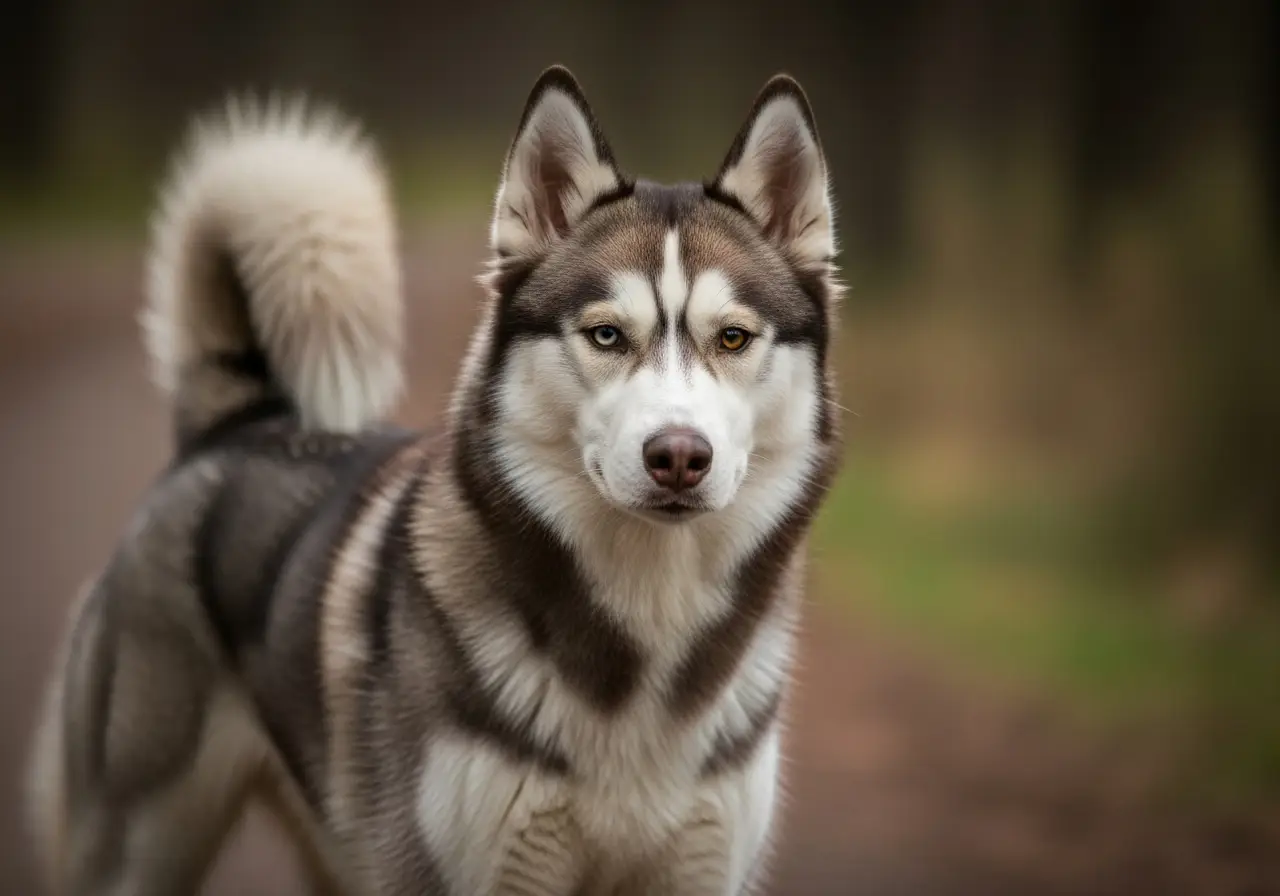
The Siberian Husky is a Nordic sled dog bred for endurance under extreme conditions, not for the sofa. Anyone keeping this dog commits to at least two hours of intensive exercise daily, secure terrain, and consistent handling of a dog that thinks independently, communicates loudly, and becomes destructive when under-stimulated. It is friendly, but that does not mean it is easy to care for.
02Introduction
What makes the Siberian Husky special
Siberian Husky: Nordic sled dog with endurance potential, energetic, sociable and difficult when under-stimulated
03Profile
Key facts and suitability
- Origin
- Russland/USA
- Original purpose
- Sled pulling
- FCI
- No. 270 · Group 5 · Sektion 1: Nordische Schlittenhunde, ohne Arbeitsprüfung
- height at the withers
- 51–60 cm
- Weight
- 16–27 kg
- Life expectancy
- 12–15 Years
- Coat type
- Doppel
- Minimum exercise
- 120 min/day
- Puppy price
- 1'500–2'500 CHF
- Waiting period
- 4 months
- Sports
- Sled dog Canicross Bikejoring
04Temperament
How the Siberian Husky shows up in everyday life
When you come home after a long day at work, a Siberian Husky greets you loudly, with howling, whining or the characteristic “Woo-Woo” that Huskies use as a means of communication. That is not an exceptional day. That is everyday life.
Internally, what the dog needs: The Siberian Husky has a need for movement that is not even remotely met by a walk in the park. Two hours of intensive activity daily are a minimum, not a guideline for particularly active days. Sled dog sports, canicross, bikejoring or structured running sessions correspond to its genetic profile. Mental work alone is not enough; the body must be involved too. The need for social contact is high: This dog was bred in packs and requires regular contact with people or other dogs. Being left alone for more than two to three hours is a real strain for many individuals and must be built up consistently and gradually.
Externally, how the dog reacts: Towards strangers, the Siberian Husky generally shows no aggression but also no exuberant openness. It accepts contact but does not actively seek it from unknown people. As a guard or watch dog, it is unsuitable; territorial behaviour is hardly present as breed-typical. Towards other dogs, it is usually socially compatible, provided it was socialised early and consistently. The prey drive is pronounced: As soon as a trigger (a hare, a bicycle, a jogger) occurs, the Husky switches to pursuit. This reaction cannot be trained away; it is manageable. Off-leash walking without secured terrain is not a realistic option for most individuals.
05Needs
What this breed needs daily
The Siberian Husky needs at least 120 minutes of intensive physical exercise daily, and that is the lower limit, not a target figure. On days with less stimulation, it shows this through vocalisation, destruction of objects or escape attempts. Suitable forms of activity are sled dog sports, canicross, bikejoring, skijoring or extended running sessions. Walks on a lead do not meet its needs.
Mental stimulation complements physical activity but does not replace it. Nose work, search games or training sessions with a clear task structure are useful but alone they are not sufficient to keep a Husky occupied.
The terrain must be secured. A fence of at least 180 cm in height, secured against digging at the base, is not a recommendation but a prerequisite. The prey drive activates quickly and reliably; an unsecured property is a safety risk.
The need for social contact is high. The Husky needs regular contact with people or conspecifics. Keeping multiple dogs corresponds to its origin as a pack dog and can make keeping easier. Being left alone must be built up gradually over weeks and months; more than two to three hours are a strain limit for many individuals.
The coat sheds intensively twice a year and requires daily brushing during these phases. Outside the shedding periods, weekly care is sufficient. Bathing is rarely necessary; the coat cleans itself to a large extent.
Exercise
Very high
mental work
A lot
Social needs
Very high
training
Demanding
06Sport & Mental and Physical Stimulation
What sports the Siberian Husky is suited for
Realistic in terms of physiology and genetics – not every breed suits every sport.
Structurally and physiologically suitable: Suitable for mantrailing, dummy work and tracking · CaniCross / bikejoring possible.
07Quick Check
08Suitability
Who this breed is suitable for – and who it isn't
✓Matches
The Siberian Husky suits owners who can integrate at least two hours of active movement into their daily routine, not as an exception but as a fixed structure. Suitable are people with experience in dog keeping who know the difference between a dog with high drive and a “difficult” dog.
An active single household or a family with older children from about ten years of age, in which all members are familiar with handling a large, energetic dog, may be suitable, provided secured terrain is available or immediately accessible.
Owners who engage in or are interested in sled dog sports, canicross, or bikejöring will find in the Husky a dog that is genetically suited for these activities. Those living in a rural or suburban environment with regular access to extensive terrain create better conditions than those in a dense city centre.
Those who already keep a socially compatible second dog can meet part of the Husky's social needs with them. It is important that the primary caregiver remains consistent in training and brings realistic expectations regarding recall reliability during free exercise.
×Doesn't match
The Siberian Husky is unsuitable for owners who are away from home for more than three hours a day without having a reliable care solution. Those who leave the dog alone most of the time will be confronted with vocalisation, destruction, and escape attempts; this is not a question of training but of meeting needs.
Those keeping a dog for the first time and letting themselves be guided by the Husky's friendly demeanour often underestimate the management effort. Friendliness towards people does not mean obedience in training or reliable recall during free exercise in this breed; these two aspects must not be confused.
Those living in a rented flat without a garden and without regular access to secure terrain do not create suitable housing conditions. Those who consider prey drive to be trainable and insist on free exercise in unsecured terrain take a safety risk, for the dog and for other animals.
Those looking for a calm companion dog for relaxed walks or a dog that reliably guards will not structurally match with the Siberian Husky. Households with small animals such as rabbits or cats, which have not grown up with the dog from the start, should also factor in the pronounced prey drive as a serious risk.
10Line reality
Show line, working line, breeder market
The Siberian Husky exists today in two clearly distinguishable populations that differ significantly in drive, physique and trainability.
Working line / sled dog sports: Dogs from active sled dog sport breeding are slimmer, more enduring and exhibit a higher work drive. They are used for distance races, sprint races or sled dog sports. Their need for movement exceeds that of show dogs significantly. For owners without a sporting background in sled dog sports, these dogs are more demanding in terms of stimulation.
Show line: Dogs from FCI-compliant show breeding are selected for exterior and breed standard. They are generally built somewhat more massively and show a slightly lower work drive than sled dog sport lines, but their need for movement remains high. The differences to the working line are real but should not be used as an argument for underestimating the effort involved in keeping them.
Anyone who acquires a Husky from a working line and does not engage in sled dog sports must compensate for the missing work outlet through other intensive activities. Anyone who acquires a show dog and assumes it is “calmer” underestimates the basic requirements of the breed. Both lines demand daily intensive exercise, secured terrain and consistent management.
11Health · Reality
What you need to plan for medically with your Siberian Husky
According to the FCI breed standard and breeding association data, the life expectancy of the Siberian Husky is 12 to 14 years, an average to slightly above-average range for medium-sized dogs.
Hip dysplasia (HD) is present in the breed, but less common compared to other large breeds. The Orthopedic Foundation for Animals (OFA) reports an HD rate of around 2% for the Siberian Husky (OFA database, status 2023), significantly lower than, for example, in German Shepherds or Labrador Retrievers. Nevertheless, both parent dogs of a litter should be radiologically examined and assessed for HD.
Eye diseases are relevant to the breed. Cataracts, progressive retinal atrophy (PRA), and corneal dystrophy occur more frequently in the Siberian Husky than in the breed average. Data from the Siberian Husky Club of America Health Committee show that cataracts are among the most common hereditary diseases in this breed. Eye examinations of the parent dogs by a veterinary specialist in ophthalmology must be checked before purchasing a puppy.
Hypothyroidism occurs occasionally in the breed and manifests as weight gain, coat changes, and decreased performance. A blood test clarifies the suspicion.
Overweight is less common in the Siberian Husky than in many other breeds; its metabolism is designed for endurance performance and is efficient. With sufficient exercise and breed-appropriate feeding, weight usually remains stable. This can change with a lack of exercise.
Preventive examinations: annual eye examination, HD screening of parent dogs, thyroid values if suspected.
12Structured data
Health by the numbers
Prone to diseases
Hip dysplasia Eye problems (PRA) Zinc deficiency dermatosis
Recommended health tests
Hip X-ray Eye examination Zinc status
13Myths ↔ Reality
What is often said incorrectly about this breed
Five myths, five realities, five sources.
"The Husky is a dangerous dog because of its wolf-like look.
The Siberian Husky shows a markedly low readiness for aggression towards people. Territorial behaviour and protective instinct are weakly developed as typical for the breed. It is unsuitable as a guard dog. The visual similarity to the wolf is purely phenotypic and has no influence on its social behaviour towards people.
"Huskies are free runners, they do not need a fence.
The Siberian Husky has a pronounced prey and running drive. As soon as a movement stimulus sets in, recall reliability in off-leash situations is not reliable for most individuals. A fence of at least 180 cm height, secured against digging, is not a comfort solution but a safety requirement. Many Huskies dig under fences or overcome low obstacles by climbing.
"Huskies are loners and do not need contact with other dogs.
The opposite is true. The Siberian Husky was bred as a pack dog in sled teams and has a high need for social contact with conspecifics. Keeping alone without sufficient social contact, to people or other dogs, often leads to vocalisation, restlessness and destructive behaviour. Multi-dog keeping is often a relief for this breed, not a burden.
"A Husky from an animal shelter is a problem dog.
Siberian Huskies are among the most frequently surrendered breeds in German-speaking animal shelters, not because they are problem dogs, but because their keeping requirements are massively underestimated. Most surrenders occur due to owners being overwhelmed. An adult Husky from rehoming often already has socialisation and is easier to assess in terms of its temperament structure than a puppy.
“Huskies are only suitable for cold regions because of their thick coat.
The Siberian Husky regulates its body temperature via its double-layered coat in both directions; it insulates against cold and against heat. Nevertheless, the breed is more sensitive to heat than many other dogs. At temperatures above 20 °C, intensive activities should be moved to the cooler times of day or night. Keeping in warm climate zones is possible but requires adapted activity management.
14animal welfare
The animal welfare perspective
Breeder market, designer versions, animal shelter reality — what no one writes in the puppy ad.
In Germany and Austria, the Siberian Husky is among the breeds that regularly end up in animal shelters, not due to aggression or illness, but because of massively underestimated housing requirements. Many surrenders occur within the first year. The main reason is consistent: The exercise needs, prey drive, and noise level of the Husky exceed what owners imagined before purchase.
Backyard breeder market: The Husky is a visually striking breed with high demand, making it attractive to backyard breeders who breed without health screening and stud books. Puppies from such sources are often cheaper, but lack documentation on eye health or the hip dysplasia status of the parent dogs. The follow-up costs due to hereditary diseases can exceed the apparent savings many times over.
Trend effects: Following media appearances (films, series, social media accounts featuring Huskies), demand rises sharply in the short term. Many of these impulse purchases end with the dog being given up. Anyone who lets themselves be guided by the look or character in a video, without researching the reality of keeping the dog, makes a decision on an incomplete basis.
Problems related to keeping: Destructive behaviour, attempts to escape and persistent vocalisation are not character flaws; they are symptoms of under-stimulation. A Husky that is exercised intensively for two hours daily, has a secure area and receives social contact, shows these behaviours significantly less often. The problem almost always lies in the keeping conditions, not in the dog.
Adoption as an option: Adult Huskies from animal shelters or breed rescue organisations are a fully valid alternative to buying a puppy. Their temperament is assessable, their socialisation known and their needs documented. Anyone open to adoption relieves the burden on animal shelters and often makes a more informed decision than when choosing a puppy.
15Costs · Transparency
What this breed realistically costs
A puppy from a reputable breeder with VDH/FCI papers costs between 1,200 and 2,000 EUR in Germany and Austria. Offers significantly below this, under 800 EUR, often come from undocumented breeding operations without health screening.
The annual living costs consist of food (high-quality dry food or BARF for a medium-sized dog: approx. 600–900 EUR/year), grooming (brushing, occasional trimming: approx. 100–200 EUR/year) and basic equipment (leash, harness, transport box: one-off approx. 200–400 EUR).
Average veterinary costs: Basic care (vaccinations, parasite prevention, annual check-up) is approx. 300–500 EUR/year. Eye examinations by a specialist veterinarian cost 80–150 EUR depending on the region. In the case of hereditary diseases such as cataracts or hip dysplasia, treatment costs can quickly rise into the four-figure range.
Dog health insurance for a Siberian Husky costs between 40 and 100 EUR/month (approx. 480–1,200 EUR/year) depending on the provider and scope of benefits. Given the breed-typical eye problems, it is sensible to consider coverage.
Total costs in the first year (including getting a dog): realistically 3,000–5,000 EUR. From the second year: approx. 1,500–2,500 EUR/year, excluding extraordinary veterinary costs.
16Puppy search
What you need to consider when choosing a breeder
- A reputable breeder of Siberian Huskies is a member of a recognised breed club, in Germany for example the Siberian Husky Club Deutschland e.V.
- They breed under VDH/FCI conditions, carry out health examinations for hip dysplasia and eye diseases, and release puppies no earlier than eight weeks of age.
- Litter planning, parent dogs, and health certificates are communicated transparently.
- Anyone offering a puppy without access to the parent dogs, without health documentation, or at a suspiciously low price does not meet these criteria.
- Caution is advised with offers on classifieds portals if no club membership is proven and the breeder offers several litters simultaneously.
- The rehoming of an adult Husky from an animal shelter or via breed rescue organisations is an equally valid option.
- Adult dogs can be assessed more accurately in terms of their character structure, exercise needs, and social compatibility than puppies.
- Siberian Huskies belong to the frequently surrendered breeds, so there is a corresponding selection available for rehoming.
- Contacting breed rescue organisations such as the Husky Rescue Network in the German-speaking region is worth it as a first step.
FAQ
Frequently asked questions about the Siberian Husky
Is Siberian Husky a family dog?
Siberian Husky is considered suitable for families with good socialisation and species-appropriate care.
How much exercise does Siberian Husky need?
At least around 120 minutes of exercise per day. As an active breed, more so — plus mental stimulation.
What is the size and weight of Siberian Husky?
Fully grown, Siberian Husky reaches about 51–60 cm at the withers and weighs around 16–27 kg.
What is the life expectancy of Siberian Husky?
The life expectancy of Siberian Husky is approximately 12–15 years.
Which diseases are common in Siberian Husky?
Hip dysplasia Eye problems (PRA) Zinc deficiency dermatosis
17Breed clubs
Official breed clubs in DACH
19Related
Similar breeds – and their differences
You might also be interested in
Participate
Do you have a good photo of your Siberian Husky?
We are looking for expressive images for our breed profiles. Submit yours; the editorial team reviews every submission before publication.
Does this breed suit you?
Escape artist with extremely high drive for movement – not a dog for the undecided or city life without a plan