
01Summary
In a paragraph
If you only have 30 seconds.
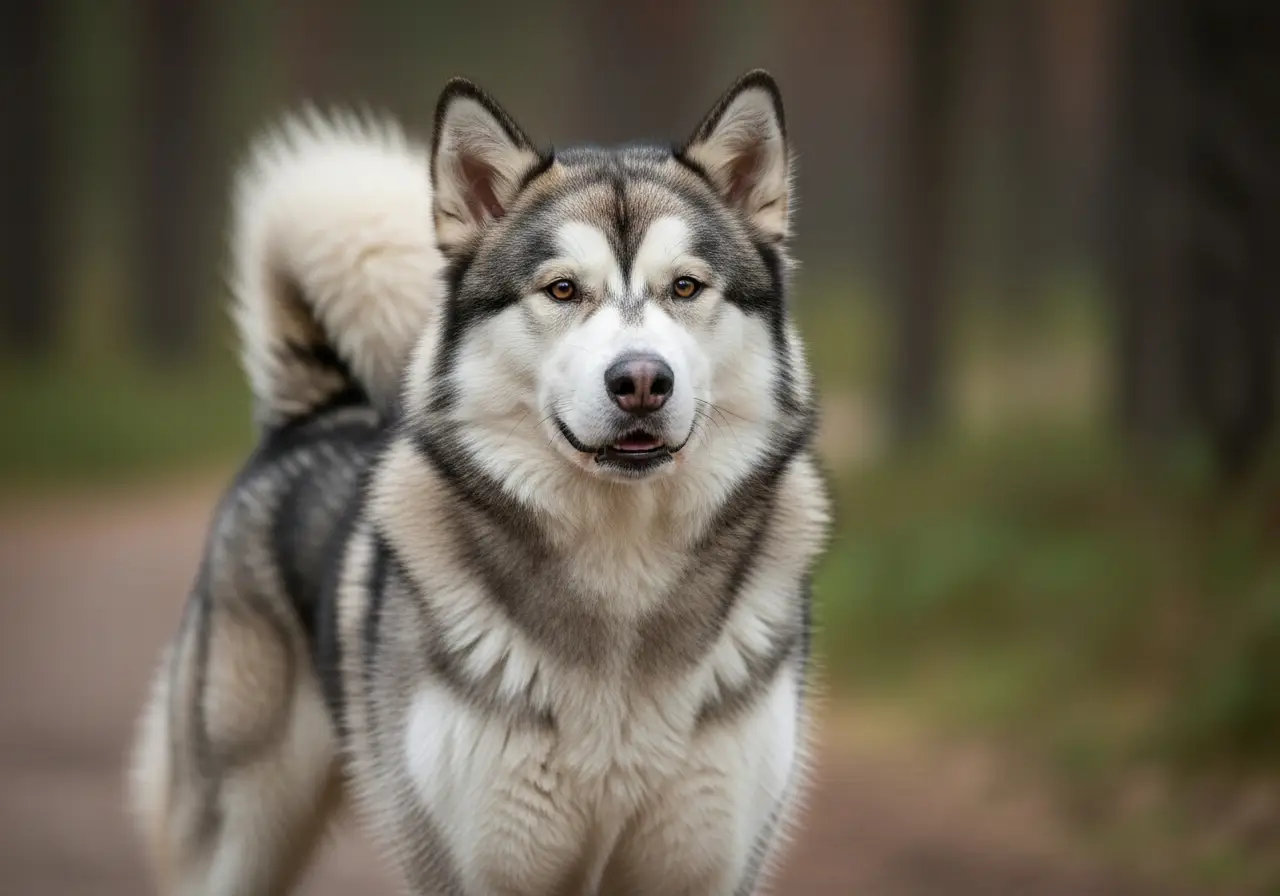
The Alaskan Malamute is not a companion dog in the classical sense; it is a freight sled dog bred for endurance and heavy work under arctic conditions. Its friendliness masks its pronounced prey drive, its dominance towards conspecifics, and its Nordic independence. Anyone keeping this dog needs structure, daily intensive stimulation, and realistic expectations regarding its obedience.
02Introduction
What makes the Alaskan Malamute special
The Alaskan Malamute is a powerful Nordic sled dog from Alaska, FCI Group 5, with a withers height of 58–64 cm, bred for cold climates and endurance work.
03Profile
Key facts and suitability
- Origin
- USA (Alaska)
- Original purpose
- Freight sled dog of the Mahlemut Inuit
- FCI
- No. 243 · Group 5 · Sektion 1: Nordische Schlittenhunde
- height at the withers
- 58–64 cm
- Weight
- 34–38 kg
- Life expectancy
- 10–12 Years
- Coat type
- Doppel
- Minimum exercise
- 120 min/day
- Puppy price
- 1'200–2'500 CHF
- Waiting period
- 9 months
- Sports
- Canicross · Sled dog sports · Bikejöring · Skijöring · Weight pulling
04Temperament
How the Alaskan Malamute shows up in everyday life
The morning run shows what makes the Malamute unique: it pulls. Not because it is poorly trained, but because pulling behaviour is genetically deeply rooted. Anyone who leads it without a harness and clear leash training fights against its nature every day.
When a stranger visits, the Malamute generally greets them curiously and openly, no alarm, no distrust. This external reaction to strangers (axis: friendliness towards unknown people, value 3 out of 5) is moderately positive, but not exuberant. As a watchdog, it is out of the question.
Internally, things look different: the need for social contact is high (value 4 out of 5). The Malamute needs the closeness of its reference people, wants to be included in activities and reacts to prolonged isolation with audible protest; howling belongs to its repertoire. It is important to keep these two axes apart: a dog that greets strangers friendly is not necessarily a dog that stays well alone.
In everyday life with children, it works if clear rules exist and children treat it respectfully. Its body size and strength require supervision, not because of aggression, but simply due to its mass.
On a walk without a task, it often appears restless, pulls towards smells, and reacts to small animals with high attention. The prey drive is pronounced: off-leash exercise without secured terrain and a stable recall is a calculable risk, and not a training issue that can be trained away. Those who accept this and work with a harness, long line, and structured activities will experience a dog with exceptional endurance and genuine willingness to cooperate.
05Needs
What this breed needs daily
The Alaskan Malamute requires at least 90 minutes of intensive exercise daily, and this does not mean a leisurely walk. Sled dog sports, skijoring, weight pulling, extended hikes with a harness, or bikejoring correspond to its genetic profile. Pure walks without a task do not meet its exercise needs.
Its exercise requirement is 5 out of 5, the maximum on the scale. In practice, this means: those who are heavily committed professionally or do not have access to suitable terrain will quickly reach their limits.
Mental stimulation is just as relevant as physical exercise. The need for mental work is 4 out of 5. Nose work, search games, structured training with varying tasks, and sled dog sports as a combined challenge meet this need. Monotonous repetitions lead to disinterest.
The Malamute tolerates being left alone for up to about four hours, with training and habituation. Longer periods without a primary caregiver lead to audible protest or destructive behaviour in many dogs. A dog sitter or a daily structure with several caregivers is not an option but a necessity for full-time employment.
Its dense double coat requires daily brushing during the moulting period (twice a year, over several weeks). Outside these phases, weekly care is sufficient. Due to its adaptation to cold, it is only suitable to a limited extent for permanently hot climate zones: shade, fresh water, and reduced exertion at temperatures above 25 degrees are mandatory, not a comfort measure.
Exercise
Very high
mental work
A lot
Social needs
High
training
Demanding
06Sport & Mental and Physical Stimulation
What sports the Alaskan Malamute is suited for
Realistic in terms of physiology and genetics – not every breed suits every sport.
Structurally and physiologically suitable: Suitable for mantrailing, dummy work and tracking · CaniCross / bikejoring possible.
07Quick Check
08Suitability
Who this breed is suitable for – and who it isn't
✓Matches
The Alaskan Malamute suits owners who can plan at least 90 minutes of active exercise with the dog daily, not as an occasional exception but as a fixed daily structure. Sled dog sports, hiking, or comparable activities should be part of everyday life or seriously pursued.
Experience with independent or northern breeds is a realistic prerequisite. Those who have already handled a dog with pronounced independence and know that cooperation is based on mutual respect will find a reliable partner in the Malamute.
Families with children from about eight years of age, where clear rules for dealing with the dog apply and supervision is ensured, are also suitable. The dog requires an adult primary caregiver with leadership competence.
Owners who live in temperate to cool climate zones and have access to secured terrain or sled dog sports infrastructure benefit from its strengths. A house with a securely fenced garden facilitates management, but is not a mandatory requirement if daily stimulation is otherwise secured.
Those who are prepared to actively manage prey drive (long line, secured terrain, no unsupervised off-leash exercise in open terrain) and realistically assess the dog's external reaction to small animals can work safely and satisfactorily with this dog.
×Doesn't match
The Alaskan Malamute does not suit owners who can or want to devote less than 90 minutes daily to intensive exercise. Those hoping for a calm companion dog for short walks will be permanently overwhelmed by this dog.
First-time owners without prior experience with independent breeds should not choose the Malamute as a starter dog. Its willingness to question leadership and its pronounced prey drive require consistency and experience, not strictness, but clarity.
Those looking for a guard dog or a dog with a high level of obedience are mistaken with this breed. The Malamute is friendly towards strangers and checks instructions for their sense; both are genetically anchored and cannot be trained away.
Households where the dog regularly remains alone for longer than four hours and no care concept exists are unsuitable. Those who confuse the Malamute's high need for social contact with its openness towards strangers and believe it gets along well alone because it "seems so uncomplicated" underestimate its internal bonding intensity.
In permanently hot climate zones (Mediterranean region, tropical regions), keeping is restricted in terms of animal welfare. Those who cannot ensure access to shade, air conditioning, and reduced exertion in heat should choose a different breed.
10Line reality
Show line, working line, breeder market
The Alaskan Malamute is kept today in two functional contexts: as a sled dog sport dog and as a companion or show dog. A formal line separation like that of some retrievers or herding dogs does not exist to the same extent, nevertheless the differences are noticeable in practice.
Dogs from active sled dog sport lines generally show higher work motivation, more pronounced pulling behaviour and greater physical endurance. They are designed for owners who actually use the dog in sports. Their need for exercise is even more pronounced than that of the average Malamute.
Dogs from show or companion lines are often somewhat calmer in everyday life, but retain the basic character of the breed: independence, prey drive and high need for exercise. Anyone who keeps such a dog as a pure family dog must still ensure intensive daily stimulation.
When buying a puppy, it is worth asking specifically about the purpose of the parent animals. A breeder who actively uses their dogs in sled dog sports generally produces puppies with a higher work drive. This is neither better nor worse, it must suit the owner's everyday life.
Regional differences in breeding exist: in Scandinavia and North America, the focus is more on working characteristics, while companion and show breeding predominates in Central Europe. The FCI standard applies as a binding basis for both contexts.
11Health · Reality
What you need to plan for medically with your Alaskan Malamute
The Alaskan Malamute is considered a robust breed with a life expectancy of approximately 10 to 14 years. Nevertheless, there are breed-typical health risks that should be known before purchase.
Hip dysplasia (HD) is the most frequently documented orthopaedic condition. According to evaluations by the OFA (Orthopedic Foundation for Animals, as of 2023), approximately 19–22 % of examined Malamutes show an HD classification ranging from "mild" to "severe". Reputable breeders provide HD X-ray results for both parent animals; this is not a bonus but the minimum standard.
Hereditary eye diseases, in particular progressive retinal atrophy (PRA) and cataracts, are documented in the breed. The Veterinary Association for Animal Welfare (TVT) recommends annual eye examinations by a specialist vet in ophthalmology. DNA tests for known PRA variants are standard with responsible breeders.
Hereditary polyneuropathy (HPN) is a breed-typical neurological disease that leads to muscle weakness and coordination disorders. A DNA test for the known defect is available and should be documented in breeding animals.
Overweight is an underestimated risk: The Malamute tends to gain weight with insufficient stimulation and excessive feeding, which exacerbates orthopaedic problems. Sport-appropriate feeding, oriented towards the actual activity level, is not optional.
Preventive examinations: HD X-rays (from 12 months), annual eye examination, HPN DNA test for breeding animals, regular weight checks at the vet.
12Structured data
Health by the numbers
Prone to diseases
Hip dysplasia, elbow dysplasia, chondrodysplasia, polyneuropathy, eye problems
Recommended health tests
Hip and elbow X-rays, eye examination, DNA test for chondrodysplasia
13Myths ↔ Reality
What is often said incorrectly about this breed
Five myths, five realities, five sources.
"The Alaskan Malamute is like a wolf, dangerous and unpredictable.
The FCI standard explicitly describes the Malamute as an affectionate, friendly dog that is not a one-person dog. Its appearance resembles that of a wolf, but its character does not. It generally shows itself open towards people, including strangers. As a guard dog, it is unsuitable. Aggression towards people is considered a serious fault in the standard.
"Malamutes are Huskies, just bigger.
Alaskan Malamute and Siberian Husky are independent breeds with different breeding histories and functions. The Malamute was bred for strength and heavy loads, the Husky for speed over medium distances. Body structure, weight and temperament differ significantly. The FCI standard explicitly emphasises that the Malamute is not a racing sled dog.
"A large garden replaces daily stimulation.
A garden offers the Malamute freedom of movement, but does not replace structured stimulation. Without a task (dog sledding sports, hiking with a harness, weight pulling), many Malamutes develop behavioural problems such as digging, howling or destructive behaviour. The dog needs at least 90 minutes of active enrichment per day with both physical and mental components.
"Malamutes are easy to train because of their friendliness.
Friendliness and trainability are two different axes. The Malamute is social and people-oriented, but checks the purpose of tasks and decides situationally for itself. Repetitions without variation lead to disinterest. Inconsistent leadership is consistently exploited by it. Experience with independent breeds is a realistic prerequisite, not a recommendation.
"The Malamute gets along well with all dogs because it is so social.
The Malamute often shows dominant behaviour towards dogs of the same sex. Its high need for social contact refers primarily to people and its reference group, not to arbitrary conspecifics. Without early, consistent socialisation, conflicts can arise, especially in multi-dog households with males. The distinction between need for social contact and general dog-friendliness is crucial.
14animal welfare
The animal welfare perspective
Breeder market, designer versions, animal shelter reality — what no one writes in the puppy ad.
The Alaskan Malamute belongs to the breeds that land in animal shelters and with breed rescue organisations disproportionately frequently. The reason is almost always the same: underestimated exercise needs, being overwhelmed by Nordic independence, and the expectation of an obedient family dog.
Backyard breeder market: Malamutes are visually impressive and fetch high prices on classifieds platforms. This attracts backyard breeders who do not carry out HD X-rays, eye examinations, or HPN DNA tests. Puppies from such sources often cost less than 1,000 euros; the follow-up costs due to health problems regularly exceed this saving. A price under 1,500 euros without health documentation for the parent animals is a concrete warning signal.
Designer versions: "Wooly Malamutes", dogs with excessively long coats, are marketed as particularly attractive. The overly long coat is classified as a fault in the FCI standard and leads to increased grooming effort and risk of overheating. No reputable breeder promotes this variant as a quality feature.
Housing-related problems: The Malamute is not suitable for permanently hot climate zones. Nevertheless, dogs are kept in regions with summer temperatures above 30 degrees without shade, air conditioning, or activity reduction being implemented consistently. This is not a marginal problem; it is a structural housing risk that increases with climate change.
Adoption as an equivalent option: Malamute rescue organisations and animal shelters regularly place adult dogs whose character and health status can already be assessed. An adult Malamute from adoption is not a stopgap solution; for experienced owners, it is often the more realistic choice than a puppy whose development is still open. The Swiss Club for Nordic Dogs (SKNH) and the Alaskan Malamute Club e.V. have adoption contacts.
15Costs · Transparency
What this breed realistically costs
A Malamute puppy from reputable breeding costs between 1,500 and 2,500 euros in the DACH region. Offers under 1,000 euros without health documentation for the parent animals are not a bargain; they shift costs into the future.
Annual living costs amount to approximately 2,500 to 4,500 euros depending on activity level and region. Food for an adult Malamute (34–39 kg, active) comes to 80–150 euros per month, depending on quality and feeding method. Grooming, especially during the coat change, can cost 200–400 euros per year with professional support.
Average vet costs: Basic care (vaccinations, parasite prevention, annual check-up) amounts to 300–600 euros per year. Orthopaedic treatments for HD can reach 2,000–8,000 euros depending on severity. Pet insurance costs between 60 and 150 euros per month for a Malamute depending on provider and scope of benefits; for a breed with documented HD and eye risks, this is a serious option.
Sled dog sport equipment (harness, lead, sled or bike attachment) is a one-off investment of 200–600 euros that pays for itself over years. Anyone keeping the dog without this infrastructure underestimates the effort required for adequate stimulation.
16Puppy search
What you need to consider when choosing a breeder
- A reputable breeder provides health certificates for both parent animals before sale: HD X-ray report (OFA or A/B classification), current eye examination by a specialist vet, and HPN DNA test.
- Those who do not show these documents or deem them unnecessary are excluded as a source.
- Visits to the breeder, with the mother and ideally the father on site, are mandatory, not optional.
- Puppies handed over outside the breeding operation or offers without personal contact are a concrete warning signal.
- The purchase price for a Malamute puppy from reputable breeding in the DACH region is typically between 1,500 and 2,500 euros.
- Significantly cheaper offers without health certificates signal missing breeding standards.
- Adoption is an equally valid option: adult Malamutes from shelters or breed rescue organisations often come from living conditions that were overwhelmed by the exercise requirement.
- Their character is assessable, their health status documentable.
- The SKNH (sknh.ch) and the Alaskan Malamute Club e.V.
- have adoption contacts and can provide further assistance.
- No named breeder recommendations: Current lists of breeders are maintained by the official breed clubs; these are a more reliable and up-to-date source than any editorial recommendation.
FAQ
Frequently asked questions about the Alaskan Malamute
Is Alaskan Malamute a family dog?
Alaskan Malamute is considered suitable for families with good socialisation and species-appropriate care.
How much exercise does Alaskan Malamute need?
At least around 120 minutes of exercise per day. As an active breed, more so — plus mental stimulation.
What is the size and weight of Alaskan Malamute?
Fully grown, Alaskan Malamute reaches about 58–64 cm at the withers and weighs around 34–38 kg.
What is the life expectancy of Alaskan Malamute?
The life expectancy of Alaskan Malamute is approximately 10–12 years.
Which diseases are common in Alaskan Malamute?
Hip dysplasia, elbow dysplasia, chondrodysplasia, polyneuropathy, eye problems
17Breed clubs
Official breed clubs in DACH
19Related
Similar breeds – and their differences
You might also be interested in
Participate
Do you have a good photo of your Alaskan Malamute?
We are looking for expressive images for our breed profiles. Submit yours; the editorial team reviews every submission before publication.
Does this breed suit you?
Powerful working dog for active families with plenty of space. Does not tolerate heat and needs daily intensive exercise. Dominant towards other dogs.