
01Summary
In a paragraph
If you only have 30 seconds.
The Schwyzer Laufhund is a traditional Swiss hunting dog, whose tricoloured appearance is only the first impression. Behind this lies a dog with a pronounced willingness to track, high stamina, and a work drive that needs to be taken seriously every day. Anyone who keeps it without a hunting context or a structured alternative programme will end up with a dog that finds its own enrichment, rarely to the owner’s delight.
02Introduction
What makes the Schwyzer Laufhund special
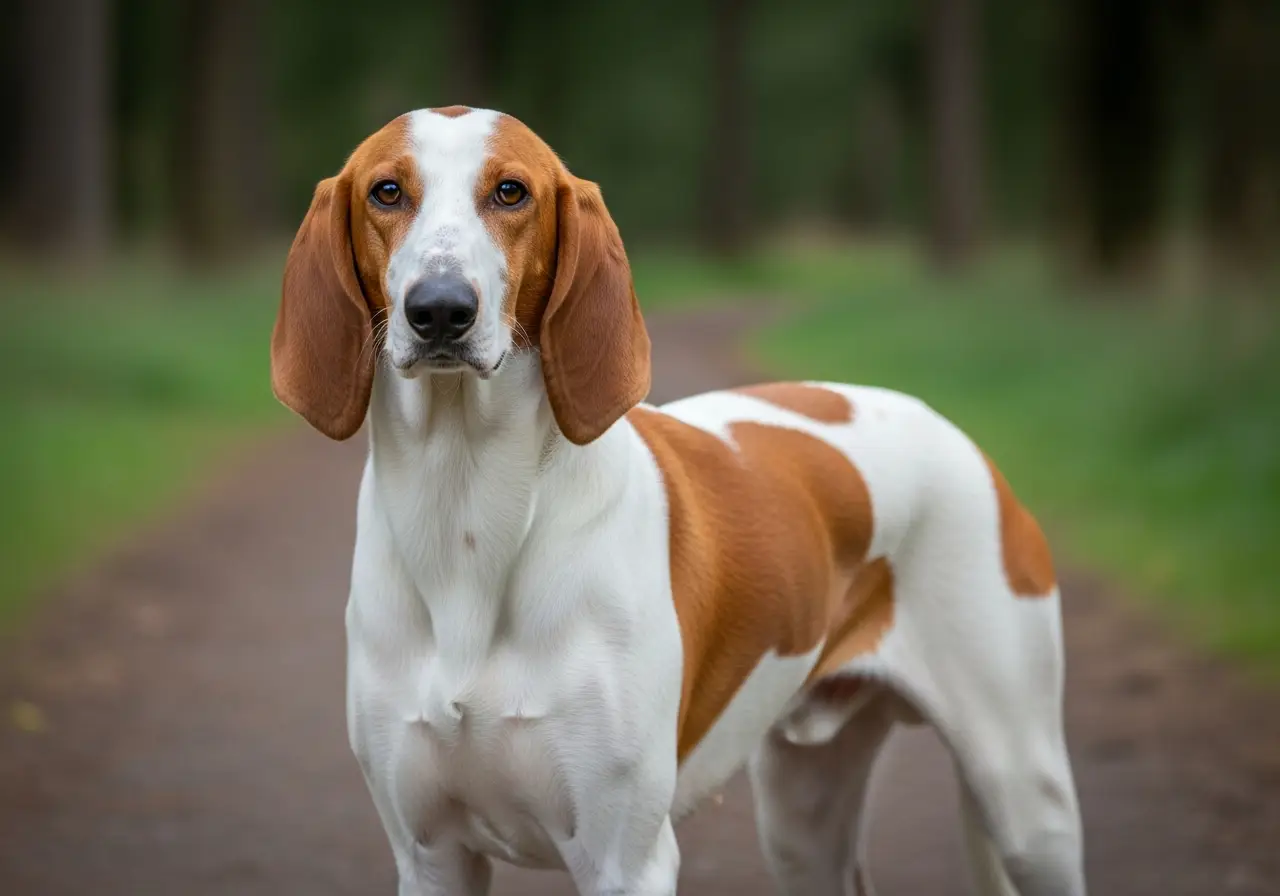
Schwyzer Laufhund: traditional Swiss hunting dog, elegantly marked in white and red, and designed for small game hunting
03Profile
Key facts and suitability
- Origin
- Schweiz
- Original purpose
- Small game hunting
- FCI
- No. 59 · Group 6 · Section 1.2
- height at the withers
- 47–59 cm
- Weight
- 17–22 kg
- Life expectancy
- 12–15 Years
- Coat type
- Short-haired
- Minimum exercise
- 90 min/day
- Puppy price
- 1'000–1'800 CHF
- Waiting period
- 4 months
- Sports
- Scent work Mantrailing
04Temperament
How the Schwyzer Laufhund shows up in everyday life
The morning walk reveals what distinguishes the Schwyzer Laufhund from a companion dog: the nose immediately goes to the ground, the body turns towards the strongest scent, and the dog pulls in that direction with calm but determined endurance. This is not disobedience; this is readiness to work.
Internally, the Schwyzer Laufhund requires intensive nose work daily. Exercise alone is not enough. Without scent trailing, mantrailing, or similar tasks, a significant portion of its drive potential goes unused. The need for mental work is high, as is the need for physical exercise; both together, not as alternatives.
Externally, the dog behaves more reservedly than openly towards strangers. It is not a dog that joyfully greets every visitor. This reserve is not aggression, but a selective bonding structure: the Schwyzer Laufhund orients itself towards its primary caregiver, not the environment. Anyone who equates the need for social contact with openness towards strangers misunderstands this dog.
In household daily life, it is calm if its needs are met. It sleeps a lot if it has been sufficiently stimulated. If not, it seeks out enrichment, and this rarely turns out calmly. It tolerates being left alone for up to four hours if the build-up was gradual. Longer periods are problematic without a care solution.
It gets along well with children who are calm and respectful in their handling. Hectic, unpredictable situations are stressful for it.
05Needs
What this breed needs daily
The Schwyzer Laufhund requires at least 90 to 120 minutes of active exercise daily, not as off-leash running in a meadow, but as structured stimulation with nose work. Scent trailing according to hunting patterns, mantrailing, or built-up search games cover its need for mental work. Without this component, the dog remains mentally under-supplied, even if it appears physically tired.
The prey drive is strongly pronounced and genetically anchored. This means concretely: off-leash exercise in areas rich in wild game without secured terrain is not a realistic everyday scenario. A fenced property or a secured training area significantly facilitates daily management.
The need for social contact is medium to high; the dog closely orients itself towards its primary caregiver and requires active interaction, not just presence. Being left alone for up to four hours is possible with gradual build-up; longer absences require a care solution.
Training requires consistency, experience, and a realistic picture of the hunting dog. Classic obedience exercises are only limitedly effective when the dog is on scent. Training must be built around hunting contexts and factor in the limits of recall upon contact with wild game from the start.
An owner who handles this dog without a hunting background requires a very structured alternative programme, and the willingness to implement it daily, not just at weekends.
Exercise
High
mental work
A lot
Social needs
Medium
training
Demanding
06Sport & Mental and Physical Stimulation
What sports the Schwyzer Laufhund is suited for
Realistic in terms of physiology and genetics – not every breed suits every sport.
Structurally and physiologically suitable: Suitable for mantrailing, dummy work and tracking · CaniCross / bikejoring possible.
07Quick Check
08Suitability
Who this breed is suitable for – and who it isn't
✓Matches
The Schwyzer Laufhund suits active hunters looking for an enduring tracking dog for small game hunting and who can use the breed in its original context. It is also suitable for very experienced dog owners with sound knowledge of hunting-motivated dogs, who can offer 90 to 120 minutes of structured stimulation with nose work daily.
A secure area, an enclosed property or regular access to a training ground is not optional but a prerequisite. The owner must be able to cope with the fact that the recall reaches its limits when the dog comes into contact with game, and adjust their management accordingly.
Families with older children from around ten years of age, in which at least one person brings hunting experience or comparable dog experience, are also suitable, provided that daily life allows for sufficient exercise and nose work. Anyone who understands the reserved attitude towards strangers and does not regard it as a problem but plans for it as a character trait will find a loyal, enduring companion in this dog.
×Doesn't match
The Schwyzer Laufhund is not suitable for households keeping a dog for the first time. The combination of high drive potential, limited recall when in contact with game and the daily need for nose work structurally overwhelms owners without prior experience with hunting-motivated dogs.
Anyone who is away from home for more than four hours a day and cannot organise care arrangements should not choose this breed. The same applies to urban living conditions without access to secure areas or game-rich areas where off-leash exercise without safety measures is not possible.
Anyone who interprets the dog's friendliness as a signal of openness towards strangers and expects a sociable everyday companion will be disappointed by the reserved outward appearance of the Schwyzer Laufhund. The internal bond with the primary caregiver is strong; this is not the same as social openness.
Owners who rely on reliable off-leash exercise in nature without fencing should also not choose this breed. The desire to follow a scent can be trained and channelled, but not trained away.
10Line reality
Show line, working line, breeder market
The Schwyzer Laufhund is bred exclusively in the working line; a separation into show and working lines, as exists with other breeds, is not established for this breed. Breeding is closely oriented towards the hunting function: desire to track, endurance, vocalisation on the trail, and nose performance are the central selection criteria.
Since the total population is very small, there are no regionally differentiated lines with demonstrably different temperaments or drive profiles. Breeders work in close coordination with hunting associations and conduct performance tests that document the hunting suitability of the dogs.
Anyone looking for a Schwyzer Laufhund will find almost exclusively dogs from active hunting dog breeding. This means: the drive is not weakened, the working profile is consistent. A dog from this breeding behaves in everyday life like a hunting dog, because it is one.
11Health · Reality
What you need to plan for medically with your Schwyzer Laufhund
The Schwyzer Laufhund is considered a robust breed with a life expectancy of 12 to 14 years. Breed-typical diseases with high prevalence are not systematically documented for this breed due to the small population and the lack of large-scale health studies.
Hip dysplasia (HD) is fundamentally relevant in scent hounds; however, reliable breed-typical HD rates for the Schwyzer Laufhund are not available in the form that exists, for example, for Retriever breeds. The Swiss Kynological Association (SKV) recommends an HD X-ray examination for breeding dogs before approval for breeding; a look at the parent dog’s breeding approval certificate provides information on the findings.
As an active hunting dog, it is susceptible to injuries during field work: paw injuries, cuts from undergrowth, and muscle strains are more common in everyday hunting than in companion dogs. Regular checks of the paws, ears, and skin after every field outing are mandatory.
The risk of overweight is low in sufficiently exercised individuals. In dogs that cannot meet their exercise needs, the risk of metabolic follow-up problems increases. An annual weight check at the vet is recommended.
Preventive examinations should include annual general check-ups, dental checks, and blood tests from the seventh year of life onwards. In cases of lameness, decline in performance, or behavioural changes, veterinary investigation without delay is indicated.
12Structured data
Health by the numbers
Prone to diseases
Hip dysplasia Ear infections
Recommended health tests
Hip X-ray Ear check
13Myths ↔ Reality
What is often said incorrectly about this breed
Five myths, five realities, five sources.
The Schwyzer Laufhund is an uncomplicated family dog for every household due to its friendliness.
The friendliness of the Schwyzer Laufhund towards people masks its high management effort. Its genetically anchored tracking willingness requires daily structured stimulation. Households without a hunting context or experienced leadership quickly reach limits that cannot be bridged by friendliness alone.
A long walk is sufficient to provide the Schwyzer Laufhund with adequate stimulation.
Pure exercise without nose work does not meet this dog's needs. The Schwyzer Laufhund has been selectively bred over centuries for independent tracking work. Without mental stimulation through scent trailing, mantrailing, or similar nose work, a significant portion of its drive potential remains unsatisfied, which can lead to frustration and displacement behaviour.
The recall can be reliably extended to include contact with wild game through consistent training.
The Schwyzer Laufhund's desire to track is a deeply anchored selection trait, not an obedience problem. As soon as the dog has picked up a scent trail, recall drops significantly in the hierarchy of priorities. Experienced hunting dog handlers work with secured terrain and clear management strategies rather than expecting a reliable off-leash recall in areas rich in wild game.
Schwyzer Laufhunds are easily compatible with all dogs due to their pack history.
Working in a pack means cooperation during the hunt, not automatic social compatibility in every everyday context. Individual socialisation, line affiliation, and the specific living situation significantly influence behaviour towards conspecifics. A blanket guarantee of compatibility cannot be derived from this.
The Schwyzer Laufhund is a widely distributed breed in Switzerland and easy to find.
Annual FCI registrations for the Schwyzer Laufhund are in the double-digit range. The breed belongs to the rarest recognised hunting dog breeds in the German-speaking region. Waiting times for puppies from reputable breeders are the rule, not the exception.
14animal welfare
The animal welfare perspective
Breeder market, designer versions, animal shelter reality — what no one writes in the puppy ad.
In Switzerland, the Schwyzer Laufhund is a pronounced rarity in Germany and Austria. This protects the breed from the mass market, but at the same time makes it vulnerable to a different dynamic: anyone looking for a Schwyzer Laufhund and unable to find a reputable breeder will quickly end up with offers from abroad whose origin and health status are not traceable.
Breeding operations specialising in rare breeds deliberately exploit the demand for rare dogs. The pattern is recognisable: no proof of performance tests for the parent dogs, no breeding approval by a recognised association, puppies without pedigrees or with forged papers. For a breed whose serious annual registrations are in the double digits, a suddenly available offer on a classified ad platform is a clear warning signal.
Designer versions or crossbreeds with the Schwyzer Laufhund as a base hardly exist on the market, the rarity of the breed has prevented this so far. Nevertheless, mixed-breed dogs occasionally appear that are offered as purebred Laufhunde.
In Switzerland, Laufhunde are occasionally rehomed through animal welfare organisations, usually by hunters who give up their hunting activities or by owners who have underestimated the prey drive. These dogs are often well-socialised and have a clear history. A Laufhund from rehome is not a stopgap solution but an equally valid option for experienced owners who know what to expect.
Anyone taking in a Schwyzer Laufhund that comes from a keeping situation without sufficient mental and physical stimulation should expect increased effort during the settling-in period. Behavioural issues arising from chronic under-stimulation can generally be reduced with consistent structure and hunting-related training, but not within a few weeks.
15Costs · Transparency
What this breed realistically costs
A puppy from a reputable breeder with an FCI pedigree, breeding approval for the parent animals and performance records costs between 1,200 and 1,800 CHF or EUR in Switzerland and the German-speaking region. Offers significantly below this without traceable origin are a warning sign.
The annual keeping costs consist of food (high-quality dry food or BARF for a medium-sized active dog: approx. 600–900 EUR/year), basic equipment and care (approx. 200–400 EUR/year) as well as veterinary costs. For routine examinations, vaccinations and parasite prevention, 300–500 EUR per year is realistic. Unforeseen treatments, not uncommon for a hunting dog in field use, can quickly mean an additional 500–1,500 EUR.
A dog liability insurance is strongly recommended for a hunting dog and costs 60–150 EUR/year depending on the provider and coverage amount. A health insurance for the dog is optional, but sensible for actively used hunting dogs; annual premiums start at approx. 400 EUR.
Anyone using the dog for hunting should additionally calculate costs for a hunting licence, training and performance tests.
16Puppy search
What you need to consider when choosing a breeder
- Reputable breeders of the Schwyzer Laufhund are affiliated with the Verein für Französische und Schweizer Laufhunde e.V.
- or the Swiss Kynological Association (SKV).
- A reputable breeder provides proof of breeding approvals for the parent dogs, presents results from performance tests and allows a visit to the litter before handing over the puppies.
- The puppies leave the litter no earlier than at eight weeks of age, are vaccinated, dewormed and registered with an FCI pedigree.
- Waiting times of several months to over a year are normal for this rare breed.
- Anyone who finds a puppy immediately should check the origin particularly critically.
- In Switzerland, rehoming an adult Schwyzer Laufhund through animal welfare organisations is an equally valid alternative.
- Hounds from rehoming often have a traceable background and are already socialised.
- Contact with hunting associations in Switzerland can be helpful when looking for dogs available for rehoming.
- No reputable source offers puppies without personal contact, without an inspection, and without proof of the parent dogs.
- Classified ad platforms with immediately available puppies where the breeder has no club affiliation should be treated with great caution.
FAQ
Frequently asked questions about the Schwyzer Laufhund
Is Schwyzer Laufhund a family dog?
Schwyzer Laufhund is considered suitable for families with good socialisation and species-appropriate care.
How much exercise does Schwyzer Laufhund need?
At least around 90 minutes of exercise per day.
Does Schwyzer Laufhund suit an apartment?
With enough exercise and enrichment, Schwyzer Laufhund can also be kept in an apartment.
What is the size and weight of Schwyzer Laufhund?
Fully grown, Schwyzer Laufhund reaches about 47–59 cm at the withers and weighs around 17–22 kg.
What is the life expectancy of Schwyzer Laufhund?
The life expectancy of Schwyzer Laufhund is approximately 12–15 years.
Which diseases are common in Schwyzer Laufhund?
Hip dysplasia Ear infections
17Breed clubs
Official breed clubs in DACH
19Related
Similar breeds – and their differences
You might also be interested in
Participate
Do you have a good photo of your Schwyzer Laufhund?
We are looking for expressive images for our breed profiles. Submit yours; the editorial team reviews every submission before publication.
Does this breed suit you?
One of the four Swiss hounds – suitable for hunting and nose work