
01Summary
In a paragraph
If you only have 30 seconds.
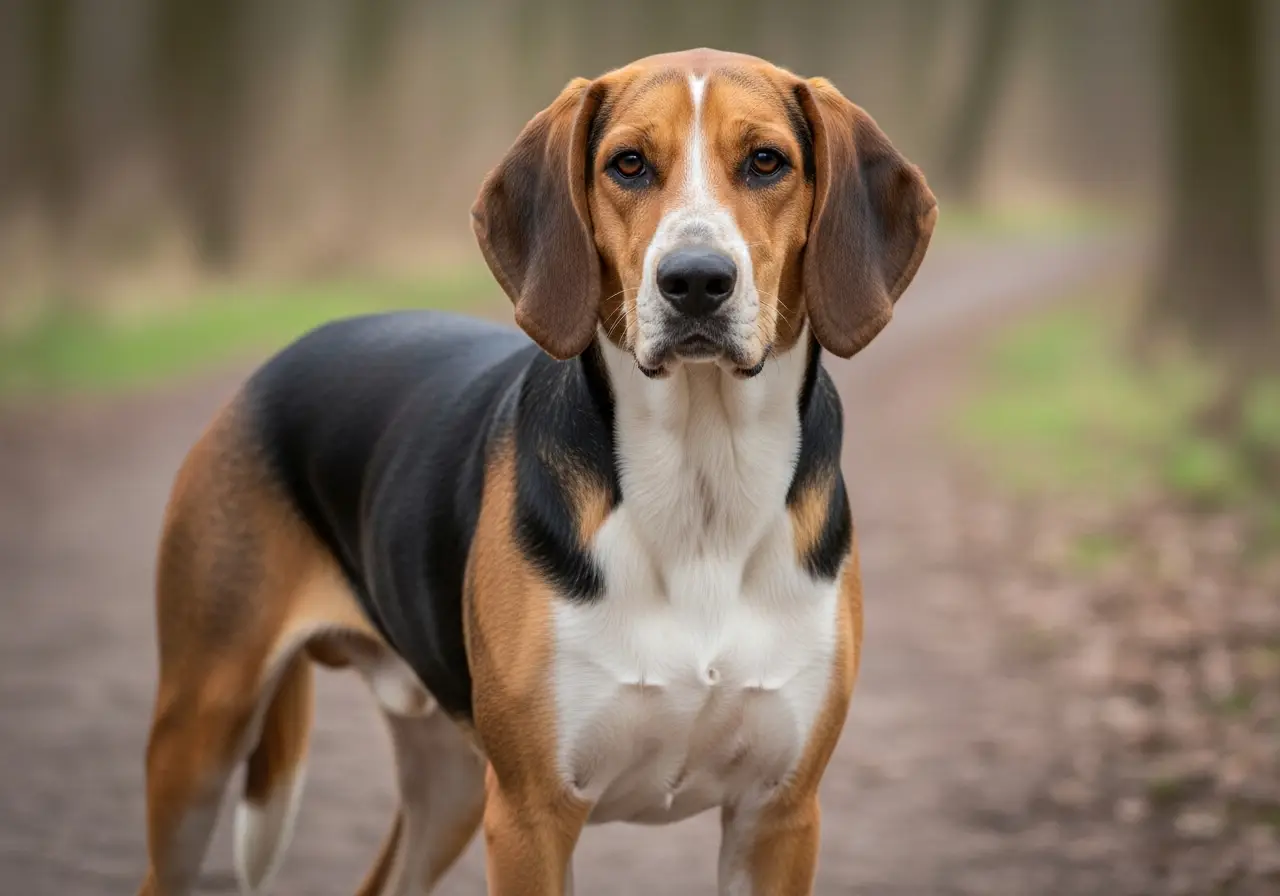
The English Foxhound is a British pack dog that was selected exclusively for fox hunting on horseback over centuries. Its prey drive is deeply rooted in its genetics, and its need for movement is exceptionally high. Anyone who keeps this breed takes on a dog that thinks independently, works loudly and needs intensive mental and physical stimulation daily; it is not a beginner's dog, nor a city dog.
02Introduction
What makes the English Foxhound special
The English Foxhound is a British pack hound for horseback fox hunting, FCI Group 6, enduring and vocal, withers height 58–64 cm.
03Profile
Key facts and suitability
- Origin
- Grossbritannien
- Original purpose
- Pack fox hunting on horseback
- FCI
- No. 159 · Group 6 · Section 1.1
- height at the withers
- 58–64 cm
- Weight
- 25–34 kg
- Life expectancy
- 10–13 Years
- Coat type
- Short-haired
- Minimum exercise
- 120 min/day
- Puppy price
- 800–1'500 CHF
- Waiting period
- 12 months
- Sports
- Hunting · Tracking
04Temperament
How the English Foxhound shows up in everyday life
The morning run reveals what distinguishes the English Foxhound from other large dogs: as soon as a scent trail captures its attention, it switches to work mode. The head goes down, the pace increases, and verbal signals from the owner recede into the background. This is not an obedience problem; this is the breed doing what it was selected for over centuries.
Internally, the Foxhound requires daily intensive exercise to an extent that most owners underestimate. 120 to 180 minutes are considered a minimum threshold, not a guideline for particularly active days. This is accompanied by a high need for social contact: the Foxhound is a pack animal that tolerates isolation poorly. Being left alone for more than three hours constitutes a real strain for most representatives of this breed.
Externally, it behaves openly and friendly towards people. Strangers are rarely met with distrust; the Foxhound is not a protection dog and shows no pronounced territorial instinct towards persons. However, this friendliness must not be confused with adaptability to any everyday life. A dog that is open towards people still requires consistent management in the field.
At home, the Foxhound is calmer than expected, provided its exercise needs are met. A sufficiently stimulated Foxhound lies down. An under-stimulated Foxhound finds its own enrichment: it vocalises, digs, and tests fences. Vocal exuberance is not an isolated incident in this context but a recurring issue in residential areas.
05Needs
What this breed needs daily
The English Foxhound requires at least 120 to 180 minutes of intensive exercise daily, not as a walk but as genuine physical stimulation. Suitable forms include canicross, mantrailing, nose work in the field, or hunting-accompanied exercise in a secure environment. Normal dog walking in the city does not structurally cover its endurance needs.
A securely fenced area is almost a prerequisite. The prey drive reliably kicks in upon scent contact; off-leash activity without security measures is not realistic with this breed in most everyday situations. The fence height should be at least 180 cm; the Foxhound is an enduring and motivated climber if a trail prompts it to do so.
Mental work complements physical stimulation. Nose work, search games, and structured tracking utilise its primary sensory level—the sense of smell—and tire it more effectively than pure running exercise. The need for mental work is high; a Foxhound that is only physically stimulated without receiving mental tasks often shows restlessness and vocalisation.
The need for social contact is pronounced. The Foxhound tolerates being alone poorly; a maximum of three hours is considered acceptable. Keeping a second dog or regular contact with conspecifics significantly reduces stress symptoms. Anyone who is out of the house during the day requires a reliable care solution.
Exercise
Very high
mental work
A lot
Social needs
High
training
Demanding
06Sport & Mental and Physical Stimulation
What sports the English Foxhound is suited for
Realistic in terms of physiology and genetics – not every breed suits every sport.
Structurally and physiologically suitable: Suitable for mantrailing, dummy work and tracking · CaniCross / bikejoring possible.
07Quick Check
08Suitability
Who this breed is suitable for – and who it isn't
✓Matches
The English Foxhound suits owners who can plan at least two to three hours of active time outdoors daily, not as an exception but as part of everyday life. A rural or suburban environment with access to secure terrain is not a matter of comfort but a basic requirement.
Experience with hunting-motivated dogs or scent hounds is necessary. Anyone who has already kept a dog with a pronounced scent drive and brings realistic expectations regarding recall will find in the Foxhound an enduring, friendly companion for sport and field work.
The breed is suitable for owners who actively engage in canicross, mantrailing, or nose work, or are willing to learn these activities. Families with older children from ten years upwards, who participate actively in dog sports themselves, are also an option, provided the dog’s exercise needs are not delegated solely to the children.
Anyone looking for a second dog and already keeping a socially compatible dog benefits from the Foxhound’s high need for social contact: it integrates well into a stable two-dog household. It is important that both dogs are sufficiently individually stimulated.
×Doesn't match
The English Foxhound does not suit owners who can plan less than two hours daily for intensive exercise. Anyone who is heavily committed professionally and has no reliable dog care plan will be structurally overwhelmed with this breed, regardless of motivation and good intentions.
City dwellers without access to secure land and a quiet exercise area should not choose this breed. The vocal nature of the Foxhound regularly leads to conflicts in multi-storey apartment buildings and densely populated residential areas. This is not a training issue that can be trained away; it is a breed characteristic.
Anyone looking for a dog that is reliably recallable and responds to signals even when encountering wildlife should choose a different breed. The Foxhound works independently in scent mode, which is genetically ingrained and cannot be completely overridden by training.
First-time owners without prior experience with hunting-motivated dogs are overwhelmed by this breed. Anyone who interprets the Foxhound's friendliness towards people as an indicator of general manageability confuses the external reaction axis with the internal needs profile, a common error that ends in animal welfare surrenders.
10Line reality
Show line, working line, breeder market
In practice, the English Foxhound exists almost exclusively as a working line. A distinct show line, such as has developed for many other FCI breeds, has not become established to a comparable extent in the Foxhound. Breeding has historically been, and still largely is, in the hands of Masters of Foxhounds—hunt masters who select primarily for function: endurance, scent drive, vocalisation, and pack compatibility.
In Great Britain, regional differences exist between individual packs that have been bred in geographically separated areas over decades. These regional lines differ slightly in physique and working style but are not formally recognised subtypes in the FCI sense.
Outside Great Britain, particularly in the German-speaking region, the breed is so rare that one can hardly speak of a differentiated line structure. Anyone looking for an English Foxhound in the DACH region usually encounters dogs with direct links to British hunt packs or their offspring. A distinction between working and companion dog lines is not meaningful here, as the total population is too small.
11Health · Reality
What you need to plan for medically with your English Foxhound
The English Foxhound is considered robust in comparison with other breeds. According to the Kennel Club (UK), the life expectancy is an average of 10 to 13 years, a solid range for a large dog, which is due to consistent functional selection without extreme changes to body structure.
Hip dysplasia (HD) is fundamentally relevant in large hounds. Reliable breed-specific HD prevalence studies on the English Foxhound are scarce outside the UK due to the small total population. The Veterinary Association for Animal Welfare (TVT) recommends an HD X-ray examination of parent animals before breeding as a minimum standard for all large hound breeds.
Due to the high range of movement, there is an increased risk of soft tissue trauma, paw injuries and overload damage to joints, particularly in dogs that are exercised intensively on hard surfaces. Regular paw checks after field work are sensible.
Ear problems are generally more common in breeds with floppy ears. The Foxhound requires a weekly ear check; wet or dirty ears after field work increase the risk of infection. Chronic otitis externa is one of the most common reasons for presentation in small animal practices for hounds.
Preventive examinations should include HD screening of parent animals, annual weight checks and semi-annual dental checks. Overweight is rare in sufficiently exercised Foxhounds, but with a lack of exercise it is a real risk that accelerates joint problems.
12Structured data
Health by the numbers
Prone to diseases
Hip dysplasia, generally robust breed
Recommended health tests
Hip X-ray
13Myths ↔ Reality
What is often said incorrectly about this breed
Five myths, five realities, five sources.
“The English Foxhound is an uncomplicated family dog because of its friendliness.
Friendliness towards people and suitability as a family dog are two different axes. The Foxhound does indeed show open, social behaviour towards people, but its exercise need of 120–180 minutes of intensive stimulation daily and its genetically anchored prey drive make it a demanding dog that requires consistent management and much experience.
“As a scent hound, long walks are sufficient for stimulation.
The English Foxhound was selected for hours of galloping work in the field. Normal walks do not meet its endurance needs. Meaningful forms of stimulation include structured nose work, mantrailing, canicross or hunting-accompanied exercise, always in a secure environment, as the desire to follow a scent reliably overrides recall when encountering wildlife.
“The Foxhound is easily compatible with other dogs because of its pack experience.
Pack compatibility within a pack of similarly socialised dogs is not the same as general social compatibility with unknown dogs in everyday life. The Foxhound is selected for pack cooperation, not for spontaneous encounters in the city park. Encounters with unknown dogs require careful introduction and observation.
“The English Foxhound is easy to train because it is not dominant.
Lack of dominance does not mean trainability in the classical sense. The Foxhound primarily orients itself to scent trails outdoors, not to verbal signals from the owner. It works independently, a trait that was desirable for hunting in a pack, but requires consistent lead management and realistic expectations regarding recall in everyday life.
“Foxhounds hardly bark, they are quiet dogs.
The opposite is true. The Foxhound was explicitly selected for vocalisation on the trail; this so-called pack baying is a core element of its working style. In residential areas, this trait regularly leads to conflicts with neighbours. Vocal exuberance is not a training issue but a genetically ingrained breed characteristic.
14animal welfare
The animal welfare perspective
Breeder market, designer versions, animal shelter reality — what no one writes in the puppy ad.
In Switzerland, the English Foxhound ends up in animal welfare organisations disproportionately often compared to its already small population. The most common reasons for surrender are being overwhelmed by the need for movement, conflicts with neighbours due to vocal nature and lack of recallability off-lead. These problems are not isolated cases, but predictable consequences when owners choose the breed without sufficient prior information.
The backyard breeder market plays a lesser role with the Foxhound than with popular breeds; the breed is too rare and not trendy enough to be produced en masse. However, this does not mean that all available dogs come from reputable breeding. Anyone who acquires a Foxhound via classifieds portals or without proof of studbook membership risks taking on a dog with an unknown health status and unclear socialisation.
Designer versions or hybrid forms hardly exist for the Foxhound. The breed is not marketed as a fashion dog, which protects it from certain breeding trends, but also means that information on reputable sources is harder to access.
Housing-related problems arise almost exclusively from underestimating the need for movement and social contact. A Foxhound that receives less than 90 minutes of mental and physical stimulation daily and is alone for many hours develops stress symptoms: vocalisation, destructiveness, fence jumping. These symptoms are often interpreted as character flaws; they are an expression of unmet basic needs.
Placement via animal welfare organisations is an equally valid option for the Foxhound. Many placed dogs come from disbanded hunting packs or from homes that underestimated the needs; they are social, healthy and looking for an experienced home. An initial enquiry with specialised hound animal welfare associations is worthwhile before any purchase decision.
15Costs · Transparency
What this breed realistically costs
A puppy from reputable breeding with FCI papers costs between 1,200 and 2,000 EUR in the DACH region. Due to limited availability outside Great Britain, import costs may apply, raising the price to 2,500 EUR or more. Offers significantly below 800 EUR without pedigree documentation are a warning sign.
The annual living costs for an English Foxhound are estimated at 2,000 to 3,500 EUR. High-quality food for a dog of this size and activity level costs 80 to 150 EUR per month. Additional costs include grooming needs (low for short hair), equipment for field work, and transport.
Basic veterinary costs (vaccinations, parasite prevention, annual check-up) amount to 300 to 600 EUR per year. Injuries from field activities or ear treatments can incur individual costs of 200 to 800 EUR. Pet insurance with surgical coverage costs 40 to 90 EUR monthly for this breed and size and is recommended given the active lifestyle.
16Puppy search
What you need to consider when choosing a breeder
- A reputable breeder of English Foxhounds provides proof of studbook entries, presents health examinations of the parent animals (at least HD screening) and allows a visit to the litter in the rearing environment.
- The puppies remain with the mother for at least eight weeks and are handed over socialised.
- Anyone who does not receive proof of studbook membership, cannot establish contact with the mother or pushes for a quick handover without questions is not acting in the spirit of the breed.
- Purchase contracts with return regulations are a sign of reputable breeding.
- Due to the small population size in the DACH region, waiting times of six to twelve months are realistic.
- Anyone who finds a Foxhound available immediately should check the origin particularly critically.
- Placement via animal welfare organisations is an equally valid alternative.
- Specialised hound and hunting dog placements occasionally have Foxhounds in stock, often from disbanded packs or surrenders due to being overwhelmed.
- These dogs are often adult, well-socialised and looking for an experienced home.
- An initial enquiry is worthwhile.
- No named breeder recommendation is made here; breeding associations provide vetted contacts on request.
FAQ
Frequently asked questions about the English Foxhound
Is English Foxhound a family dog?
English Foxhound is considered suitable for families with good socialisation and species-appropriate care.
How much exercise does English Foxhound need?
At least around 120 minutes of exercise per day. As an active breed, more so — plus mental stimulation.
What is the size and weight of English Foxhound?
Fully grown, English Foxhound reaches about 58–64 cm at the withers and weighs around 25–34 kg.
What is the life expectancy of English Foxhound?
The life expectancy of English Foxhound is approximately 10–13 years.
Which diseases are common in English Foxhound?
Hip dysplasia, generally robust breed
17Breed clubs
Official breed clubs in DACH
19Related
Similar breeds – and their differences
You might also be interested in

Participate
Do you have a good photo of your English Foxhound?
We are looking for expressive images for our breed profiles. Submit yours; the editorial team reviews every submission before publication.
Does this breed suit you?
Kept almost exclusively in packs. As a single dog hardly practical. Extremely loud hunting barker.