
01Summary
In a paragraph
If you only have 30 seconds.
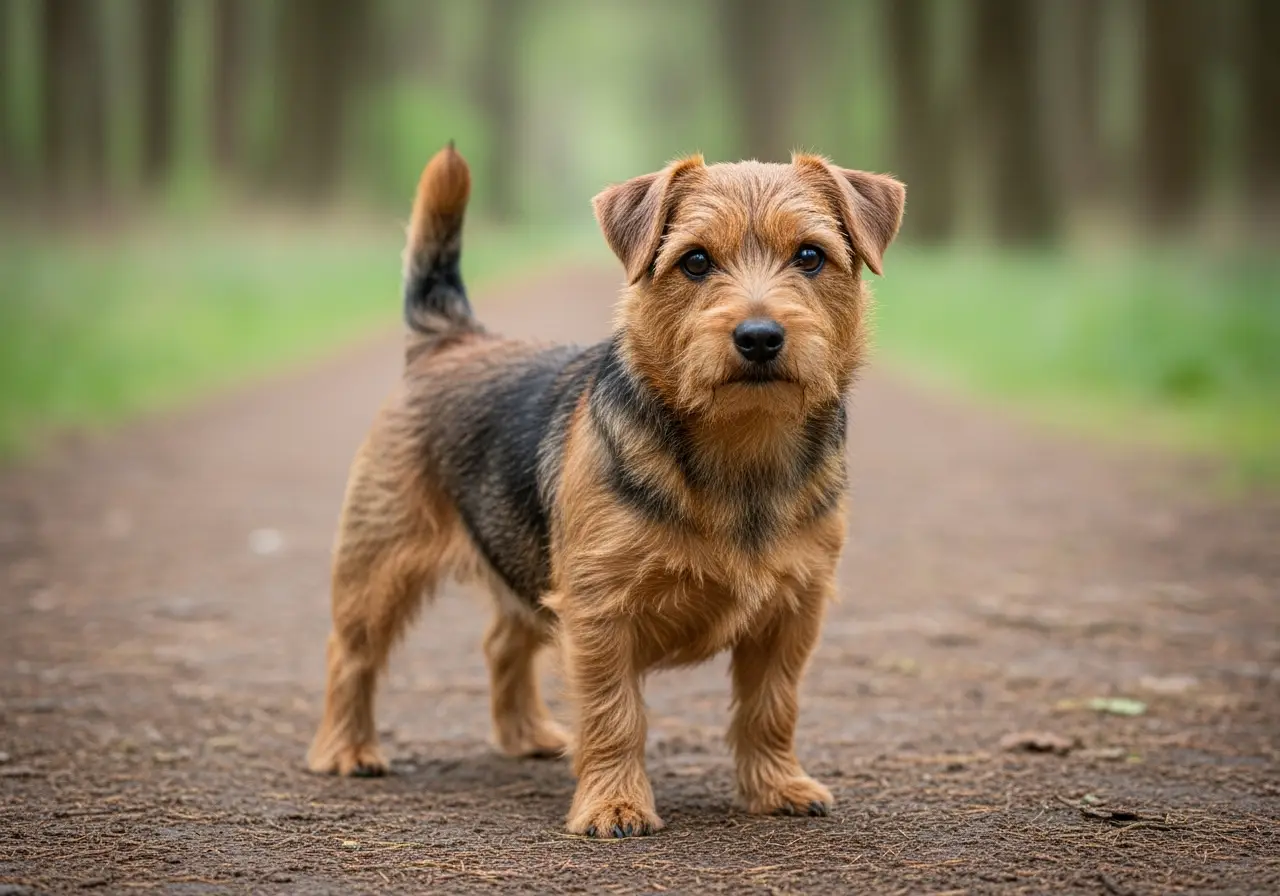
The Norfolk Terrier is one of the smallest terriers from Great Britain and one of the strongest in character. Drooping ears, wiry coat and unshakeable self-confidence define its image. Anyone who keeps this dog does not get a lap dog but an independent hunting terrier with pronounced prey drive, which demands daily structure, mental stimulation and a consistent primary caregiver. Compact in form, demanding in temperament.
02Introduction
What makes the Norfolk Terrier special
Norfolk Terrier: small English terrier with drop ears, exuberantly brave and close to its family
03Profile
Key facts and suitability
- Origin
- Grossbritannien
- Original purpose
- Rat and fox hunting
- FCI
- No. 272 · Group 3 · Section 2
- height at the withers
- 24–25 cm
- Weight
- 5–6 kg
- Life expectancy
- 12–15 Years
- Coat type
- Wire-haired
- Minimum exercise
- 45 min/day
- Puppy price
- 1'800–2'800 CHF
- Waiting period
- 4 months
- Sports
- Agility Earthdog work
04Temperament
How the Norfolk Terrier shows up in everyday life
The morning walk reveals what makes the Norfolk Terrier unique: its nose goes straight to the ground, every gap in a wall is inspected, every bush searched. The prey drive is not an occasional impulse; it is a permanently active mode. On the lead, the dog needs an owner who channels this energy, rather than ignoring it.
At home, the picture is different. The Norfolk Terrier actively seeks proximity to its primary caregiver, follows them through the apartment and observes attentively. The need for social contact is high; this dog is not a loner that occupies itself. Anyone who is out of the house for several hours daily without having a care solution will find an unsatisfied dog.
Towards strangers, the Norfolk Terrier behaves reservedly to neutrally. It does not greet visitors enthusiastically, but also shows no pronounced guarding instinct reaction. Here, internal and external axes diverge significantly: the high need for social contact applies to the familiar primary caregiver, not to every person entering the apartment. Anyone expecting an openly friendly greeting dog is mistaken.
With other dogs, everyday life works with good socialisation, but the Norfolk Terrier sets boundaries. It does not back down when it feels provoked and consistently underestimates its own body size. In multi-dog households, it requires clear structures and an owner who recognises escalations early.
The prey drive makes off-lead exercise without a secure environment risky. A fenced garden or a secured open area is not a comfort solution; it is a safety prerequisite.
05Needs
What this breed needs daily
The Norfolk Terrier needs 60 to 90 minutes of active exercise daily, divided into several sessions, not completed in one block. Pure walks are not enough. The dog needs situations where it can use its nose: mantrailing, nose work, search games in the terrain or structured sniffing on varying routes.
Mental stimulation is not an option, but a basic need. The need for mental work is at a medium level; the dog is intelligent enough to learn quickly and independent enough to seek its own enrichment when under-stimulated. The latter rarely manifests constructively.
The need for social contact is high. The Norfolk Terrier needs a primary caregiver who is present, not in the sense of constant interaction, but in the sense of presence and reliability. Being left alone for up to four hours is possible if it has been built up gradually. Longer absences without a care solution permanently overwhelm the dog.
Training requires consistency and humour. The Norfolk Terrier tests boundaries, not out of malice, but because terrier genetics rewards initiative. Anyone who reacts inconsistently quickly loses leadership. Positive reinforcement works well as long as the rules remain clear and stable.
The coat requires regular trimming, two to three times a year. Anyone wishing to do this themselves needs instruction from an experienced trimmer. Clipping permanently alters the coat structure and is not an equivalent alternative.
Exercise
Medium
mental work
Medium
Social needs
High
training
Medium
06Sport & Mental and Physical Stimulation
What sports the Norfolk Terrier is suited for
Realistic in terms of physiology and genetics – not every breed suits every sport.
Structurally and physiologically suitable: Suitable for mantrailing, dummy work and tracking.
07Quick Check
08Suitability
Who this breed is suitable for – and who it isn't
✓Matches
The Norfolk Terrier suits active individuals or couples who can plan 60 to 90 minutes of structured exercise and additional mental work daily. An owner who enjoys working with an independent dog and understands terrier nature not as a deficit but as a character trait will find a reliable companion in this breed.
Families with children from about eight years old are suitable if the interaction is respectful and calm. Toddlers and the pronounced drive for movement of the Norfolk Terrier do not fit well together structurally.
Owners with experience in terrier training or at least prior experience with independent breeds are clearly at an advantage. First-time owners without guidance from an experienced dog training school should assess the demands realistically.
City and apartment keeping is possible if sufficient exercise and off-leash areas with secure fencing are available. A garden is helpful but does not replace structured activity.
Those who already keep another dog and bring experience in socialising terrier-typical characters can integrate the Norfolk Terrier well, provided the introduction phase is carefully guided.
×Doesn't match
The Norfolk Terrier does not suit owners looking for a calm, adaptable companion dog without significant training effort. Anyone who equates small size with low needs will be permanently challenged by this dog in a way that is frustrating without preparation.
People who are regularly away from home for eight hours or longer and cannot organise care solutions do not meet the high need for social contact of this breed. The dog suffers from prolonged isolation and develops behavioural problems.
Owners who plan off-leash activity without a secure environment as standard underestimate the prey drive. The Norfolk Terrier follows a stimulus consistently; recall in hunting situations is not reliable without intensive training.
Anyone who confuses the dog's high need for social contact with general friendliness towards strangers will experience disappointment: The Norfolk Terrier is closely bonded to its primary caregiver but reserved towards strangers. These two axes diverge and must not be equated.
Households with small animals such as rabbits, guinea pigs or birds are critical to assess due to the pronounced prey drive. Co-habitation involves considerable effort and remains a permanent risk.
10Line reality
Show line, working line, breeder market
In the DACH region, the Norfolk Terrier is kept almost exclusively as a companion dog and for shows. A pronounced differentiation between working and show lines, such as exists with the Jack Russell Terrier, is less pronounced in this breed; the total number of litters is too small to establish parallel lines with clearly different profiles.
In Great Britain, there are a few breeders who focus on working traits and present their dogs in earthdog trials. These dogs tend towards a somewhat more compact, muscular build and often show a more intense prey drive than pure show lines. Anyone acquiring a Norfolk Terrier from British working breeding should factor this difference into everyday life.
Show lines in the DACH region are bred according to FCI standard No. 272. The focus is on exterior, coat quality and temperament according to the standard. The prey drive remains present here too; it is typical for the breed and not a breeding fault, but will vary in intensity in everyday keeping.
Anyone acquiring a Norfolk Terrier should specifically ask the breeder about line affiliation and the working traits of the parent animals. A look at the show results and health tests of the parents provides additional orientation regarding the breeding direction.
11Health · Reality
What you need to plan for medically with your Norfolk Terrier
The Norfolk Terrier is considered a robust breed with a life expectancy of 12 to 15 years. This places it in the upper range of small terrier breeds. Serious breed-typical hereditary diseases are less common than in many other small dogs, yet known health risks exist that should be known before purchase.
Patellar luxation (kneecap dislocation) occurs disproportionately frequently in small breeds. The Norfolk Terrier is no exception. According to the Orthopedic Foundation for Animals (OFA), terrier breeds show patellar luxation rates of 5 to 15 percent in samples, depending on breeding line and scope of examination (OFA database, status 2023). Reputable breeders have parent dogs tested for patellar luxation and disclose findings transparently.
Heart diseases, particularly mitral valve dysplasia, are documented in older Norfolk Terriers. Regular heart auscultation from the fifth year of life by a vet is recommended.
The wiry coat does not require medical management but regular trimming. Anyone who clips the coat instead of trimming it risks permanent loss of structure without health consequences in the narrower sense.
Overweight is an underestimated risk: The Norfolk Terrier is motivated by food and tends to gain weight with too high calorie intake and insufficient exercise. Overweight puts additional strain on joints and heart. Body weight should be checked regularly; the FCI standard does not specify an exact weight but describes the dog as compact and substantial with a height at the withers of about 24 to 25 cm.
Preventive examinations: annual vet check-up, patella check for the puppy, heart auscultation from the fifth year of life, dental check (small breeds are prone to tartar).
12Structured data
Health by the numbers
Prone to diseases
Heart problems Epilepsy Eye problems
Recommended health tests
Heart examination Eye examination
13Myths ↔ Reality
What is often said incorrectly about this breed
Five myths, five realities, five sources.
"The Norfolk Terrier is an easy-care beginner's dog because of its size.
Body size says nothing about the training effort. The Norfolk Terrier has a pronounced prey drive, terrier-typical stubbornness and high initiative. Without consistent leadership and clear structures, it quickly develops undesirable behaviours such as excessive barking or escape attempts. First-time owners need sound knowledge of terrier nature and should plan for accompanying dog training school attendance.
"Small dogs need hardly any exercise; the Norfolk Terrier gets by with a short walk.
The Norfolk Terrier was bred as a working terrier and possesses endurance disproportionate to its body. It needs 60 to 90 minutes of active exercise daily as well as additional mental stimulation through nose work, search games or training sessions. Too little enrichment manifests in destructiveness and increased noise levels.
"Norfolk Terriers are naturally compatible with other dogs because they are so small.
The FCI standard describes the Norfolk Terrier as fearless but not quarrelsome. This means: it does not shy away from conflicts and regularly underestimates its own body size. Towards other dogs, it shows typical terrier self-confidence, which without early and consistent socialisation can lead to conflicts, especially towards dogs of the same sex.
„The wiry coat of the Norfolk Terrier cares for itself and does not need to be treated professionally.
The hard, wiry topcoat of the Norfolk Terrier requires regular trimming, not clipping. Anyone who clips the coat permanently alters its texture and colour and impairs the natural protective function of the hair. Professional trimming two to three times a year by an experienced dog groomer or the owner themselves is mandatory.
„Norfolk Terriers and Norwich Terriers are the same breed with different names.
Both breeds share a common origin, but have been officially separate breeds since 1964. The decisive distinguishing feature is ear carriage: the Norfolk Terrier has V-shaped drop ears, the Norwich Terrier has erect ears. The FCI lists both under their own standards, the Norfolk Terrier under No. 272, the Norwich Terrier under No. 271.
14animal welfare
The animal welfare perspective
Breeder market, designer versions, animal shelter reality — what no one writes in the puppy ad.
The Norfolk Terrier is a rare breed in Germany, Austria and Switzerland. The annual number of litters is low, which means that backyard breeders and puppy farms occur less frequently than with popular breeds. On the other hand, this results in long waiting times for reputable breeders, leading some interested parties to turn to dubious offers.
Norfolk Terrier puppies occasionally appear on platforms such as classifieds or via Eastern European intermediaries, whose origin is unclear. Missing health certificates for the parent animals, no proof of breeding club membership and a price significantly below market level are warning signs. Anyone who buys there finances structures that treat animal welfare as secondary and assumes an increased health risk for the puppy.
The most common reasons for surrender in animal welfare are underestimated training effort and terrier-typical behaviour: barking, stubbornness, prey drive. Owners who expected a calm companion dog give up the dog when reality does not match their ideal image. This is not a failure of the dog, it is an information problem before purchase.
Animal welfare organisations and breed club placements occasionally offer adult Norfolk Terriers. An adult dog has the advantage that temperament and health status can already be assessed. Settling in takes time and patience, but is a fully valid alternative to a puppy for experienced owners.
Anyone who receives a Norfolk Terrier placed from abroad should carefully check the entry documents (EU pet passport, rabies vaccination, microchip). Illegal puppy imports also affect rare breeds and are problematic in terms of animal welfare law and veterinary law.
15Costs · Transparency
What this breed realistically costs
A Norfolk Terrier puppy from reputable breeding costs between 1,500 and 2,500 euros in the DACH region. Offers significantly below this often come from unrecognised breeding without health certificates. The acquisition costs are one-off, the ongoing costs are permanent.
Ongoing costs per year (guideline values): food for a small dog is 400 to 700 euros annually, depending on quality and form of food. Grooming by professional trimming costs between 80 and 150 euros per session two to three times a year. Vet costs in case of illness (prevention, vaccinations, parasite prevention) amount to 300 to 600 euros annually. In addition, there is dog liability insurance (from approx. 60 euros/year) and optionally pet health insurance (100 to 400 euros/year depending on tariff and scope of benefits).
In case of illness, costs for patellar luxation operations can be between 1,500 and 3,500 euros per joint. Pet health insurance that covers operation costs is a sensible consideration for this breed.
Total costs in the first year including acquisition, basic equipment and vet: realistically 3,000 to 5,000 euros. From the second year: 1,500 to 2,500 euros annually as a guideline value.
16Puppy search
What you need to consider when choosing a breeder
- Reputable Norfolk Terrier breeders in the DACH region can be found through recognised breed clubs, in Switzerland through the Swiss Terrier Club (SCFT), in Germany through the VDH and its member associations.
- A reputable breeder is a member of a recognised breeding association, breeds according to FCI standards and provides proof of health tests for the parent dogs.
- Concrete criteria for a reputable breeder: The puppies grow up in the household, not in kennels.
- The breeder asks questions about daily life and the interest's experience.
- Parent dogs are tested for patellar luxation and heart health.
- The puppy leaves the litter no earlier than eight weeks of age.
- A purchase contract and after-sales care are a matter of course.
- Waiting times of six to twelve months are usual for this rare breed.
- Anyone who wants a puppy immediately is likely to fall into dubious offers.
- Adoption as an equivalent option: Adult Norfolk Terriers from animal welfare or breed club rehoming are a fully valid alternative.
- Temperament and health status are easier to assess in adult dogs than in puppies.
- Breed club rehoming organisations know the dogs and can provide targeted advice.
- No named breeder recommendation; the current breeder lists of the recognised clubs offer the most reliable and up-to-date overview.
FAQ
Frequently asked questions about the Norfolk Terrier
Is Norfolk Terrier suitable for beginners?
Norfolk Terrier is considered suitable for first-time dog owners.
Is Norfolk Terrier a family dog?
Norfolk Terrier is considered suitable for families with good socialisation and species-appropriate care.
How much exercise does Norfolk Terrier need?
At least around 45 minutes of exercise per day.
Does Norfolk Terrier suit an apartment?
With enough exercise and enrichment, Norfolk Terrier can also be kept in an apartment.
What is the size and weight of Norfolk Terrier?
Fully grown, Norfolk Terrier reaches about 24–25 cm at the withers and weighs around 5–6 kg.
What is the life expectancy of Norfolk Terrier?
The life expectancy of Norfolk Terrier is approximately 12–15 years.
Which diseases are common in Norfolk Terrier?
Heart problems Epilepsy Eye problems
17Breed clubs
Official breed clubs in DACH
19Related
Similar breeds – and their differences
You might also be interested in

Participate
Do you have a good photo of your Norfolk Terrier?
We are looking for expressive images for our breed profiles. Submit yours; the editorial team reviews every submission before publication.
Does this breed suit you?
One of the smallest terriers – more robust than it looks and with real hunting drive despite its size