
01Summary
In a paragraph
If you only have 30 seconds.
The Louisiana Catahoula Leopard Dog is a functionally bred working dog from the southern USA, independent, high-drive and with pronounced hunting and guarding behaviour. Anyone keeping one needs 90 to 120 minutes of structured mental and physical stimulation daily, experience with work-intensive dogs and a clear leadership structure. It is not suitable for first-time owners or pure city apartments without a movement concept.
02Introduction
What makes the Louisiana Catahoula Leopard Dog special
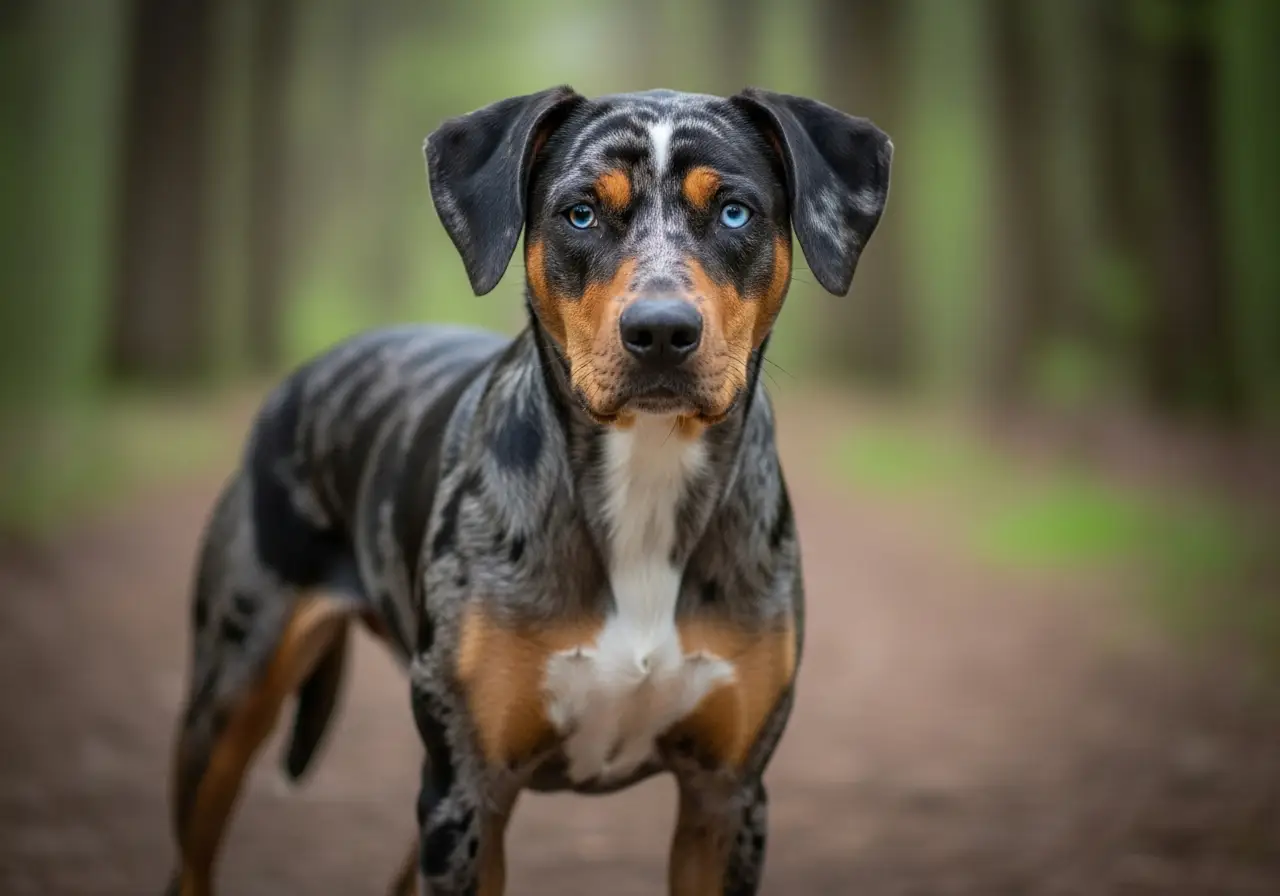
The Louisiana Catahoula Leopard Dog is the state dog of Louisiana, not FCI-recognised, with unique coat markings, shoulder height 50–66 cm.
03Profile
Key facts and suitability
- Origin
- USA (Louisiana)
- Original purpose
- Wild boar hunting, herding livestock
- height at the withers
- 50–66 cm
- Weight
- 16–37 kg
- Life expectancy
- 10–14 Years
- Coat type
- Short-haired
- Minimum exercise
- 120 min/day
- Puppy price
- 600–1'200 CHF
- Waiting period
- 6 months
- Sports
- Hunting · Herding work · Agility · Scent work
04Temperament
How the Louisiana Catahoula Leopard Dog shows up in everyday life
The morning run reveals what sets the Catahoula apart from many other dogs: it systematically scans its surroundings, reacts immediately to movement in the undergrowth, and heads towards game trails—not out of disobedience, but due to genetic programming. The prey drive is not a character flaw; it is the working profile of the breed.
Internally, the Catahoula requires intensive daily mental and physical stimulation (mental work requirement 5/5, exercise requirement 5/5). Simple walks do not fill this quota. It needs structured tasks: nose work, mantrailing, protection sports, or controlled hunting work. If you do not give it a task, you will watch as it finds one for itself, usually in the garden, along the fence line, or by dismantling furniture.
Externally, it behaves reservedly to expectantly towards strangers (friendliness towards strangers 3/5). These two axes must not be confused: a high need for social contact with the primary caregiver does not mean that it welcomes visitors. The Catahoula bonds closely with its owner; strangers must earn this trust.
With conspecifics, it is compatible if socialised early, but shows tendencies towards dominance, particularly towards dogs of the same sex. Being left alone works for a maximum of four hours, provided stimulation and daily structure are appropriate. Those who regularly leave it alone for longer risk stress behaviour, which manifests as destructiveness or vocalisation.
05Needs
What this breed needs daily
The Catahoula requires at least 90 to 120 minutes of structured physical activity daily, not divided into three short rounds, but in units that truly challenge it. Trail running, bikejoring, swimming, or controlled hunting work correspond to its endurance profile.
In parallel, it requires mental work daily. The mental work requirement is 5 out of 5; this is not a guideline but a basic condition. Nose work, mantrailing, complex search tasks, or protection sports (IGP) are suitable formats. Simple obedience exercises in the living room are insufficient.
Being left alone is limited to a maximum of four hours if the rest of the daily structure is appropriate. A Catahoula that has not been sufficiently stimulated in the morning will not tolerate four hours of being left alone without consequences.
A securely fenced area is not a comfort option but a safety prerequisite. The pronounced prey drive makes off-leash walking in unsecured terrain a calculable risk, not an exception. Fences should be at least 1.80 m high and without climbing structures.
The leadership structure must be consistent and suitable for everyday life. The Catahoula actively questions inconsistent rules. It needs an owner who communicates boundaries clearly without using harshness—sovereign leadership, not dominance training. A dog training school with experience in working breeds is recommended for the first twelve months.
Exercise
Very high
mental work
A lot
Social needs
Medium
training
Demanding
06Sport & Mental and Physical Stimulation
What sports the Louisiana Catahoula Leopard Dog is suited for
Realistic in terms of physiology and genetics – not every breed suits every sport.
Structurally and physiologically suitable: Suitable for mantrailing, dummy work and tracking · CaniCross / bikejoring possible.
07Quick Check
08Suitability
Who this breed is suitable for – and who it isn't
✓Matches
The Catahoula suits owners with proven experience in handling working dogs or work-intensive breeds. Those who have already handled a Malinois, a Hovawart, or a hunting dog and know the demands of these breeds bring a realistic starting basis.
A suitable profile looks concretely like this: The person is available for at least two hours of structured activity daily, lives in a rural or suburban environment with access to terrain, has a securely fenced property, and is interested in dog sports or hunting work. Households with children aged ten and over are possible if the children are socialised in dealing with dogs and the dog has been handled consistently since puppyhood.
Those who use the Catahoula as a working dog (e.g., in hunting, protection service, or mantrailing) meet the breed in its actual context. Sportively active individuals or couples without children who can provide daily stimulation also fit the profile. Important: The external axis (friendliness towards strangers 3/5) requires an everyday life in which encounters with strangers are predictable and controllable—not a café dog, not a dog for busy city centres without a training concept.
×Doesn't match
The Catahoula does not suit first-time dog owners. The combination of high exercise needs, pronounced prey drive, and protective instincts structurally overwhelms novice owners—not due to a lack of good will, but due to a lack of experience.
Those who are away from home for more than six hours daily and do not have a reliable dog care plan should not choose this breed. The maximum limit of four hours for being left alone is not a guideline that can be arbitrarily extended through habituation.
Households in urban apartments without access to terrain and without a securely fenced property do not provide the Catahoula with an adequate basis for life. Those who underestimate the prey drive and believe that recall training replaces secured exercise take on a safety risk.
Those who interpret the reserve towards strangers as "it will settle down" misunderstand the external axis of this breed. The Catahoula is not a dog that becomes an open social dog through mere habituation. Those who frequently receive visitors or live in a social environment requiring spontaneous encounters with strangers need an active socialisation concept and should realistically assess the limits of this breed.
10Line reality
Show line, working line, breeder market
The Louisiana Catahoula Leopard Dog does not have formal breeding lines in the sense of FCI-recognised show or working lines. As the breed is not recognised by the FCI, there is no internationally binding exterior standard that would enforce a separation into show and working lines.
In practice, however, two informal breeding directions can be observed: on the one hand, dogs selected in the USA for working ability, for wild boar hunting, herding livestock or mantrailing. These animals generally show higher drive intensity, more pronounced independence and stronger hunting motivation. On the other hand, there are breeding programmes that focus more on exterior and coat markings, without systematic working trials.
This distinction is relevant for buyers in Germany: a dog from a US line oriented towards working ability brings a significantly higher level of drive and activity than a dog whose parent animals were primarily selected for appearance. As standardised health and performance certificates, as required for FCI breeds, are not mandatory, transparency regarding the origin of a Catahoula puppy in Europe is often limited. Buyers should actively ask for proof of working ability of the parent animals and for BAER test results.
11Health · Reality
What you need to plan for medically with your Louisiana Catahoula Leopard Dog
The life expectancy of the Louisiana Catahoula Leopard Dog is 10 to 14 years, a range that depends heavily on keeping conditions, weight management and genetic predisposition.
The most medically relevant issue in this breed is merle-associated deafness. Dogs with two merle alleles (so-called “double merles”) carry a significantly increased risk of congenital deafness and vision problems up to blindness. A study by Strain et al. (2009, Louisiana State University) shows that in dogs with the double merle genotype, hearing loss in one or both ears occurs in over 60% of cases. A BAER test (Brainstem Auditory Evoked Response) is the only reliable method for checking hearing ability and should be proven by the breeder before purchase.
Hip dysplasia (HD) occurs in the breed, but reliable breed-specific prevalence rates are lacking due to the absence of FCI studbook registration. Buyers should demand HD X-ray reports for both parent animals. Eye problems, including colobomas and microphthalmia, are documented in merle-coloured dogs and require an ophthalmological examination before purchase.
Overweight is a real risk in this breed if the need for exercise is not met. A Catahoula with reduced activity tends to gain weight, which puts strain on joints and the cardiovascular system. Regular weight checks at the vet, at least twice a year, are recommended. Preventative examinations include: BAER test (puppy age), eye examination, HD X-ray (from 12 months), annual general check-up.
12Structured data
Health by the numbers
Prone to diseases
Deafness (in merle carriers), hip dysplasia, heart problems
Recommended health tests
BAER test, hip X-ray
13Myths ↔ Reality
What is often said incorrectly about this breed
Five myths, five realities, five sources.
"The Catahoula is an exotic designer dog because of its colourful coat.
The merle or leopard pattern is not a breeding trend, but a functional legacy of working dog selection. The coat markings arose from the genetic mixing of indigenous and European dog types over centuries. Designer dogs are deliberately crossed for aesthetics, whereas the Catahoula was selected for working ability.
"Two Catahoulas keep each other occupied, so the owner has less to do.
Two dogs with a mental stimulation requirement of 5 and an exercise requirement of 5 double the care workload, they do not halve it. Without structured stimulation by the owner, both dogs develop problem behaviours. The breed's independence is amplified in a group if there is no clear leadership structure.
"Merle colouring is an aesthetic trait with no health relevance.
Merle genetics are directly linked to congenital deafness, particularly in double merle carriers (MM genotype). Studies show that dogs with two merle alleles carry a significantly increased risk of deafness and vision problems. A BAER test (Brainstem Auditory Evoked Response) before purchase is not just a recommendation for this breed, it is a medical necessity.
"Because of its guarding instincts, the Catahoula is a good family dog for children.
Guarding instincts and suitability as a family dog are two different axes. The Catahoula shows reserve to mistrust towards strangers (external axis: friendliness towards strangers = 3/5). Children who run up unexpectedly or make noise can trigger its guarding reflex. Early, consistent socialisation is a necessary prerequisite, not a guarantee.
"Because it is not an FCI dog, there are no breeding standards and all Catahoulas are the same.
The UKC has maintained a breed standard for the Louisiana Catahoula Leopard Dog since 1995. Nevertheless, breeding programmes in the USA vary considerably, as there is no internationally binding health certification prescribed as with FCI breeds. Buyers in Germany must actively request health tests (HD, BAER, eyes) from the breeder.
14animal welfare
The animal welfare perspective
Breeder market, designer versions, animal shelter reality — what no one writes in the puppy ad.
The Louisiana Catahoula Leopard Dog is a rare breed in Germany, and precisely that makes it susceptible to a specific animal welfare problem: the exotic effect. Anyone looking for a dog with spectacular coat markings and an unusual name increasingly finds it on classifieds platforms, often without traceable origin, without health tests and without knowledge of owner requirements.
Backyard breeder market: As the Catahoula is not FCI-recognised, binding studbook requirements are lacking in Germany. This facilitates market access for dubious suppliers. Puppies without BAER test, without HD results for the parent animals and without proof of socialisation are offered at prices between 800 and 2,000 euros. A low price is not a quality feature; it is often a warning sign.
Surrenders due to keeping conditions: Catahoulas end up disproportionately often in animal shelters or with breed rescue organisations because their need for exercise and mental work was underestimated. The exotic purchase without preparation leads to surrender within the first two years in many cases. Animal welfare organisations in the USA report high return rates for this breed.
Adoption as an equivalent option: Adult Catahoulas from rehoming come with a known character and assessable behaviour. For experienced owners who know what they are looking for, a rehomed dog is often the more transparent choice than a puppy of unclear origin. Organisations such as the Louisiana Catahoula Rescue (USA) or European working dog rehoming centres occasionally have animals of this breed.
Anyone buying a Catahoula puppy bears responsibility for the demand they generate. Transparent breeding with BAER test, HD results and proof of socialisation is the minimum standard, not the optimum.
15Costs · Transparency
What this breed realistically costs
The acquisition costs for a Louisiana Catahoula Leopard Dog vary considerably. With reputable breeders providing BAER test, HD results for the parent animals and proof of socialisation, prices between 1,200 and 2,000 euros are realistic in Germany. Offers significantly below that often come from backyard breeding without health tests; follow-up costs regularly exceed the savings.
The annual living costs consist of: food (high-quality dry food or BARF for a 30-kg dog) approx. 600–1,000 euros/year, grooming needs (brushing, occasional bathing) approx. 100–200 euros/year, dog training school and training in the first two years approx. 500–1,000 euros, accessories (lead, harness, transport box, toys) approx. 300–500 euros in the first year.
Vet costs: Basic care (vaccinations, annual examination, parasite prophylaxis) is approx. 300–500 euros/year. In addition come BAER test (one-off approx. 80–150 euros), HD X-ray (approx. 150–250 euros) and ophthalmological examination (approx. 80–150 euros). In case of illnesses or operations, individual costs can quickly reach 2,000–5,000 euros.
A dog health insurance policy costs for this breed approx. 50–120 euros/month depending on provider and scope of cover. Given the health profile (merle-associated risks, HD), insurance is recommended.
16Puppy search
What you need to consider when choosing a breeder
- As the Louisiana Catahoula Leopard Dog is not FCI-recognised, there is no VDH studbook in Germany to serve as a guide.
- This significantly increases the duty of care when searching for a puppy.
- Reputable providers exhibit the following characteristics: BAER test results for all puppies in the litter (not just individual animals), hip dysplasia X-ray reports for both parent dogs, ophthalmological examination for merle-coloured animals, proof of socialisation (puppies were exposed to various stimuli in a home environment), the opportunity to view the mother at the breeder’s, and no sale before the eighth week of life.
- Warning signs: No BAER test, no health certificates for the parents, sale via classifieds platforms without the possibility of viewing in person, prices under 800 euros without explanation, breeders offering several breeds simultaneously.
- Adoption as an equivalent option: Adult Catahoulas from animal welfare organisations or breed rescue groups come with assessable behaviour and a known history.
- For experienced owners, this is often the more transparent choice.
- European working dog rehoming centres occasionally have animals of this breed.
- No specific breeder recommendation is made here; the platform rundum.dog refers to verified entries in the breeder directory.
FAQ
Frequently asked questions about the Louisiana Catahoula Leopard Dog
Is Louisiana Catahoula Leopard Dog a family dog?
Louisiana Catahoula Leopard Dog is considered suitable for families with good socialisation and species-appropriate care.
How much exercise does Louisiana Catahoula Leopard Dog need?
At least around 120 minutes of exercise per day. As an active breed, more so — plus mental stimulation.
What is the size and weight of Louisiana Catahoula Leopard Dog?
Fully grown, Louisiana Catahoula Leopard Dog reaches about 50–66 cm at the withers and weighs around 16–37 kg.
What is the life expectancy of Louisiana Catahoula Leopard Dog?
The life expectancy of Louisiana Catahoula Leopard Dog is approximately 10–14 years.
Which diseases are common in Louisiana Catahoula Leopard Dog?
Deafness (in merle carriers), hip dysplasia, heart problems
17Breed clubs
Official breed clubs in DACH
19Related
Similar breeds – and their differences
You might also be interested in
Participate
Do you have a good photo of your Louisiana Catahoula Leopard Dog?
We are looking for expressive images for our breed profiles. Submit yours; the editorial team reviews every submission before publication.
Does this breed suit you?
State dog of Louisiana. Unique leg colours and glass eyes. Eager to work and enduring. Very rare in Europe.