
01Summary
In a paragraph
If you only have 30 seconds.
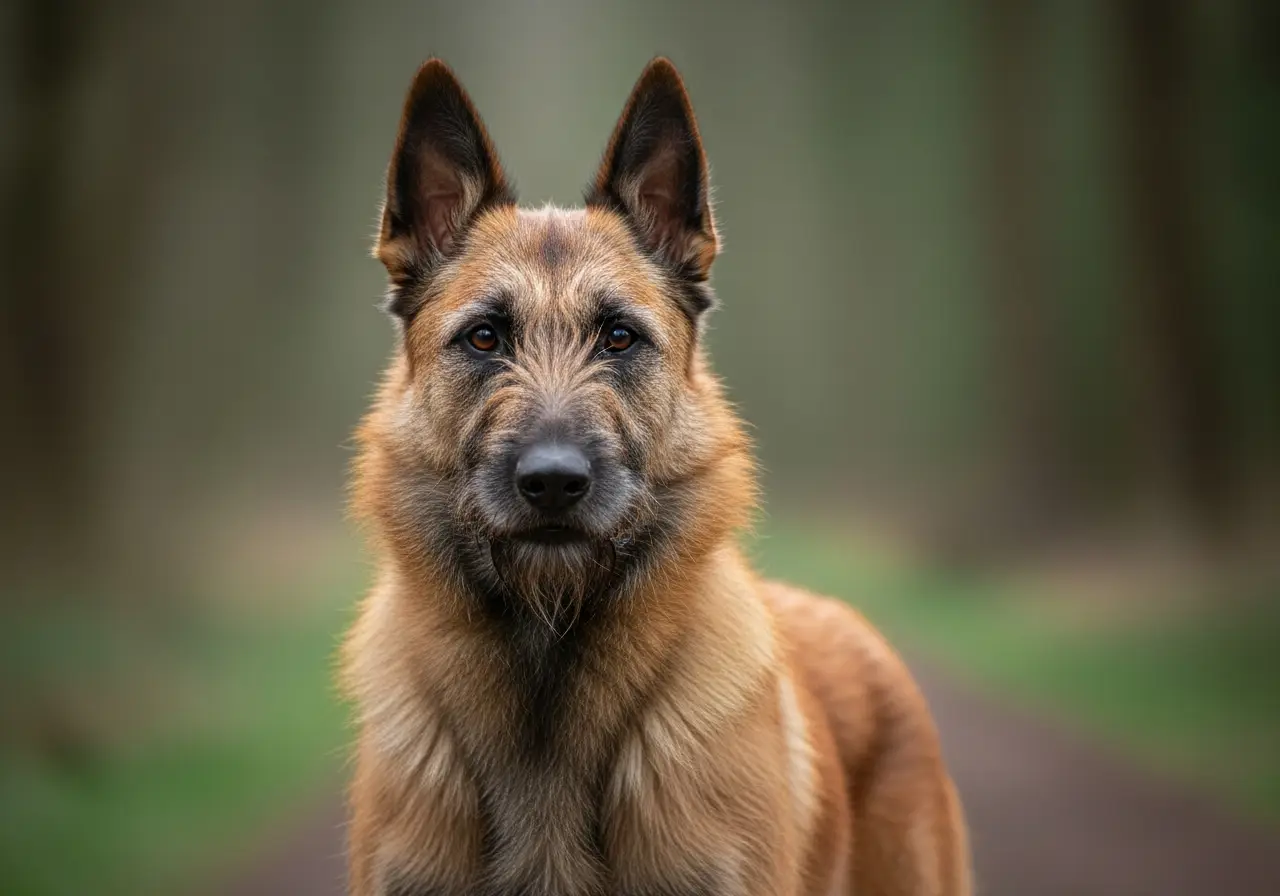
The Laekenois is the rarest of the four varieties of the Belgian Shepherd, rough in coat, precise in mind, and uncompromising in its willingness to work. Anyone who brings daily structured stimulation of 90 to 120 minutes, training competence, and experience with working dogs will receive an exceptionally high-performing partner. Anyone who cannot provide this faces a dog that will utilise its potential on its own terms.
02Introduction
What makes the Laekenois special
The Laekenois is the rarest of the four Belgian Shepherd breeds, FCI Group 1, with a rough wire coat and a withers height of 56–66 cm.
03Profile
Key facts and suitability
- Origin
- Belgien
- Original purpose
- Herding and guarding sheep in Laeken
- FCI
- No. 15 · Group 1 · Sektion 1: Schäferhunde, mit Arbeitsprüfung
- height at the withers
- 56–66 cm
- Weight
- 20–30 kg
- Life expectancy
- 12–14 Years
- Coat type
- Wire-haired
- Minimum exercise
- 120 min/day
- Puppy price
- 1'500–3'000 CHF
- Waiting period
- 12 months
- Sports
- Schutzhund · Agility · Obedience · Tracking
04Temperament
How the Laekenois shows up in everyday life
When coming home, the Laekenois immediately registers whether the primary caregiver is tense or relaxed. It reacts to body language, tone of voice and routine, not to words alone. Anyone who starts the evening in an unstructured way will notice it in the dog: restlessness, seeking contact, pacing.
Internally (i.e. in what the dog needs from itself), an extremely high need for mental work comes first. The Laekenois is genetically oriented towards tasks. Without a clear daily structure with training, nose work or dog sports, it finds its own enrichment, and this rarely turns out in the owner's interest.
Externally, i.e. in its reaction to environmental stimuli, it shows a different picture. It behaves reservedly to vigilantly towards strangers. This is not an educational error, but a breed trait: The Laekenois was selected over generations as a guard and herding dog. This reserve towards unknown people is not identical with insecurity; a well-socialised Laekenois remains controlled, but it does not open up to everyone.
On the walk, this means concretely: The dog actively scans the environment, registers movements early and reacts to stimuli faster than many other breeds. Anyone who interprets this as nervousness and intervenes in a calming manner inadvertently reinforces the reaction. Anyone who recognises it as working mode and leads clearly has a focused companion.
With conspecifics, the Laekenois is compatible with early and consistent socialisation; no guarantee exists, and the herding instinct can also manifest itself towards other dogs.
05Needs
What this breed needs daily
The Laekenois needs at least 90 to 120 minutes of structured activity daily, and structured here means not only movement but mental involvement. A long free run without a task does release energy, but it does not satisfy the need for mental work.
Concrete forms of stimulation that correspond to the profile: protection work (IPO/IGP), tracking work, search and rescue dog work, nose work, agility with a high training component or structured obedience work at competition level. Pure leisure activities without a clear training goal are not sufficient in the medium term.
The need for social contact is high, but it is directed primarily towards the primary caregiver, not towards social breadth. The Laekenois wants to work with its primary caregiver, not simply be in their vicinity. Passive time together does not satisfy it. Anyone who sits on the sofa in the evening and expects the dog to lie down will find: the dog lies down, but it does not sleep.
Being left alone is possible, but must be built up carefully. More than four hours daily are not a long-term solution for this breed. A dog that regularly stays alone for longer periods without being sufficiently stimulated develops stress symptoms.
The coat requires regular checking and professional trimming twice a year. Daily grooming is not required, but checking for tangles, especially after field use, is part of the routine.
Exercise
Very high
mental work
A lot
Social needs
High
training
Demanding
06Sport & Mental and Physical Stimulation
What sports the Laekenois is suited for
Realistic in terms of physiology and genetics – not every breed suits every sport.
Structurally and physiologically suitable: Suitable for herding work, treibball and coursing · CaniCross / bikejoring possible.
07Quick Check
08Suitability
Who this breed is suitable for – and who it isn't
✓Matches
The Laekenois suits owners who have already gained experience with drive-strong working dogs, not just with active dogs in general, but with dogs that bring guarding instinct and herding instinct. Anyone who has handled a Malinois, Tervueren or German Shepherd from the working line brings a realistic expectation with them.
Suitable are owners who can plan 90 to 120 minutes of structured training daily, not as an occasional exception, but as a fixed part of everyday life. Dog sports at club level (IGP, search and rescue dog, tracking) or a comparable form of enrichment should be available or concretely planned.
People living in a household with children from about ten years of age can keep a Laekenois if the children are instructed in handling the dog and the dog has clear retreat options. Toddlers and the Laekenois are not a recommended combination, because the herding instinct can become active towards small, fast-moving people.
A house with a garden or direct access to training grounds is advantageous. Keeping in an apartment is possible if daily stimulation is consistently ensured; this requires a high degree of self-discipline from the owner.
×Doesn't match
The Laekenois does not suit owners who are keeping a dog for the first time, even if they are physically active. Physical activity does not replace experience with drive-strong, sensitive working dogs. Anyone who shows inconsistency in handling (whether through changing rules, insecure body language or lack of training routine) will get a dog that fills these gaps itself.
Households in which the dog regularly stays alone for more than four hours daily are not suitable for the Laekenois. The high need for social contact is directed towards work with the primary caregiver, not towards passive presence, and even less towards absence.
Anyone who chooses the Laekenois because they are looking for a "calmer Malinois" or because the wiry coat appeals to them visually is misunderstanding the breed on both axes: internally, it requires the same level of stimulation as its sibling breeds; externally, it displays high vigilance towards strangers and unfamiliar stimuli, which is difficult to handle without leadership competence.
Families with toddlers under six years old should not choose the Laekenois. The pronounced herding instinct can be triggered by small, fast-moving children; this is not an aggression problem, but a risk that cannot be controlled without professional guidance.
10Line reality
Show line, working line, breeder market
The Laekenois does not exist in clearly separated show and working lines like the Labrador Retriever or the German Shepherd. The breeding population is so small worldwide that strong line differentiation has not yet taken place.
Within the Belgian Shepherd dogs as a whole, i.e. across all four varieties, there is a distinction between dogs from dog sports (IGP breeding) and dogs from pure show breeding. In the Laekenois, show breeding dominates due to the low number of breeding animals, although many breeders also place value on true-to-type character and working ability.
Anyone looking for a Laekenois from a line that is explicitly oriented towards dog sports will find very few breeding facilities in Europe. Contact with the German Club for Belgian Shepherd Dogs (DKBS) is the most direct way to identify current breeding facilities with character proof.
For the owner, this means: The question of lines is less decisive for the Laekenois than for other working dog breeds; the basic profile (high drive, high sensitivity, high willingness to work) is stable due to the breed. More important is the socialisation of the parent animals and the rearing situation of the puppies.
11Health · Reality
What you need to plan for medically with your Laekenois
The life expectancy of the Laekenois is 12 to 14 years, comparable to other medium-sized working dog breeds in this size class. Reliable breed-specific mortality studies do not exist due to the small global population; the figure is based on breeder surveys and data for Belgian Shepherds as a whole.
Hip dysplasia (HD) and elbow dysplasia (ED) are the most relevant orthopaedic risks. For Belgian Shepherds as a whole, the OFA database (Orthopedic Foundation for Animals, status 2023) shows an HD rate of approx. 6–8% of examined dogs, significantly lower than in many other shepherd dog breeds, but not negligible. Reputable breeders provide HD/ED X-ray reports for both parent animals; this is the minimum standard for the Laekenois, not a bonus.
Eye diseases (Progressive Retinal Atrophy, PRA) occur in Belgian Shepherds. An annual eye examination by a specialist veterinary ophthalmologist is recommended, particularly during the first four years of life.
Epilepsy is documented in Belgian Shepherds, although no specific prevalence values exist for the Laekenois. Owners should seek immediate veterinary assessment in the event of first-time seizures.
The wiry coat requires trimming twice a year; without care, skin irritation occurs. Overweight is rare in this active breed if stimulation levels are appropriate, but it is a real risk with insufficient exercise, placing additional strain on the joints.
12Structured data
Health by the numbers
Prone to diseases
Hip dysplasia, epilepsy, eye problems
Recommended health tests
Hip X-ray, eye examination
13Myths ↔ Reality
What is often said incorrectly about this breed
Five myths, five realities, five sources.
“The Laekenois is like a Malinois, just with a rough coat, so somewhat calmer.
Coat and temperament are two independent traits. The Laekenois shares the same FCI standard as the Malinois regarding character and instinct profile: high willingness to work, pronounced guarding and herding instincts, high responsiveness. Anyone expecting a calmer dog because the coat looks wirer fundamentally underestimates the breed.
“Belgian Shepherds are family dogs that adapt to any household.
The Laekenois does not adapt; it demands. Without daily structured mental and physical stimulation of 90 to 120 minutes, without training competence and without a clear daily structure, it shows behavioural problems such as excessive barking, destruction or displacement activities. Adaptation to a passive household does not take place.
“The wiry coat of the Laekenois is maintenance-free.
The rough wire coat requires regular checking for tangles, especially around the ears, armpits and tail. Professional trimming twice a year is recommended, as the coat does not shed on its own but remains dead in the coat. Without care, skin irritation occurs under the coat.
“Anyone who gets a Belgian Shepherd from animal welfare gets an unpredictable problem dog.
Belgian Shepherds often end up in animal welfare because owners have underestimated their stimulation needs, not because the dogs are genetically problematic. With careful assessment by experienced animal welfare staff and a suitable owner profile, rehoming regularly succeeds. Background and socialisation are decisive, not origin alone.
“The Laekenois is suitable for active beginners who do sports.
Physical activity alone is not enough. The Laekenois needs mental stimulation through structured training, clear leadership and knowledge of working dog dynamics. Sporty beginners without experience with high-drive dogs underestimate the intensity of the bond, the sensitivity to inconsistency and the consequences of errors in the rearing phase.
14animal welfare
The animal welfare perspective
Breeder market, designer versions, animal shelter reality — what no one writes in the puppy ad.
The Laekenois is practically non-existent in animal welfare organisations in the German-speaking region; the breeding population is too small to generate larger waves of surrenders. This changes when you widen your view to Belgian Shepherds as a whole: Malinois and Tervueren regularly end up in shelters because owners have underestimated their need for occupation.
The pattern is well known: An owner decides on a Belgian Shepherd because they are sportily active and want an intelligent dog. What they underestimate is the intensity of the bond, the sensitivity to inconsistency, and the consequences of under-stimulation. After six to twelve months, the dog shows behavioural problems and ends up in rehoming.
Anyone who takes a Belgian Shepherd from animal welfare does not receive a genetically damaged dog. They receive a dog with a history that requires patience, experience, and often professional guidance. Animal welfare organisations specialising in working dogs conduct preliminary assessments and only rehome to suitable owners. This is not a disadvantage; it is quality assurance.
When buying a Laekenois puppy, the low number of breeding animals is a double-edged sword: On the one hand, there are hardly any mass-breeding operations because the breed is too little known. On the other hand, its rarity tempts some buyers to be less critical when assessing the breeder. HD/ED certificates for the parent animals, temperament tests, and transparent rearing documentation are non-negotiable for the Laekenois as well.
Designer versions or trend crossbreeds currently do not exist in significant numbers for the Laekenois. The risk here lies less in breeding for harmful traits (Qualzucht) than in impulse purchases by owners who choose the breed due to its rarity or distinctive appearance without knowing its working profile.
15Costs · Transparency
What this breed realistically costs
A Laekenois puppy from a VDH-recognised breeding facility costs between 1,500 and 2,500 EUR. The low availability means that waiting periods of six to twelve months are realistic. Offers significantly below this price range without a pedigree and health certificates are a warning sign.
The annual cost of keeping a Laekenois is approximately 2,000 to 3,500 EUR, depending on the quality of food, training effort and veterinary costs. High-quality dry food or raw feeding costs between 600 and 1,200 EUR annually for a dog of this size. Professional grooming twice a year costs between 60 and 120 EUR per session, depending on the region.
Average veterinary costs: The annual basic care (vaccinations, parasite prevention, check-up) is between 200 and 400 EUR. Orthopaedic assessments (HD/ED X-rays) cost a one-off 150 to 300 EUR. Dog health insurance for this breed and size class costs between 40 and 90 EUR monthly; whether it is worthwhile depends on the chosen tariff and individual risk appetite.
Dog sports at club level (IGP, tracking) cost an additional 200 to 600 EUR annually for membership fees and training equipment.
16Puppy search
What you need to consider when choosing a breeder
- Reputable Laekenois breeders in the German-speaking region can be found through the Deutscher Klub für Belgische Schäferhunde (DKBS).
- The DKBS maintains a breeder list with breeding facilities affiliated with the VDH; these dogs are supplied with a pedigree, HD/ED certificates for the parent animals, and a puppy protection contract.
- Concrete criteria for a reputable breeding facility: The parent animals are visible on-site, and at least the mother lives in the household.
- The breeder asks questions about your planned daily routine and rejects buyers without experience with working dogs.
- Puppies leave the breeding facility no earlier than eight weeks of age.
- Written HD/ED X-ray reports for both parent animals are available.
- Warning signs: Puppies offered at significantly reduced prices without a pedigree, offers on general classifieds portals without proof of breeding credentials, breeders who do not ask any questions.
- Adopting an adult Belgian Shepherd from animal welfare organisations is an equally valid option, particularly for experienced owners who prefer a dog with an already assessed temperament over the unknown development of a puppy.
- Specialised working dog animal welfare organisations conduct temperament tests and provide professional support during the rehoming process.
FAQ
Frequently asked questions about the Laekenois
Is Laekenois a family dog?
Laekenois is considered suitable for families with good socialisation and species-appropriate care.
How much exercise does Laekenois need?
At least around 120 minutes of exercise per day. As an active breed, more so — plus mental stimulation.
What is the size and weight of Laekenois?
Fully grown, Laekenois reaches about 56–66 cm at the withers and weighs around 20–30 kg.
What is the life expectancy of Laekenois?
The life expectancy of Laekenois is approximately 12–14 years.
Which diseases are common in Laekenois?
Hip dysplasia, epilepsy, eye problems
17Breed clubs
Official breed clubs in DACH
19Related
Similar breeds – and their differences
You might also be interested in

Participate
Do you have a good photo of your Laekenois?
We are looking for expressive images for our breed profiles. Submit yours; the editorial team reviews every submission before publication.
Does this breed suit you?
Rarest of the four Belgian Shepherd breeds with a rough wire coat. Equal to the Malinois in working use.