
01Summary
In a paragraph
If you only have 30 seconds.
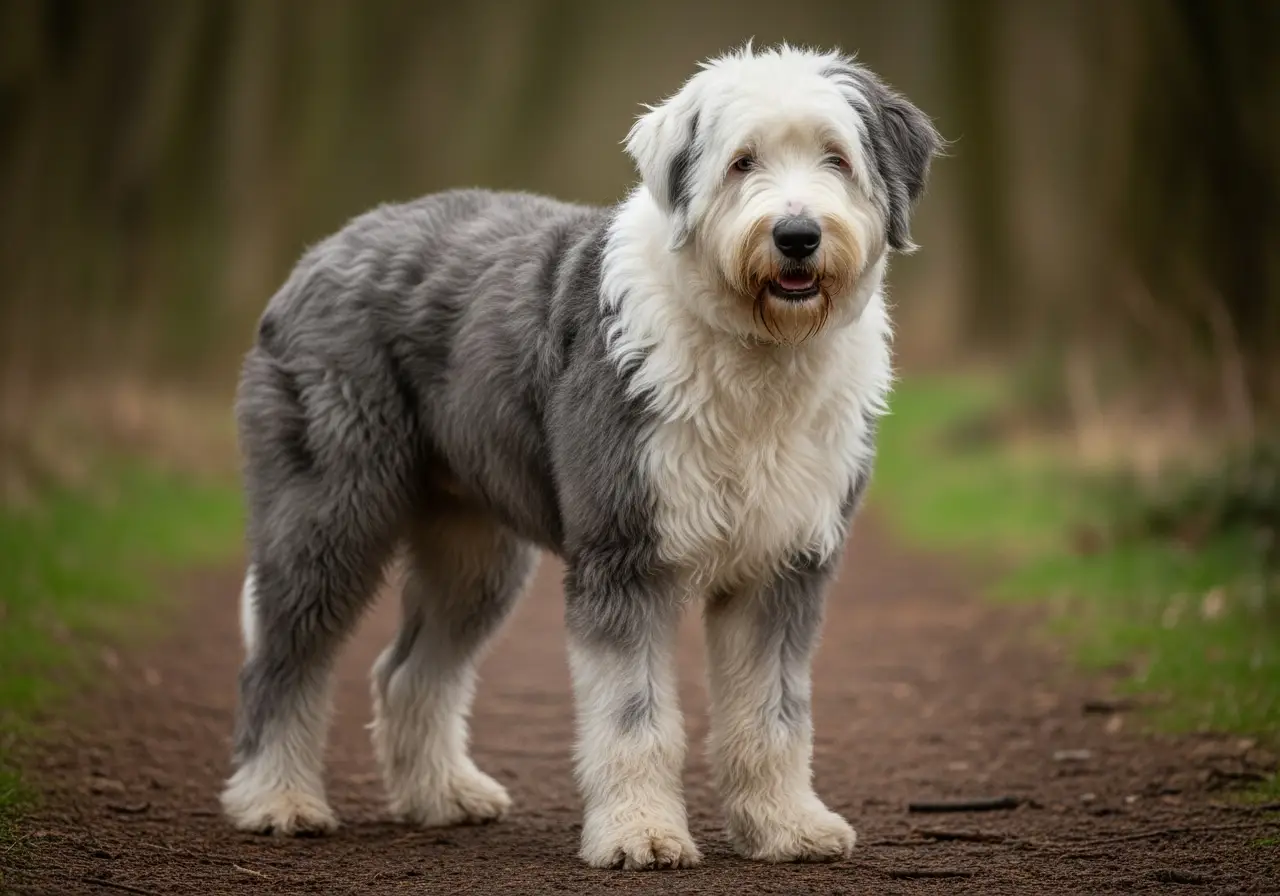
The Old English Sheepdog, known internationally as the Old English Sheepdog or Bobtail, is a British herding dog with pronounced willingness to work, a high need for social contact, and a coat that requires intensive care several times a week. Anyone who expects a cosy companion dog behind the shaggy appearance fundamentally underestimates this breed. Exercise, structure, and coat management are not options but basic prerequisites.
02Introduction
What makes the Old English Sheepdog special
The Old English Sheepdog (Bobtail) is a British herding dog, FCI Group 1, with typical grey-and-white coat and a withers height of at least 56 cm.
03Profile
Key facts and suitability
- Origin
- Grossbritannien
- Original purpose
- Herding sheep and cattle
- FCI
- No. 16 · Group 1 · Sektion 1: Schäferhunde
- height at the withers
- 56–61 cm
- Weight
- 27–45 kg
- Life expectancy
- 10–12 Years
- Coat type
- Long-haired
- Minimum exercise
- 90 min/day
- Puppy price
- 1'500–2'500 CHF
- Waiting period
- 9 months
- Sports
- Agility · Obedience · Herding work
04Temperament
How the Old English Sheepdog shows up in everyday life
When you come home, you are greeted by a dog that actively registers and demands attention from every family member upon their arrival. The Old English Sheepdog forms close bonds with its primary caregivers and attentively follows household activities. This is not passive attachment; the dog wants to be included.
Internally, the breed has a high need for social contact (internal axis: score 4 out of 5) combined with an equally pronounced need for mental work and exercise. A Bobtail that goes for a 30-minute walk in the morning and waits alone for the rest of the day will develop strategies for self-entertainment, rarely to the owner’s delight. Typical signs are controlling behaviour towards children or other pets, excessive barking or destructive behaviour.
Externally, the Bobtail is generally open and curious towards strangers (external axis: friendliness towards strangers 4 out of 5). However, this openness must not be confused with uncritical tolerance: the original herding instinct manifests in daily life as a controlling impulse towards moving objects, children or animals. During group walks, circling or crowding other dogs may occur – not aggression, but herding behaviour.
In training, the Old English Sheepdog works with concentration when the task is clearly structured. It quickly registers mood changes in its primary caregiver and reacts accordingly. Unclear or contradictory signals lead to uncertainty, which manifests as impulsivity. Positive reinforcement with clear structure yields the best results. Dog sports such as obedience, rally obedience or herding work suit the nature of this breed significantly better than mere walks.
05Needs
What this breed needs daily
The Old English Sheepdog needs at least 90 minutes of active exercise daily, not as total time including breaks, but as actual workload. Walks at a walking pace do not meet this need. Running sessions, free work on secure terrain, fetch training or structured play with task characteristics are suitable formats.
Mental work is not a bonus, but a mandatory component. The Bobtail has a genetically anchored willingness to work that leads to frustration without an outlet. Nose work, search games, obedience training or herding work provide meaningful stimulation. At least one session of mental work per day should be planned.
Being left alone must be built up early and systematically. The high need for social contact makes the Bobtail susceptible to separation stress. Four hours alone are realistic for a well-conditioned dog; more should remain the exception, not the rule.
Grooming is an independent time factor: several times a week, daily for puppies, the dense double coat must be thoroughly brushed. This is supplemented by regular checks of paws, ears and the belly area for matting. Anyone who cannot or does not want to plan this time should not choose this breed. Professional grooming every six to eight weeks complements the home routine but does not replace it.
A house with a garden facilitates daily management, but is not an absolute requirement. What matters is the owner’s willingness to implement exercise and enrichment consistently and structuredly, regardless of the living environment.
Exercise
High
mental work
A lot
Social needs
High
training
Medium
06Sport & Mental and Physical Stimulation
What sports the Old English Sheepdog is suited for
Realistic in terms of physiology and genetics – not every breed suits every sport.
Structurally and physiologically suitable: Suitable for herding work, treibball and coursing · CaniCross / bikejoring possible.
07Quick Check
08Suitability
Who this breed is suitable for – and who it isn't
✓Matches
The Old English Sheepdog suits owners who can plan at least 90 minutes of active exercise and additional mental work daily. Families with children from about eight years old, where clear rules for handling the dog apply, get along well with this breed, provided that adults consistently take responsibility for guidance.
Active individuals or couples who do dog sports or are interested in obedience, rally obedience or herding work will find a motivated partner in the Bobtail. Anyone who enjoys regular grooming or is willing to learn this routine is well prepared.
Owners with prior experience in training large, drive-strong dogs cope better with the Bobtail’s temperament than first-time owners without support. Anyone living in an apartment can keep this breed if exercise and enrichment are implemented daily and consistently and secure open space is available nearby.
Households where at least one person is present during the day or where a reliable care solution exists better meet the high need for social contact of this breed than households with long periods of absence.
×Doesn't match
The Old English Sheepdog does not suit owners looking for a calm, low-maintenance companion dog. Anyone who equates the shaggy appearance with an uncomplicated temperament fundamentally underestimates the breed; this is a common misconception that directly leads to surrenders to animal shelters.
Households where all individuals are away from home for eight or more hours daily and cannot arrange reliable care do not meet the need for social contact of this breed. Anyone who regards grooming as an occasional task will be confronted with matting and the associated health problems.
First-time owners without a supporting dog training school and without the willingness to implement training consistently will quickly reach their limits with the herding instinct and controlling behaviour of the Bobtail. Anyone who has children in the household who have not yet shown safe behaviour towards dogs should take the pronounced herding instinct of this breed seriously; circling and pestering small children is not an attack, but it is stressful for toddlers.
Anyone who interprets the Bobtail’s external openness towards strangers as general sociability without effort in handling overlooks the fact that this breed requires clear structures to regulate its behaviour reliably.
10Line reality
Show line, working line, breeder market
The Old English Sheepdog is primarily kept today as a companion and show dog. A clearly defined working line in the sense of active herding operations hardly exists anymore in the German-speaking region. Nevertheless, differences in temperament and willingness to work within the breed are evident, which are due to different breeding priorities.
Show lines aimed at exhibition success focus on coat quality, body structure and movement harmony in accordance with the FCI standard. Dogs from these lines may appear more balanced in temperament, but have the same basic need for exercise and enrichment as more work-oriented animals.
Dogs from breeding lines with a stronger focus on temperament testing and working traits often show more pronounced herding behaviour and higher responsiveness. For owners who aim to do dog sports or herding work, this line may be a better fit, but it also demands more experience in handling.
When buying a puppy, it is worth specifically asking about the kennel’s breeding goals: Are puppies shown at exhibitions? Are temperament tests or working trials carried out? The answers provide clues about line priorities and help you find the dog that fits your daily life.
11Health · Reality
What you need to plan for medically with your Old English Sheepdog
According to information from British breeding associations, the life expectancy of the Old English Sheepdog is on average 10 to 12 years. Individual dogs reach 13 to 14 years, but this is the exception.
Hip dysplasia (HD) is a known issue in the breed. Breeding associations recommend radiological HD examination of both parent animals before mating. Without this selection, the risk for offspring with painful joint changes increases considerably. When buying a puppy, HD findings for both parent animals should be presented.
Eye diseases — including cataracts and progressive retinal atrophy (PRA) — occur in the breed. Examination for hereditary eye diseases by a specialist veterinary ophthalmologist is part of responsible breeding preparation. DNA tests for PRA are available for some forms and should be used on breeding animals.
Autoimmune diseases, including hypothyroidism and immune-mediated diseases, are documented in the breed but are rarer than HD or eye problems.
The dense coat increases the risk of skin problems if care is neglected. Matting leads to skin irritation, fungal infections, and in the worst case, pressure sores. Regular inspection of the skin under the coat is mandatory.
Overweight poses a relevant risk for this breed, especially if exercise and food quantity are not coordinated. A healthy body weight protects the joints and extends the active life phase.
12Structured data
Health by the numbers
Prone to diseases
Hip dysplasia, eye problems (progressive retinal atrophy), hypothyroidism, heart problems
Recommended health tests
Hip X-ray, eye examination, heart examination
13Myths ↔ Reality
What is often said incorrectly about this breed
Five myths, five realities, five sources.
The Old English Sheepdog is a calm, cosy family dog that requires little stimulation.
The Bobtail descends from an active herding line and possesses a genetically anchored drive for exercise and enrichment. At least 90 minutes of active exercise daily as well as mental stimulation through training or dog sports are not a recommendation, but a minimum requirement. Underestimated workload often leads to controlling behaviour, destructiveness and over-excited behaviour.
The Bobtail's coat largely cares for itself and only needs to be brushed occasionally.
The dense double coat of the Old English Sheepdog mats down to the skin without regular care. Mats can cause pain, skin irritation and restricted movement. Specialist associations recommend brushing several times a week, daily for puppies and young dogs. Many animal shelter surrenders of this breed are directly due to underestimated care effort.
Because the Bobtail looks so friendly, it is easily suitable for first-time owners.
The Old English Sheepdog reacts sensitively to inconsistent handling and quickly develops undesirable controlling behaviour towards children, other animals or moving objects when structures are unclear. First-time owners without experience with large, high-drive dogs absolutely need a supporting dog training school and should realistically assess the time required for training and care.
The Bobtail is naturally tailless; this is a natural breed characteristic without intervention.
Historically, the tail was docked to mark the dog's working status for tax purposes. A genetically determined bobtail exists in some dogs, but it is not present in all animals. In large parts of Europe, including Germany, Austria and Switzerland, tail docking has been banned for years. Undocked Bobtails carry their tails naturally and fully.
A large garden completely replaces daily exercise and enrichment.
A garden provides the Old English Sheepdog with additional space, but does not replace structured stimulation. Without active interaction, training and targeted enrichment, most dogs hardly use a garden meaningfully. The herding instinct demands tasks and human guidance, not uncontrolled freedom.
14animal welfare
The animal welfare perspective
Breeder market, designer versions, animal shelter reality — what no one writes in the puppy ad.
The Old English Sheepdog does not experience mass production in the German-speaking area like some trendy breeds, but it is not free from problems in the areas of breeding and keeping.
Bobtail puppies without club membership and without health certificates regularly appear on classifieds platforms. These animals often come from backyard breeding operations where neither HD nor eye health of the parent animals was checked. The low price is often paid for with higher veterinary costs later in the dog’s life.
A specific keeping problem for this breed is the underestimated care effort. The popularity boom of the 1970s, triggered by advertising appearances of the Bobtail, led to a wave of surrenders at the time because owners were overwhelmed by coat management. This pattern repeats itself on a smaller scale to this day: from the cute puppy comes a dog weighing 30 to 40 kilograms with a coat that becomes a health burden without daily care. Animal shelters report that coat problems and being overwhelmed by the need for exercise are among the most common reasons for surrendering this breed.
Designer crosses with the Bobtail, such as Bobtail-Doodle variants, are offered occasionally. No standardised health examinations exist for these mixed breeds, and the promise of a lower-maintenance coat is not always fulfilled.
Adoption of adult Bobtails via animal shelters or specialised rescue organisations is a serious alternative to buying a puppy. Adult dogs show their temperament more clearly, are often already basic socialised, and find a new family less frequently, although they deserve it just as much as a puppy. Anyone interested in this option can find contacts via the recognised breed clubs in the DACH region.
15Costs · Transparency
What this breed realistically costs
A puppy from reputable breeding with club membership, health certificates and a pedigree typically costs between 1,500 and 2,500 euros in the German-speaking region. Offers significantly below this should be critically examined; missing examinations of the parent dogs save money at purchase but often cause higher subsequent costs.
The annual living costs for an adult Old English Sheepdog are estimated at between 2,000 and 3,500 euros depending on the region and form of keeping. This includes food (high-quality dry food or raw feeding: approx. 600 to 1,200 euros/year), basic equipment, dog tax and liability insurance.
Grooming represents a separate cost factor: professional grooming every six to eight weeks costs between 80 and 180 euros per session depending on the region and effort involved, resulting in 480 to 1,080 euros annually for external care alone.
Veterinary costs for routine examinations, vaccinations and parasite prevention amount to approx. 300 to 600 euros annually. Treatment costs can quickly rise into the four-digit range with hip dysplasia-related joint problems or eye diseases. Pet insurance with surgical cover costs between 50 and 120 euros monthly for this breed depending on the provider and scope of benefits, and is a sensible consideration given the breed-specific health risks.
16Puppy search
What you need to consider when choosing a breeder
- A reputable breeder of the Old English Sheepdog is a member of a recognised breed club, such as the Club für Britische Hütehunde e.V.
- (Germany) or the Bobtail Club der Schweiz in the German-speaking area.
- They have breeding animals tested for hip dysplasia and eye diseases and make the results available transparently.
- Puppies grow up in a home environment and are comprehensively socialised before being handed over at the earliest age of eight weeks.
- Warning signs include immediate availability without waiting time, missing health certificates, no interest in the buyer’s living situation, and offers via animal exchanges or dubious online platforms.
- Low puppy prices below the market average are often associated with missing examinations or poor rearing conditions.
- Adoption via animal shelters or breed rescue organisations is an equally valid option.
- Adult Bobtails from adoption often already have basic socialisation and allow a more realistic assessment of temperament than a puppy.
- Specialised rescue organisations for British herding dogs regularly place dogs of this breed.
- Preliminary research into the clubs is worthwhile in any case.
FAQ
Frequently asked questions about the Old English Sheepdog
Is Old English Sheepdog suitable for beginners?
Old English Sheepdog is considered suitable for first-time dog owners.
Is Old English Sheepdog a family dog?
Old English Sheepdog is considered suitable for families with good socialisation and species-appropriate care.
How much exercise does Old English Sheepdog need?
At least around 90 minutes of exercise per day. As an active breed, more so — plus mental stimulation.
What is the size and weight of Old English Sheepdog?
Fully grown, Old English Sheepdog reaches about 56–61 cm at the withers and weighs around 27–45 kg.
What is the life expectancy of Old English Sheepdog?
The life expectancy of Old English Sheepdog is approximately 10–12 years.
Which diseases are common in Old English Sheepdog?
Hip dysplasia, eye problems (progressive retinal atrophy), hypothyroidism, heart problems
17Breed clubs
Official breed clubs in DACH
19Related
Similar breeds – and their differences
You might also be interested in
Participate
Do you have a good photo of your Old English Sheepdog?
We are looking for expressive images for our breed profiles. Submit yours; the editorial team reviews every submission before publication.
Does this breed suit you?
Friendly family dog with enormous grooming effort. The dense coat requires daily care and regular clipping. A clear no for neat freaks.