
01Summary
In a paragraph
If you only have 30 seconds.
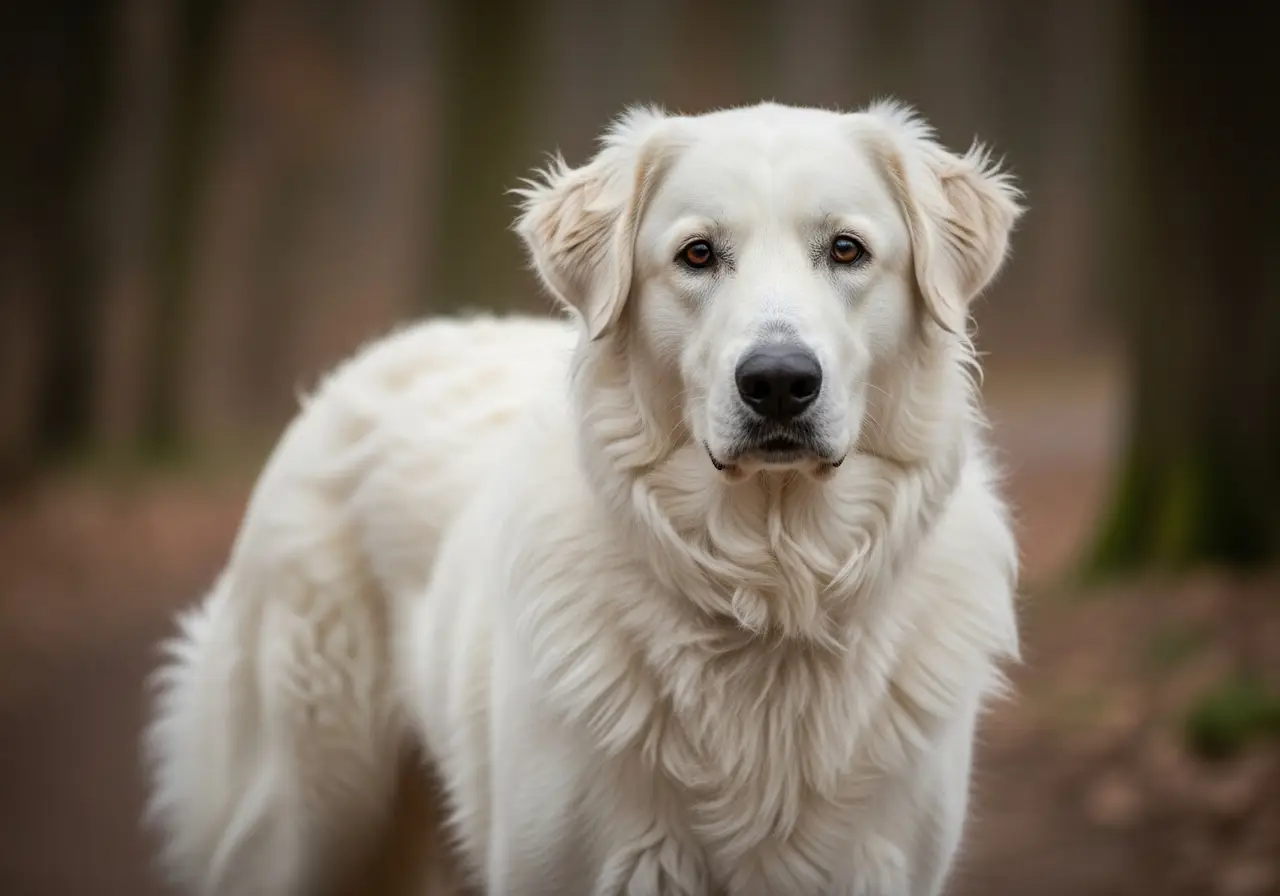
The Kuvasz is a large, white livestock guardian dog from Hungary with a centuries-old history as a watch and guard dog. It bonds closely with its family but makes decisions independently and shows pronounced reserve towards strangers. Its guarding instinct is genetically ingrained, not the result of training, but the starting point. Anyone keeping this dog needs experience, space and a clear leadership concept.
02Introduction
What makes the Kuvasz special
The Kuvasz is a large white Hungarian livestock guardian dog, FCI Group 1, former bodyguard of Hungarian kings, withers height 66–76 cm.
03Profile
Key facts and suitability
- Origin
- Ungarn
- Original purpose
- Livestock guarding and bodyguard of Hungarian kings
- FCI
- No. 54 · Group 1 · Sektion 1: Schäferhunde
- height at the withers
- 66–76 cm
- Weight
- 37–62 kg
- Life expectancy
- 10–12 Years
- Coat type
- Long-haired
- Minimum exercise
- 60 min/day
- Puppy price
- 1'000–2'000 CHF
- Waiting period
- 12 months
- Sports
- Schutzhund
04Temperament
How the Kuvasz shows up in everyday life
When a stranger enters the property, the Kuvasz does not react with welcoming enthusiasm, but by positioning itself attentively between the visitor and its family. It observes, assesses, and then makes its own decision. This is not a training error, but the result of centuries of targeted selection for independent guarding behaviour.
In everyday family life, a different picture emerges: The Kuvasz bonds closely with its key people, follows them around the house and seeks physical proximity. It is not an excited greeting dog; when you come home, you can expect a calm tail wag and an assessing look rather than exuberant jumping. This calmness is not disinterest, but dignity.
Here, the separation of the two behavioural axes becomes clear: Internally, the Kuvasz has a high need for social contact; it requires close integration into family life and cannot tolerate social isolation. Externally, however, it remains reserved to distrustful towards strangers (friendliness towards strangers: low). Anyone who confuses these two poles and assumes that a dog focused on its family is automatically open to every visitor fundamentally underestimates the breed.
With children who have grown up in the household and know the dog, the Kuvasz shows patience and readiness to protect. However, unfamiliar children running towards it unexpectedly are assessed differently. Clear rules and a structured introduction are not an option in such situations, but a must.
Towards other dogs, it behaves compatibly if socialised early, but shows territorial behaviour when it perceives its territory as threatened. The Kuvasz is not a dog for the dog park without preparation.
05Needs
What this breed needs daily
The Kuvasz needs 60 to 90 minutes of active exercise daily, divided into several sessions, not as a single marathon walk. More important than sporting intensity is the quality of the exercise: terrain that it can explore and assess suits its profile better than monotonous laps on asphalt.
A securely fenced property is not a comfort option, but a basic prerequisite. The Kuvasz defines its territory and defends it; without clear spatial boundaries, there is potential for conflict with neighbours, passers-by and other animals. The fence must be sturdy and high enough; a Kuvasz that sets its own territorial boundaries does not always do so where the owner expects.
It needs mental stimulation in the form of structure, not tricks. Nose work, controlled territory patrols and clear daily routines give it orientation. Classic obedience exercises from dog sports are possible, but reach their limits if the Kuvasz considers the task situationally pointless.
The need for social contact is high: The Kuvasz requires close integration into family life. Being left alone for up to five hours is possible if the territory is clearly defined and the dog has been sufficiently stimulated. Longer absences without a care concept are incompatible with this breed.
Early and broad socialisation (from the first week of life by the breeder, from moving in by the owner) is crucial. A Kuvasz that learns to know different people, environments and situations as a puppy develops a more differentiated ability to assess situations in adulthood. This investment in the first months of life pays off over its entire lifespan.
Exercise
Medium
mental work
Medium
Social needs
Medium
training
Experts
06Sport & Mental and Physical Stimulation
What sports the Kuvasz is suited for
Realistic in terms of physiology and genetics – not every breed suits every sport.
Structurally and physiologically suitable: CaniCross / bikejoring possible.
07Quick Check
08Suitability
Who this breed is suitable for – and who it isn't
✓Matches
The Kuvasz suits owners with proven experience in handling independent or guarding-motivated dog breeds. Anyone who has already handled a livestock guardian dog, a Molosser or a similarly independent breed brings the necessary foundation.
A rural or at least suburban living environment with its own, securely fenced property is a prerequisite. Keeping it in an apartment is out of the question, not just because of its size alone, but because of its territorial behaviour.
Suitable are owners who can offer 60 to 90 minutes of structured exercise daily and are willing to consistently integrate the dog into family life. Families with children are possible if the children grow up in the household and interaction with the dog is clearly regulated from the start. Children of school age, who understand and respect boundaries, cope better with the Kuvasz than toddlers.
Owners who rarely receive visitors or have a clearly manageable social circle benefit from the fact that the Kuvasz can then reliably categorise its territory and key people. Anyone who has the dog professionally accompanied from the start, for example by a dog training school specialising in guarding dogs, creates a significantly more stable starting situation.
×Doesn't match
The Kuvasz is unsuitable for first-time dog owners. Experience shows that anyone who does bring dog experience but has gathered it exclusively with socially open, people-friendly breeds underestimates the independence of a livestock guardian dog.
Anyone living in a rented apartment, a city flat or a terraced housing estate with close neighbour contact will come into conflict with the Kuvasz; its barking behaviour for marking territory and its reaction to strangers are difficult to manage in such environments.
Owners who are away from home for eight hours or longer during the day and have no care concept overwhelm this dog. Social isolation leads to behavioural problems in a breed with a high need for social contact.
Anyone who assumes that the Kuvasz’s calm demeanour means openness towards strangers confuses internal family orientation with external friendliness, a common misunderstanding that can lead to dangerous situations in practice. The Kuvasz is not a dog for owners who view guarding instinct as a bonus that can be switched off if needed.
10Line reality
Show line, working line, breeder market
The Kuvasz does not have a pronounced split into working and show lines, as exists for example in the German Shepherd Dog or the Labrador Retriever. The breed is too rare and breeding too limited for independent lines with distinctly different performance or appearance profiles to have developed.
Nevertheless, regional differences exist: Hungarian breeders working closely with the original livestock guardian dog type place value on working traits, guarding instinct, endurance, weather resistance, and independent action. Western European breeders orient themselves more towards the FCI breed standard for shows, without fundamentally altering the character traits.
In practice, this means: A Kuvasz from Hungarian breeding may be more pronounced in guarding instinct and independence than a dog from Western European show breeding. These differences are however gradual and not documented by formal line designations. A conversation with the breeder about the working traits of the parent dogs provides more insight than geographical origin alone.
For owners who wish to keep the Kuvasz purely as a companion dog, a dog from a breeding focused on a balanced temperament and broad socialisation is preferable. Those who wish to use the breed in its original guarding function, for example on a farm, should specifically seek out breeders who document and verify working traits.
11Health · Reality
What you need to plan for medically with your Kuvasz
The Kuvasz belongs to the large breeds for which hip dysplasia (HD) and elbow dysplasia (ED) are relevant health risks. Reliable breed-specific prevalence figures for the Kuvasz are only available to a limited extent due to the small population size. The Orthopedic Foundation for Animals (OFA) reports an HD rate of around 20% of the dogs tested in its database (as of 2023), with a small sample size that calls for caution in interpretation. Reputable breeders X-ray both parent dogs before mating and disclose the results.
According to the FCI breed standard and breeder information, life expectancy is 10 to 12 years. Large breeds age faster than small ones; orthopaedic problems often occur from the sixth year of life onwards.
Gastric torsion (bloat) is a serious risk in large, deep-chested breeds. Owners should know the warning signs: distended abdomen, unproductive retching, restlessness. Gastric torsion is a life-threatening emergency that requires immediate veterinary intervention.
Preventive examinations recommended for the Kuvasz include HD/ED X-rays of the parent dogs before breeding, annual weight checks (overweight places disproportionate stress on the joints), and dental checks (the scissor bite is fully dentate according to the FCI standard and should be checked regularly). Overweight is an underestimated risk in this breed; the Kuvasz is naturally muscular and initially appears compact even when overweight. Regular weight checks by the vet are therefore advisable.
12Structured data
Health by the numbers
Prone to diseases
Hip dysplasia, osteochondrosis, heart problems
Recommended health tests
Hip X-ray, cardiac examination
13Myths ↔ Reality
What is often said incorrectly about this breed
Five myths, five realities, five sources.
“The Kuvasz is a gentle family dog for every household due to its white coat and calm nature.
The Kuvasz’s calm demeanour conceals its genetically ingrained guarding behaviour. It actively defends its territory and family, even against visitors it cannot categorise. Without early, consistent socialisation and experienced guidance, this behaviour can become a serious challenge in everyday life. The FCI standard explicitly describes it as brave and fearless, with the willingness to risk its life for the people entrusted to it.
“As a livestock guardian dog, the Kuvasz is easy to train because it is people-oriented.
The Kuvasz has been selected over centuries to make independent decisions without consulting humans. It questions instructions that do not seem situationally sensible to it. This makes it demanding for owners with classic obedience expectations. It requires a primary caregiver who leads with confidence and consistency, not one who relies on blind obedience.
“Large dogs like the Kuvasz primarily need plenty of exercise; whoever provides that has done everything right.
Exercise alone is not enough for the Kuvasz. It requires a clearly structured environment with a defined territory and a primary caregiver who provides orientation. Without mental structure and clear rules, livestock guardian dogs develop undesirable behaviours such as uncontrolled barking, taking over boundary lines, or distrust of everyday situations.
“The Kuvasz is aggressive and dangerous.
The FCI standard describes the Kuvasz as self-confident and loyal, with a high threshold for irritation in its normal state. Aggressiveness usually arises from poor treatment, lack of socialisation, or keeping errors, not from the breed itself. A well-handled, early-socialised Kuvasz displays controlled guarding behaviour, not uncontrolled aggression.
“The white coat of the Kuvasz is high-maintenance and requires daily brushing.
The dense, wavy coat of the Kuvasz is designed for self-cleaning and does not require daily grooming effort under normal conditions. During moulting, which occurs twice a year, the effort increases significantly and regular brushing becomes necessary. However, the coat is no more prone to dirt than that of other large breeds with dense undercoats.
14animal welfare
The animal welfare perspective
Breeder market, designer versions, animal shelter reality — what no one writes in the puppy ad.
The Kuvasz regularly ends up in animal welfare organisations in Germany and Austria. The most common reasons for surrender are not aggression or illness, but being overwhelmed: owners who have underestimated the guarding instinct, neighbourhood conflicts due to barking behaviour, living spaces that are too small and a lack of experience with independently acting dogs. This is not the failure of individual people; it is the result of an information gap at the time of purchase.
The backyard breeder market for rare breeds works differently than for trend breeds. For the Kuvasz, there is no mass market via classifieds portals, but occasional offers appear without pedigree registration, without health testing of the parent dogs and without socialisation of the puppies. These dogs end up in animal welfare disproportionately often because behavioural problems resulting from inadequate early socialisation are difficult to correct later.
Designer versions of the Kuvasz hardly exist; the breed is too rare and not trendy enough to serve as a crossbreeding partner for hybrid dogs. This is an advantage: the Kuvasz has so far been spared from the worst excesses of the designer dog market.
Breeding-related problems are concentrated on HD/ED and the generally increased susceptibility to joint diseases in large breeds. Brachycephaly or other extreme morphological breeding characteristics are not an issue with the Kuvasz.
Adopting an adult Kuvasz from animal welfare is a fully valid alternative to buying a puppy for experienced owners. Adult dogs already show their character; guarding instinct, social behaviour and basic temperament can be assessed. Specialised breed-specific shelters and livestock guardian dog adoption agencies know the breed and can provide a well-founded assessment of the individual animal. Anyone who chooses this path not only saves a dog but also makes an informed decision.
15Costs · Transparency
What this breed realistically costs
A Kuvasz puppy from a reputable breeder affiliated with the VDH costs between 1,500 and 2,500 euros in Germany. Offers significantly below this should be scrutinised; missing health tests of the parent dogs and inadequate socialisation are frequent cost drivers that later result in vet and training costs.
The annual living costs for an adult Kuvasz range from 2,000 to 3,500 euros, depending on food quality, grooming effort and health status. High-quality dry food for a large breed costs between 80 and 150 euros per month. Grooming can cost an additional 100 to 200 euros per year with professional support during the coat change.
Average vet costs: routine check-ups, vaccinations and parasite prevention add up to 300–600 euros per year. HD/ED X-rays for an adolescent dog cost a one-off 200–400 euros. In the event of illness, such as gastric torsion (bloat) as an emergency, costs of 3,000–6,000 euros can arise.
Dog liability insurance is strongly recommended for the Kuvasz and compulsory in some federal states. Annual premiums are between 80 and 200 euros. Pet health insurance costs between 600 and 1,500 euros per year depending on the provider and scope of cover, and can be sensible for a rare breed with orthopaedic risks.
16Puppy search
What you need to consider when choosing a breeder
- Reputable Kuvasz breeders are members of an FCI-recognised breeding club and subject their breeding dogs to health testing, at least for hip dysplasia (HD) and elbow dysplasia (ED).
- Ask for the X-ray results of both parent dogs and have the results presented to you in writing.
- A breeder who cannot or will not produce these documents is not a reputable contact.
- The Kuvasz is a rare breed.
- Waiting times of a year or more are not uncommon with reputable breeders and are a sign that dogs are not produced on demand.
- Be wary of offers that are available at short notice and without a waiting list.
- Visit the litter in person.
- The mother should be present, accessible and stable in her behaviour.
- Puppies that grow up in isolation or without human contact often develop socialisation deficits that are difficult to make up for later.
- Adoption through animal welfare organisations is an equally valid option.
- Kuvasz regularly end up in animal welfare in Germany, often due to overwhelmed owners who have underestimated their territoriality and independence.
- An adult Kuvasz from a rescue comes with a known history and can be the better choice for experienced owners than a puppy.
- Breed-specific animal welfare associations and specialised adoption agencies are the first point of contact.
FAQ
Frequently asked questions about the Kuvasz
Is Kuvasz a family dog?
Kuvasz is considered suitable for families with good socialisation and species-appropriate care.
How much exercise does Kuvasz need?
At least around 60 minutes of exercise per day.
What is the size and weight of Kuvasz?
Fully grown, Kuvasz reaches about 66–76 cm at the withers and weighs around 37–62 kg.
What is the life expectancy of Kuvasz?
The life expectancy of Kuvasz is approximately 10–12 years.
Which diseases are common in Kuvasz?
Hip dysplasia, osteochondrosis, heart problems
17Breed clubs
Official breed clubs in DACH
19Related
Similar breeds – and their differences
You might also be interested in
Participate
Do you have a good photo of your Kuvasz?
We are looking for expressive images for our breed profiles. Submit yours; the editorial team reviews every submission before publication.
Does this breed suit you?
Hungarian national breed. Large white livestock guardian dog. Independent and territorial. Only for specialists.