
01Summary
In a paragraph
If you only have 30 seconds.
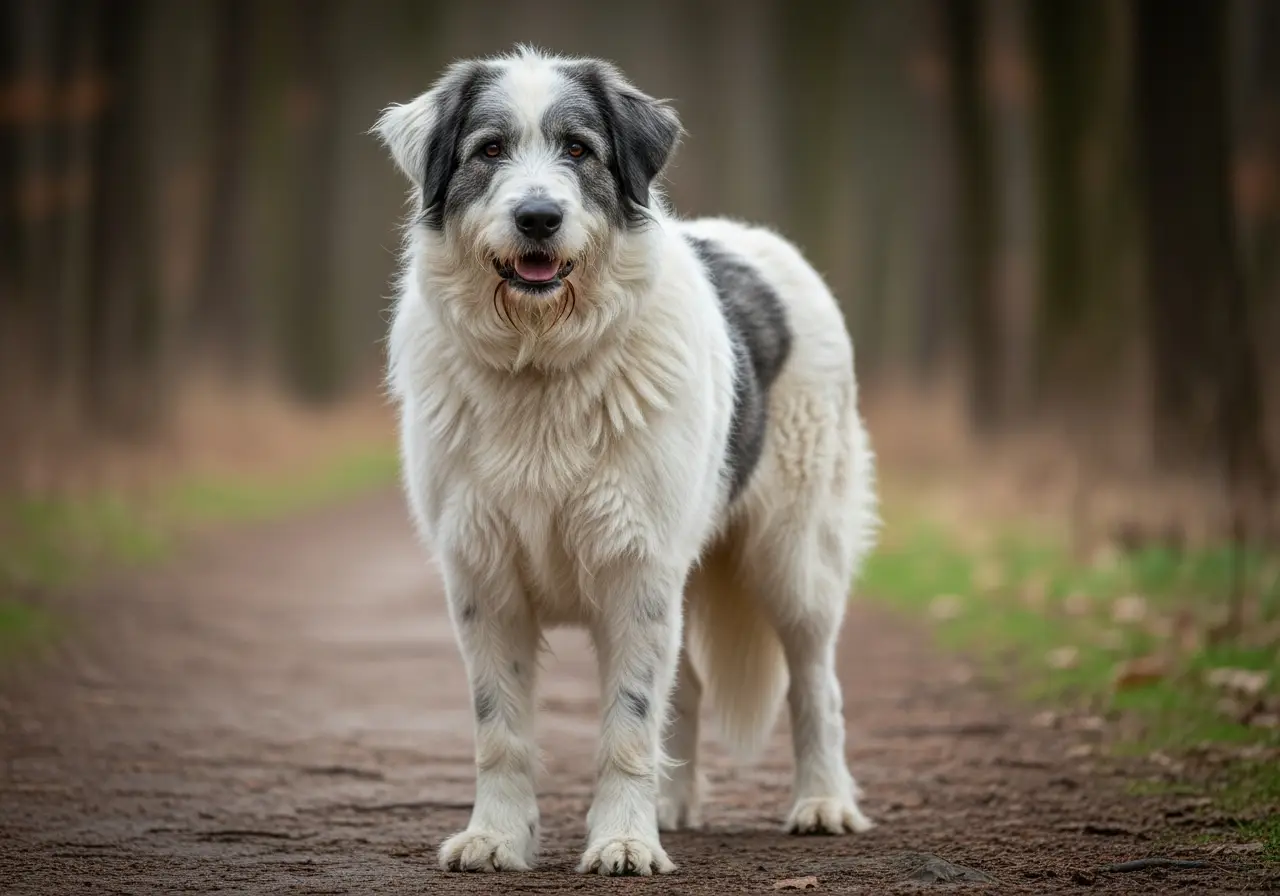
The Ciobănesc Românesc Mioritic is a large Romanian Carpathian livestock guardian dog with pronounced territorial and protective behaviour, long curly coat and calm, imposing presence. The breed was selected over centuries for independent decision-making and defence against predators. This genetic imprinting is omnipresent in everyday life and demands experience, space and consistent structures from owners.
02Introduction
What makes the Ciobănesc Românesc Mioritic special
The Ciobănesc Românesc Mioritic is a large Romanian Carpathian livestock guardian dog, FCI Group 1, with a white curly coat and a withers height of 65–75 cm.
03Profile
Key facts and suitability
- Origin
- Rumänien
- Original purpose
- Sheep herding and flock protection in the Carpathians
- FCI
- No. 349 · Group 1 · Sektion 1: Schäferhunde
- height at the withers
- 65–75 cm
- Weight
- 50–70 kg
- Life expectancy
- 12–14 Years
- Coat type
- Long-haired
- Minimum exercise
- 60 min/day
- Puppy price
- 800–1'500 CHF
- Waiting period
- 12 months
- Sports
- Schutzhund
04Temperament
How the Ciobănesc Românesc Mioritic shows up in everyday life
When you come home, no excited greeting ritual awaits you. The Mioritic registers your arrival, rises calmly, and resumes its place; it guarded its territory in your absence, and that was its task. This calmness is not disinterest but an expression of a deep, non-demonstrative bond.
Internally, the Mioritic needs a clearly defined territory that it recognises as its own. A securely fenced property is not a comfort solution but a basic prerequisite. Without this territory, it lacks the structural framework in which its behaviour remains orderly. Its need for social contact focuses on its own reference group; it forms deep bonds but remains independent in its assessment of situations.
Externally, it reacts to strangers with marked reserve. An unknown visitor entering the property triggers immediate attention. The Mioritic positions itself, observes and decides independently; this is genetically ingrained and not a training deficit. Visit situations require consistent management: announcement, controlled introduction, clear signals from the primary caregiver.
With other dogs, it displays confident, partly dominant behaviour. Encounters with unknown dogs in confined spaces demand attention and leadership. Within its own pack, which it knows and accepts, it behaves stably.
The Mioritic reacts sensitively to uncertainty. If the primary caregiver hesitates, communicates unclearly or relinquishes leadership in stressful situations, it takes over according to its own rules. Clear body language and calm consistency are not training tips, but daily demands on the owner.
05Needs
What this breed needs daily
The Mioritic requires approximately 60 to 90 minutes of controlled exercise daily. The distance covered is not the main focus, but rather the quality of the movement: structured walks with clear signals, terrain exploration in familiar surroundings, occasional nose work. Jogging as a primary form of exertion is insufficient; the Mioritic is not an endurance athlete.
A secure, fenced property is the most important physical prerequisite. The fence must be stable, high enough and gap-free, not because the dog flees, but because it actively defends its territory and encounters with passers-by or strangers become uncontrollable without a barrier. The size of the property is less decisive than the reliability of the fencing.
Mentally, the Mioritic does not require complex training tasks in the sense of obedience sports. It requires clarity: clear boundaries, clear routines, clear communication. Unstructured situations, frequently changing environments or inconsistent signals from the primary caregiver create uncertainty, and uncertainty intensifies its guarding behaviour.
Socialisation must begin early and be continued consistently. Puppies need controlled, positive encounters with various people, noises and situations, not to suppress the guarding instinct, but to give the dog a differentiated picture of its environment. A supporting dog training school with experience in livestock guardian dogs is recommended.
The Mioritic can be left alone for up to approximately five hours if it perceives its territory as secure. Longer absences without structure are problematic.
Exercise
Medium
mental work
Medium
Social needs
Medium
training
Experts
07Quick Check
08Suitability
Who this breed is suitable for – and who it isn't
✓Matches
The Mioritic suits owners with proven experience in handling livestock guardian dogs or similarly independent breeds. Anyone who has already owned a Kangal, Pyrenean Mountain Dog or Caucasian Ovcharka brings a realistic set of expectations.
A rural or at least quiet, suburban environment with its own, securely fenced property is a prerequisite. Households with a stable daily structure, little fluctuating visitor traffic and the willingness to consistently manage encounters with strangers provide the Mioritic with the framework in which it remains stable.
Families with older children from approximately ten years of age, who are trained in handling large dogs and can read the dog's body language, are suitable as owners, provided the adult primary caregivers clearly take on leadership.
Owners who are willing to invest in training long-term (not as a one-off course, but as a continuous process over years) and who find joy in a deep, non-demonstrative bond will find a reliable companion in this breed. Anyone who can dedicate at least two hours daily to exercise, care and structured interaction meets the basic time requirement.
×Doesn't match
The Mioritic is not a breed for first-time owners, even if motivation and willingness to learn are present. The independence and readiness to protect of this breed demand experience that does not come from books or online courses, but from lived daily life with similar dogs.
Urban households with apartment living, heavy public traffic, frequent visitors or regular encounters with strangers in confined spaces are structurally unsuitable. Anyone who is away from home for eight hours a day and does not have a reliable dog care plan cannot provide the Mioritic with the stability it needs.
Anyone looking for a dog that adapts quickly, reacts openly to strangers or interacts problem-free with unknown dogs in the dog park will be in permanent conflict with the Mioritic. The external reaction to strangers, whether people or dogs, is reserved to mistrustful and remains so, regardless of the training effort.
Households with young children and an unstructured daily routine, where children bring friends over and situations are difficult to control, should not choose this breed. Anyone who views the Mioritic as a calm companion dog without special requirements underestimates the responsibility that comes with its guarding behaviour.
10Line reality
Show line, working line, breeder market
The Ciobănesc Românesc Mioritic is still used in Romania as a working dog in sheep farming. This working population differs from the few breeding animals kept in Central Europe for show breeding in one essential aspect: socialisation.
A Mioritic from active flock keeping is conditioned to dealing with sheep, living outdoors, and minimal human contact outside the primary caregiver. These dogs bring a high degree of independence and willingness to guard, along with significantly lower tolerance for unfamiliar situations in household life.
Dogs from European show breeding are generally more strongly socialised towards human contact and show slightly greater adaptability in everyday life, without the breed’s basic character changing. Guarding instinct and territorial behaviour remain defining, regardless of the line.
A field trial or sport line does not exist for this breed. Anyone importing a Mioritic from Romania should actively ask about the dog’s origin—working operation or targeted household breeding—and critically assess the puppy’s socialisation. The difference in everyday life is considerable.
11Health · Reality
What you need to plan for medically with your Ciobănesc Românesc Mioritic
To date, there are no published breed-specific health studies with large case numbers for the Ciobănesc Românesc Mioritic; the rarity of the breed in Central Europe makes epidemiological surveys difficult. The available data come from breeding associations and veterinary experience with comparable large livestock guardian dogs.
Life expectancy is approximately 10 to 12 years, which corresponds to the average for large breeds. Hip dysplasia (HD) and elbow dysplasia (ED) are generally relevant in large breeds. Reputable breeders provide HD/ED X-ray results of the parent dogs; this is not an optional bonus with this breed but a minimum standard when choosing a breeder.
The dense, long coat requires regular checks for matting, skin irritation and parasite infestation, especially after time spent in the field and in damp weather. Untreated matting can lead to skin problems requiring veterinary treatment.
Overweight is a real risk with this breed if exercise and food quantity are not coordinated. A Mioritic that is overweight places disproportionate strain on joints and the cardiovascular system; regular weight checks at the vet, at least twice a year, are advisable.
Preventive examinations should take place annually and include joint, dental and heart status. In cases of lameness, reluctance to move or changes in coat condition, prompt veterinary assessment is necessary.
12Structured data
Health by the numbers
Prone to diseases
Hip dysplasia, generally robust
Recommended health tests
Hip X-ray
13Myths ↔ Reality
What is often said incorrectly about this breed
Five myths, five realities, five sources.
“The Mioritic is a calm family dog that integrates into any household without problems with good training.”
The Mioritic is indeed calm in temperament, but this calmness is not adaptability. The breed carries a genetically anchored guarding and territorial motivation that cannot be trained away. In households lacking clear structure, experience with livestock guardian dogs, and a suitable environment, this behaviour intensifies. The FCI standard explicitly describes it as suspicious of strangers.
“Large dogs need lots of exercise; the Mioritic must run for hours every day.”
The Mioritic is not an endurance athlete but a guardian. In daily flock life, it did not cover long distances but patrolled a defined territory. In household life, it needs about 60 to 90 minutes of controlled exercise daily. More decisive than distance is a clearly demarcated, secure territory. Excessive workload through running sports does not replace the mental structure this breed requires.
“The Mioritic likes children, so it is a good family dog for households with young children.”
The FCI standard states that the Mioritic likes children; this refers to children of its own family, whom it considers part of its pack. Stranger children, unknown visitors, or unstructured situations with many people can trigger its guarding behaviour. Households with young children and regular visitor traffic must actively manage this risk and require considerable experience to do so.
“A livestock guardian dog without a flock is pointless; the Mioritic is only suitable for shepherds.”
The Mioritic transfers its guarding instinct to what it defines as its territory and pack, which can be people, a property, or a family. A flock is not a prerequisite. What matters is that the environment is clearly structured, the territory is securely fenced, and the primary caregiver is experienced enough to channel the dog’s willingness to guard.
“The Mioritic’s long coat requires intensive care; this is the biggest effort with this breed.”
The coat requires regular checking and care, especially when wet and during moulting periods. However, this effort is not the biggest factor in keeping the dog. The significantly more demanding aspect is behaviour management: consistent socialisation, structured training over years, and managing encounters with strangers. Anyone who sees grooming effort as the main challenge underestimates the breed.
14animal welfare
The animal welfare perspective
Breeder market, designer versions, animal shelter reality — what no one writes in the puppy ad.
The Ciobănesc Românesc Mioritic rarely appears in Central European animal shelters and animal welfare systems; the breed is too rare to create a systematic rehoming problem. This does not mean, however, that there are no relevant animal welfare aspects.
The backyard breeder market for rare breeds functions differently than with trend breeds: anyone offering a Mioritic at a conspicuously low price and without waiting time is often working with imports from uncontrolled conditions. Puppies from Romanian working kennels without targeted socialisation end up in Central European households for which they were not prepared. The result is dogs with massive protective behaviour that are no longer manageable for their owners and, due to their size and character, are hardly rehoming-able.
A specific husbandry problem arises from misjudging the breed: anyone who buys a Mioritic as a calm, adaptable companion dog will be confronted with a dog that makes independent decisions, wards off strangers and requires a clearly defined territory. Dogs kept in urban apartments or without sufficient structure develop behavioural abnormalities, which are often misinterpreted as aggression.
Rehoming adult Mioritics via specialised livestock guardian dog organisations in Romania or South-East Europe is an equally valid alternative to buying a puppy. Adult dogs already show their character, which considerably reduces the risk of a wrong decision. Anyone interested in this option should choose organisations that list prior experience with livestock guardian dogs as a prerequisite for rehoming.
15Costs · Transparency
What this breed realistically costs
A puppy from a reputable breeder with VDH/ÖKV/SKG papers usually costs between 1,500 and 2,500 euros. Offers significantly below this often come from uncontrolled sources; follow-up costs due to lack of socialisation or health problems regularly exceed the savings.
Annual living costs for a breed of this size are typically between 2,000 and 3,500 euros. Food for an adult Mioritic (50–70 kg) amounts to approximately 80 to 150 euros per month, depending on food quality and type. Grooming (regular brushing, occasional professional trimming) incurs additional costs of approximately 200 to 400 euros annually.
Veterinary costs vary greatly: routine examinations and vaccinations cost approximately 200 to 400 euros annually. With orthopaedic problems (HD/ED), diagnosis and treatment can quickly reach 1,000 to 3,000 euros. Pet insurance or a health savings plan is advisable for large breeds with corresponding joint risk; premiums range from 60 to 120 euros monthly depending on provider and scope of cover.
16Puppy search
What you need to consider when choosing a breeder
- The Mioritic is extremely rare in Germany, Austria and Switzerland.
- Reputable breeders can be found via the VDH (Germany), the ÖKV (Austria) or the SKG (Switzerland).
- Waiting times of a year or more are not the exception with reputable breeders, but the norm.
- A reputable breeder allows visits to the litter, shows both parent animals or at least the mother, provides health certificates (HD/ED X-rays) and asks questions about the living situation.
- Anyone offering a puppy without a waiting period, without the possibility of inspection or at a suspiciously low price should be questioned critically.
- Imports from Romania are possible but require careful scrutiny: a EU pet passport, rabies vaccination, microchip and compliance with the entry regulations of the destination country are minimum requirements.
- The origin from Romanian working kennels does not indicate anything about the puppy’s socialisation; a livestock guardian dog from an active working background requires intensive socialisation for everyday household life.
- Rehoming via animal welfare organisations is an equally valid option.
- Adult dogs from rehoming often come with a known history, which allows for a realistic assessment of their character.
- Specialised livestock guardian dog rescue stations in South-East Europe occasionally rehome Mioritics.
FAQ
Frequently asked questions about the Ciobănesc Românesc Mioritic
Is Ciobănesc Românesc Mioritic a family dog?
Ciobănesc Românesc Mioritic is considered suitable for families with good socialisation and species-appropriate care.
How much exercise does Ciobănesc Românesc Mioritic need?
At least around 60 minutes of exercise per day.
What is the size and weight of Ciobănesc Românesc Mioritic?
Fully grown, Ciobănesc Românesc Mioritic reaches about 65–75 cm at the withers and weighs around 50–70 kg.
What is the life expectancy of Ciobănesc Românesc Mioritic?
The life expectancy of Ciobănesc Românesc Mioritic is approximately 12–14 years.
Which diseases are common in Ciobănesc Românesc Mioritic?
Hip dysplasia, generally robust
17Breed clubs
Official breed clubs in DACH
19Related
Similar breeds – and their differences
You might also be interested in


Participate
Do you have a good photo of your Ciobănesc Românesc Mioritic?
We are looking for expressive images for our breed profiles. Submit yours; the editorial team reviews every submission before publication.
Does this breed suit you?
Large Romanian livestock guardian dog. Territorial and independent. For experienced owners in a rural environment.