
01Summary
In a paragraph
If you only have 30 seconds.
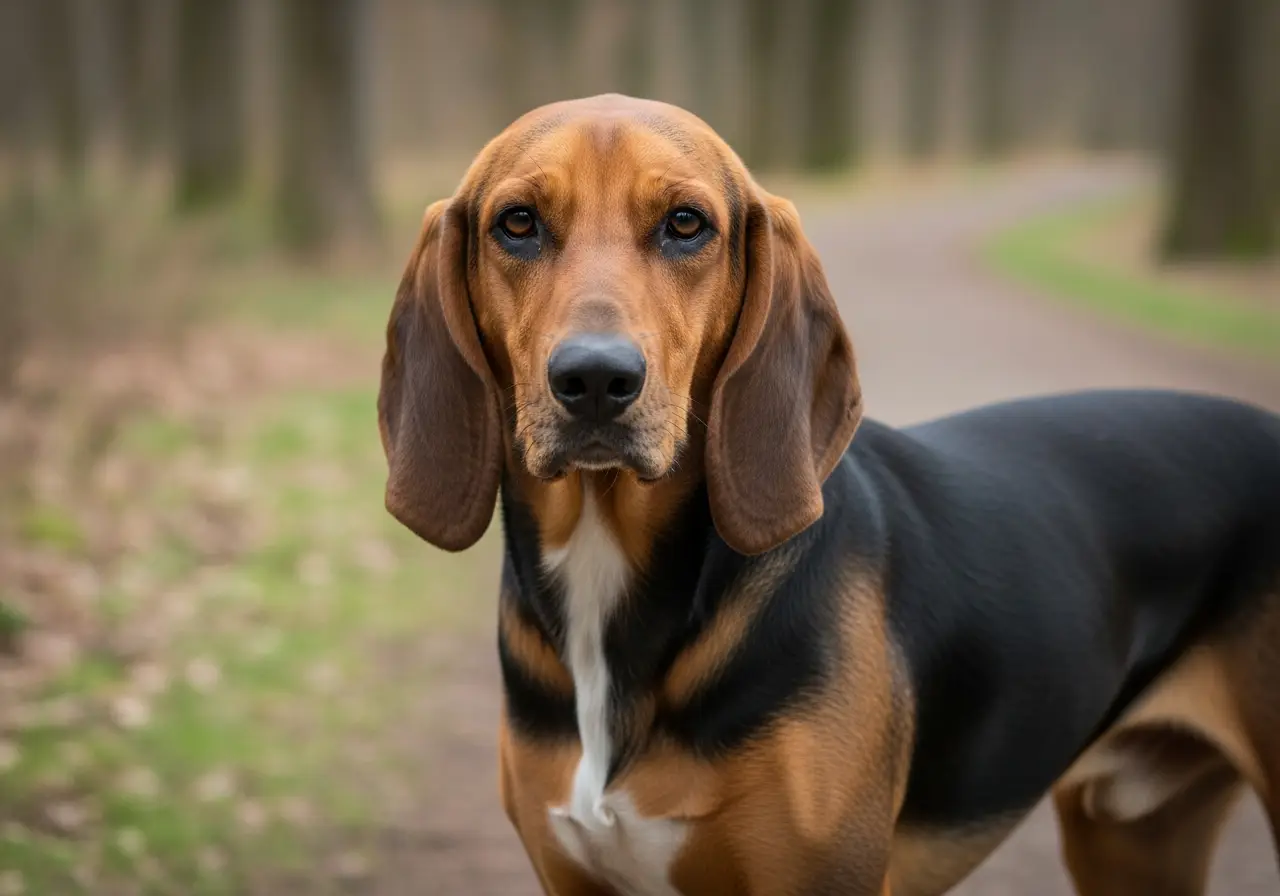
The Jura Laufhund is one of the four varieties of the Swiss Hound and counts among the rarest hunting dog breeds in the German-speaking region. Its tracking drive is genetically deeply rooted, and its vocalisation on the trail is clearly audible. Anyone integrating this dog into everyday life needs a hunting connection or a very consistent substitute programme at a high level, and a rural environment without compromises.
02Introduction
What makes the Jura Hound special
The Jura Hound is a Swiss scenthound, FCI Group 6, specialised in mountain hunting in the Jura, withers height 44–57 cm.
03Profile
Key facts and suitability
- Origin
- Schweiz
- Original purpose
- Hunting hare and fox in the Jura
- FCI
- No. 59 · Group 6 · Section 1.2
- height at the withers
- 47–59 cm
- Weight
- 15–22 kg
- Life expectancy
- 12–14 Years
- Coat type
- Short-haired
- Minimum exercise
- 90 min/day
- Puppy price
- 800–1'400 CHF
- Waiting period
- 9 months
- Sports
- Hunting · Tracking · Mantrailing
04Temperament
How the Jura Hound shows up in everyday life
In the morning, when the door to the garden opens, the Jura Laufhund already has its nose to the ground. Not out of restlessness, but by design. The nose works before the rest of the dog even appears awake. This is not behaviour that can be switched off; it is the core of this breed.
Inside the house, a different picture emerges. After a sufficiently long session with genuine nose work, the dog lies down and rests. This calmness is deceptive: it is the result of stimulation, not a baseline state. Anyone keeping this dog without sufficient enrichment will experience the other side: restlessness, baying in the apartment, signs of frustration.
Internally, the Jura Laufhund requires daily intensive exercise of at least two hours, supplemented by structured nose work. Its mental workload is high: mantrailing, tracking exercises, or hunting-related enrichment are not extras but basic care. It can be left alone for a maximum of four hours before stress signals appear.
Externally, it behaves neutrally to reservedly towards strangers; it is not a dog that joyfully greets every visitor. This reserve is not a flaw but typical of the breed. Towards conspecifics, it is generally tolerant, as selection occurred for pack hunting. It observes children calmly, provided its need for rest after stimulation is respected.
On a walk in wildlife-rich terrain, the picture changes abruptly: the dog pulls, the nose takes the lead, and baying begins. Anyone unfamiliar with this or unable to manage it loses control. This is not a matter of training; it is the working profile of this breed.
05Needs
What this breed needs daily
The Jura Laufhund requires at least 120 minutes of active movement daily, not just a walk, but movement with purpose. Tracking exercises, mantrailing, structured nose work, or hunting activities meet its mental needs. Monotonous walks on paved paths are insufficient.
Nose work is not an optional addition. The dog has been selected over generations for independent tracking. This drive requires an outlet; without it, frustration and stress behaviour arise. Mantrailing courses, tracking exercises based on SchH/VPG fundamentals, or hunting trials are suitable formats.
The Jura Laufhund tolerates being left alone for up to four hours if it has been sufficiently stimulated beforehand. Longer periods without enrichment and social contact lead to baying and restlessness. A second dog as a social partner can stabilise the situation but does not replace active stimulation by the owner.
A rural environment is almost a prerequisite. Off-leash freedom without secure fencing is unrealistic in wildlife-rich areas, as tracking drive overrides any recall once a fresh scent is picked up. A large, securely fenced property or access to secured terrain are not comfort factors but safety requirements.
The need for social contact is pronounced: the dog requires regular contact with conspecifics and close integration into family life. Isolation in a kennel without social interaction fundamentally contradicts its well-being.
Exercise
Very high
mental work
A lot
Social needs
Medium
training
Demanding
06Sport & Mental and Physical Stimulation
What sports the Jura Hound is suited for
Realistic in terms of physiology and genetics – not every breed suits every sport.
Structurally and physiologically suitable: Suitable for mantrailing, dummy work and tracking · CaniCross / bikejoring possible.
07Quick Check
08Suitability
Who this breed is suitable for – and who it isn't
✓Matches
The Jura Laufhund suits owners with a hunting background or proven experience handling high-drive scent hounds. Those who actively hunt or have access to hunting-related enrichment will find an enduring, motivated working partner in this breed.
It is also suitable for very active people who can provide at least two hours of structured movement with a nose work component daily, such as mantrailing, tracking exercises, or comparable sports. A rural residence with secure outdoor space is not an option but a basic requirement.
Families with older children from around ten years old, who respectfully leave the dog alone during its rest phases and are actively involved in its stimulation, may also be suitable, provided all adults in the household understand and share the breed’s requirements.
Owners already experienced with independently working dogs and who have realistic expectations regarding recall in wildlife-rich terrain are clearly at an advantage. Those who understand that management and safety measures remain necessary long-term make an informed decision.
×Doesn't match
The Jura Laufhund does not suit owners looking for a socially open, accessible dog. Its reserve towards strangers is typical of the breed; anyone who sees this as a problem chooses the wrong breed.
The breed is unsuitable for city dwellers without access to extensive, secured terrain. Keeping it in an apartment in an urban environment structurally fails to meet its movement and nose work needs.
Anyone who is away from home for more than four hours a day and does not have a reliable dog care plan will overwhelm this dog with isolation. Vocalisation and stress behaviour are the result; this is not a training issue but a problem of keeping.
First-time owners without prior experience with high-drive hunting dogs should not choose this breed. The Jura Laufhund requires a primary caregiver who can understand, manage and channel its tracking drive, not one who wants to train it out of the dog.
Anyone who wants to keep the dog as a jogging companion or purely as a leisure dog without hunting-related enrichment underestimates the requirements. Endurance on the trail is no substitute for mental stimulation through nose work.
10Line reality
Show line, working line, breeder market
The Jura Laufhund is bred exclusively as a working dog; there is no independent show line. The breeding goal focuses on hunting suitability: tracking ability, stamina, baying, and terrain adaptability are the main priorities.
Within the breed, there is no formal division into working and show lines, as is known with retrievers or German Shepherds. The small population size does not allow for such differentiation in breeding. All active breeders follow FCI Standard No. 60 and the guidelines of the Swiss Kynological Society (SKG).
Regionally, there are slight differences in type: heavier, more substantial dogs with pronounced Saint-Hubert influence on one side, and slimmer, more agile specimens on the other. These differences are not formal lines but reflect the small breeding base and varying breeding priorities of individual breeders.
Anyone looking for a Jura Laufhund will find almost exclusively dogs from hunting-oriented breeding programmes. This means that the working profile (tracking drive, independence, baying) is present in every litter and cannot be ignored.
11Health · Reality
What you need to plan for medically with your Jura Hound
The Jura Laufhund is considered a robust breed with a life expectancy of approximately 11 to 13 years. Reliable cross-breed studies with large sample sizes do not exist due to the small population size; statements are based on breeder observations and data from related Swiss Hounds.
Ear problems are structurally more common in drop-eared breeds: restricted air circulation in the ear canal promotes moisture and thus inflammation. Regular ear checks, at least weekly after water exposure, are a mandatory part of the care routine. Chronically recurring otitis externa should be investigated by a vet.
Hip and elbow dysplasia (HD/ED) are documented in medium-sized hunting dogs; no prevalence studies specific to the Jura Laufhund are available. Breeders who provide hip X-rays of the parent animals work according to current minimum standards. When buying a puppy, X-ray findings for both parents should be requested.
Overweight is an underestimated risk: the dog is designed for endurance work and requires an adjusted food quantity when exercise is reduced. Adiposity puts strain on joints and demonstrably shortens life expectancy; a study by the University of Liverpool (German et al., 2012, Journal of Veterinary Internal Medicine) showed that overweight dogs had a life expectancy reduced by up to 2.5 years.
Preventive examinations: annual vet check-up, ears after every field deployment, dental check from the fifth year of life, weight check every six months.
12Structured data
Health by the numbers
Prone to diseases
Hip dysplasia, ear problems
Recommended health tests
Hip X-ray
13Myths ↔ Reality
What is often said incorrectly about this breed
Five myths, five realities, five sources.
The Jura Hound is calm and balanced at home, making it suitable for less active owners too.
Calmness at home is not a sign of low exercise needs, but rather the expression of a dog that switches off after intense stimulation. Without sufficient exercise and nose work, the breed develops frustration and stress behaviour. The exercise requirement is at least 120 minutes daily, supplemented by scent-oriented enrichment.
Because the Jura Hound was selected for pack hunting, it gets along without problems with all dogs.
Selection for pack suitability means that the dog generally tolerates conspecifics, not that it interacts conflict-free with every dog. Social behaviour depends on socialisation, individual temperament and context. Encounters with unknown dogs require careful introduction as with any breed.
The strong prey drive can be completely suppressed through consistent training.
The desire to track of the Jura Hound is genetically anchored and cannot be eliminated through training. Impulse control and management can facilitate handling, but do not replace a safe environment. Off-leash running without security remains a realistic risk in areas rich in wildlife that owners must actively manage.
As a rare breed, the Jura Hound is particularly healthy and free from hereditary diseases.
Small population size can increase, not decrease, the risk of genetic bottlenecks. Small gene pools require particularly careful breeding planning. Ear problems and occasional joint diseases are documented in hounds. The seriousness of the breeder and health screenings remain decisive.
The Jura Hound is suitable as a jogging companion because it is so enduring.
Endurance on the trail is not synonymous with suitability as a running companion on paved paths. The dog needs nose work and scent-oriented movement, not monotonous distance runs. Jogging alone does not meet its mental needs and can lead to uncontrollable situations upon contact with wildlife.
14animal welfare
The animal welfare perspective
Breeder market, designer versions, animal shelter reality — what no one writes in the puppy ad.
The Jura Laufhund practically does not appear in animal welfare. The breed is so rare that shelters and placement organisations hardly care for any specimens. This sounds positive at first, but has a downside: anyone buying a Jura Laufhund does so almost exclusively through breeders, and the quality of these breeding operations varies considerably.
The backyard breeder market for rare hunting dog breeds works differently than for fashion dogs. Here, it is not the trend that attracts, but the rarity itself: anyone offering a Jura Laufhund finds buyers who have been searching for a long time and can compare little. This increases the risk of encountering breeders who neglect health screenings or give away puppies without sufficient socialisation.
Designer versions or hybrid trends do not exist for this breed. This is an advantage; the typical breed characteristics are preserved, and breeding errors such as exaggeration of physical traits are not an issue.
A real problem is keeping under hunting conditions: kennel keeping without sufficient social contact and enrichment fundamentally contradicts the dog’s well-being, even if it was historically widespread. Anyone who keeps a Jura Laufhund as a family dog bears responsibility for species-appropriate integration into everyday life; this means social contact, nose work and exercise, not kennel keeping with occasional hunting use.
Anyone open to hounds from animal welfare may occasionally find related hound types (Beagles, Harriers or other hound mixes) there with a similar requirements profile. These dogs require the same stimulation and the same level of experience as a purebred Jura Laufhund. The decision for a shelter dog is equivalent and deserves the same careful preparation.
15Costs · Transparency
What this breed realistically costs
A puppy from a reputable breeder with FCI papers usually costs between 1,200 and 1,800 EUR. Due to the rarity of the breed, prices outside this range are possible; significantly cheaper offers without papers indicate backyard breeding.
The annual living costs are approximately 1,500 to 2,500 EUR. High-quality food for an active medium-sized dog amounts to 600 to 900 EUR/year. Care (ear cleaning, nail trimming, occasional grooming) is inexpensive compared to more demanding breeds, around 100 to 200 EUR/year.
Average vet costs: basic care (vaccinations, parasite prevention, annual check-up) approximately 300 to 500 EUR/year. Unforeseen treatments (ear infections, lameness after hunting use) can cost 200 to 800 EUR per incident.
In Switzerland and Germany, dog liability insurance is recommended; in some cantons and federal states, it is mandatory. Annual premiums range from 60 to 150 EUR depending on the provider. Dog health insurance costs between 400 and 900 EUR/year depending on coverage and can be sensible for a breed with a small population size.
16Puppy search
What you need to consider when choosing a breeder
- The Jura Laufhund is one of the rarest dog breeds in the German-speaking region.
- Waiting times of a year or more are realistic.
- Anyone looking for a puppy immediately will hardly find any with reputable breeders.
- Reputable breeders are members of the Verein für Französische und Schweizer Laufhunde e.V.
- or an recognised SKG breeding club.
- They provide a pedigree, health checks of the parent animals and insight into the rearing conditions.
- A visit on site is standard; no reputable breeder sells puppies without getting to know each other personally.
- Warning signs: puppies without a pedigree, several litters available at the same time, no interest in the buyer’s living situation, shipping without a visit.
- These characteristics indicate backyard breeding.
- Placement via animal welfare organisations is a theoretical option for this breed; in practice, Jura Laufhunde rarely appear in shelters.
- Anyone open to hounds from animal welfare may occasionally find related hound types there that come with similar requirements.
- Breed-transcending hound placements are a sensible point of contact.
FAQ
Frequently asked questions about the Jura Hound
Is Jura Hound a family dog?
Jura Hound is considered suitable for families with good socialisation and species-appropriate care.
How much exercise does Jura Hound need?
At least around 90 minutes of exercise per day. As an active breed, more so — plus mental stimulation.
What is the size and weight of Jura Hound?
Fully grown, Jura Hound reaches about 47–59 cm at the withers and weighs around 15–22 kg.
What is the life expectancy of Jura Hound?
The life expectancy of Jura Hound is approximately 12–14 years.
Which diseases are common in Jura Hound?
Hip dysplasia, ear problems
17Breed clubs
Official breed clubs in DACH
19Related
Similar breeds – and their differences
You might also be interested in
Participate
Do you have a good photo of your Jura Hound?
We are looking for expressive images for our breed profiles. Submit yours; the editorial team reviews every submission before publication.
Does this breed suit you?
Swiss scenthound from the Jura. Kept almost exclusively for hunting. Rarely kept as a pure companion dog.