
01Summary
In a paragraph
If you only have 30 seconds.
The German Shepherd is not a companion dog with utility dog looks — it is a working animal that demands structure, daily mental and physical stimulation and a confident key person. Those who provide this receive a highly trainable, loyal partner. Those who do not receive a dog that seeks its own enrichment — rarely to the delight of all parties involved.
02Introduction
What makes the German Shepherd Dog special
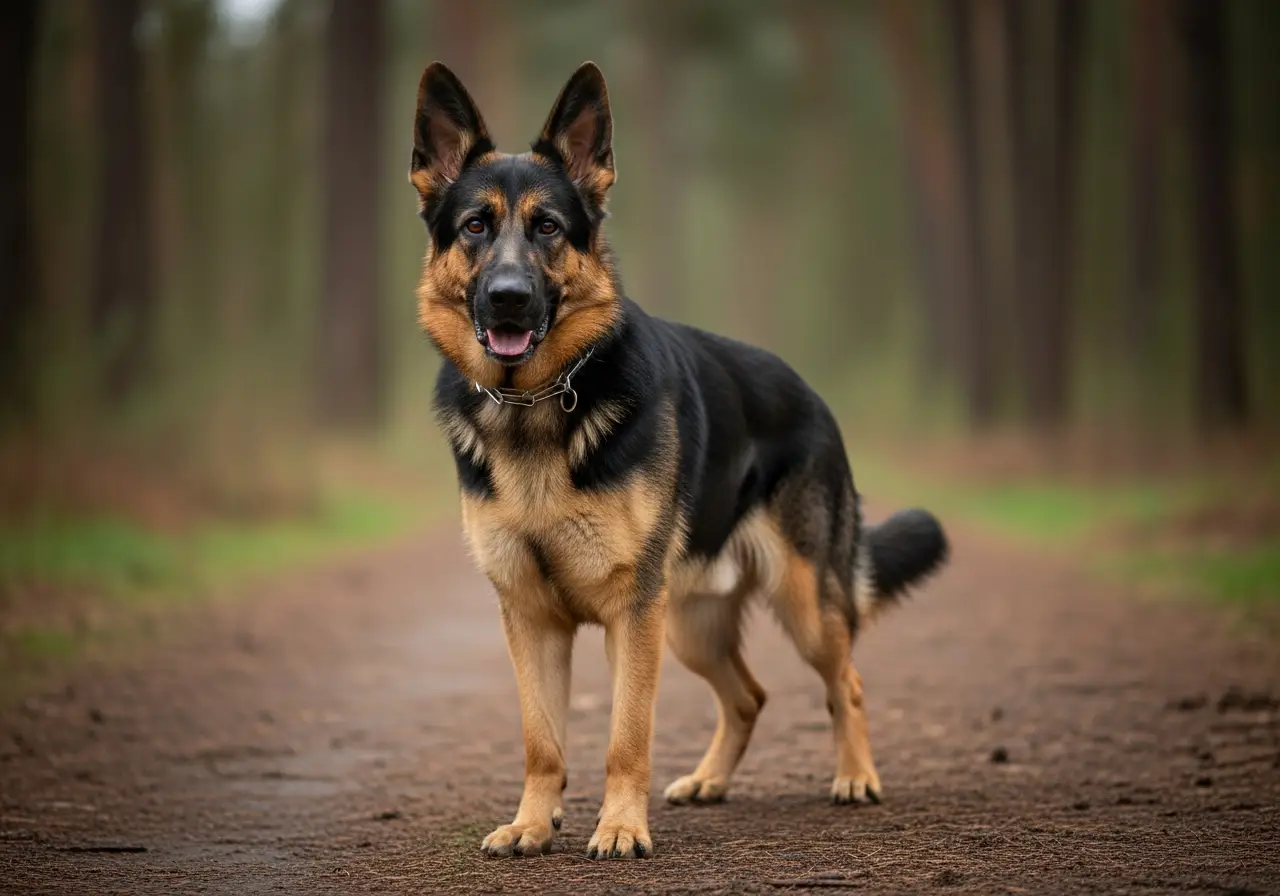
The German Shepherd Dog is the world's most famous working breed, FCI Group 1, versatile and loyal, with a withers height of 55–65 cm.
03Profile
Key facts and suitability
- Origin
- Deutschland
- Original purpose
- sheep herding, police and military dog
- FCI
- No. 166 · Group 1 · Sektion 1: Schäferhunde
- height at the withers
- 55–65 cm
- Weight
- 22–40 kg
- Life expectancy
- 9–13 Years
- Coat type
- Doppel
- Minimum exercise
- 120 min/day
- Puppy price
- 1'200–2'500 CHF
- Waiting period
- 9 months
- Sports
- Schutzhund · Agility · Scent work · Obedience · Search and rescue dog
04Temperament
How the German Shepherd Dog shows up in everyday life
When you come home, you are not met by a dog lying apathetically on the sofa. The German Shepherd registers your arrival, assesses your mood and immediately orients itself towards you. This close bond is no coincidence — it is genetically anchored. The dog was bred for biddability, not independence.
In everyday life, this means: It follows you through the apartment, watches you while you work and alerts you if something unusual happens. Strangers at the door are perceived and reported — not necessarily with aggression, but with attention and distance. This guarding instinct is typical of the breed and not a training error. It can be shaped, but not trained away.
Here, the separation of the two axes becomes clear: The internal need for social contact is high — the dog needs closeness, shared tasks and interaction with the reference person. The external reaction to strangers, however, is reserved to watchful. A dog with a high need for social contact is not automatically open to every person. Those who confuse this will experience surprises on the first visit.
On the walk, it shows interest in its surroundings, reacts to movement stimuli and needs clear signals when led on a lead. Without training, it pulls; without structure, it escalates. With consistent work, it develops into a reliable companion that can be safely handled even in busy environments.
Towards conspecifics, it is tolerant with early and broad socialisation. Without this foundation, the pronounced guarding instinct can lead to conflicts, especially towards unknown dogs.
05Needs
What this breed needs daily
The German Shepherd requires at least 120 minutes of active exercise daily — not as free roaming in the garden, but as guided, structured activity with the reference person. Walks alone are not enough. The dog needs tasks that challenge both mind and body simultaneously.
Mental stimulation is not an option, but a basic requirement. Nose work, tracking, obedience, protection work or agility cover the need for mental work. Those who do not participate in dog sports should at least plan daily training sessions of 15–20 minutes. An under-stimulated German Shepherd develops behavioural problems — barking, destruction, displacement activities — with high reliability.
The need for social contact is at a high level. The dog needs several hours of genuine contact with the reference person daily. Being left alone can be trained, but should be built up gradually and not permanently exceed four hours daily. Dogs that are regularly left alone for longer periods often show stress symptoms.
For keeping, a household with a garden or direct access to green spaces is recommended. A city apartment is possible if the need for exercise is consistently met through daily outings. The dog does not need luxury, but space, structure and reliability.
A visit to a supportive dog training school is not a recommendation for first-time owners of this breed, but a serious necessity. The combination of high intelligence, drive intensity and sensitivity demands a reference person who masters body language, timing and consistency.
Exercise
High
mental work
A lot
Social needs
High
training
Medium
06Sport & Mental and Physical Stimulation
What sports the German Shepherd Dog is suited for
Realistic in terms of physiology and genetics – not every breed suits every sport.
Structurally and physiologically suitable: Suitable for herding work, treibball and coursing · CaniCross / bikejoring possible.
07Quick Check
08Suitability
Who this breed is suitable for – and who it isn't
✓Matches
The German Shepherd suits owners with prior experience with high-drive or working-dog-related breeds, who can plan at least two hours of active enrichment daily. Those who participate in dog sports — protection work, IPO/IGP, tracking, rescue dog work, agility — will find a high-performance partner in this breed.
Families with children from around eight years of age are suitable, provided that clear rules apply, the children are involved in the training routine and sufficient supervision is present. In this context, the dog requires an adult key person who takes on the leadership role.
Owners who spend a lot of time at home professionally or privately and can offer the dog a structured daily routine benefit from its willingness to form close bonds. A household with a garden or direct access to exercise areas significantly facilitates keeping the dog.
Those who are willing to invest in an accompanying dog training school and understand the dog as a working partner — not as decoration or a status symbol — receive a loyal, highly trainable companion with long-term readiness for activity.
×Doesn't match
The German Shepherd is not suitable for owners who are away from home for more than four hours daily and do not have a reliable dog care plan. Anyone looking primarily for a calm apartment companion will be structurally overwhelmed by this breed.
Households without prior experience with high-drive dogs should carefully consider starting with this breed. The combination of a strong guarding instinct, sensitivity to leadership uncertainty and intense need for mental and physical stimulation demands experience — not just good intentions.
Anyone who confuses the dog’s high need for social contact with openness towards strangers will encounter problems: The dog bonds closely with its key person but reacts to unknown people with reserve or vigilance. Those who frequently receive visitors and expect an uncomplicated interaction with strangers must actively train this aspect — it does not happen by itself.
Owners who are physically limited and cannot maintain an intensive exercise routine should also consider another breed. The need for exercise is non-negotiable — it is part of the genetic profile of this breed.
10Line reality
Show line, working line, breeder market
The German Shepherd exists today in two clearly distinguishable breeding lines that differ considerably in temperament, physique and health profile.
The working line — also called the performance line — is based on Stephanitz’s original breeding goal: biddability, resilience, drive intensity. Dogs from working lines show pronounced drive intensity, high willingness to learn and strong work motivation. They are used in police, military, rescue services and dog sports. For private keeping without sporting involvement, they are demanding to overwhelming.
The show line — also the breeding line for exhibitions — was selected more strongly for physique, gait and appearance. The characteristic swinging trot and pronounced angulation of the hindquarters are typical features. Critics complain that the steeply sloping croup of some show lines can lead to strain injuries to the spine and hindquarters. The SV has initiated counter-corrections in its breeding programme in recent years.
For prospective owners, this means: The question of which line is not a minor detail. A dog from a high-performance working line in a purely family household without sport is a structural misplacement. A dog from a show line with an over-typed croup carries an increased health risk. Both aspects should be actively researched before purchase.
11Health · Reality
What you need to plan for medically with your German Shepherd Dog
The German Shepherd has a breed-specific health profile that should be known before purchase. According to data from the Verein für Deutsche Schäferhunde (SV), life expectancy averages between 9 and 13 years, with dogs from working lines tending to live longer than heavily typified show line animals.
Hip dysplasia (HD) and elbow dysplasia (ED) are among the most common orthopaedic conditions in the breed. According to evaluations of the SV stud book, between 15 and 25 % of examined dogs show HD findings depending on breeding line and year of birth (Source: SV Stud Book, status 2022). Reputable breeders provide HD/ED X-ray reports for both parent animals — this is minimum standard, not a bonus.
Degenerative Myelopathy (DM) is a progressive neurological disease that is genetically detectable in German Shepherds. A DNA test for the SODM1 gene enables risk assessment. Affected dogs show increasing hind limb weakness from their seventh year of life. No cure exists; the course is progressive.
Gastric dilatation-volvulus (bloat) occurs at an elevated rate in large, deep-chested breeds. Preventively, feeding in several small meals and rest periods after eating are recommended.
Preventive examinations that a responsible owner should plan for: annual hip and elbow checks with the vet, DM genetic test for the puppy, regular weight monitoring (overweight significantly increases joint stress) and dental care from the first year of life.
12Structured data
Health by the numbers
Prone to diseases
Degenerative myelopathy (DM), hip and elbow dysplasia, gastric torsion, pannus (eyes), heart problems
Recommended health tests
hip and elbow X-rays, DNA test for DM, eye examination
13Myths ↔ Reality
What is often said incorrectly about this breed
Five myths, five realities, five sources.
„The German Shepherd Dog is naturally aggressive.
The FCI standard explicitly describes the ideal temperament as balanced, nerve-strong, self-confident, and good-natured outside of a stimulus situation. Aggressive behaviour is considered a temperament fault. Problematic behaviour usually arises from lack of socialisation, insufficient mental and physical stimulation, or inconsistent guidance — not from breed-typical predisposition.
„All German Shepherd Dogs are the same — line plays no role.
Working lines and show lines differ considerably in temperament, drive intensity, and body structure. Working lines show significantly higher drive intensity and endurance, while show lines have been more strongly selected for gait and body structure. Anyone keeping a dog from a high-performance working line as a pure family dog systematically underestimates the need for mental and physical stimulation.
„The sloping croup in show lines is a quality feature.
The strongly sloping croup, which is pronounced in some show lines, is not stated as a breeding goal in the FCI standard and is critically assessed by vets and breeding associations. It can lead to incorrect loading of the spine and hindquarters. The SV has made corrections to the breeding programme in recent years to counteract over-typing.
„A German Shepherd Dog in the garden does not need additional exercise.
A garden does not replace structured exercise and mental stimulation. The German Shepherd requires at least 120 minutes of active enrichment with the reference person daily — free roaming in the garden covers neither the need for physical activity nor that for mental work. Dogs left to their own devices often develop stereotypies or behavioural problems.
“The German Shepherd is a beginner’s dog because it is so well-known.
Fame and suitability for beginners are two different things. The German Shepherd reacts sensitively to uncertainty, inconsistent handling and lack of structure. Without experience with high-drive working dogs, leadership problems arise that quickly manifest as behavioural disorders. It is among the most common reasons for surrender in animal welfare organisations in Germany, Austria and Switzerland.
14animal welfare
The animal welfare perspective
Breeder market, designer versions, animal shelter reality — what no one writes in the puppy ad.
In Switzerland, the German Shepherd is among the breeds with the highest intake in animal shelters and animal welfare organisations. The main reasons for surrender are documented: underestimated working readiness, lack of consistency in leadership and overwhelm for owners without prior experience. This is no coincidence — it is the direct result of a breed that belongs to the most widely bred worldwide and whose demands are often underestimated at the time of purchase.
The backyard breeder market is particularly active for this breed. Puppies without stud books, without HD/ED certificates for the parent animals and without socialisation are offered on classifieds platforms at prices between 300 and 800 euros. The price difference to reputable breeders — 1,500 to 2,500 euros — leads to the false conclusion that the cheaper puppy is the same. It is not: missing health tests, inadequate early socialisation and unknown lineage significantly increase the risk of behavioural and health problems.
Designer variants such as the "White Swiss Shepherd" or crosses with other breeds are occasionally marketed under the shepherd dog label. These animals are distinct breeds or mixed-breed dogs — neither better nor worse, but different. Anyone looking for a German Shepherd should insist on FCI papers and registration in the SV studbook.
Adoption through animal welfare organisations is an equally valid option. Many of the surrendered dogs are young, basic socialised, and do not fail due to themselves, but rather because their living situation does not match their profile. Those who bring experience and are willing to support a dog with a past history will regularly find suitable animals in animal welfare organisations. A trial period and an honest assessment by the adoption organisation are standard practice — no disadvantage.
15Costs · Transparency
What this breed realistically costs
The acquisition costs for a German Shepherd from reputable breeding range between 1,500 and 2,500 euros in Germany and Austria, and between 1,800 and 3,000 CHF in Switzerland. Puppies without studbook registration or health certificates are offered at lower prices — the subsequent costs due to health problems significantly exceed the savings in many cases.
The annual keeping costs consist of food (approx. 600–1,000 euros/year for high-quality nutrition for an adult dog), basic equipment, care and accessories (approx. 200–400 euros/year) as well as dog tax (depending on the municipality 50–200 euros/year).
Basic veterinary care — vaccinations, parasite prophylaxis, annual preventive care — costs an average of 300–500 euros per year. For breed-typical diseases such as HD or DM, diagnosis and treatment can quickly reach 2,000–5,000 euros and more. Pet insurance for this breed costs between 50 and 120 euros per month depending on the provider and scope of benefits, and should be seriously considered given the health profile.
Dog sports, dog training school and training are not optional expenses for this breed — they are part of basic care. Course fees range from 150–400 euros per course.
16Puppy search
What you need to consider when choosing a breeder
- A reputable breeder provides hip dysplasia (HD) and elbow dysplasia (ED) X-ray reports for both parent animals before sale, proves lineage through the SV stud book and allows a visit to the litter before handover.
- The puppy leaves the breeder no earlier than at eight weeks of age, vaccinated, dewormed and microchipped.
- Warning signs: no stud book, no health certificates for the parents, handover before eight weeks, sale via intermediaries, no personal contact with the breeder, multiple litters available simultaneously.
- Adoption through animal welfare organisations is a fully valid alternative.
- Many German Shepherds in animal welfare are young and fail due to their living situation, not their temperament.
- Organisations such as the German Animal Welfare Federation or regional Shepherd rescue associations facilitate adoption with prior experience checks and aftercare.
- rundum.dog generally does not provide specific breeder recommendations.
- Points of contact for finding breeders are the Verein für Deutsche Schäferhunde (SV) at schaeferhunde.de and the Schweizerische Schäferhund-Club (SC) at schaeferhund.ch.
FAQ
Frequently asked questions about the German Shepherd Dog
Is German Shepherd Dog a family dog?
German Shepherd Dog is considered suitable for families with good socialisation and species-appropriate care.
How much exercise does German Shepherd Dog need?
At least around 120 minutes of exercise per day. As an active breed, more so — plus mental stimulation.
What is the size and weight of German Shepherd Dog?
Fully grown, German Shepherd Dog reaches about 55–65 cm at the withers and weighs around 22–40 kg.
What is the life expectancy of German Shepherd Dog?
The life expectancy of German Shepherd Dog is approximately 9–13 years.
Which diseases are common in German Shepherd Dog?
Degenerative myelopathy (DM), hip and elbow dysplasia, gastric torsion, pannus (eyes), heart problems
17Breed clubs
Official breed clubs in DACH
19Related
Similar breeds – and their differences
You might also be interested in
Participate
Do you have a good photo of your German Shepherd Dog?
We are looking for expressive images for our breed profiles. Submit yours; the editorial team reviews every submission before publication.
Does this breed suit you?
Most popular breed in Germany. Versatile, loyal and keen to work. Health status varies significantly by breeding line – show lines vs working lines.