
01Summary
In a paragraph
If you only have 30 seconds.
The Beauceron is a large, athletic working dog from France that has been selected over centuries for independent herding and protection work. This origin shapes it to this day: a dog with high willingness to work, pronounced guarding instinct and a depth of bonding that requires consistency. Anyone who underestimates it receives a dog that sets its own rules.
02Introduction
What makes the Beauceron special
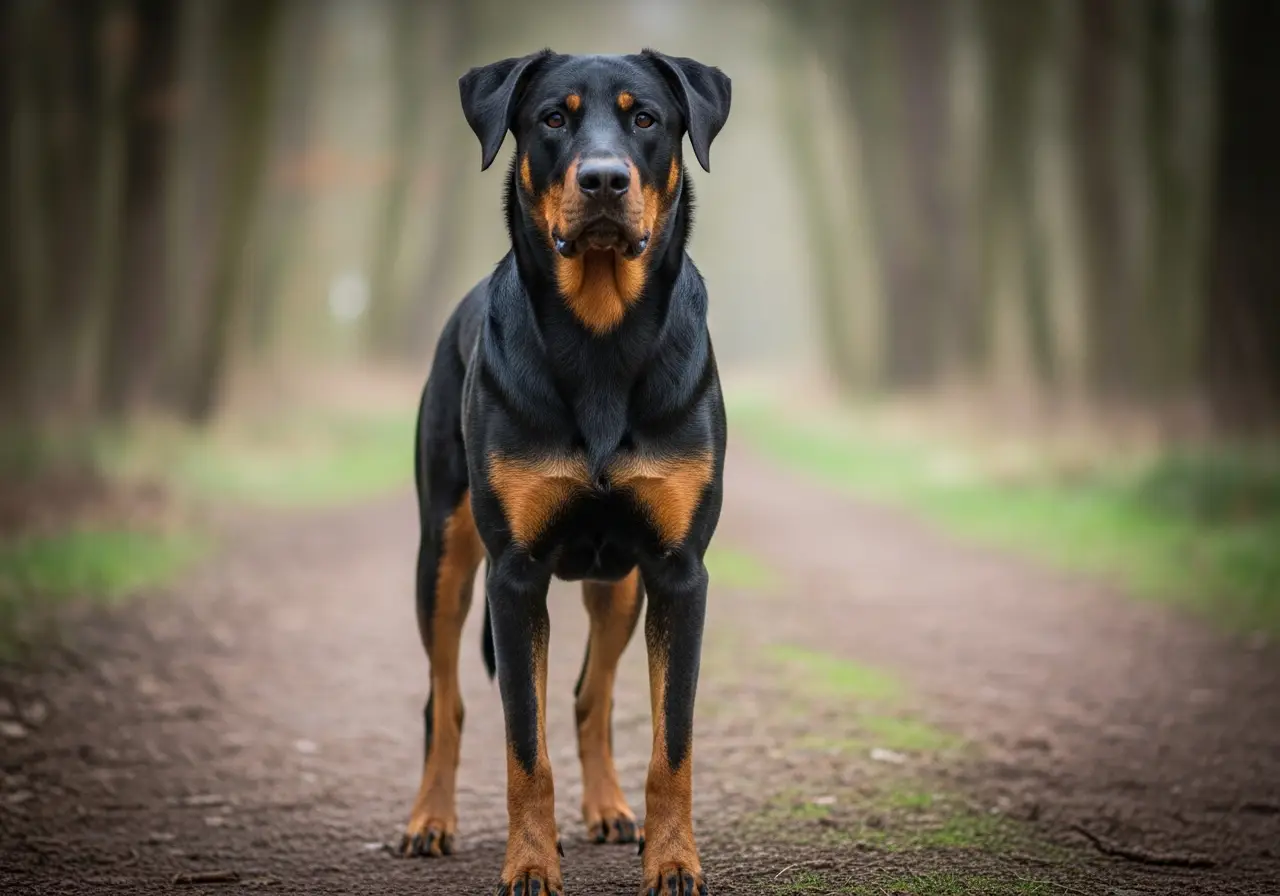
The Beauceron is a large French herding dog, FCI Group 1, known for double dewclaws and powerful appearance, withers height 61–70 cm.
03Profile
Key facts and suitability
- Origin
- Frankreich
- Original purpose
- Herding sheep and cattle, guard dog
- FCI
- No. 44 · Group 1 · Sektion 1: Hütehund und Treibhund, mit Arbeitsprüfung
- height at the withers
- 61–70 cm
- Weight
- 30–50 kg
- Life expectancy
- 10–13 Years
- Coat type
- Short-haired
- Minimum exercise
- 120 min/day
- Puppy price
- 1'200–2'500 CHF
- Waiting period
- 9 months
- Sports
- Schutzhund · Agility · Scent work · Obedience · Herding work
04Temperament
How the Beauceron shows up in everyday life
When you come home, the Beauceron does not greet you with frantic jumping; it first observes, registers who is with you, and only relaxes once it has assessed the situation. This behaviour is not mistrust towards you, but its guarding instinct in action.
Here, the two behavioural axes diverge significantly: internally, the Beauceron bonds closely with its primary caregiver, seeks closeness and cooperation, and its need for social contact within the core family is high. Externally, towards strangers, it shows a friendliness of 2 on a scale up to 5. This means: visitors are tolerated, not greeted. A Beauceron that runs joyfully towards a stranger is the exception, not the rule. Anyone who confuses these two poles and expects a „cuddly-open" dog will be disappointed.
In daily life with the family, it shows attentiveness and cooperation when guidance is clear. On a walk in unfamiliar terrain, it actively scans the surroundings, reacts to movements at the edge of its field of vision and instinctively positions itself between the primary caregiver and potential threat. This behaviour can be directed, but not trained away.
With conspecifics it has known since puppyhood, it shows tolerance. Towards unknown dogs, especially those of the same sex, it can appear dominant. Off-leash walking in uncontrolled situations therefore requires assessment skills from the owner.
Mental under-stimulation in the Beauceron does not manifest as apathy, but as control behaviour: it begins to manage situations itself, test boundaries or become destructive. A stimulated Beauceron is a calm Beauceron; this connection is direct and reliable.
05Needs
What this breed needs daily
The Beauceron requires at least 90 to 120 minutes of active exercise daily, not as a leisurely walk, but as structured activity with a task. Free running on secure terrain, scent work, protection sports (IPO/IGP), Mantrailing or demanding obedience training correspond to its profile.
Mental work is not an optional addition. The Beauceron was selected for independent decision-making during herding work; its brain demands tasks requiring genuine concentration daily. Nose work, search games, structured training sessions or working dog sports cover this need. Anyone relying exclusively on physical stimulation will experience a dog that occupies its mind in other ways.
Being left alone is possible if it is built up early and gradually. Four hours are a realistic maximum for a well-conditioned Beauceron; beyond this, the risk of stress behaviour increases. A dog that is alone for eight hours daily is structurally overwhelmed by this breed.
The Beauceron requires a primary caregiver with stable body language and clear communication. It tests insecurity, not out of malice, but because it made its own decisions in its original role and demands leadership if it is not offered. Consistency here means: predictable behaviour from the owner, not strictness.
A securely fenced property significantly eases keeping the dog, but is not a basic prerequisite. The decisive factor is the daily enrichment offer; this can also be realised without a garden, but then requires more planning effort and mobility.
Exercise
Very high
mental work
A lot
Social needs
High
training
Demanding
06Sport & Mental and Physical Stimulation
What sports the Beauceron is suited for
Realistic in terms of physiology and genetics – not every breed suits every sport.
Structurally and physiologically suitable: Suitable for herding work, treibball and coursing · CaniCross / bikejoring possible.
07Quick Check
08Suitability
Who this breed is suitable for – and who it isn't
✓Matches
The Beauceron suits owners with proven experience in handling working dogs or large, self-confident breeds. Anyone who has already handled a dog with a guarding instinct and knows what consistency without harshness feels like brings the right starting position.
Concrete profiles that work: Active individuals or couples who can plan two hours daily for structured enrichment and have an interest in dog sports, scent work or Mantrailing. Families with children from about ten years old, in which all household members handle the dog consistently and uniformly. Owners with access to a securely fenced area, not as a substitute for enrichment, but as an easing of everyday life.
Anyone who is professionally flexible and rarely leaves the dog alone for longer than four hours creates a basis for keeping that corresponds to the Beauceron. Experience with a dog club or a working dog school is a clear advantage, not because the Beauceron would be difficult to learn, but because structured training specifically promotes its willingness to bond and cooperate.
×Doesn't match
The Beauceron is unsuitable for owners keeping a dog for the first time, regardless of how motivated they are. The combination of guarding instinct, initiative and body size demands experience that cannot be replaced by books or YouTube videos.
Anyone who confuses the high need for social contact of the Beauceron with openness towards strangers will encounter problems in everyday life: A Beauceron that is closely bonded to its family does not mean that it welcomes visitors warmly. Anyone who frequently has guests and expects an uncomplicated interaction with strangers should review this expectation.
Households in which the dog is alone for more than four hours daily do not provide a suitable basis for keeping. Equally unsuitable: owners who consider physical stimulation sufficient and classify mental enrichment as optional. Anyone who brings little time for structured training or fundamentally rejects dog sports will be permanently overwhelmed with a Beauceron. Toddlers in the household under six years of age present an additional management risk that is only manageable with very high experience and consistent supervision.
10Line reality
Show line, working line, breeder market
The Beauceron does not have a pronounced split between show and working lines in the sense of some other working dog breeds such as the German Shepherd Dog. Breeding has historically remained more focused on function, which has so far prevented extreme divergence between show and working dogs.
Nevertheless, differences exist within the breed that are relevant for prospective owners. Breeders with a focus on working dog sports (IPO/IGP, ring sports, protection sports) select for high drive intensity, resilience and willingness to work; these dogs demand an even more structured environment and more experience in handling guarding instinct. Breeders with a focus on showing and companion dog suitability place greater emphasis on temperament calmness and social compatibility, without abandoning the basic characteristics of the breed.
In France, its country of origin, the Beauceron is still used as a service dog by the police and gendarmerie. This working line is deliberately maintained by specialised breeders.
For prospective owners, this means: before buying, it is worth specifically asking the breeder about the focus of their line. A dog from a line with high selection for guarding instinct places different demands on guidance and daily management than a dog from a temperament-focused companion dog line. Both are Beaucerons, but their daily lives differ noticeably.
11Health · Reality
What you need to plan for medically with your Beauceron
The Beauceron is considered robust compared to many other large breeds. The average life expectancy is 10 to 12 years, with well-kept dogs occasionally reaching 13 years.
Hip dysplasia (HD) is the most frequently documented orthopaedic condition in the breed. According to evaluations by the Club for French Shepherd Dogs, HD findings are in the mid-range for large breeds; mandatory X-ray screening of parent dogs before breeding is standard in reputable kennels. Elbow dysplasia (ED) occurs less frequently but should also be checked as a screening criterion for the parents when purchasing a puppy.
Heart diseases — particularly dilated cardiomyopathy (DCM) — are generally a risk factor in large breeds. For the Beauceron, there are individual reports, but a systematic prevalence survey specifically for the breed is still lacking. A basic cardiological examination as part of annual preventive care is recommended.
Gastric dilatation-volvulus (bloat) is a serious risk in deep-chested large dogs. Preventive measures: several small meals daily, no intense exercise immediately after eating, awareness of symptoms (distended abdomen, unproductive retching, restlessness) as an emergency signal.
During growth, up to approximately 18 to 24 months, the Beauceron requires controlled load building. Excessive jumping stress and long runs on hard surfaces can damage joints before the bones are fully grown. Overweight increases joint risk additionally and should be avoided through regular weight checks with the vet.
12Structured data
Health by the numbers
Prone to diseases
Hip dysplasia, gastric torsion (bloat), dilated cardiomyopathy, eye problems
Recommended health tests
Hip X-ray, heart examination, eye examination
13Myths ↔ Reality
What is often said incorrectly about this breed
Five myths, five realities, five sources.
"The Beauceron is fundamentally dangerous due to its guarding instinct and unsuitable for families.
A well-socialised, consistently handled Beauceron with clear structure in daily life is not an unpredictable dog. Its guarding instinct is selective and controllable, provided the primary caregiver handles it with clarity and experience. Problems do not arise from the guarding instinct itself, but from a lack of guidance or inadequate socialisation during puppyhood. Families with children who provide a structured daily routine and have experience with working dogs can successfully live with a Beauceron.
„The Beauceron requires a large plot of land in the countryside; it is not suitable for keeping in the city.
A plot of land facilitates keeping, but does not replace active enrichment. A Beauceron left to its own devices on a large area is worse off than a Beauceron in the city with two hours of structured stimulation daily. City life is possible, but demands intensive socialisation, consistent management in public spaces and a high level of daily activity.
„Beaucerons are only manageable through harsh training due to their size and strength.
Harshness destabilises the relationship with the Beauceron and fosters mistrust or resistance. The Beauceron responds significantly better to calm consistency, clear body language and positive reinforcement than to pressure or punishment. Studies on learning theory in working dogs show that aversive methods more often lead to aggression and withdrawal in confident breeds than to reliable obedience.
„The double dewclaw of the Beauceron is a defect and should be surgically removed.
The double dewclaw (wolf claw) on the hind legs is a breed-typical characteristic in the Beauceron and explicitly required by the FCI standard; its absence is considered a fault. It is functionally anchored and not a vestigial remnant without use. Removal is not medically indicated unless there is an injury or inflammation. However, regular trimming of the claw is necessary, as it does not wear down through movement on hard surfaces.
„A Beauceron that gets plenty of exercise is automatically balanced.
Physical exercise alone is not enough for the Beauceron. The breed was selected for independent decision-making work; a dog with a mental work requirement of 5 (maximum value) needs mental stimulation just as urgently as physical. Pure walking rounds without tasks or interaction can even lead to increased restlessness, because the dog cannot channel its drive to work. Scent work, protection sports or structured daily training are necessary supplements.
14animal welfare
The animal welfare perspective
Breeder market, designer versions, animal shelter reality — what no one writes in the puppy ad.
The Beauceron ends up in rehoming significantly more often than average, not because it is a difficult dog, but because its requirements are systematically underestimated before purchase. Guarding instinct, independence, and the daily need for two hours of mental and physical stimulation are not traits that can be reconciled with the everyday life of many owners who do not admit this to themselves at the time of purchase.
Backyard breeders and unscrupulous suppliers exploit the growing interest in the breed. Beaucerons from uncontrolled breeding without health tests and without selection for temperament end up in rehoming with behavioural issues more frequently than dogs from reputable breeding. The price difference between a puppy from a backyard breeder (often 800–1,200 euros) and a puppy from a tested kennel (1,500–2,500 euros) is real, but the follow-up costs for health problems or behavioural problems due to inadequate socialisation regularly exceed this difference.
Designer versions of the Beauceron (crossbreeds marketed under the name “Beauceron mix” or similar designations) exist on the market. They offer no predictability in temperament or health and are no substitute for documented breeding.
Keeping-related problems arise with the Beauceron classically through under-stimulation: territorial behaviour that spreads uncontrollably, destructive behaviour in the apartment, or dominant behaviour towards family members. These problems are not breed defects; they are symptoms of keeping conditions that do not meet the dog’s needs.
Rehoming an adult Beauceron is a serious option. Many dogs in breed rescue organisations are not behaviourally problematic but were simply given up by owners who misjudged their capacities. An experienced owner taking on an adult dog already knows its temperament, which considerably reduces the risk of surprises compared to a puppy.
15Costs · Transparency
What this breed realistically costs
A puppy from reputable breeding with pedigree and health examinations of the parent dogs costs between 1,500 and 2,500 euros in Germany and Austria. Offers significantly below that, under 1,000 euros, often come from uncontrolled breeding without health tests.
The annual living costs for a Beauceron realistically lie between 2,000 and 3,500 euros. Food for a large, active dog amounts to 600 to 1,200 euros per year, depending on food quality and body weight. Care is comparatively inexpensive for the short coat of the Beauceron; occasional brushing and nail care, including the dewclaw, are sufficient.
Average vet costs: annual preventive care including vaccinations and parasite prevention approx. 200 to 400 euros. Orthopaedic examinations (HD/ED X-rays) if needed 150 to 300 euros. Pet insurance for a large breed costs between 60 and 150 euros monthly depending on provider and coverage, sensible protection for a breed with joint risk.
Working dog sports, training sessions and club membership are not optional expenses for the Beauceron but part of basic care: 200 to 600 euros annually should be realistically planned for.
16Puppy search
What you need to consider when choosing a breeder
- A reputable Beauceron breeder is a member of a recognised breed club, in Germany for example the Club für Französische Hirtenhunde e.V.
- (CFH), in Austria via the Österreichischen Club für Beauceron.
- Reputable breeders carry out health examinations (HD/ED X-rays, heart examination), release puppies no earlier than eight weeks of age and enable several visits to the litter.
- Warning signs: Puppies without pedigree, no insight into the mother, handover before the eighth week of life, multiple litters available simultaneously, no interest from the breeder in the buyer's living situation.
- Placement via animal welfare organisations or Beauceron rescue networks is an equally valid option.
- Beaucerons frequently end up in placement because their claim to leadership was underestimated; this does not mean that these dogs are problematic.
- An experienced owner who takes on an adult Beauceron from placement already knows the temperament and health status of the animal better than with a puppy.
- Breed-specific placement centres offer expert support during matching.
FAQ
Frequently asked questions about the Beauceron
Is Beauceron a family dog?
Beauceron is considered suitable for families with good socialisation and species-appropriate care.
How much exercise does Beauceron need?
At least around 120 minutes of exercise per day. As an active breed, more so — plus mental stimulation.
What is the size and weight of Beauceron?
Fully grown, Beauceron reaches about 61–70 cm at the withers and weighs around 30–50 kg.
What is the life expectancy of Beauceron?
The life expectancy of Beauceron is approximately 10–13 years.
Which diseases are common in Beauceron?
Hip dysplasia, gastric torsion (bloat), dilated cardiomyopathy, eye problems
17Breed clubs
Official breed clubs in DACH
19Related
Similar breeds – and their differences
You might also be interested in
Participate
Do you have a good photo of your Beauceron?
We are looking for expressive images for our breed profiles. Submit yours; the editorial team reviews every submission before publication.
Does this breed suit you?
Versatile, self-confident herding dog for experienced owners. Needs lots of exercise and consistent leadership. Recognisable by the double dewclaws.