
01Summary
In a paragraph
If you only have 30 seconds.
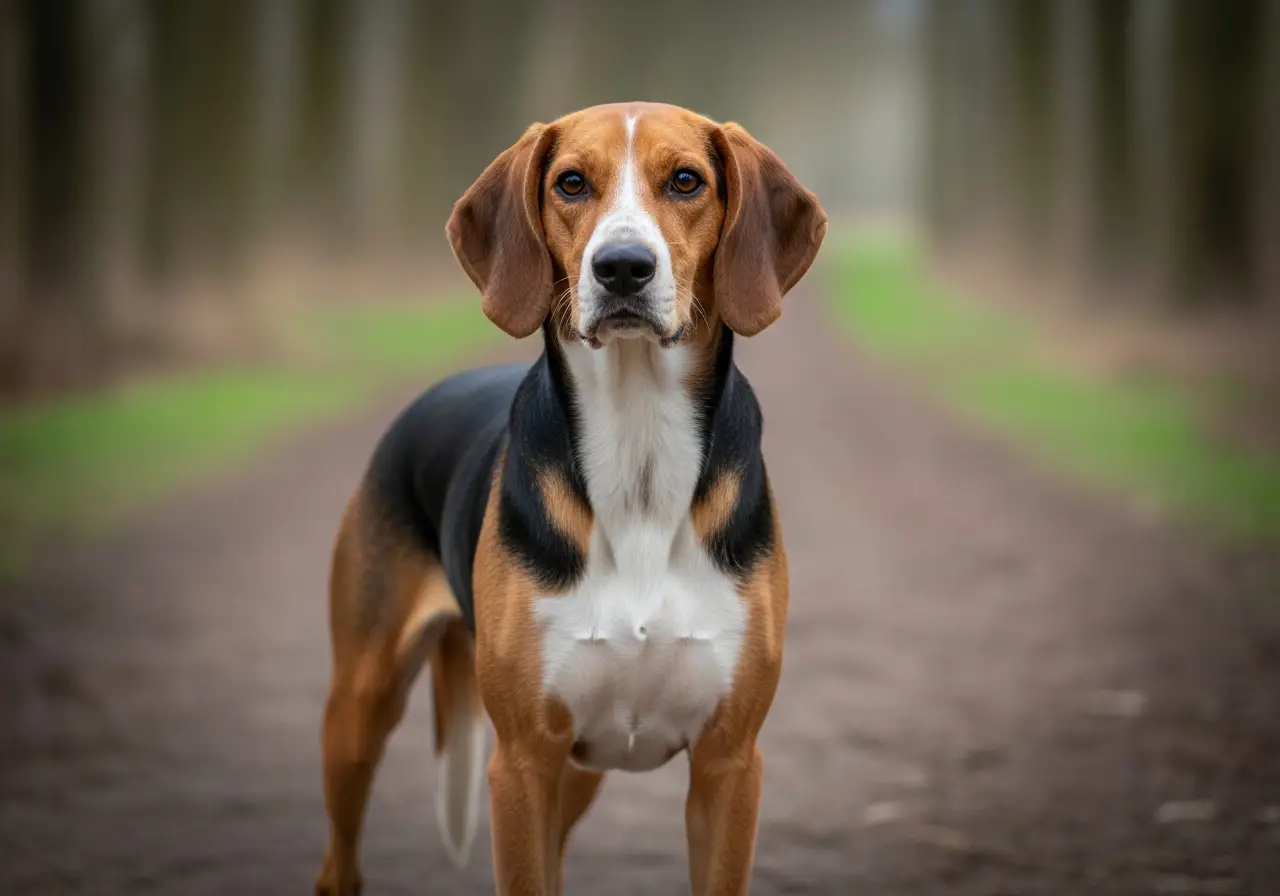
The English Harrier is a British pack hound that has been selected for hare hunting over long distances since the 13th century. Its exercise requirement is at least two hours daily, its prey drive is deeply ingrained genetically, and its need for social contact demands interaction with conspecifics. Anyone keeping this dog takes on a specialised working animal, not an everyday companion for urban lifestyles.
02Introduction
What makes the English Harrier special
The English Harrier is a rare British pack hound for hare hunting, FCI Group 6, enduring and friendly, withers height 48–55 cm.
03Profile
Key facts and suitability
- Origin
- Grossbritannien
- Original purpose
- Hare hunting in the pack
- FCI
- No. 295 · Group 6 · Section 1.2
- height at the withers
- 48–55 cm
- Weight
- 22–27 kg
- Life expectancy
- 10–12 Years
- Coat type
- Short-haired
- Minimum exercise
- 120 min/day
- Puppy price
- 800–1'500 CHF
- Waiting period
- 12 months
- Sports
- Hunting · Tracking · Mantrailing
04Temperament
How the English Harrier shows up in everyday life
The morning run shows what defines the Harrier: as soon as a scent trail reaches its nose, it switches into work mode. Eye contact with the owner breaks off, speed increases, and calls are perceived selectively. This is not defiance; this is the behaviour for which this breed was selected over centuries.
Internally, the Harrier requires daily intensive exercise, mental stimulation through nose work and social contact. Its need for social contact is high; it orients itself towards the pack and key people, tolerates being alone poorly and benefits significantly from a second dog in the household. Without sufficient activity, under-stimulation manifests as persistent vocalisation, restlessness or destructive behaviour.
Externally, the Harrier is open and little reserved towards strangers. It shows no pronounced guarding instinct and generally greets unknown people in a friendly manner. However, this openness must not be confused with obedience: in the field, it makes independent decisions based on scent and instinct, not on signals from the owner.
With other dogs, it is exceptionally tolerant; its pack nature makes it an uncomplicated cohabitant for other dogs. Small animals in the household are a different matter: prey drive makes living with rabbits, cats or small rodents risky and demands consistent management.
In everyday life at home, the Harrier appears calm and balanced, provided its exercise needs have been met. A Harrier that has worked actively for two hours will lie down. One that hasn’t will find its own entertainment.
05Needs
What this breed needs daily
The Harrier requires at least 120 to 180 minutes of active exercise daily, and this does not mean walking on a lead. Meaningful forms of exercise include lure coursing, mantrailing, field runs in secured terrain or organised nose work. Pure lead walks do not meet its fitness needs.
A securely fenced area is almost a prerequisite. The scent drive is so strong that off-leash exercise in open terrain without security measures permanently poses a risk. Fences must be escape-proof; the Harrier is enduring and motivated enough to exploit weak points.
Mentally, it requires tasks that challenge its nose. Sniffing meadows, search games and structured tracking work are suitable supplements to physical exercise. Without cognitive enrichment, frustration arises, which manifests in vocalisation or restlessness.
The need for social contact is high. A second dog in the household is not a luxury option but a sensible addition that corresponds to the pack animal’s nature. Being left alone for more than two to three hours is stressful for this breed and should be mitigated by dog care or daily structure.
Training requires patience, consistency and realistic expectations. The Harrier learns, but it prioritises scent information over the owner’s signals during outdoor use. Training must be management-oriented: create safe environments, build impulse control, solidify recall under controlled conditions. Anyone expecting a dog with reliable off-leash recall in any terrain will remain permanently dissatisfied with this breed.
Exercise
Very high
mental work
A lot
Social needs
High
training
Demanding
06Sport & Mental and Physical Stimulation
What sports the English Harrier is suited for
Realistic in terms of physiology and genetics – not every breed suits every sport.
Structurally and physiologically suitable: Suitable for mantrailing, dummy work and tracking · CaniCross / bikejoring possible.
07Quick Check
08Suitability
Who this breed is suitable for – and who it isn't
✓Matches
The Harrier suits owners who can plan at least two hours of active exercise in nature daily, not as an exception but as part of the daily routine. It is suitable for experienced dog owners with knowledge of handling scent-motivated hounds.
A rural or suburban environment with access to secure terrain is almost a prerequisite. Owners who actively engage in nose work, lure coursing or mantrailing, or are willing to learn these sports, provide the Harrier with meaningful stimulation.
Households with another dog benefit from the Harrier’s pack nature; it gets along exceptionally well with other dogs and shows significantly fewer signs of stress when left alone in the company of a conspecific.
People who enjoy an independent, character-strong dog and do not expect unconditional obedience in open areas will find in the Harrier an enduring companion for active outdoor activities. Hunting experience or an interest in dog sports with a focus on nose work is a clear advantage.
×Doesn't match
The Harrier does not suit owners who can or want to devote less than two hours daily to active exercise. Anyone living in a city apartment without access to secure outdoor space will not be able to meet the exercise needs of this breed on a permanent basis.
Owners who expect reliable recall off-lead in open terrain will remain permanently dissatisfied with the Harrier; its desire to follow a scent trail is genetically ingrained and not a training deficit.
Households with small animals such as rabbits, cats or rodents are unsuitable without consistent separation management. Anyone looking for the Harrier as a calm apartment companion with low maintenance requirements is mistaking its friendliness towards people for a low activity profile.
First-time owners without experience of highly motivated hunting dogs regularly underestimate the management effort involved. Anyone who is also away from home for more than three hours a day and cannot organise dog care should take the high need for social contact of this breed seriously; a Harrier that is permanently alone will develop stress-related behaviour.
10Line reality
Show line, working line, breeder market
The Harrier does not have a pronounced differentiation between show and working lines, as exists for example with Labrador or Golden Retrievers. The global population is too small for independent breeding directions with clearly different profiles to have become established.
In Great Britain, Harriers are still predominantly kept in active packs and selected for working suitability. The Harrier Club maintains a stud book and documents packs that still hunt actively. These dogs are primarily oriented towards endurance, scent drive and pack compatibility; show success plays a subordinate role.
Outside Great Britain, and thus also in the German-speaking region, there are isolated breeders who keep the Harrier as a companion dog. These dogs generally originate from British pack breeding and carry the same genetic foundation. An independent “companion dog line” with reduced prey drive does not exist.
Anyone acquiring a Harrier from an active pack breeding programme receives a dog with high willingness to work and a pronounced scent instinct. Anyone who believes that a Harrier from a less active breeding line is automatically weaker in its instincts underestimates the genetic stability of these traits. Before purchase, it makes sense to speak with the breeder about the specific working tests of the parent animals.
11Health · Reality
What you need to plan for medically with your English Harrier
The Harrier is considered a robust breed with a life expectancy of 12 to 14 years. Reliable breed-specific health statistics hardly exist due to the small global population; systematic studies with large sample sizes are lacking.
As is generally known for medium-sized hounds, hip dysplasia (HD) and elbow dysplasia (ED) are relevant areas for preventive care. An evaluation by the Orthopedic Foundation for Animals (OFA) from 2023 shows HD rates between 8 and 15% of examined dogs for related hound breeds; insufficient OFA data is available for the Harrier itself. Nevertheless, X-ray examinations of both parent dogs before breeding remain standard practice.
Ear infections are more common in dogs with drop ears than in those with erect ears. Regular ear checks and cleaning reduce the risk. Persistent head shaking or scratching at the ear requires veterinary investigation.
Overweight is a real risk for this breed if its exercise needs are not met. A Harrier that receives insufficient stimulation tends to gain weight, which puts strain on joints and the cardiovascular system. Regular weight checks by the vet (at least once a year) are advisable.
Preventive examinations should include annual general check-ups, dental checks and blood tests if necessary. Puppy buyers should insist on health certificates for the parent dogs.
12Structured data
Health by the numbers
Prone to diseases
Hip dysplasia, generally robust breed
Recommended health tests
Hip X-ray
13Myths ↔ Reality
What is often said incorrectly about this breed
Five myths, five realities, five sources.
"The Harrier is like a smaller Foxhound, so just as easy to keep.
The Harrier shares its ancestry with the Foxhound from British pack hounds, but differs in pace and deployment profile. It was selected for hunting on foot, which makes it more enduring, but not easier to handle. Its scent drive and independence in the field are just as strongly pronounced as in the Foxhound; the smaller body size does not reduce the effort required for keeping.
"Hounds are well occupied outdoors, a long walk is enough.
A walk on a lead does not meet the exercise needs of a Harrier. The breed was selected for hours-long scent work in the pack. Without targeted nose work, trailing or comparable stimulation, behavioural problems arise due to under-stimulation. The daily minimum requirement is 120 to 180 minutes of active movement, supplemented by cognitive enrichment.
"The Harrier is so friendly that it can be left alone without problems.
Friendliness towards people and tolerance of being alone are two different axes. The Harrier was bred as a pack dog; social contact with conspecifics and humans is a genetically anchored need. Being left alone for more than two to three hours regularly leads to stress behaviour in this breed, such as vocalisation, destruction or restlessness.
„The prey drive can be completely eliminated through consistent training.
The Harrier’s scent drive is the result of centuries of targeted selection for precisely this behaviour. It can be managed and channelled through training, but not eliminated. Off-leash exercise in unsecured terrain remains permanently risky. Owners who expect reliable recall in any terrain underestimate the genetic depth of this instinct.
“Rare breeds are healthier because they have not been overbred.
Small population sizes increase the risk of inbreeding depression and restricted genetic diversity. The Harrier’s global population is small, which makes selecting health-tested breeding animals more difficult. Health depends on concrete breeding decisions, not on the rarity of a breed. X-rays, health certificates and access to pedigree records remain mandatory.
14animal welfare
The animal welfare perspective
Breeder market, designer versions, animal shelter reality — what no one writes in the puppy ad.
The Harrier is one of the rarest dog breeds in Germany and Switzerland. This protects it from the mass market but creates its own risks.
Backyard breeders and grey market
Because demand is low and reputable breeders are scarce, a vacuum arises that is occasionally filled by suppliers selling Harriers or mixed breeds declared as Harriers without stud book registration. Anyone looking for a genuine Harrier should insist on FCI papers and access to the stud book of the Harrier Club. Cheap offers without documentation are a clear warning sign.
Keeping-related problems
The biggest animal welfare issue with the Harrier is not breeding, but keeping. A dog selected for hours-long pack hunting that lives in a city household without sufficient stimulation will develop behavioural problems. Persistent vocalisation, destruction and restlessness are not character flaws; they are symptoms of inappropriate living conditions. Anyone keeping this dog bears responsibility for a specialised working animal.
Rehoming as an equal option
Although Harriers are rarely found in German-speaking animal welfare organisations, international hound rescue organisations occasionally rehome Harriers or closely related pack dogs. These dogs are often adult, socialised and their personality is already evident, which is an advantage over a puppy whose drive profile only reveals itself over time. Anyone open to adopting an adult dog should take this option seriously.
Trends and designer variants
There are no known designer crosses or trend variants for the Harrier. The rarity of the breed has so far protected it from this phenomenon. This could change if the breed gains visibility through social media, a pattern already observed with other rare breeds.
15Costs · Transparency
What this breed realistically costs
A Harrier puppy from a reputable breeder usually costs between 1,200 and 2,000 euros. As there are hardly any reputable breeders in Germany and Switzerland, import costs from Great Britain often apply; travel or shipping fees of 300 to 600 euros are realistic.
The annual living costs consist of several items. High-quality dry food for a medium-sized, active dog costs between 600 and 1,000 euros per year. Grooming is minimal for the Harrier with its smooth, short coat; one to two baths per year and regular ear checks are sufficient, so grooming costs are low.
Basic veterinary care (vaccinations, parasite prevention, annual check-up) amounts to 300 to 500 euros annually. Unforeseen treatments (e.g. for lameness, ear infections or injuries in the field) can quickly cost 500 to 2,000 euros per incident. Pet insurance for a medium-sized dog costs between 50 and 120 euros monthly depending on the provider and coverage, and is advisable for this active breed.
Dog sports, mantrailing courses or participation in lure coursing incur additional costs of 200 to 600 euros annually, but are necessary for species-appropriate stimulation.
16Puppy search
What you need to consider when choosing a breeder
- Reputable Harrier breeders are extremely rare in Germany and Switzerland.
- Anyone looking for a puppy will generally come across British breeding lines.
- The same criteria apply as for any other breed: both parent dogs should be introduced personally or via video, health certificates (hips, eyes) must be available, and the breeder should be able to answer questions about the working tests of the parent dogs.
- Caution is advised with suppliers who sell puppies without access to the stud book or without a right of return.
- Platforms offering very low prices and immediate availability are a warning sign.
- Since the Harrier rarely appears in animal welfare organisations in Central Europe, rehoming through hound rescue organisations is a rare but equally valid option.
- Organisations such as Laufhundrettung or international pack dog rehoming services occasionally rehome Harriers or related breeds to experienced owners.
- Anyone taking on a Harrier from an active pack breeding line should be aware that these dogs are accustomed to pack structure and that single-dog keeping requires special settling-in support.
- Attending a dog training school with experience in hounds is recommended.
FAQ
Frequently asked questions about the English Harrier
Is English Harrier a family dog?
English Harrier is considered suitable for families with good socialisation and species-appropriate care.
How much exercise does English Harrier need?
At least around 120 minutes of exercise per day. As an active breed, more so — plus mental stimulation.
What is the size and weight of English Harrier?
Fully grown, English Harrier reaches about 48–55 cm at the withers and weighs around 22–27 kg.
What is the life expectancy of English Harrier?
The life expectancy of English Harrier is approximately 10–12 years.
Which diseases are common in English Harrier?
Hip dysplasia, generally robust breed
17Breed clubs
Official breed clubs in DACH
19Related
Similar breeds – and their differences
You might also be interested in
Participate
Do you have a good photo of your English Harrier?
We are looking for expressive images for our breed profiles. Submit yours; the editorial team reviews every submission before publication.
Does this breed suit you?
Larger than Beagle, smaller than Foxhound. Primarily kept for hunting. Very rare in Europe.