
01Summary
In a paragraph
If you only have 30 seconds.
The Brandlbracke is an Austrian mountain hunting dog with a centuries-old function: independent, enduring, nose-oriented. Anyone keeping this breed takes on a dog whose genetic programme is geared towards scent work, not recallability in off-leash situations. Two hours of exercise daily are the minimum, not the target. Without hunting involvement or intensive nose work, a dog arises that seeks its own enrichment.
02Introduction
What makes the Brandlbracke special
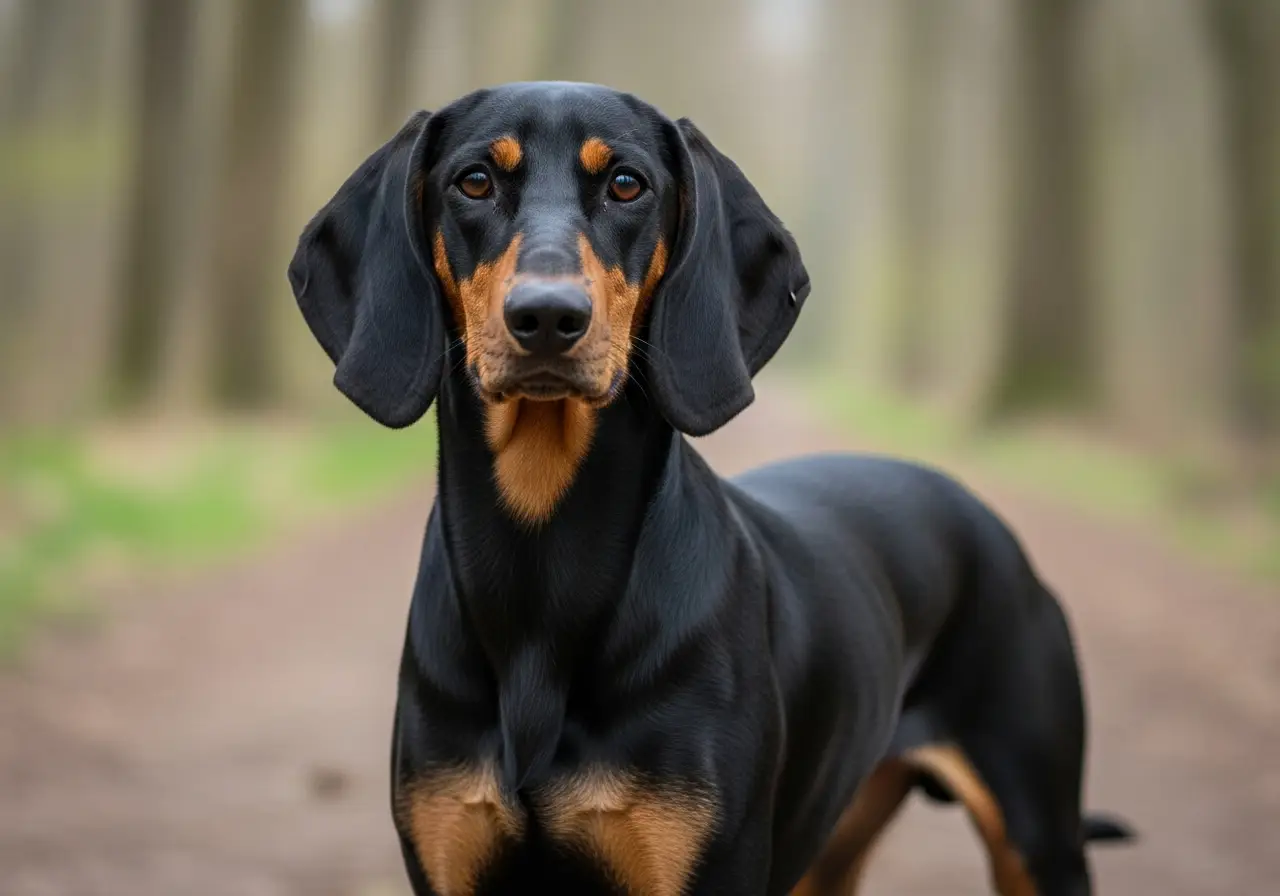
The Brandlbracke is an Austrian mountain hunting dog, FCI Group 6, black with brown markings, enduring and robust, shoulder height 40–50 cm.
03Profile
Key facts and suitability
- Origin
- Österreich
- Original purpose
- Baying and tracking dog in the mountains
- FCI
- No. 63 · Group 6 · Sektion 1.2: Mittelgroße Laufhunde, mit Arbeitsprüfung
- height at the withers
- 48–56 cm
- Weight
- 15–22 kg
- Life expectancy
- 12–14 Years
- Coat type
- Short-haired
- Minimum exercise
- 90 min/day
- Puppy price
- 700–1'300 CHF
- Waiting period
- 9 months
- Sports
- Hunting · Tracking · Mantrailing
04Temperament
How the Brandlbracke shows up in everyday life
On the morning walk in the forest, it becomes clear what the Brandlbracke really is: as soon as it picks up a trail (roe deer, hare, fox), it lowers its head, the tail goes up, and the surroundings no longer exist for it. This is not an obedience problem. This is the result of centuries of targeted selection for independent trail work.
Internally, the Brandlbracke needs intensive nose work daily. A walk on a lead is not enough. Tracking, mantrailing, or hunting deployments fulfil this need. The need for mental work is high; a dog that does not do nose work will find other ways to use its intellect. This manifests as restlessness, digging, or escape attempts.
Externally, the Brandlbracke behaves openly to neutrally towards strangers. It shows no pronounced guarding instinct and no strong territorial behaviour. Visitors in the house are registered but not assessed as a threat. This point clearly distinguishes it from herding dogs or protection dogs: the friendliness towards strangers is genuine, but it is not a sign of obedience or recallability.
At home, the Brandlbracke is calm if it has been sufficiently exercised. It seeks physical contact with its primary caregiver without being intrusive. The need for social contact is present; it is not a loner. Being alone is tolerated for up to four hours if the workload is correct. Longer leads to restlessness.
With other dogs, it generally shows itself to be compatible. The pack background shapes this: conspecifics are not competitors but familiar social partners. This makes multi-dog households with this breed well possible.
05Needs
What this breed needs daily
The Brandlbracke needs at least two hours of active exercise daily, and this is the lower limit for a balanced dog, not the optimum. Walks on a lead do not fully cover this need. The quality of the exercise is decisive: terrain runs, tracking, mantrailing, or hunting deployments engage the scent performance that is constitutive for this breed.
Nose work is not an optional addition. The Brandlbracke's need for mental work is high; it was selected for independent decision-making on the trail. Anyone who does not meet this need will get a dog that organises its own enrichment: through digging, running away, or persistent restlessness in the house.
A secured area or off-lead exercise in fenced areas is not a comfort solution for this breed, but a safety measure. Off-lead exercise in unsecured forest regularly ends with the dog following a trail and being unfindable for hours.
A rural environment with access to forest and fields represents the optimum for keeping. Keeping in a city is possible, but requires a significantly higher level of organised stimulation, including daily trips to suitable terrain.
Socially, the Brandlbracke needs a reliable primary caregiver and regular contact. Keeping multiple dogs is compatible and can supplement the need for social contact. Being left alone for more than four hours is problematic without prior intensive stimulation.
Training requires patience and realism: classic obedience takes a back seat to hunting motivation in this breed. Anyone expecting a companion dog that is available at all times places a demand on the Brandlbracke that contradicts its genetics.
Exercise
High
mental work
A lot
Social needs
Medium
training
Demanding
06Sport & Mental and Physical Stimulation
What sports the Brandlbracke is suited for
Realistic in terms of physiology and genetics – not every breed suits every sport.
Structurally and physiologically suitable: Suitable for mantrailing, dummy work and tracking · CaniCross / bikejoring possible.
07Quick Check
08Suitability
Who this breed is suitable for – and who it isn't
✓Matches
The Brandlbracke suits owners who can devote at least two to three hours daily to active exercise and nose work, and who see this not as an exception but as part of everyday life. Hunters who use the breed for hunting cover this need most completely. Non-hunters with access to tracking work, mantrailing or organised nose work courses can also keep the Brandlbracke in a species-appropriate manner.
A rural environment with direct access to forest and fields represents the optimum for keeping. Owners with their own property or guaranteed exercise areas benefit additionally.
Families with children of school age are suitable if the dog's need for exercise is met independently of the children; the breed is social and compatible, but not a substitute for toys.
Multi-dog households work well, as the Brandlbracke is compatible with conspecifics and benefits from social partners.
Experience with hunting-motivated or independently working dogs is a realistic prerequisite. Anyone who knows and respects the independence of this breed will receive a robust, healthy dog with a strong character and long life expectancy.
×Doesn't match
The Brandlbracke does not suit owners who are away from home for eight or more hours daily and do not have a reliable dog care plan. Anyone who sees nose work as an occasional leisure activity underestimates the daily need of this breed.
Keeping in a city without daily access to suitable terrain involves considerable organisational effort; anyone who cannot or does not want to provide this is making an unsuitable choice with the Brandlbracke.
Anyone who equates the friendly, social nature of the breed with obedience or easy trainability will be disappointed: friendliness towards strangers and recallability on a scent are two different axes. The Brandlbracke is open and compatible, but not a dog that reliably responds to recall in off-leash situations as soon as a scent is present.
Households keeping a dog for the first time and without experience of independently working breeds face a steep learning curve. Without guidance from an experienced dog training school with knowledge of hound work, keeping errors arise quickly that are difficult to correct.
Anyone looking for a calm companion dog for short walks will not find the right profile in the Brandlbracke.
10Line reality
Show line, working line, breeder market
The Brandlbracke does not have a pronounced separation into show and working lines, as exists for example with the German Shepherd Dog or the Labrador Retriever. Breeding has always been use-oriented; the FCI standard requires a working test (scent hound and bloodhound test), which is relevant for breeding approval.
This means in practice: dogs from reputable breeding are almost exclusively selected for scent performance, endurance, and terrain ability. Pure beauty breeding without a working test is the exception, not the rule, in Brandlbracke breeding.
Regional differences exist between Austrian and German breeding stocks, but these should be understood less as line differentiation and more as an expression of different hunting traditions. Austrian stocks were traditionally used more for high mountains and bloodhound work; Bavarian stocks sometimes show an emphasis on scent hound characteristics in flatland.
For interested parties, this means: the question of show or working line is less relevant for the Brandlbracke than for other breeds. More relevant is the question of whether the breeder undergoes working tests and what hunting performances the parent dogs can demonstrate. A puppy from a breeding without working tests offers less planning security regarding scent performance and willingness to track.
11Health · Reality
What you need to plan for medically with your Brandlbracke
The Brandlbracke is considered a robust, functionally bred breed with a life expectancy of 12 to 14 years. As breeding was consistently oriented towards utility traits and beauty breeding played no role, breed-typical extreme characteristics are largely absent.
Hip dysplasia (HD) occurs occasionally. Reliable breed-typical HD rates are not widely available for the Brandlbracke due to the small population size; the Austrian Kennel Club (ÖKV) recommends HD X-rays of parent animals before breeding. Interested parties should request HD findings for both parent animals from the breeder.
Ear health: The drooping ears of the Brandlbracke favour a moist-warm microclimate in the ear canal, which can promote yeast and bacterial infections. Weekly ear checks and regular cleaning with suitable products (veterinary recommendation) reduce the risk. In the case of recurring inflammation, veterinary investigation for allergies or anatomical peculiarities is advisable.
Overweight is a real risk for this breed if its exercise needs are not met. Hounds with insufficient stimulation tend to gain weight; overweight places strain on joints and demonstrably shortens life expectancy (Source: German Veterinary Association, Weight Management Guideline 2022).
Recommended preventive examinations: annual veterinary check-up from the 7th year of life, HD screening of parent animals, regular dental checks, weekly ear checks by the owner. Eye problems are not disproportionately common in this breed; the FCI standard requires clear, dark brown eyes without redness in the corners.
12Structured data
Health by the numbers
Prone to diseases
Hip dysplasia, ear problems
Recommended health tests
Hip X-ray
13Myths ↔ Reality
What is often said incorrectly about this breed
Five myths, five realities, five sources.
"The Brandlbracke is an uncomplicated family dog due to its friendly nature.
The friendly, social nature of the Brandlbracke is real, but it says nothing about its keeping requirements. The breed has a genetically anchored prey and tracking drive, which requires daily stimulation through nose work or hunting-related enrichment. Without this stimulation, behavioural problems such as running away, destruction or persistent restlessness arise. Friendliness and keeping complexity do not exclude each other.
"A hound with a strong prey drive can be reliably recalled through consistent training."
Hounds of FCI Group 6 were selected over centuries for independent work on the scent trail, without visual contact with the hunter. This selective pressure is deeply ingrained. As soon as the Brandlbracke picks up a scent, obedience structurally takes a back seat. Recallability off-lead is not a training goal for this breed that can be reliably achieved with standard methods. Off-lead exercise in unsecured terrain remains a risk.
"The Brandlbracke is only suitable for hunters."
The breed was bred for hunting, and involvement in hunting fulfils its needs most completely. Nevertheless, non-hunters can also keep a Brandlbracke if they offer intensive nose work (mantrailing, tracking, scent work courses) as a full equivalent. The decisive factor is not the hunting licence, but the willingness to invest several hours daily in meaningful enrichment. Without this compensation, the animal suffers.
"Hounds are loud and bark constantly."
The vocalisation of the Brandlbracke is functional: it bays on the trail to indicate the whereabouts of the game to the hunter. In everyday household life without scent stimuli, the breed is generally quiet. Problematic barking usually arises from under-stimulation or insufficient workload, not from a general predisposition to loudness. Anyone who exercises the breed in a species-appropriate manner will not experience a constant barker.
"The Brandlbracke gets along poorly with other dogs."
The opposite is closer to reality. The Brandlbracke was historically kept in packs and is generally good with conspecifics. Territorial behaviour is low for the breed. Conflicts arise more from insufficient socialisation or husbandry errors than from breed-typical aggression. The FCI standard explicitly lists aggressiveness as a disqualifying fault.
14animal welfare
The animal welfare perspective
Breeder market, designer versions, animal shelter reality — what no one writes in the puppy ad.
The Brandlbracke is a marginal phenomenon in animal welfare, not because no problems exist, but because the breed is generally rare. When Brandlbracken enter rehoming, the reason is almost always an owner's misjudgement: the prey drive was underestimated, nose work was not organised, and free running was not secured. The result is dogs that run away, cause destruction or are permanently restless, and whose owners give up because they are overwhelmed.
Backyard breeder market: As the breed is little known, there is no significant backyard breeder market in the sense of mass production. The risk lies rather with occasional breeders without club affiliation who hand over puppies without proof of working tests for the parent animals. Such puppies offer no planning security regarding nose performance and willingness to track, two characteristics that are central to species-appropriate keeping.
Designer versions and trends: The Brandlbracke is not a trend dog and does not exist as a designer crossbreed. This protects the breed from the problems associated with fashion waves, but it is no free pass. Anyone who buys the breed out of interest in its looks or "original" image, without knowing the keeping requirements, harms the animal.
Keeping-related problems: Under-stimulation is the most common keeping-related problem for this breed. A hound without daily nose work develops behavioural patterns that are difficult to correct. This is not a character flaw of the dog; it is a predictable consequence of keeping that does not correspond to the genetic profile.
Rehoming as an option: Anyone looking for a Brandlbracke should actively contact animal welfare organisations with a focus on hunting dogs. An adult dog from rehoming often already has basic training and allows a more realistic assessment of the individual character than a puppy. The need for nose work and exercise remains identical; age does not fundamentally change the profile.
15Costs · Transparency
What this breed realistically costs
A puppy from reputable, club-affiliated breeding with a pedigree and proof of working tests for the parent animals usually costs between 800 and 1,400 EUR. Prices significantly below this indicate a lack of club affiliation or untested parent animals, a warning sign that can lead to follow-up costs due to health problems or behavioural difficulties.
Running costs per year (guideline values for Germany/Austria): Food for a medium-sized dog of this activity level is 600 to 900 EUR annually, depending on food quality and body weight. Care costs are low for the Brandlbracke; the smooth, close-lying coat does not require professional care; occasional brushing and regular ear checks are sufficient.
Veterinary costs: The annual basic care (vaccinations, parasite prevention, check-up examination) is 200 to 400 EUR. In the case of ear problems or orthopaedic investigations, individual costs of 100 to 500 EUR are added. Pet insurance for this breed and size class costs between 40 and 90 EUR monthly depending on provider and scope of benefits (status 2025, DACH market).
Nose work and enrichment incur additional costs: Courses for mantrailing or tracking work are 20 to 60 EUR per session. Anyone who uses the breed for hunting bears costs for a hunting licence, territory fees and equipment; these vary greatly and must be calculated individually.
16Puppy search
What you need to consider when choosing a breeder
- Reputable Brandlbracke breeders are members of the German Hound Association e.V.
- (Deutscher Brackenverein e.V.) or the Austrian breeding association and demonstrably pass working tests.
- A puppy from reputable breeding comes with a pedigree, vaccination record, initial veterinary examination and, in the case of responsible breeders, proof of health examinations of the parent animals.
- Concrete criteria for reliability: The breeder allows visits to the litter, shows both parent animals or explains plausibly why one parent is not on site.
- They ask questions about the planned keeping and refuse handover if the prerequisites are not met.
- Puppies are handed over no earlier than eight weeks of age.
- Warning signs: multiple litters available simultaneously, no personal contact before purchase, handover under eight weeks, missing pedigree, prices significantly below market level.
- As the Brandlbracke is very rare in the German-speaking area, puppies are often mediated directly among hunters, without public advertisements.
- The German Hound Association e.V.
- (Deutscher Brackenverein e.V.) facilitates contact with breeders.
- Animal welfare and rehoming: Brandlbracken in animal welfare are rare, but not excluded.
- Specialised hound rehoming services or hunting dog animal welfare organisations are the first points of contact.
- A dog from rehoming requires the same species-appropriate stimulation as a puppy; age does not change the need.
FAQ
Frequently asked questions about the Brandlbracke
Is Brandlbracke a family dog?
Brandlbracke is considered suitable for families with good socialisation and species-appropriate care.
How much exercise does Brandlbracke need?
At least around 90 minutes of exercise per day. As an active breed, more so — plus mental stimulation.
What is the size and weight of Brandlbracke?
Fully grown, Brandlbracke reaches about 48–56 cm at the withers and weighs around 15–22 kg.
What is the life expectancy of Brandlbracke?
The life expectancy of Brandlbracke is approximately 12–14 years.
Which diseases are common in Brandlbracke?
Hip dysplasia, ear problems
17Breed clubs
Official breed clubs in DACH
19Related
Similar breeds – and their differences
You might also be interested in
Participate
Do you have a good photo of your Brandlbracke?
We are looking for expressive images for our breed profiles. Submit yours; the editorial team reviews every submission before publication.
Does this breed suit you?
Austrian hunting dog with black-brown markings. Suitable for hunters and active country dwellers.