
01Summary
In a paragraph
If you only have 30 seconds.
The Bernese Hound is a highly specialised Swiss hunting dog that has been bred for centuries for pack hunting with bay on hares. Its prey drive is genetically deeply rooted, its exercise requirement is considerable, and its recall in open country is unreliable without consistent management. Anyone who understands this dog and handles it accordingly receives an enduring, socially compatible companion with exceptional nose performance.
02Introduction
What makes the Bernese Hound special
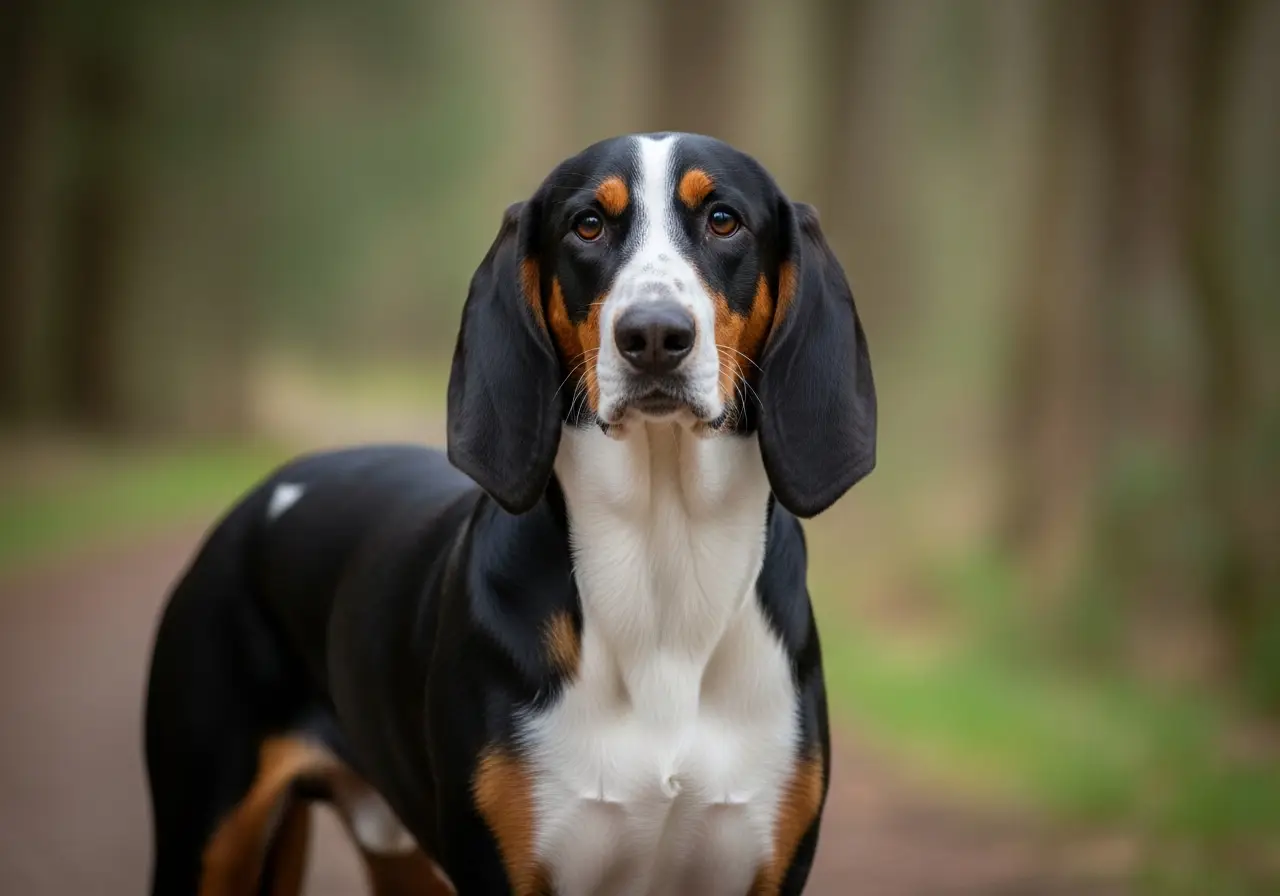
The Bernese Hound is a Swiss pack hunting dog, FCI Group 6, with tricolour markings and a melodious hunting voice, standing 40–45 cm at the withers.
03Profile
Key facts and suitability
- Origin
- Schweiz
- Original purpose
- Hunting hares in a pack
- FCI
- No. 59 · Group 6 · Section 1.2
- height at the withers
- 47–59 cm
- Weight
- 15–20 kg
- Life expectancy
- 12–14 Years
- Coat type
- Short-haired
- Minimum exercise
- 120 min/day
- Puppy price
- 800–1'500 CHF
- Waiting period
- 12 months
- Sports
- Hunting · Tracking · Mantrailing
04Temperament
How the Bernese Hound shows up in everyday life
The morning walk reveals what makes the Bernese Hound unique: as soon as a scent reaches its nose, the dog switches modes. Eye contact with the owner breaks off, the body lowers, and the pace increases. This is not disobedience; this is the behaviour for which this breed was selected over centuries.
Internally, the Bernese Hound requires intensive nose work daily. Walks without olfactory stimuli do not meet its need for mental stimulation. Scent work, mantrailing or hunting-related enrichment are not extras but a basic prerequisite for a balanced dog. The exercise requirement is at least two hours of active activity per day, not as free running on the lawn, but as targeted workload.
Externally, the Bernese Hound behaves openly and calmly towards people. Strangers are generally perceived neutrally to friendly. It is not a protection dog nor a mistrustful guard dog. However, this openness towards strangers must not be confused with low demands: the dog needs a clear primary caregiver who understands and channels its prey drive.
In the household, it is calm when sufficiently stimulated. A Bernese Hound that receives too little nose work will seek out its own enrichment, which rarely turns out in the owner's favour. Being left alone for up to four hours is possible for a well-stimulated dog; longer absences without preparation are problematic.
Due to its pack background, it usually shows itself tolerant towards conspecifics. Small animals in the household are a different matter: the prey drive does not distinguish between wild game and domestic rabbits.
05Needs
What this breed needs daily
The Bernese Hound requires at least two hours of active exercise daily, not as a leisurely walk, but as targeted physical and mental workload. Free running without nose work is insufficient.
Nose work takes top priority. Scent work according to FCI rules, mantrailing or structured search games meet its genetically anchored need for mental stimulation. An owner who does not organise the possibility for regular nose work fundamentally underestimates the breed.
The need for social contact is moderate to high. The Bernese Hound is not a loner; it benefits from contact with people and, if possible, with other dogs. Being left alone for up to four hours is manageable for a stimulated dog, but presupposes that it has been sufficiently occupied beforehand.
The environment plays an important role. A rural home with access to forest and field significantly facilitates workload. Keeping in the city is possible but requires considerably more planning effort: secured terrain for free running, regular excursions to natural areas and consistent use of a long lead in unsecured areas.
Training requires patience and realism. The dog learns, but its scent orientation overrides learned commands in stimulating situations. Classic obedience work alone is insufficient. A dog training school with experience in hunting-motivated breeds is recommended. Managing the prey drive (through a long line, secure exercise areas, and targeted enrichment) is more important in the long term than a perfect recall.
Exercise
Very high
mental work
A lot
Social needs
Medium
training
Demanding
06Sport & Mental and Physical Stimulation
What sports the Bernese Hound is suited for
Realistic in terms of physiology and genetics – not every breed suits every sport.
Structurally and physiologically suitable: Suitable for mantrailing, dummy work and tracking · CaniCross / bikejoring possible.
07Quick Check
08Suitability
Who this breed is suitable for – and who it isn't
✓Matches
The Bernese Hound suits owners who can plan at least two hours of active exercise in natural terrain daily and are prepared to establish nose work as an integral part of everyday life.
People actively involved in hunting benefit the most: the dog works at a high level in bloodhound and pack hunting, where it can fully realise its potential. Owners without a hunting licence who practice tracking or mantrailing as dog sports will find a motivated partner in this breed.
The breed is suitable for people living in rural or suburban areas with access to woods and fields, and who have experience with hunting-motivated or high-drive dogs. Anyone who has previously owned a hound, a Beagle, or another scenthound type will be familiar with the demands.
Families with children from around eight years of age can keep a Bernese Hound if the exercise needs are met by active adults and the children are guided in handling a high-drive dog.
Having multiple dogs in the household is not a problem; its pack background generally makes it compatible with other dogs. Owners who already work with a group will find a socially stable partner in this breed.
×Doesn't match
The Bernese Hound does not suit owners who can dedicate less than two hours daily to active exercise and nose work. Anyone who is away from home for eight hours and does not arrange day care or a dog sitter will structurally overwhelm this dog.
People without prior experience with high-drive or hunting-motivated dogs often underestimate what a pronounced prey drive means in everyday life: no reliable off-leash freedom in unsecured terrain, consistent long-line management, and the willingness to view nose work as an obligation, not a leisure option.
Anyone looking for a dog that is available at all times, can run freely in the park, and is content with short walks will choose the wrong dog with the Bernese Hound. The passion for scent trails is not a training problem that can be trained away; it is the core of the breed’s character.
Keeping the dog in a city without regular access to natural terrain is possible but demanding. Anyone not prepared to make this extra effort permanently should choose a different breed.
Households with small animals such as rabbits, guinea pigs or cats without dog experience are also to be viewed critically: the prey drive does not distinguish based on pet status. Anyone who believes that friendliness towards people means low demands in everyday life fundamentally misunderstands the breed.
10Line reality
Show line, working line, breeder market
The Bernese Hound is still actively used in hunting in Switzerland. A pronounced differentiation between working and show lines, as known with other breeds such as the Labrador or the German Shepherd Dog, does not exist for this breed in a comparable form; the population is too small and breeding is too closely linked to its hunting origins.
Nevertheless, there are differences between dogs from actively hunted stocks and those kept primarily as companion dogs. Dogs from hunting-active lines generally show a higher drive intensity, stronger scent orientation and more pronounced baying on the trail. Dogs from companion-dog-oriented stocks can be somewhat easier to handle in everyday life, without the prey drive fundamentally disappearing; it remains present as typical for the breed.
Anyone looking for a Bernese Hound for hunting should specifically ask for breeders whose dogs have been tested in the field. The CCFS provides information on breeding operations and performance tests. For owners without a hunting background, a dog from a stock with experience in companion dog keeping is often the more sensible starting point, while maintaining realistic expectations regarding drive.
11Health · Reality
What you need to plan for medically with your Bernese Hound
The Bernese Hound is considered a functionally bred, comparatively robust breed. The average life expectancy is 10 to 13 years, whereby individual keeping conditions, weight and preventive care have a considerable influence.
Otitis externa, inflammation of the external auditory canal, is one of the most common health problems in dogs with long drop ears. The hanging pinnae reduce air circulation in the ear canal, which promotes moist conditions and thus an increased risk of infection. Regular ear checks, at least weekly, are mandatory. In the case of recurring inflammation, a veterinary investigation for allergies or anatomical peculiarities is advisable.
Hip dysplasia (HD) occurs in hounds, but is less documented in this breed than in large working dog breeds. Reliable breed-specific HD prevalence figures for the Bernese Hound are not publicly available, indicating that systematic health surveys for this rare breed are still outstanding. Breeders who can prove HD X-ray examinations of the parent animals should therefore be particularly preferred.
Overweight is an underestimated risk: A hound that cannot meet its exercise needs gains weight quickly. Overweight puts strain on joints and demonstrably shortens life expectancy. The amount of food should be regularly adjusted to the actual activity level.
Recommended preventive care: annual veterinary examination, ear checks weekly, weight check every three months, dental care regularly. In the event of lameness or behavioural changes, a timely examination is indicated.
12Structured data
Health by the numbers
Prone to diseases
Hip dysplasia, ear problems, epilepsy
Recommended health tests
Hip X-ray
13Myths ↔ Reality
What is often said incorrectly about this breed
Five myths, five realities, five sources.
The Bernese Hound is an uncomplicated family dog for every household due to its friendliness.
Friendliness towards people does not mean that the dog is easy to keep. The Bernese Hound has a strongly pronounced prey drive, which requires consistent management in everyday life. Without sufficient nose work and exercise, it develops behavioural problems. FCI breed group 6 comprises dogs that were selected for independent hunting work, which fundamentally shapes their character.
A Bernese Hound can be reliably recalled in open fields if it is well trained.
The recall of a hound on a fresh scent trail is not guaranteed even with consistent training. Scent orientation is genetically anchored and overrides learned commands in many situations. Experienced owners rely on a long lead, secure terrain and hunting-like enrichment as an outlet, not on perfection in recall.
Hounds are loud and bark uncontrollably all day long.
The Bernese Hound gives its melodious hunting bay situationally, primarily on the scent trail. In keeping without hunting-related workload, undesirable baying can increase because the dog cannot channel its natural means of expression. Sufficient enrichment significantly reduces this behaviour.
Because hounds work in a pack, they are easily compatible with all other dogs.
The pack background promotes compatibility with conspecifics, but is no guarantee for conflict-free cohabitation with every dog. Socialisation, individual imprinting and the specific situation are decisive. Unknown dogs are not automatically accepted as pack partners.
The Bernese Hound is a robust breed without significant health problems.
The breed is considered functional and comparatively robust, but has breed-typical weak points. The long ear flaps promote moist ear canals and thus an increased risk of otitis externa. Hip dysplasia occurs occasionally. Regular ear checks and veterinary preventive examinations are not an optional extra, but part of responsible ownership.
14animal welfare
The animal welfare perspective
Breeder market, designer versions, animal shelter reality — what no one writes in the puppy ad.
The Bernese Hound is a rare breed, which partially protects it from the mass market, but does not rule out problems.
Backyard breeders and dubious offers exist even for rare breeds. Anyone who buys a Bernese Hound without a pedigree, without health certificates of the parent animals and without counter-questions from the breeder is financing breeding that does not systematically select for either health or character. The dog bears the consequences, and in the long term so does the owner.
Designer versions of the Bernese Hound are currently not a widespread phenomenon. The breed is too rare and too unfashionable to serve as a crossbreeding partner for fashion dogs. This may change if the breed gains popularity through social media presence. Owners who share photos of their dogs publicly bear indirect responsibility for how the breed is perceived.
The biggest animal welfare problem with this breed is structural in nature: dogs being rehomed because of their prey drive and exercise needs. Bernese Hounds enter rehoming because owners have not recognised the difference between a friendly dog and a low-maintenance dog. Friendliness towards people is no indicator of low keeping effort.
Adopting an adult Bernese Hound from animal welfare is a fully valid alternative to buying a puppy. Specialised hound rescuers know the dogs and can assess whether a dog fits a specific household. An adult dog brings the advantage that character, drive intensity and social behaviour are already observable, which considerably reduces the risk of a mismatch.
Anyone interested in the Bernese Hound should contact the CCFS before purchasing or taking on a dog and inform themselves about the specific requirements. An honest self-assessment of your own everyday life is more important here than enthusiasm for the breed's appearance.
15Costs · Transparency
What this breed realistically costs
The purchase price for a Bernese Hound from reputable breeding in Germany and Switzerland is between 1,200 and 1,800 EUR or CHF respectively. Offers significantly below this are a warning signal. The small breeding population means that waiting times of several months are usual.
The annual keeping costs consist of several items. Food for a medium-sized dog of this size class ranges from 600 to 1,000 EUR per year, depending on quality. Grooming is moderate for the Bernese Hound; the short to medium-length coat does not require professional clipping appointments, but regular brushing and ear care are necessary.
Veterinary costs vary considerably. For routine examinations, vaccinations, and parasite prevention, you should budget 300 to 600 EUR annually. Ear treatments for otitis externa can cost 80 to 200 EUR per treatment; in chronic cases, the costs add up significantly.
Dog liability insurance is mandatory in Germany depending on the federal state and costs 50 to 150 EUR per year. Health insurance for the dog is optional but sensible for a breed with potential ear and joint problems; premiums range from 600 to 1,200 EUR annually, depending on the scope of cover.
Total costs in the first year including getting a dog: realistically 3,000 to 5,000 EUR. From the second year onwards: 1,500 to 3,000 EUR annually, depending on health status and insurance model.
16Puppy search
What you need to consider when choosing a breeder
- Reputable breeders of the Bernese Hound are rare in Germany and Switzerland, as the breed is kept in small populations.
- The Association for French and Swiss Scenthounds e.V.
- (CCFS) is the responsible breeding organisation in the German-speaking region and facilitates contact with tested breeders.
- Characteristics of reputable breeding: The parent animals are tested for hip dysplasia, the ears are checked regularly, and the breeder provides proof of health examinations.
- Puppies grow up in a household environment and are socialised at an early stage.
- A reputable breeder asks counter-questions (regarding the environment, experience, planned enrichment) and refuses to hand over the puppy if the profile does not fit.
- Warning signs: Puppies without a pedigree, offers without viewing the mother, very short waiting times for a rare breed, prices significantly below market level.
- Adoption via animal welfare organisations is an equally valid option.
- Bernese Hounds occasionally enter rehoming because their exercise needs and prey drive were underestimated.
- Breed protection organisations and specialised hound rescuers know the dogs and can provide a well-founded assessment of suitability.
- An adult dog from rescue often has the advantage that its character is already assessable.
FAQ
Frequently asked questions about the Bernese Hound
Is Bernese Hound a family dog?
Bernese Hound is considered suitable for families with good socialisation and species-appropriate care.
How much exercise does Bernese Hound need?
At least around 120 minutes of exercise per day. As an active breed, more so — plus mental stimulation.
What is the size and weight of Bernese Hound?
Fully grown, Bernese Hound reaches about 47–59 cm at the withers and weighs around 15–20 kg.
What is the life expectancy of Bernese Hound?
The life expectancy of Bernese Hound is approximately 12–14 years.
Which diseases are common in Bernese Hound?
Hip dysplasia, ear problems, epilepsy
17Breed clubs
Official breed clubs in DACH
19Related
Similar breeds – and their differences
You might also be interested in
Participate
Do you have a good photo of your Bernese Hound?
We are looking for expressive images for our breed profiles. Submit yours; the editorial team reviews every submission before publication.
Does this breed suit you?
Swiss hunting dog, primarily kept for hunting. Extremely loud baying – not suitable for close neighbours. Not suitable as a pure companion dog.