
01Summary
In a paragraph
If you only have 30 seconds.
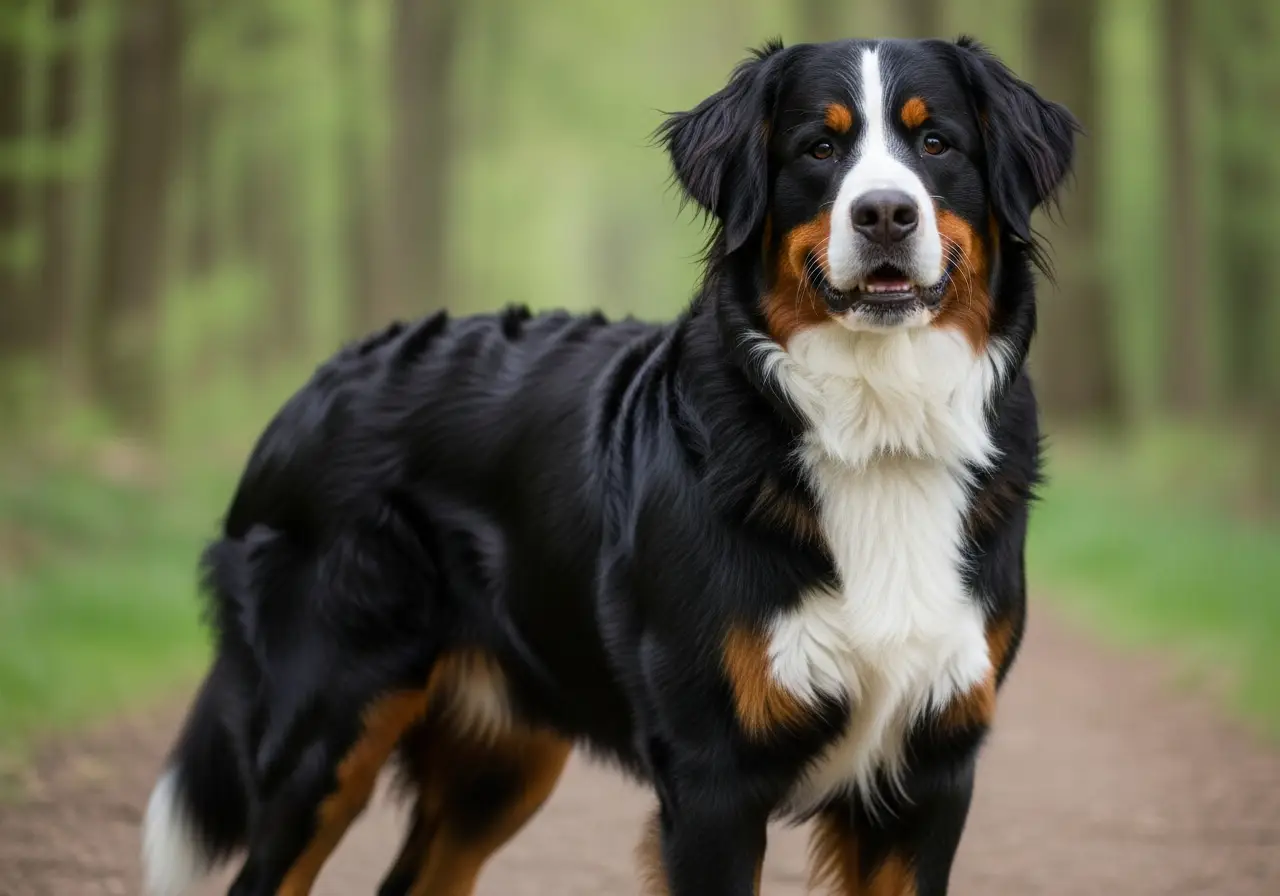
The Bernese Mountain Dog is a tricoloured Swiss farm dog with a strong family bond and a calm basic temperament. Its life expectancy of 7 to 10 years is significantly below the breed average. Cancer, hip dysplasia and gastric torsion are part of the known risk profile. Anyone who decides on a Bernese makes a decision for a dog with great presence and an early farewell.
02Introduction
What makes the Bernese Mountain Dog special
The Bernese Mountain Dog is a Swiss Sennenhund, FCI Group 2, tri-coloured and gentle, with a short life expectancy of 7–10 years compared to other breeds.
03Profile
Key facts and suitability
- Origin
- Schweiz
- Original purpose
- Herding, draft animal, companion dog
- FCI
- No. 45 · Group 2 · Section 3
- height at the withers
- 58–70 cm
- Weight
- 38–50 kg
- Life expectancy
- 7–10 Years
- Coat type
- Long-haired
- Minimum exercise
- 60 min/day
- Puppy price
- 1'500–2'500 CHF
- Waiting period
- 12 months
- Sports
- Draft dog sports · Agility · Obedience · Therapy dog
04Temperament
How the Bernese Mountain Dog shows up in everyday life
When you come home, you are greeted by a dog that registers your arrival calmly but present. The Bernese Mountain Dog greets familiar people with physical closeness, not hysteria. It follows you through the apartment, lies down within sight and observes what is happening. This behaviour reflects its high need for social contact: it requires human proximity as a basic condition, not as a bonus.
It behaves differently towards strangers. The Bernese shows vigilance; it observes, assesses and initially keeps its distance. This is not a lack of socialisation, but a characteristic stemming from its guarding role. Anyone expecting it to warmly welcome every visitor immediately will be disappointed. Those who give it time will experience a dog that builds trust and then remains reliable.
In everyday life with children, the Bernese shows patience, provided the children are steady and handling is regulated. A toddler stumbling and holding onto the dog can unbalance a 45 kg dog, and vice versa. Size and strength are not just theory, but part of daily life.
On walks, the Bernese likes to work at a moderate pace. It is not an endurance athlete, but nor is it a couch dog. It requires mental engagement: nose work, carting or companion dog sports correspond better to its historical profile than monotonous laps in the park. It rarely expresses boredom loudly, rather through withdrawal or decreasing willingness to cooperate.
05Needs
What this breed needs daily
The Bernese Mountain Dog requires 60 to 90 minutes of active exercise daily. The rule here is: quality over quantity. Monotonous walks without interaction only partially meet its needs. Structured activities, nose work, carting, companion dog sports or controlled terrain runs are more sensible. Intense joint stress in the first year of life should be avoided, as skeletal growth continues until the 18th month.
The need for social contact is high. The Bernese is not a dog that can easily cope with eight hours alone. It requires human presence as a structuring element of its daily life. Being left alone can be trained, but four hours should be considered the upper limit, and only after gradual training over weeks.
Mental stimulation is not an optional extra. The Bernese has sufficient intelligence and willingness to work to solve tasks, but it needs these tasks to remain balanced. Search games, fetching exercises or simple trick training sessions of 10 to 15 minutes daily are sufficient to meet its need for mental work.
Care requires regular attention: the tricoloured coat of the Bernese sheds intensively twice a year and needs weekly brushing, daily during moulting phases. Ears, paws and eyes should be checked regularly. Anyone who considers dog hair on clothes and furniture a problem should assess this realistically before making a decision.
Exercise
Medium
mental work
Medium
Social needs
High
training
Medium
07Quick Check
08Suitability
Who this breed is suitable for – and who it isn't
✓Matches
The Bernese Mountain Dog suits owners who can provide 60 to 90 minutes of structured exercise daily and where at least one person in the household is mostly at home. A house with a garden is advantageous, but not a mandatory criterion; the decisive factor is the daily activity time, not the type of accommodation.
Families with children from around 8 years of age who are experienced in dealing with large dogs and adhere to clear rules provide a suitable environment for the Bernese Mountain Dog. Quiet households with a structured daily routine suit its temperament better than hectic, changing environments.
Owners who are prepared to actively plan for health costs (regular preventive examinations, joint checks, early cancer detection) and can emotionally and financially cope with a short life expectancy are suitable for this breed. Anyone planning for a dog for 14 years should be aware of the Bernese's risk profile.
Experienced first-time owners who are willing to attend a dog training school and have a realistic view of size and strength are also suitable. It is important that the external axis (reserve towards strangers, moderate guarding behaviour) is supported by targeted socialisation from the beginning.
×Doesn't match
The Bernese Mountain Dog is not suitable for owners who are regularly away from home for more than four hours a day and cannot organise reliable care. Its high need for social contact is not a character flaw; it is genetically anchored and cannot be trained away.
Anyone looking for a sporting companion dog for intensive endurance activities (canicross, bikejöring, multi-hour mountain tours) will not find the right partner in the Bernese. Its exercise requirement is moderate, not high-intensity.
Households that consider dog hair an unacceptable problem or cannot plan time for regular grooming significantly underestimate the care effort required for this breed.
Anyone who misinterprets the Bernese's reserve towards strangers as "friendliness towards everyone" and does not invest time in targeted socialisation risks having a dog that becomes overwhelmed in social situations. The external axis, i.e. how the dog reacts to unknown people, differs from its familial warmth and must not be equated with it.
Owners who wish to minimise veterinary costs and cannot build up a reserve for breed-typical illnesses should soberly assess the Bernese's risk profile before making a decision.
10Line reality
Show line, working line, breeder market
The Bernese Mountain Dog is today bred primarily as a family and companion dog. A pronounced differentiation between working and show lines, such as exists for the German Shepherd or Labrador Retriever, is less pronounced in the Bernese, but not non-existent.
Differences can be observed within the breeding population: dogs from lines focused on show success sometimes exhibit stronger type characteristics (coat, colour, build), while dogs from lines with working tests — such as companion dog sports or carting — tend to be more eager for movement and have stronger drives. These differences are real but gradual compared to other breeds.
Historically, the Bernese was an all-rounder: pulling, herding, guarding. Today, carting is the only sport that directly links to its original task and is actively promoted by some breeding clubs. The Swiss Club for Bernese Mountain Dogs (KBS) conducts corresponding tests.
Anyone looking for a Bernese with increased willingness to work and endurance should specifically ask the breeder about parent dogs with working tests. Anyone looking for a calm family dog will find this in the majority of today’s breeding lines, but should still insist on health tests for the parent dogs, regardless of line affiliation.
11Health · Reality
What you need to plan for medically with your Bernese Mountain Dog
The life expectancy of the Bernese Mountain Dog is 7 to 10 years, making it one of the shortest-lived dog breeds. For comparison: the average life expectancy for medium-sized dogs is 12 to 14 years. This difference is not a coincidence but an expression of a known genetic risk profile.
Malignant histiocytosis is the most common cause of death in Bernese Mountain Dogs. Studies estimate the prevalence at 20 to 25% of the breed (Source: Oncological data from the SSV, status 2022). This aggressive form of cancer often occurs between the 6th and 9th year of life and progresses rapidly. Other forms of cancer (mast cell tumours, osteosarcomas) also occur above average.
Hip dysplasia (HD) and elbow dysplasia (ED) are further core issues. Reputable breeding associations require X-ray findings for both parent animals before approval for breeding. Nevertheless, evaluations by the SSV show that HD findings in grades B and C also occur in tested lines.
Gastric torsion (gastric dilatation-volvulus) is a real risk due to body size and chest depth. Symptoms (distended abdomen, restlessness, unproductive retching) require immediate veterinary intervention.
Recommended preventive examinations: annual general check-up, joint assessment from the 12th month, eye examination, blood count from the 6th year of life for early detection of tumour markers. Overweight significantly increases joint stress and must be consistently avoided in Bernese Mountain Dogs due to their body mass.
12Structured data
Health by the numbers
Prone to diseases
Hip dysplasia, elbow dysplasia, malignant histiocytosis (breed-typical, frequent cause of death), heart problems, gastric torsion (bloat)
Recommended health tests
Hip and elbow X-rays, cardiac examination, regular preventive check-ups
13Myths ↔ Reality
What is often said incorrectly about this breed
Five myths, five realities, five sources.
"The Bernese Mountain Dog is a robust mountain worker that rarely gets ill.
The opposite is true. The Bernese Mountain Dog is among the breeds with the shortest life expectancy overall, averaging 7 to 10 years. Malignant histiocytosis, an aggressive form of cancer, occurs in an estimated 25% of the breed. Hip and elbow dysplasia are also above-average frequent. Robustness is not a breed attribute of the Bernese.
"Bernese Mountain Dogs are so gentle that they do not require consistent training.
A calm temperament does not mean a dog trains itself. The Bernese reaches a weight of up to 50 kg and develops considerable physical strength. Without early loose-leash walking and clear boundaries, problems arise that are difficult to correct due to the size. Consistency and patience are not opposites; both are necessary.
"A garden replaces daily exercise.
A garden offers the Bernese Mountain Dog freedom of movement, but it does not replace joint activity with the owner. The dog requires 60 to 90 minutes of structured exercise and social interaction daily. A dog standing alone in the garden does not meet its need for social contact and may develop behavioural issues.
“Bernese Mountain Dogs are suitable for any owner because they are so gentle.
Gentleness is not synonymous with low demands. The Bernese reacts sensitively to inconsistency and stress in the household. It requires a calm, structured environment and an owner who realistically assesses its size, need for social contact, and health risks. For owners without experience with large dogs, attending a dog training school is strongly recommended.
“Bernese Mountain Dogs cannot tolerate heat, but are otherwise weather-resistant.
The Bernese’s sensitivity to heat is real and medically relevant; the dense coat and body mass significantly increase the risk of overheating. At the same time, intense exertion in cold weather is problematic for young dogs, as skeletal growth continues until the 18th month. Neither heat nor joint-stressing activities in puppyhood are harmless.
14animal welfare
The animal welfare perspective
Breeder market, designer versions, animal shelter reality — what no one writes in the puppy ad.
The Bernese Mountain Dog is not a breed that frequently appears in animal welfare contexts; most dogs remain with their families until the end of their lives. However, this does not mean that there are no aspects relevant to animal welfare.
Backyard breeder market and demand pressure
The sustained popularity of the Bernese, which regularly ranks among the most registered breeds in the VDH, creates demand pressure that attracts backyard breeders. Puppies from dubious origins are often sold without health examinations of the parent animals, given away too early and raised without socialisation. The result is dogs with an increased risk of illness and behavioural problems, costs borne by the buyer, not the seller.
Health risks associated with breeding
The short life expectancy and high prevalence of cancer are not inevitable natural facts. They are the result of a breeding history that prioritised type over health for a long time. Reputable breeders today actively work with health databases and breeding value estimations. Anyone buying a Bernese Mountain Dog without asking about HD/ED findings, cancer history in the lineage, and the life expectancy of the grandparents is foregoing relevant information.
Obesity as an underestimated problem
Bernese Mountain Dogs tend to become overweight, particularly after neutering and in old age. Overweight accelerates joint degeneration and increases the risk of anaesthesia during operations. A structured feeding plan and regular weight checks at the vet are not luxury measures, but basic ones.
Adoption as an equally valid option
Although Bernese Mountain Dogs rarely end up in animal shelters, breed-specific rehoming organisations exist, for example via the SSV or KBS. Older dogs from rehoming come with a known temperament and completed socialisation. For owners who do not want to deal with the effort of raising a puppy, this is a serious alternative to buying.
15Costs · Transparency
What this breed realistically costs
A puppy from reputable breeding with documented health checks of the parent animals costs between 1,800 and 2,800 EUR in the DACH region. Offers significantly below this, particularly under 1,200 EUR, often come from backyard breeders without health documentation. The lower purchase price is usually offset by higher subsequent costs.
The annual living costs for an adult Bernese Mountain Dog are between 2,500 and 4,000 EUR. This includes: high-quality food for a dog weighing 36 to 50 kg (approx. 80 to 120 EUR/month), regular grooming (professional 4 to 6 times/year, approx. 60 to 100 EUR per session), basic equipment, dog training school and accessories.
Vet costs for the Bernese Mountain Dog should be planned above average. The annual preventive examination alone is between 80 and 150 EUR. Treatments for joint diseases, tumour diagnoses or gastric torsion can quickly reach 3,000 to 10,000 EUR. Pet insurance is not a precautionary measure for this breed, but a fundamental financial consideration; monthly premiums are between 60 and 120 EUR depending on the provider and scope of benefits.
Anyone taking in a Bernese Mountain Dog from rehoming saves the purchase price, but may incur pre-treatment costs. Here too applies: build up a reserve fund.
16Puppy search
What you need to consider when choosing a breeder
- A reputable breeder allows puppies to leave no earlier than at 8 weeks, provides proof of health examinations for both parent animals (HD, ED, eyes), is a member of the KBS or SSV and enables a visit to the litter before handover.
- They ask questions about the living situation, experience and daily routine.
- Anyone who does not ask questions is just selling.
- Warning signs: puppies without vaccination records, no home visit possible, multiple litters available simultaneously, no proof of health examinations for the parent animals, handover at a neutral location.
- These characteristics indicate backyard breeding, regardless of how professional the website appears.
- Adopting an older Bernese through the SSV or KBS is an equally valid option.
- Older dogs come with a known temperament, completed socialisation and often already have basic training.
- For owners without puppy experience, this can be an advantage.
- No reputable platform recommends individual breeders by name.
- The studbook lists of the KBS (bernersennenhund.ch) and the SSV (ssv-ev.de) offer a structured starting point for searching for tested breeding facilities.
FAQ
Frequently asked questions about the Bernese Mountain Dog
Is Bernese Mountain Dog suitable for beginners?
Bernese Mountain Dog is considered suitable for first-time dog owners.
Is Bernese Mountain Dog a family dog?
Bernese Mountain Dog is considered suitable for families with good socialisation and species-appropriate care.
How much exercise does Bernese Mountain Dog need?
At least around 60 minutes of exercise per day.
What is the size and weight of Bernese Mountain Dog?
Fully grown, Bernese Mountain Dog reaches about 58–70 cm at the withers and weighs around 38–50 kg.
What is the life expectancy of Bernese Mountain Dog?
The life expectancy of Bernese Mountain Dog is approximately 7–10 years.
Which diseases are common in Bernese Mountain Dog?
Hip dysplasia, elbow dysplasia, malignant histiocytosis (breed-typical, frequent cause of death), heart problems, gastric torsion (bloat)
17Breed clubs
Official breed clubs in DACH
19Related
Similar breeds – and their differences
You might also be interested in
Participate
Do you have a good photo of your Bernese Mountain Dog?
We are looking for expressive images for our breed profiles. Submit yours; the editorial team reviews every submission before publication.
Does this breed suit you?
Most popular Swiss dog. Gentle and family-friendly, but with a short life expectancy. Malignant histiocytosis affects approximately 25% of all Bernese.