
01Summary
In a paragraph
If you only have 30 seconds.
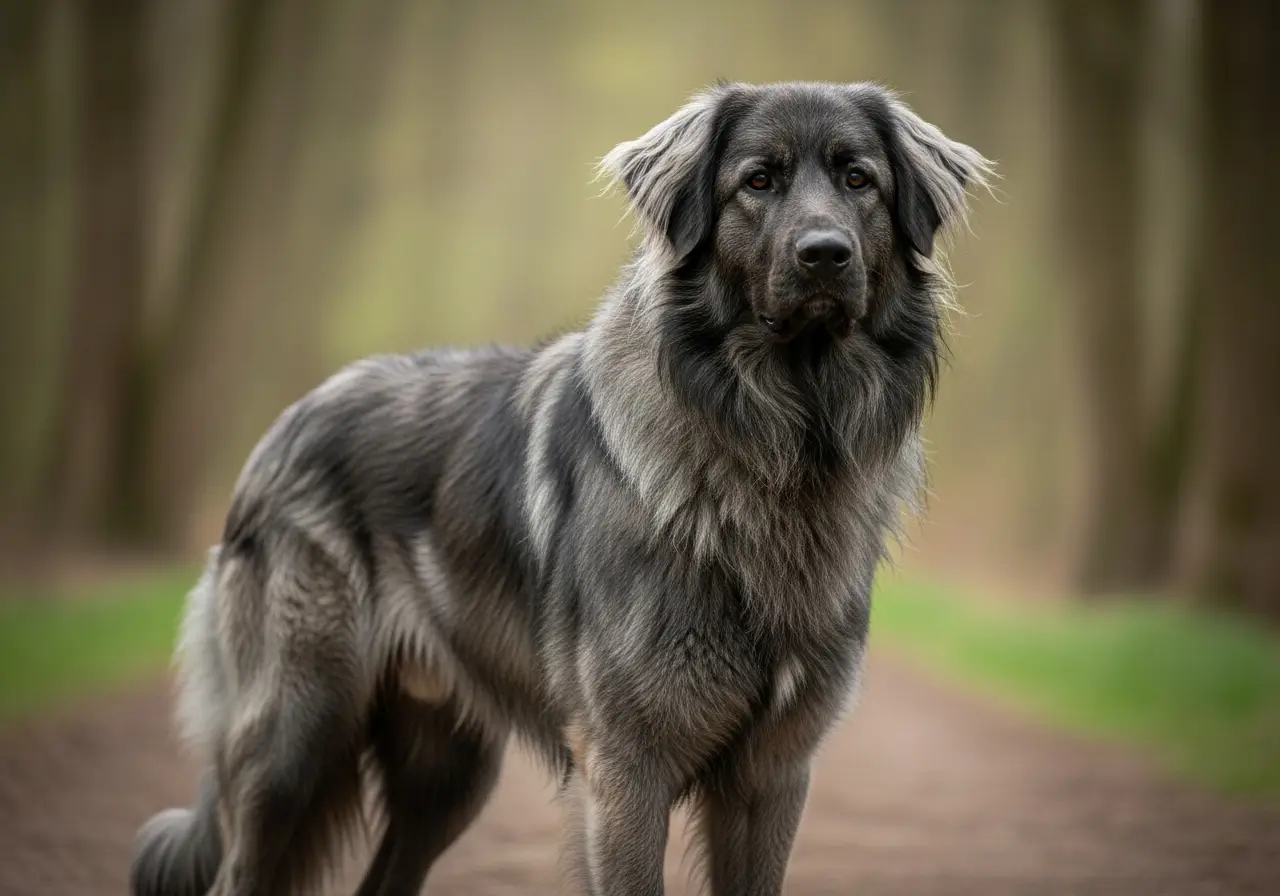
The Sarplaninac is a South-East European livestock guardian dog with centuries of functional breeding behind it. It makes decisions independently, defends its territory without hesitation and bonds deeply with its key people, remaining permanently reserved to aloof towards strangers. This combination of loyalty and independence demands owners with genuine experience, secure terrain and a daily routine that accounts for its original role.
02Introduction
What makes the Yugoslav Shepherd Dog (Sarplaninac) special
The Sarplaninac is a South Eastern European livestock guardian dog, FCI Group 2, extremely cold-resistant and wary of strangers, with a withers height of 56–62 cm.
03Profile
Key facts and suitability
- Origin
- Serbien/Nordmazedonien
- Original purpose
- Livestock guarding in the Šar-Planina mountains
- FCI
- No. 41 · Group 2 · Section 2.2
- height at the withers
- 56–62 cm
- Weight
- 30–45 kg
- Life expectancy
- 11–13 Years
- Coat type
- Long-haired
- Minimum exercise
- 60 min/day
- Puppy price
- 800–1'500 CHF
- Waiting period
- 12 months
- Sports
- Schutzhund
04Temperament
How the Yugoslav Shepherd Dog (Sarplaninac) shows up in everyday life
When returning home after a long day at work, the Sarplaninac greets its primary caregiver calmly and without exuberant gestures—a quick sniff, eye contact, then it returns to its post. This restraint is not disinterest. It expresses a deep, stable bond that does not require constant confirmation.
Internally (i.e., in what the dog needs from its owner), there is a moderate need for social contact: the Sarplaninac wants to be near its primary caregivers and included in household activities, but does not demand constant interaction. Mental work in the form of territory structure, clear rules, and situational involvement is more important than classic fetching or obedience training. The exercise requirement is moderate but regular: 60 to 90 minutes of controlled movement on familiar terrain daily.
Externally, i.e., in its reaction to stimuli from the environment, the true profile of this breed becomes apparent. Towards strangers, the Sarplaninac remains persistently reserved to repulsive. This is not a phase phenomenon nor a training error. It is the result of centuries of selection for distrust towards the unknown. A visitor entering the property will be observed, positioned, and challenged if necessary, even if invited.
These two axes must not be confused: close family bonding does not mean the dog is socially open. A Sarplaninac that is loyal to its family can simultaneously represent a serious challenge for any outsider. Anyone receiving visitors should plan ahead: the dog is secured, introduced properly, and only included in the situation after clear relaxation signals.
05Needs
What this breed needs daily
The Sarplaninac requires 60 to 90 minutes of daily exercise in the form of walks on familiar terrain or controlled work on its own property. High-performance sports like agility or canicross do not match its working profile and can destabilise protective behaviour if territorial bonding is disrupted.
Most importantly, a clearly defined, securely fenced property is essential. The fence must be sturdy, high enough (at least 1.80 m), and gap-free—not because the dog flees, but because it actively defends its territory and may test boundaries. Pure apartment living without outdoor space is incompatible with the nature of this breed.
Mental and physical stimulation for the Sarplaninac does not arise from toys or search games, but from structure: a regulated daily routine, a clear hierarchy in the household, and the opportunity to monitor its own territory. A dog that has no defined area of responsibility will develop its own solutions, which rarely correspond to the owner's expectations.
The need for social contact is moderate. The Sarplaninac requires closeness to its key people, not permanent enrichment by them. Being left alone within the familiar territory is possible for up to six hours, provided the dog is well-socialised and accustomed to absences. Outside its own territory, for example at the vet or in unfamiliar surroundings, the threshold for stress is significantly lower.
Early and consistent socialisation with people, other dogs, and everyday stimuli is not optional, but a fundamental prerequisite for safe keeping.
Exercise
Medium
mental work
Medium
Social needs
Low
training
Experts
06Sport & Mental and Physical Stimulation
What sports the Yugoslav Shepherd Dog (Sarplaninac) is suited for
Realistic in terms of physiology and genetics – not every breed suits every sport.
Structurally and physiologically suitable: CaniCross / bikejoring possible.
07Quick Check
08Suitability
Who this breed is suitable for – and who it isn't
✓Matches
The Sarplaninac suits owners with proven experience in handling livestock guardian dogs or other independently working breeds. Anyone who has already kept a Kangal, Pyrenean Mountain Dog, or Caucasian Ovcharka brings a relevant starting point.
The breed is suitable for owners with their own, generously fenced property; at least 500 m² of secured outdoor space is considered the minimum. Rural or small-town locations with low visitor traffic significantly reduce the potential for conflict.
Families with children from around twelve years old, who have grown up in the household and known the dog since puppyhood, can live with a Sarplaninac, provided the parents take full responsibility for leadership and the dog is not involved in childcare.
Owners who are prepared to actively manage visits, i.e. to secure the dog before guests arrive and introduce them gradually, and who have checked the restricted breed status in their canton, are well-prepared. Anyone working on a farm with livestock and able to offer the dog a genuine guarding task creates optimal conditions for this breed.
×Doesn't match
The Sarplaninac is not suitable for first-time dog owners or people without experience with territorially driven breeds. Anyone who interprets the dog's independence as a training deficit and attempts to remedy it through classic obedience exercises will fail and destabilise the dog in the process.
Urban keeping in rented flats, terraced houses with small gardens, or densely populated residential areas with high pedestrian traffic is incompatible with the guarding instinct of this breed. Anyone who regularly receives many visitors, has children from their social circle as guests, or lives in a multi-occupancy building significantly underestimates the management effort.
Anyone who classifies the reserve towards strangers as temporary shyness that resolves with sufficient socialisation misunderstands the genetic foundation of this breed. Keeping is equally unsuitable for owners looking for a dog that integrates effortlessly into dog groups, dog schools or public meeting zones. The Sarplaninac is not a dog for the dog park; it is a dog for a clearly defined territory with reliable leadership.
10Line reality
Show line, working line, breeder market
In Western European breeding, the Sarplaninac is not divided into formal working and show lines, as is common with the German Shepherd Dog, for example. Nevertheless, there are clear differences in practice between dogs from active livestock guardian breeding on the Balkan and those from Western European hobby breeding.
Dogs from traditional livestock guardian breeding (particularly from North Macedonia, Kosovo and Serbia) generally exhibit a more pronounced guarding and territorial instinct, are less conditioned to human leadership and show stronger independent initiative. They correspond to the original type described in the FCI standard as still preserved in regions with intensive livestock farming.
Western European breeding lines, established since the 1980s, have partly selected for more sociable basic temperaments without completely abandoning protective instincts. These dogs are easier to handle in everyday life but do not lose their fundamental character structure.
For prospective owners, this means: the origin of the parent animals and the breeder's breeding goals are crucial information before purchase. A dog from active livestock guardian breeding poses different demands than a dog from a Western European hobby breeding line, even if both carry the same breed name. Anyone who does not plan to use the dog for work should specifically ask for litters where both parents are kept in a family environment and have undergone temperament tests.
11Health · Reality
What you need to plan for medically with your Yugoslav Shepherd Dog (Sarplaninac)
According to breeder associations and available population data, the life expectancy of the Sarplaninac is 11 to 13 years. As a large-framed molossoid weighing between 30 and 45 kg, it belongs to the breeds with an increased risk of hip dysplasia (HD). Reliable breed-specific HD prevalence studies for the Sarplaninac are limited; in comparable livestock guardian dogs (Kangal, Pyrenean Mountain Dog), HD rates of 15 to 25 % are reported in breeding samples (OFA database, status 2023). Breeders who select for HD-free parent animals demonstrably reduce this risk.
The risk of gastric torsion (Gastric Dilatation-Volvulus, GDV) is generally increased in large, deep-chested breeds. Concrete incidence rates for the Sarplaninac are not available; as a preventive measure, vets recommend avoiding large meals before intense exercise and reacting immediately to signs such as a distended abdomen, restlessness and unsuccessful retching, as GDV is a life-threatening emergency.
Preventive examinations relevant before purchase and throughout life: HD and ED X-rays of the parent animals (mandatory for reputable breeding), annual weight checks, joint assessment from the fifth year of life onwards, as well as dental checks, since the dense coat easily conceals dental problems.
Overweight poses a significant risk for this breed. The Sarplaninac tends to gain weight with insufficient exercise and incorrect feeding, which strains the joints and cardiovascular system. Regular weight checks by the vet, at least twice a year, are recommended.
12Structured data
Health by the numbers
Prone to diseases
Hip dysplasia, generally robust (primitive type)
Recommended health tests
Hip X-ray
13Myths ↔ Reality
What is often said incorrectly about this breed
Five myths, five realities, five sources.
The Sarplaninac is an aggressive dog that bites as a matter of course.
The FCI standard explicitly describes the breed as balanced, reliable and watchful, but not prone to biting. The guarding instinct primarily manifests in territorial behaviour and deterrence. Bite incidents arise almost without exception from a lack of socialisation, unsuitable living conditions or owners without experience with livestock guardian dogs, not from a generally aggressive basic disposition.
Anyone who socialises the Sarplaninac early enough turns it into an amiable family dog.
Socialisation reduces overreactions and significantly improves manageability, but it does not change the genetically ingrained guarding and territorial instincts. A well-socialised Sarplaninac remains reserved towards strangers and continues to make independent decisions regarding threat situations. Anyone looking for a dog with an open, friendly basic attitude towards strangers should choose a different breed.
As a large dog, the Sarplaninac primarily needs lots of exercise and sport.
The Sarplaninac is not an endurance athlete in the sense of a retriever or Husky. Its original task consisted of calm patrolling and situational intervention, not running for hours. What is crucial is a clearly defined, securely fenced territory as well as mental engagement. Uncontrolled off-leash activity without territorial bonding can destabilise guarding behaviour.
Livestock guardian dogs like the Sarplaninac are easy to keep because they work independently.
Independence in this context means that the dog makes decisions without human instruction, including those that can become problematic in everyday life with neighbours, visitors or other dogs. This characteristic demands experienced owners who set boundaries without suppressing the guarding instinct. The care effort for management, socialisation and safety measures is considerable.
The Sarplaninac is not a restricted breed in Germany and may be kept everywhere.
Restricted breed status in Germany is a matter for the individual states (Länder) and varies by state. In some states, the Sarplaninac is subject to registration requirements or prior permission. The status of the respective state regulations changes regularly. Before getting a dog, it is essential to check the current legal situation in the respective state and municipality.
14animal welfare
The animal welfare perspective
Breeder market, designer versions, animal shelter reality — what no one writes in the puppy ad.
The Sarplaninac belongs to the breeds that regularly appear in German-speaking animal welfare, not because the breed is problematic, but because it is systematically underestimated. The most common reasons for surrender are biting incidents with visitors or neighbours, conflicts with other dogs and the simple overwhelming of owners who have kept a livestock guardian dog like a family dog.
The backyard breeder market for this breed is limited but present. Puppies from the Balkans are occasionally sold into private households without papers, without health examinations of the parent animals and without socialisation. These dogs are often harder to integrate into everyday situations and end up in animal welfare disproportionately frequently. A purchase price well below market level is a concrete warning signal.
Designer versions or crossbreeding trends hardly exist for the Sarplaninac; the breed is too unknown and too demanding to function as a trend pet. This is a structural advantage: breeding is small, manageable and maintained by an engaged circle of breeders who generally select for temperament stability.
Keeping-related problems arise mainly from properties that are too small, lack of fencing and attempts to integrate the dog into urban social contexts for which it was not selected. A Sarplaninac living in constant overstimulation develops stress behaviour, which can manifest as increased aggression, hyper-territoriality or withdrawal.
Placing an adult Sarplaninac from animal welfare is a serious option for experienced owners. Specialised organisations carry out temperament assessments and know the background of the dogs. A dog with a known background and stable basic structure can be a more reliable choice than a puppy from unknown breeding.
15Costs · Transparency
What this breed realistically costs
A puppy from a reputable breeder with FCI papers, parents tested for HD/ED and initial veterinary care costs between 1,200 and 2,000 euros in Germany and Switzerland. Offers significantly below this often come from backyard breeding without health documentation.
The annual living costs for an adult Sarplaninac (35–45 kg) are realistically 2,000 to 3,500 CHF/EUR, broken down as follows: food (high-quality, raw meat-based or premium dry food) approx. 800–1,200 EUR/year, basic care of the dense double coat (brushing, occasional professional trimming) approx. 200–400 EUR/year, core vaccinations and parasite prevention approx. 300–500 EUR/year.
Additional veterinary costs arise due to the dog's size: anaesthetics, operations and medication dosages are weight-dependent and lie significantly above the average for smaller breeds in a 40 kg dog. A hip operation (HD treatment) can cost between 2,000 and 5,000 EUR. Pet insurance with surgical cover is recommended for this breed; monthly premiums range from 60 to 120 EUR depending on provider and scope of cover.
In Switzerland, cantonal dog taxes (CHF 50–300/year depending on the canton) and liability insurance must also be budgeted for; the latter is mandatory in some cantons if the dog has restricted breed status.
16Puppy search
What you need to consider when choosing a breeder
- A reputable breeder of Sarplaninacs keeps the parent animals under conditions that correspond to the nature of the breed: secure outdoor areas, clear social structure, no mass breeding.
- Both parent animals should be tested for hip dysplasia (HD) and elbow dysplasia (ED), with results provided in writing.
- A breeder who hands over puppies without inspection of the mother or without health certificates is not a suitable contact.
- Reputable breeders ask questions in return: they want to know if the property is secure, whether experience with the breed exists and what the owner's daily routine looks like.
- Anyone who sells a puppy without asking questions does not select for suitable owners.
- Placement via animal welfare organisations is an equally valid option.
- Sarplaninac dogs regularly end up in animal welfare when owners have underestimated the protective and territorial instincts.
- Experienced animal welfare organisations specialising in livestock guardian dogs carry out temperament assessments and place dogs only with suitable households.
- The age of the dog is not a disadvantage here; an adult Sarplaninac with a known background can be a more stable choice than a puppy.
- Purchase prices under 800 euros for a puppy with papers and health examinations of the parents are a warning signal.
- Backyard breeder stock from abroad without documentation carries significant health and temperament risks.
FAQ
Frequently asked questions about the Yugoslav Shepherd Dog (Sarplaninac)
How much exercise does Yugoslav Shepherd Dog (Sarplaninac) need?
At least around 60 minutes of exercise per day.
What is the size and weight of Yugoslav Shepherd Dog (Sarplaninac)?
Fully grown, Yugoslav Shepherd Dog (Sarplaninac) reaches about 56–62 cm at the withers and weighs around 30–45 kg.
What is the life expectancy of Yugoslav Shepherd Dog (Sarplaninac)?
The life expectancy of Yugoslav Shepherd Dog (Sarplaninac) is approximately 11–13 years.
Which diseases are common in Yugoslav Shepherd Dog (Sarplaninac)?
Hip dysplasia, generally robust (primitive type)
17Breed clubs
Official breed clubs in DACH
19Related
Similar breeds – and their differences
You might also be interested in
Participate
Do you have a good photo of your Yugoslav Shepherd Dog (Sarplaninac)?
We are looking for expressive images for our breed profiles. Submit yours; the editorial team reviews every submission before publication.
Does this breed suit you?
Traditional livestock guardian dog of the Balkans. Extremely distrustful of strangers. Only for special situations.