
01Summary
In a paragraph
If you only have 30 seconds.
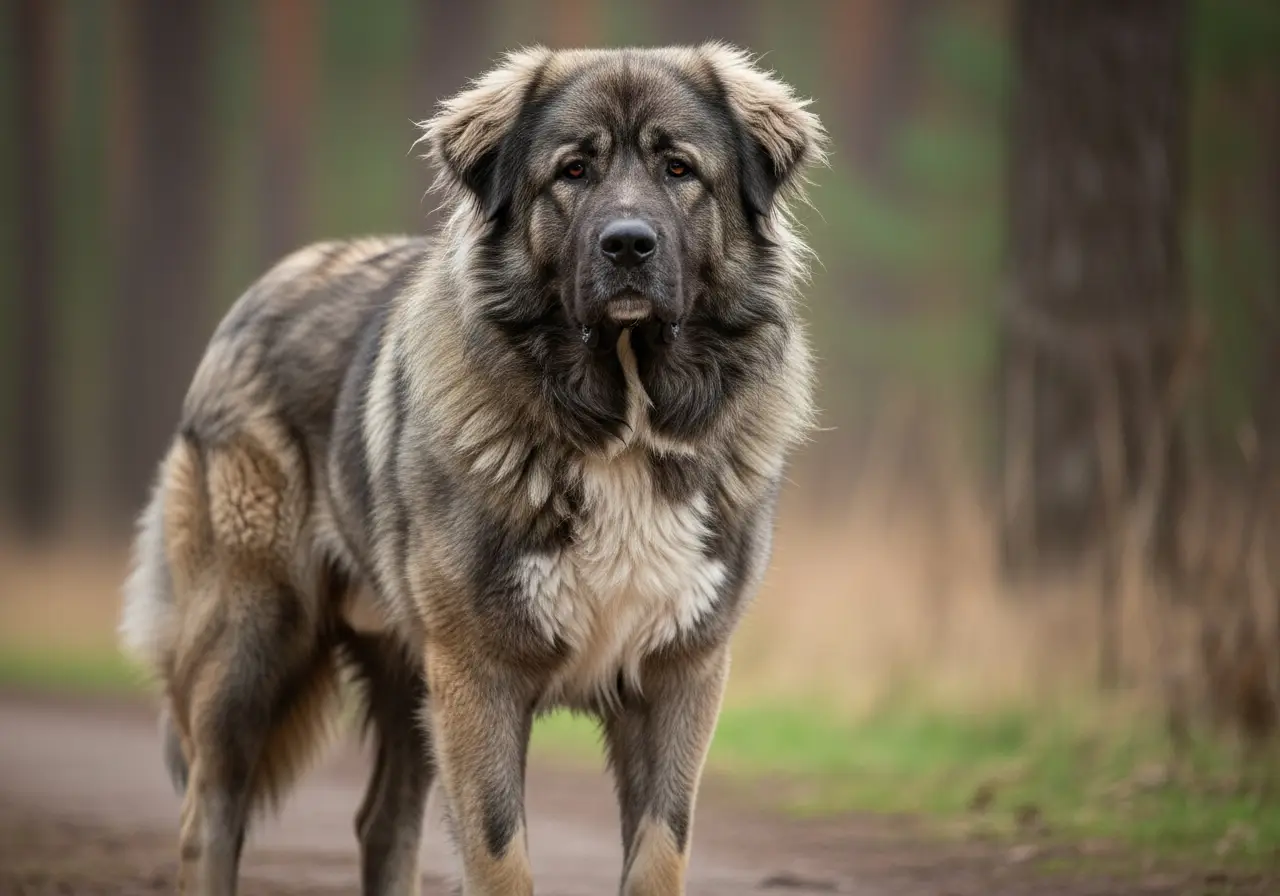
The Caucasian Ovcharka is a massive livestock guardian dog from the Caucasus that has guarded herds independently for centuries, without human instruction and without compromise. Anyone who keeps this dog takes responsibility for an animal that has genetically anchored guarding and territorial behaviour. Experience with dominant guarding breeds, a secured property, and legal clarity are not recommendations; they are minimum prerequisites.
02Introduction
What makes the Caucasian Shepherd special
The Caucasian Shepherd is a massive Russian livestock guardian dog, FCI Group 2, extremely hostile to strangers and cold-resistant, withers height 64–75 cm.
03Profile
Key facts and suitability
- Origin
- Russland (Kaukasus)
- Original purpose
- Livestock protection against wolf and bear in the Caucasus
- FCI
- No. 328 · Group 2 · Sektion 2.2: Molosser, Berghunde
- height at the withers
- 64–75 cm
- Weight
- 45–70 kg
- Life expectancy
- 10–12 Years
- Coat type
- Long-haired
- Minimum exercise
- 60 min/day
- Puppy price
- 1'000–2'500 CHF
- Waiting period
- 12 months
- Sports
- Schutzhund
04Temperament
How the Caucasian Shepherd shows up in everyday life
When a stranger enters the property, the Caucasian Ovcharka does not react with curiosity; it positions itself. This is not a sign of aggression in the clinical sense, but the result of millennia of selection for territory defence. The internal axis, what drives the dog from within, is characterised by a high guarding instinct, moderate need for movement and a pronounced bond with its territory and family.
The external axis, how the dog reacts to stimuli, shows a different picture: towards strangers, the Caucasian Ovcharka is naturally reserved to rejecting. These two axes must not be confused. A dog with a close family bond is not automatically open to visitors. The Caucasian Ovcharka is the opposite of that.
In everyday family life, it shows itself calm and patient, as long as the structure is right. It observes more than it acts. On the evening walk, it walks controlled beside its owner, as long as no strangers disturb the picture. If an unknown person appears, the body posture changes immediately: head up, gaze fixed, movement slows down. This is not training failure; this is breed.
With conspecifics, especially in its own territory, it shows dominant behaviour. Multi-dog keeping is possible, but requires careful introduction and clear hierarchy. With children who belong to the family and with whom it has grown up, it behaves patiently as a rule, but it is not a playmate in the classical sense. It guards. That is its mode.
05Needs
What this breed needs daily
The Caucasian Ovcharka requires 60 to 90 minutes of exercise daily in the form of structured walks. Free running in unsecured terrain is not feasible due to its guarding instinct profile; it requires a fully fenced property with a fence that is at least 1.80 metres high and dig-proof. Keeping it in an apartment is out of the question.
Mentally, the Caucasian Ovcharka does not require classic enrichment in the sense of fetching or agility. Its cognitive stimulation comes from guarding its territory, which constitutes work for it. Nevertheless, it requires daily, structured contact with its owner: guidance, boundaries, routine. A dog left to itself develops uncontrolled guarding behaviour.
Socialisation must begin in the first weeks of life and must be continued consistently. The puppy must encounter various people, noises, vehicles, and situations, not so that it accepts everything, but so that it can differentiate. A poorly socialised Caucasian Ovcharka is a serious safety risk.
It tolerates being left alone for up to approximately six hours, provided its territory is secured and it perceives the situation as normal. Lack of structure burdens it more than loneliness. Attending a dog training school with experience in livestock guardian dogs is not an option but a requirement during the first months.
Exercise
Medium
mental work
Medium
Social needs
Low
training
Experts
07Quick Check
08Suitability
Who this breed is suitable for – and who it isn't
✓Matches
The Caucasian Ovcharka suits owners with demonstrable experience in handling dominant guarding breeds, not just large dogs in general. Anyone who has already handled a livestock guardian dog or a comparable breed and is familiar with the dynamics of independent decision-making possesses the basic prerequisites.
A rural environment with a generously fenced property is not a recommendation but a minimum requirement. Owners who are predominantly at home during the day or whose property is permanently supervised meet the keeping profile of this breed.
Families in which children are already of compulsory school age and who consistently adhere to rules for interacting with the dog are suitable, provided both parents actively take on the leadership role. Individuals with experience and appropriate infrastructure are also suitable.
Anyone willing to fully clarify the legal situation in advance (restricted breed status in the respective federal state, liability insurance, possibly a certificate of competence) and regards these requirements as a matter of course demonstrates the attitude this breed requires. The external axis (aggression towards strangers) must be actively managed in everyday life: visitors must be announced, introduced, and supervised.
×Doesn't match
The Caucasian Ovcharka is unsuitable for owners without prior experience with guarding or livestock guardian dogs. Anyone who has previously kept exclusively social, biddable breeds regularly underestimates the independence of this breed; this is not a question of willingness but of lacking reference points.
City dwellers without a secured property are out of the question. Even a large garden in a terrace house area is not a suitable living environment if neighbours, postmen, and passers-by are within earshot daily. The barking behaviour and guarding behaviour of the Caucasian Ovcharka are not controllable in densely populated areas.
Anyone who confuses the internal bonding intensity of this breed with external openness (i.e., assumes that a family dog is also a sociable dog) makes a dangerous misjudgement. The Caucasian Ovcharka is loyal to its group and distrustful of everything outside it. This distinction must be understood before a puppy moves in.
Households with frequently changing visitors, small children under six years of age, or other pets that were not introduced from the start are also unsuitable. Anyone who perceives the legal requirements (restricted breed regulations, compulsory insurance, certificate of competence) as bureaucratic hurdles rather than a factual basis should not choose this breed.
10Line reality
Show line, working line, breeder market
The Caucasian Ovcharka does not have clearly defined show lines in the Western European sense. The differentiation is rather geographical and functional: dogs from Georgian, Armenian and Russian breeding differ considerably in body structure, coat type and temperament expression.
Russian breeding lines, shaped by Soviet military and border dog programmes, often show a more pronounced guarding instinct and a higher readiness to react to strangers. Georgian and Armenian lines, which have remained closer to the original livestock guarding use, are considered somewhat calmer in temperament, without losing their guarding instinct.
In Central Europe, the breeding base is narrow. Reputable breeders work with health tests for HD and ED as well as temperament tests that check the dog’s independence and resilience. Show-oriented breeding based purely on exterior criteria exists, but carries the risk that working characteristics, in particular the ability to differentiate between genuine threats and everyday situations, are neglected.
Anyone looking for a Caucasian Ovcharka should actively ask about the lineage of the litter and have the parent dogs demonstrate their behaviour, not just in photos, but in a real encounter.
11Health · Reality
What you need to plan for medically with your Caucasian Shepherd
The life expectancy of the Caucasian Ovcharka is 10 to 12 years, an average value for a breed of this size class. As with all large molossoids, hip dysplasia (HD) and elbow dysplasia (ED) are among the most relevant orthopaedic conditions. Reliable breed-specific HD/ED prevalence data for the Caucasian Ovcharka from controlled studies are only limitedly available for Central Europe; the VDH generally recommends an X-ray examination of both hip joints before breeding for breeds of this size class (VDH Breeding Regulations, current as of 2023).
A body weight of up to 75 kg places considerable strain on the joints. Overweight is a serious risk for this breed, as the need for movement is moderate and food quantities are easily overestimated. Regular weight checks at the vet, at least twice a year, are advisable.
The dense double coat predisposes to skin problems such as pyoderma or fungal infections if care is lacking, particularly in humid seasons. Ears should be checked regularly for inflammation.
Preventive examinations include: HD/ED X-rays (recommended from 12 months), annual heart auscultation by the vet, dental checks (large breeds are prone to tartar), and eye examinations if abnormalities are noted. Gastric dilatation-volvulus (bloat) occurs in deep-chested large breeds; owners should know the symptoms and act immediately in an emergency. Castration should be individually weighed up with the vet, as it can have effects on joint health in large breeds.
12Structured data
Health by the numbers
Prone to diseases
Hip dysplasia, heart problems, generally robust
Recommended health tests
Hip X-ray, cardiac examination
13Myths ↔ Reality
What is often said incorrectly about this breed
Five myths, five realities, five sources.
“With consistent training, the Caucasian Ovcharka is as manageable as any other breed.
The guarding instinct and territoriality of the Caucasian Ovcharka are genetically anchored, not acquired through training. Training can channel the behaviour and make it controllable, but cannot eliminate it. A dog that assesses strangers on its own property as a threat does so due to millennia of selective pressure, not because of misbehaviour.
“As a guard dog, a Caucasian Ovcharka in the garden is sufficient; it keeps itself occupied.
A Caucasian Ovcharka kept without structure, socialisation and leadership develops uncontrolled guarding behaviour. The animal requires daily active guidance, clear territory rules and regular contact with its owner. Pure kennel keeping without integration leads to behavioural abnormalities and is problematic under animal welfare law.
“The dense coat of the Caucasian Ovcharka cares for itself.
The double coat of the Caucasian Ovcharka requires daily brushing over several weeks, particularly during the moulting period, which occurs intensively twice a year. Matting forms quickly, especially behind the ears and in the armpits. Without regular care, skin problems can arise that require veterinary treatment.
“The Caucasian Ovcharka is a quiet dog; it hardly barks.
The Caucasian Ovcharka is a pronounced barking dog, which is particularly active at night. In its original function as a livestock guardian dog, barking served as a warning signal and deterrent. In residential areas, this behaviour regularly leads to conflicts with neighbours. For this reason, keeping it in densely populated areas is hardly feasible.
“Because it is so large, the Caucasian Ovcharka requires particularly lots of exercise.
The Caucasian Ovcharka is not an endurance athlete. Its need for movement lies at a moderate 60 to 90 minutes daily. The decisive factor is not the distance covered, but a clearly defined, secure territory that it recognises as its domain. Excessive physical exertion, especially during the growth phase, can predispose joint problems.
14animal welfare
The animal welfare perspective
Breeder market, designer versions, animal shelter reality — what no one writes in the puppy ad.
The Caucasian Ovcharka belongs to the breeds that end up disproportionately frequently in animal shelters and rescue stations, not because the dogs are problematic, but because expectations regarding keeping them are regularly underestimated. Territoriality and distrust of strangers, which are marketed as those of a "good guard dog" during the purchase conversation, become a burden in everyday life if infrastructure and experience are lacking.
The backyard breeder market for this breed is real. Puppies are offered without health tests of the parent animals, without temperament assessment and without buyer advice, often via classifieds portals, partly from Eastern Europe. A puppy without HD/ED documentation of the parents and without documented socialisation is not a bargain, but a calculable risk for high follow-up costs and keeping problems.
Designer versions or crosses with other molossoids circulate under various names. These dogs often carry the protective behaviour of the parent breed without breeding having taken place for differentiation ability or resilience. The result is a dog that is harder to assess than a purebred from reputable breeding.
Breeding-related problems mainly concern joint health due to too rapid growth and too early exertion. Keeping-related problems arise from kennel keeping without social contact; a Caucasian Ovcharka kept in isolation for years develops behavioural disorders that make rehoming almost impossible.
Rehoming an adult Caucasian Ovcharka from a rescue organisation or a breed club is an equally valid option, provided the animal's history is documented and the settling-in period is professionally supported. Breed clubs such as the Kaukasischer Owtscharka-Club e.V. have contacts with reputable rehoming centres and can assist in assessing an animal.
15Costs · Transparency
What this breed realistically costs
The acquisition costs for a puppy from reputable breeding with health documentation and papers are between 1,200 and 2,500 EUR in Germany. Offers significantly below this often originate from backyard breeding without health tests; follow-up costs due to joint diseases or behavioural therapy regularly exceed the apparent savings.
The annual food costs for a dog of this size class (45–75 kg) are between 800 and 1,500 EUR with high-quality nutrition, depending on the type of food and body weight. In addition, there are care costs: The dense coat requires professional grooming twice a year (approx. 80–150 EUR per session) as well as regular care materials.
The annual vet costs for routine examinations, vaccinations and parasite prevention are between 300 and 600 EUR. For orthopaedic conditions such as HD, treatment costs of 2,000 to over 5,000 EUR can arise. Dog liability insurance is mandatory for this breed, particularly in federal states with restricted breed status; the annual premium is between 100 and 300 EUR depending on the provider and coverage sum. Pet health insurance is a sensible consideration given the joint risks in large breeds (150–600 EUR/year depending on the tariff).
16Puppy search
What you need to consider when choosing a breeder
- A reputable breeder of Caucasian Ovcharkas allows interested parties to experience the parent dogs in a real encounter, not just in photos.
- HD and ED X-ray reports for both parents as well as a temperament test should be documented.
- The litter is raised in the family, not isolated in kennels.
- Reputable breeders ask questions in return; anyone who does not reject buyers does not select.
- The Caucasian Ovcharka Club e.V.
- (koc-ev.de) is the first point of contact for finding a breeder in Germany.
- Breeders from the club environment are subject to a breeding regulation that defines minimum standards for health tests and keeping conditions.
- Before purchasing, the legal situation in the respective federal state must be clarified: In some German federal states, the Caucasian Ovcharka is subject to restricted breed law with keeping requirements, leash requirement, and compulsory insurance.
- These requirements vary by federal state and can change; current information from the responsible municipality or veterinary office is essential.
- Adopting an adult dog through the breed club or a specialised protection organisation is an equivalent alternative to buying a puppy.
- Adult dogs already show their character, which considerably reduces uncertainties in assessing temperament.
FAQ
Frequently asked questions about the Caucasian Shepherd
How much exercise does Caucasian Shepherd need?
At least around 60 minutes of exercise per day.
What is the size and weight of Caucasian Shepherd?
Fully grown, Caucasian Shepherd reaches about 64–75 cm at the withers and weighs around 45–70 kg.
What is the life expectancy of Caucasian Shepherd?
The life expectancy of Caucasian Shepherd is approximately 10–12 years.
Which diseases are common in Caucasian Shepherd?
Hip dysplasia, heart problems, generally robust
17Breed clubs
Official breed clubs in DACH
19Related
Similar breeds – and their differences
You might also be interested in
Participate
Do you have a good photo of your Caucasian Shepherd?
We are looking for expressive images for our breed profiles. Submit yours; the editorial team reviews every submission before publication.
Does this breed suit you?
One of the largest and most protective dogs in the world. Barking non-stop at night. Not an owner breed – working dog.