
01Summary
In a paragraph
If you only have 30 seconds.
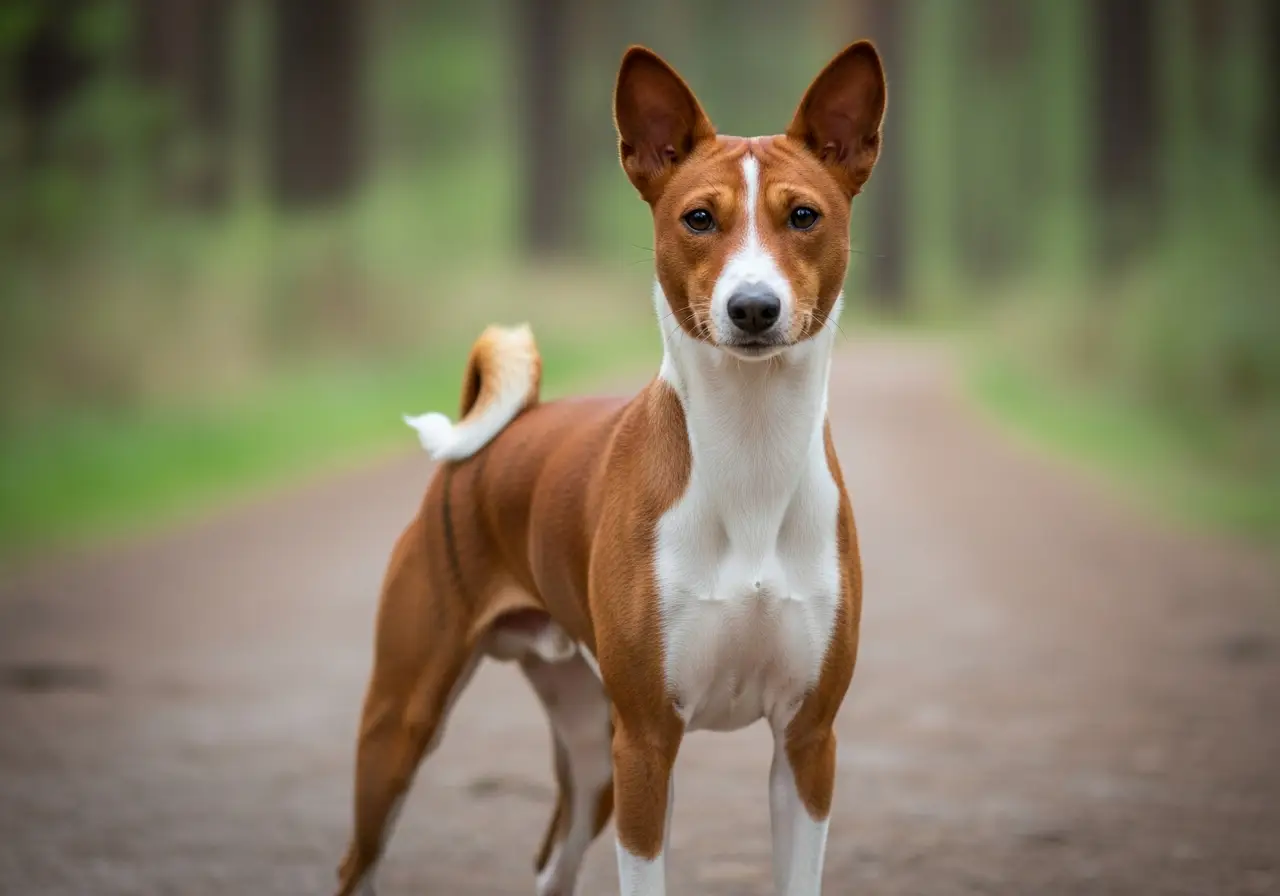
The Basenji is an African primitive hunting dog that has worked independently for millennia, and you notice this daily. It does not bark but communicates clearly in other ways. Its prey drive is genetically deeply anchored, its obedience situation-dependent. Whoever seeks a cooperative, independent dog with high exercise and mental work requirements and can provide secure terrain will find in the Basenji a fascinating partner.
02Introduction
What makes the Basenji special
The Basenji is a barkless African primitive hunting dog from the Congo, FCI Group 5, cat-like in cleanliness and independent, with a withers height of 40–43 cm.
03Profile
Key facts and suitability
- Origin
- Demokratische Republik Kongo
- Original purpose
- Hunting dog (driving hunt), guard dog
- FCI
- No. 43 · Group 5 · Sektion 6: Urtypen (Primitive breeds)
- height at the withers
- 40–43 cm
- Weight
- 9–11 kg
- Life expectancy
- 13–14 Years
- Coat type
- Short-haired
- Minimum exercise
- 60 min/day
- Puppy price
- 1'500–2'500 CHF
- Waiting period
- 12 months
- Sports
- Lure Coursing · Agility
04Temperament
How the Basenji shows up in everyday life
The morning walk reveals what defines the Basenji: as soon as movement appears in the bushes, it is focused, tense, and without a secured leash or enclosed area, gone in seconds. The prey drive switches situationally to maximum, regardless of how well recall has worked in the garden.
At home, it behaves differently. The Basenji is clean, calm and tidy; it grooms itself similarly to a cat and avoids dirt where possible. On the sofa, it seeks physical contact with its primary caregiver without being intrusive. The bond is intense but not clingy.
Here, the divergence of the two behavioural axes becomes clear: internally, the Basenji requires high social contact and mental stimulation; it wants to be included, think along and make decisions. Externally, it reacts reservedly to strangers up to rejection. A guest who spontaneously enters the apartment receives no joyful greeting. The Basenji observes, evaluates and decides itself whether approach is desired.
This independence continues in training. It refuses repetitions without recognisable purpose. Short, varied sessions with clear structure and a positive reinforcement approach work better than drill. Pressure produces withdrawal, not cooperation.
With other dogs, it is compatible if socialised early, but communicates directly and clearly. Small animals in the household are difficult to reconcile with a Basenji; its prey drive does not distinguish between wild animal and domestic rabbit.
05Needs
What this breed needs daily
The Basenji requires at least 90 minutes of active exercise daily, divided into several sessions. Particularly important are phases in which it can run: controlled sprints on secure terrain, running alongside a bicycle, or Canicross are suitable forms. Walks at walking pace are not sufficient.
Secure open space is not an option but a basic prerequisite. A fence with a minimum height of 1.80 m and no climbing possibilities is necessary; the Basenji is athletic and finds weak spots. Open fields without security are out of the question for free running.
Mentally, it requires daily challenges. Nose work, search games, retrieval tasks with variation, and short training sequences with changing tasks keep it balanced. It rejects monotonous repetitions; whoever demands the same exercise daily loses its cooperation.
The need for social contact is high. The Basenji requires companionship, ideally human reference persons who are present during the day or ensure a structured daily routine with care. Periods of solitude lasting more than four hours are critical and should remain the exception. A second dog can help but does not replace human interaction.
Training requires patience, consistency, and humour. The Basenji tests boundaries, not out of dominance but out of curiosity and independence. Whoever implements clear, fair rules consistently and designs training sessions to be engaging obtains a cooperative partner.
Exercise
High
mental work
A lot
Social needs
Medium
training
Demanding
06Sport & Mental and Physical Stimulation
What sports the Basenji is suited for
Realistic in terms of physiology and genetics – not every breed suits every sport.
Structurally and physiologically suitable: Suitable for mantrailing, dummy work and tracking · CaniCross / bikejoring possible.
07Quick Check
08Suitability
Who this breed is suitable for – and who it isn't
✓Matches
The Basenji suits owners with experience in handling independent or primitive dog breeds. Whoever has already handled a dog with a pronounced prey drive and knows that management is more important than perfection brings a good starting basis.
Suitable are active individuals or couples who can plan at least 90 minutes of exercise daily, part of which as controlled sprinting on secure terrain. An own garden with a stable, high fence is a clear advantage.
Owners who enjoy nose work, search games, or Canicross will find in the Basenji a motivated partner for these activities. Whoever appreciates short, varied training sessions and has no interest in classic obedience training gets along well with its learning style.
Households in which someone is present during the day or where a reliable care solution exists meet its high need for social contact. Quiet households without frequent visitor traffic cater to its reserve towards strangers. Families with older children from about ten years of age, who handle animals calmly and respectfully, are also suitable, provided all other conditions are met.
×Doesn't match
The Basenji is unsuitable for owners keeping a dog for the first time and who cannot ensure guidance by an experienced dog training school. Its independence and prey drive quickly become overwhelming without prior experience.
Whoever expects a reliably recallable dog without secure open space will be permanently frustrated with the Basenji. The prey drive cannot be trained away; it is part of the breed profile.
Households in which the dog is regularly alone for longer than four hours do not meet its need for social contact. Whoever believes that its independence means emotional independence confuses the external axis (reserve towards strangers) with the internal need for close bonding, a common misunderstanding.
Families with small animals such as rabbits, guinea pigs, or cats that have not grown up with dogs take on a high risk. The prey drive does not distinguish based on pet status.
Whoever values a dog that executes commands reliably and repeatably, or who aims for classic obedience training, will not have success with the Basenji. Its cooperation is situation-dependent; this is not a question of training but breed character.
10Line reality
Show line, working line, breeder market
The Basenji does not show a pronounced split into working and show lines, as is known for example with the German Shepherd Dog or Labrador Retriever. The breeding base is small worldwide, which has so far prevented strong line differentiation.
However, within breeding there are differences between dogs from European breeding programmes and those with a direct Congo import background. The latter are considered somewhat more primitive in body structure and behaviour, with a tendency towards stronger prey drive and more pronounced distrust of strangers. European breeding lines have been slightly adapted through decades of selection for show suitability and social compatibility, without fundamentally changing the basic nature.
From the 1980s onwards, fresh blood imports from the Congo were integrated into breeding several times to maintain genetic diversity. These dogs introduced new bloodlines and reduced the risk of inbreeding, a step that was accompanied and documented by international breeding associations.
Anyone acquiring a Basenji from a breeding programme with a Congo import background should be aware that these dogs must be particularly carefully supported during socialisation. The differences are not dramatic, but relevant for assessing daily life.
11Health · Reality
What you need to plan for medically with your Basenji
According to data from the Basenji Club of America, the life expectancy of the Basenji is on average 13 to 14 years, with a documented range of 10 to 17 years. This places it among the longer-lived medium-sized breeds.
The most significant breed-specific disease is Fanconi syndrome, a hereditary renal tubular dysfunction in which the kidneys cannot reabsorb essential nutrients. Without treatment, it leads to severe electrolyte deficiency and kidney failure. Since 2007, a DNA test has been available that reliably distinguishes carriers, affected dogs, and clear dogs. Reputable breeding includes this test as mandatory; a puppy without Fanconi test results for the parent dogs is a warning sign.
Progressive retinal atrophy (PRA) also occurs as a breed-specific condition and leads to progressive blindness. DNA tests exist here too, which should be used in reputable breeding.
Immune-mediated haemolytic anaemia (IMHA) (an autoimmune disease in which the immune system attacks red blood cells) is documented more frequently in Basenjis than in the breed average. Early signs include pallor of the mucous membranes, lethargy, and loss of appetite.
Hypothyroidism occurs occasionally and is well treatable with medication.
Preventive examinations include: an annual eye examination by a specialist vet, urine analysis from the fifth year of life for early detection of Fanconi syndrome, and blood count checks for non-specific symptoms. The short coat requires no intensive care but offers little protection against cold; winter gear is advisable at low temperatures.
12Structured data
Health by the numbers
Prone to diseases
Fanconi syndrome (DNA test available), progressive retinal atrophy, hip dysplasia, hypothyroidism
Recommended health tests
Fanconi DNA test, eye examination, thyroid screening
13Myths ↔ Reality
What is often said incorrectly about this breed
Five myths, five realities, five sources.
„The Basenji does not bark, so it is a calm, low-maintenance dog.
The Basenji is not mute. It produces a wide repertoire of sounds: yodeling, grunting, screaming and a chuckling laugh are typical. Moreover, it is anything but uncomplicated; its prey drive, independence and high need for mental stimulation require daily active management.
„As a primitive dog, the Basenji is particularly robust and requires little veterinary preventive care.
The Basenji is known for Fanconi syndrome, a hereditary kidney disease that becomes life-threatening without early detection. Reputable breeding includes a DNA test for Fanconi as mandatory. Additionally, progressive retinal atrophy (PRA) and immune-mediated haemolytic anaemia (IMHA) occur typically in the breed. Regular preventive examinations are therefore essential.
„The Basenji is like a cat, it comes and goes when it wants, and requires little bonding.
The Basenji forms an intense bond with its primary caregiver. Its need for social contact is high; it requires company and suffers during long periods alone. The cat-like traits refer to its grooming habits and independence, not to emotional distance.
„A Basenji can be reliably recalled with consistent training, even off-leash.
The Basenji's prey drive is genetically deeply ingrained and reliably overrides any learned recall when visual stimuli are present. Even well-trained specimens are not reliably recallable in unsecured terrain. Secured open space is not a matter of comfort, but a safety requirement.
„The Basenji is a rare exotic breed without established breeding in Europe.
In Germany, there has been a recognised breed club since 1977 (1. Basenji Klub Deutschland von 1977 e.V.), which is affiliated with the VDH. The breeding base is small but structured. Puppies from reputable breeding are available, however, they require lead time and targeted research.
14animal welfare
The animal welfare perspective
Breeder market, designer versions, animal shelter reality — what no one writes in the puppy ad.
The Basenji often ends up in rehoming, and the reason is almost always the same: the prey drive was underestimated, independence was misinterpreted as stubbornness, and being left alone was not trained. None of these dogs are problem dogs. They behave in a breed-typical manner, just not as the owner had expected.
On the puppy market, the Basenji is a rarity, which makes it attractive to unscrupulous providers. If you come across puppies available quickly online without waiting times, without parent health tests, and without club membership, you should be sceptical. Fanconi syndrome and PRA can be detected by DNA tests; if these proofs are missing, it is not a coincidence but a structural problem in breeding.
Designer versions of the Basenji (e.g. crosses marketed as "hypoallergenic" or "particularly suitable for cities") exist on the fringes of the market. They combine the independence of the Basenji with unknown health profiles and without breed club support. The result is difficult to calculate.
Keeping-related problems often arise from insufficiently secured areas. A Basenji that regularly escapes is not an outlier; it is a dog whose environment does not meet its drive profile. The consequence is accidents, surrenders, and rehoming cases.
Rehoming an adult Basenji is an equivalent option to taking on a puppy. Adult dogs show their character clearly, their health can be assessed, and many rehomed dogs did not fail themselves but rather a living situation that did not suit them. Breed club rehoming services and specialised animal welfare organisations usually accompany the handover carefully.
15Costs · Transparency
What this breed realistically costs
A Basenji puppy from reputable VDH-affiliated breeding costs between 1,400 and 2,000 EUR in the DACH region. The small breeding base and the mandatory health tests (Fanconi DNA, PRA, eyes) justify this price. Offers significantly below this, especially without proof for the parent dogs, are a warning sign.
Annual living costs average 1,500 to 2,500 CHF/EUR, depending on region, food choice, and activity profile. High-quality dry food or raw feeding for a dog of this size costs 60 to 120 EUR per month. Care is inexpensive for the Basenji; the short coat requires no professional clipping.
Veterinary costs for basic care (vaccinations, parasite prevention, annual check-up) are 300 to 500 EUR per year. In addition, there are costs for the recommended annual eye examination (80 to 150 EUR) and urine analyses from the fifth year of life. In case of illness, such as IMHA or Fanconi treatment, costs of several thousand euros can arise.
Dog health insurance is recommended for Basenjis due to breed-specific diseases. Monthly premiums are 40 to 90 EUR depending on the provider and scope of benefits. A comparison before signing up is worthwhile, as pre-existing conditions are often excluded.
16Puppy search
What you need to consider when choosing a breeder
- Reputable Basenji breeding in the DACH region is organised via the 1.
- Basenji Klub Deutschland von 1977 e.V.
- (affiliated with VDH) and the SKG in Switzerland.
- Breeders from these associations are subject to breeding regulations that prescribe health tests and regulate litter intervals.
- The following criteria characterise a reputable source: Both parent animals have a DNA test result for Fanconi syndrome and PRA.
- The puppies grow up in the household and are accustomed to everyday noises.
- The breeder asks questions about the living conditions and refuses handovers without prior discussion.
- A waiting list is usual; whoever can deliver immediately should be questioned critically.
- Warning signs: No association membership, missing health certificates, puppies under eight weeks, handover without personal meeting, prices far below 1,000 EUR.
- The rehoming of an adult Basenji via the breed club or specialised animal welfare organisations is an equally valid alternative.
- Many rehomed dogs are healthy, character-wise assessable, and simply seek living conditions that suit their profile.
- The German Breed Club maintains its own rehoming list.
FAQ
Frequently asked questions about the Basenji
How much exercise does Basenji need?
At least around 60 minutes of exercise per day. As an active breed, more so — plus mental stimulation.
Does Basenji suit an apartment?
With enough exercise and enrichment, Basenji can also be kept in an apartment.
What is the size and weight of Basenji?
Fully grown, Basenji reaches about 40–43 cm at the withers and weighs around 9–11 kg.
What is the life expectancy of Basenji?
The life expectancy of Basenji is approximately 13–14 years.
Is Basenji suitable for allergy sufferers?
Basenji is considered relatively hypoallergenic. There’s never a guarantee — test direct contact beforehand.
Which diseases are common in Basenji?
Fanconi syndrome (DNA test available), progressive retinal atrophy, hip dysplasia, hypothyroidism
17Breed clubs
Official breed clubs in DACH
19Related
Similar breeds – and their differences
You might also be interested in
Participate
Do you have a good photo of your Basenji?
We are looking for expressive images for our breed profiles. Submit yours; the editorial team reviews every submission before publication.
Does this breed suit you?
The Basenji does not bark – it yodels. Independent, cat-like in cleanliness, but difficult to train. Strong prey drive. Only for experienced enthusiasts of this breed.