
Purebred breeding in transition: options for modern breeding management
Content
Author: Dr Anja Geretschläger, CEO and Scientific Director FERAGEN GmbH, Strubergasse 26, 5020 Salzburg

Purebred dog breeding is facing a real upheaval. Not a gentle change that announces itself leisurely – but a change that is necessary if we are to continue breeding healthy, vital dogs even in twenty years’ time.
Anyone who has been involved with purebred dogs for longer notices: the challenges have grown, but so have the opportunities. The following article deals precisely with this – with breeding management that does not remain stuck in the past, but combines tradition and scientific progress. After all, the two do not exclude each other. Both are needed.
Biologically speaking, dogs are a fascinating example of what targeted selection can achieve over generations. Nowhere else in the animal kingdom is there a species with such diverse appearances – from the tiny Chihuahua to the massive Mastiff, from curly fur to smooth short hair, from lively herding dog intelligence to calm bulldog temperament. Breed-typical means: animals that resemble each other so much in appearance and character that they can be clearly assigned to a defined group – and whose offspring show the same type. Breeds are therefore consistent, predictable genetic units, clearly separated from one another.
At the same time, breeds are closed populations. Unless targeted linebreeding takes place, only animals within the breed are mated with each other. And measured against the total number of all breed representatives, it is often shockingly few animals that actually pass on their genetic material to the next generation.
This has consequences. Over the decades, several factors have led to a noticeable decline in genetic diversity within many breeds. Certain dogs or lines were repeatedly favoured – because they had won titles, because they looked “typical of the breed”, because they were available. The consequence: an ever-narrowing gene pool, rising levels of inbreeding, an accumulation of genetic defects and hereditary diseases. Some gene variants become dominant, while others disappear quietly.
This can be halted – but only with breeding practices that actively promote genetic diversity, consistently monitor inbreeding, and do not treat the health of dogs as a secondary criterion. This requires a tailored strategy for each breed. There is no universal solution that can be imposed across all breeds – and anyone who claims otherwise does not truly understand the subject.
Breeding strategy vs. breeding programme
These two terms are often mentioned in the same breath, but they refer to different things – and the distinction is important.
A breeding strategy is the plan. It defines what is to be achieved and by means of which methods. This can involve the targeted selection of parent animals to promote certain traits. It can mean avoiding inbreeding to keep the gene pool open. It encompasses health monitoring, taking genetic profiles into account when choosing partners, and clearly prioritising objectives. All of this constitutes strategy.
A breeding programme is the implementation. It describes the concrete, organised process: Which animals are to be mated? Which examinations are mandatory? Which data are to be collected? How are decisions controlled and documented? The programme turns the plan into reality.
It is important to understand: breeding strategies are not set in stone. They must be allowed to change – with the insights gained, with the resources available, and with the objectives that shift over time.
What is the goal?
Before planning anything, two questions must be answered honestly:
What do we want to achieve?
How do we want to achieve it?
The WHAT comes first – and this is no small matter. It is about clearly stating where a breed has problems. Not talking around them, not sugar-coating. Sweeping facts under the rug helps no one – certainly not the dogs.
Often, it is genetic diseases that compel breeders and clubs to act. But here, one must look more closely: not every genetic disease requires the same approach.
The simplest case: a monogenic recessive disease with an available genetic test. Here, genetic evidence can relatively precisely determine how many carrier or affected animals exist in the population. The strategy is then manageable – test breeding animals, mate carriers only with partners tested clear. In two generations, a defect can disappear from a line if a clear female dog from a carrier/clear litter enters breeding and is then mated with a clear male dog.
Nevertheless, caution applies here: anyone who categorically excludes carriers from breeding should first check whether the effective breeding population can actually sustain this. If there are no proven links between carrier status and further health or temperament-altering problems, a rigorous exclusion merely leads to an unnecessary narrowing of the gene pool – thereby creating new problems elsewhere.
Then there are the more complex cases: autoimmune diseases, epilepsy, heart disease, cancer. Here, a single genetic test is not the solution. These diseases have a multifaceted genetic basis – multiple genes interact, sometimes environmental factors are added. Such situations require more creative approaches.
One such approach: setting the preservation of genetic diversity itself as an objective. It is now well documented that a broad gene pool has positive effects – it reduces inbreeding depression, dilutes harmful genes, and lowers the probability of these meeting in homozygous form. Particularly with autoimmune diseases, a robust, diverse immune response plays a decisive role – and this is closely linked to genetic diversity.
Previously, one had to rely on pedigree calculations, which are only as good as the data behind them. Incomplete pedigrees, missing generations, possible errors in documentation – all of this limits reliability. Today, the situation is different: thanks to modern genomic analyses, degrees of relatedness and inbreeding coefficients can be calculated based on thousands of genetic markers. The result is genomic inbreeding coefficients and heterozygosity values that are significantly more precise than any pedigree evaluation. This allows not only measuring but also monitoring the degree of genetic diversity of a breed over time.
Data collection
Good decisions require a solid foundation – no gut feelings, no estimates, no selective perception. This sounds obvious, but in practice it is far from always the case.
Data must be collected systematically over years: health examinations, breeding results, genetic tests. What is prescribed in the breed standard should actually be documented and evaluated. But collecting data is only the first step. The second – and at least equally important – is regular evaluation.
Measures that made sense five or ten years ago may be outdated today. Anyone who created guidelines for dealing with carriers of a recessive disease back then should ask today: How frequent is this disease in the population now? Did the strategy work? And: Are there other issues now that deserve more attention?
Breeding strategies must remain dynamic. They are not a monument, but a steering instrument.
Encouragingly, more and more breeding clubs are recognising how valuable cross-border databases are. For example, the myFERAGEN online platform enabled data exchange between the VBSÖ in Austria and the DKBS and DMC in Germany for Belgian Shepherd Dogs. This enables an international assessment of the degree of diversity – thereby setting a real benchmark for the analysis of breeding populations.
Strategies
No breed is like another. Each brings its own history, its own strengths and weaknesses, its very own needs. Accordingly, the approaches must differ.
Sometimes small adjustments are enough to make a big difference. Sometimes a more elaborate programme is needed. Often it is a combination of several strategies that leads to success. The following examples show what this can look like in practice.
Inbreeding
Outcrossing projects belong to the most complex breeding strategies of all – and among the most controversial. Not infrequently, one hears the argument that this results in “breeding mixed-breed dogs”. This is a simplification that does not do justice to the matter.
Outcrossing with an alien breed increases the number of heterozygous gene loci – genetic diversity rises, and the fitness of the dogs improves. Yes, the appearance will be less uniform in the short term. But precisely that is the price for a healthier gene pool.
Such projects only make sense if the outcrossed dogs are actually used in further breeding – and the introduced genes thus also reach the overall population. An example that has followed this path consistently is the Kromfohrländer and its outcrossing with the Dansk-Svensk Gårdshund. The background: The Kromfohrländer originated from only two founder animals – a conceivable narrow genetic basis that has led to considerable problems over decades. The goal of the project was clear: increase genetic diversity, reduce inbreeding risks.
The challenge with every outcross lies already in the selection of the alien breed. Phenotype and behaviour play a role – but health comes first. One does not want to introduce new disease risks while fighting old ones. This requires careful backcrossing strategies: gradually restore the phenotype of the original breed and simultaneously retain the newly introduced genetic material in the population for as long as possible.
The Kromfohrländer project relied on backcrossing with purebred dogs. Figure 1 shows how the phenotype has changed from generation to generation. At the same time, heterozygosity values and genomic inbreeding coefficients were documented per generation – a depth of data that allows reliable statements.
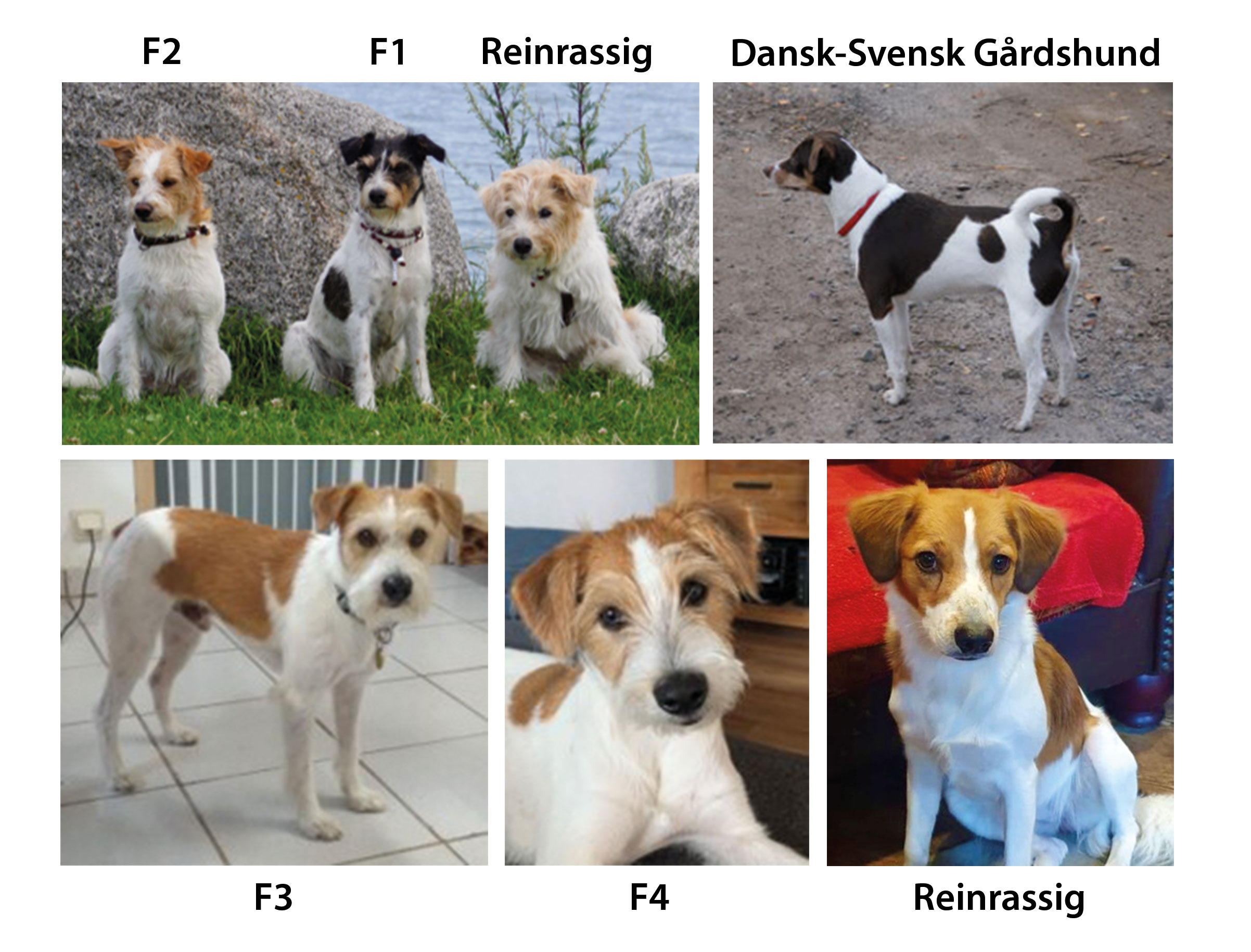
Phenotypic changes after outcrossing and backcrossing with purebred Kromfohrländers. The generations were documented phenotypically and genetically by determining genomic inbreeding coefficients (COI) taking into account 6 generations and heterozygosity values (HET).
F1 generation: COI – 0 %, HET – 47%
F2 generation: COI – 13%, HET – 36%
F3 generation: COI – 13 %, HET – 40%
F4 generation: COI – 19 %, HET – 36%
Purebred KFL: COI – 22 %; HET 34 %
Outcrossing
With outcrossing, one stays within the breed – but connects lines that previously had little or no genetic contact. The goal is the same as with outcrossing: more genetic diversity, less inbreeding pressure. The path is less radical.
Foreign lines are often used for this. That sounds tempting – “far away” sounds like “genetically very different”. But that is not necessarily true. Geographical distance is not a reliable marker for genetic difference. Before undertaking the considerable effort to organise a foreign stud dog – with all the administrative, health and logistical questions that entails – it is worth taking a look at the numbers: How high is the actual genetic diversity of both dogs? How related are they really?
Genomic analyses can answer this precisely. An outcross planned on the basis of such data is significantly more accurate than one that relies solely on hearsay or geographical intuition.
Another point that should not be underestimated: Not all FCI-affiliated clubs have the same breeding requirements. Health information from abroad is sometimes difficult to access or simply not available. This is no reason to forgo international breeding partners – but a good reason to look closely.
Utilising the existing gene pool
The fastest and most practical strategy – if the prerequisites are right – is the clever use of the existing gene pool. This means: no alien breeds, no major effort, but targeted partner selection based on genomic data.
The prerequisite is that the breed has been extensively genetically typed. If genomic inbreeding coefficients and heterozygosity values are available, concrete statements about potential breeding pairs can be made through bioinformatic evaluations. The breeder sees whether a planned mating reduces the degree of inbreeding, whether it brings added value for the puppies – or whether another combination would be more sensible.
That sounds technical, but has very tangible consequences: Long-term sensible breeding management can be built up this way, step by step, without having to immediately reach for the most elaborate tool in the toolbox.
And that is the actual core: Not every situation demands an outcrossing project. Sometimes it suffices to look more closely at what is already there. But for that, one needs the data. Our task for the future must be to truly get to know our breeds on a genetic level – and not to understand this knowledge as a threat, but as what it is: an opportunity.
With the scientific knowledge available today and the long-standing experience of good breeders, dog breeding can be reimagined. This requires courage – the courage to embrace new approaches without simply discarding the old ones. The generations of breeders before us acted according to the best understanding of their time. That remains the standard today.
Our dogs have helped shape human culture over millennia. Every breed carries a history within it, a relationship with the people who shaped them. Preserving this diversity is not sentimentality – it is responsibility. The breeding decisions we make today will shape the populations of tomorrow. Breeding dogs means thinking in generations.
For those interested, there is a two-part webinar on the topic of “Breeding and Population Management”. This will take place in May 2024 and can be booked via Caniva.
Glossary of terms
Genetic Diversity
Genetic diversity in dogs refers to the variety of genes within a dog breed or population.
Effective Breeding Population
The effective breeding population denotes the number of dogs in a breed that are used in breeding progra
- Müller et al. (2009): Pedigree analysis for conservation of genetic diversity and purging. Genetics Research 91(6):341–351. Cambridge University Press.
- Wernick et al. (2019): vWDI is inherited in an autosomal dominant manner with incomplete penetrance in the Kromfohrländer breed. BMC Veterinary Research / PMC.
- Pedersen et al. (2015): A search for genetic diversity among Italian Greyhounds and the effect of inbreeding on autoimmune disease. Canine Genetics and Epidemiology 2:14. BioMed Central.
- Pedersen et al. (2012): The effect of genetic bottlenecks and inbreeding on the incidence of two major autoimmune diseases in Standard Poodles (SA and Addison's). PLOS ONE.
- The Canine Genetics Centre, University of Cambridge: Breeding with Carriers.
- The Kennel Club UK: Manage and maintain genetic diversity in your breed.
- Mikkola et al. (2024): Genetic Regulation of Immune Response in Dogs. Frontiers in Veterinary Science / PMC.
- ProKromfohrländer / Sommerfeld-Stur (2014): Genetic diversity – a fountain of youth for breeding populations. Wuff 05/2014.
- American Kennel Club (AKC): Understanding Autosomal Recessive Conditions in Dogs.