
German Shepherd: Breeding for Harmful Traits or Not?
Content
Dog breeds change – and not always for the better. Some have been bred smaller, flatter, more wrinkled or round-headed over the decades, mostly simply because people liked it that way. What causes excitement on Instagram or in the show ring can mean a lifetime of pain for the dog itself.
In the blog post series “Breeding for harmful traits (Qualzucht) or not?”, we take a closer look at individual breeds: What did the dog originally look like? Which traits are now considered breeding for harmful traits? And are there still healthy representatives – or has the breed become so closely linked to health problems that it is hardly possible to distinguish between them? Today’s focus: the German Shepherd.
Origin and History of the Breed
The German Shepherd emerged in the late 19th century when various regional herding dog lines were deliberately brought together. The driving force was Max von Stephanitz, who is regarded as the founder of the breed. His credo was unambiguous: The dog should be useful – not beautiful. He aimed for an intelligent, resilient, agile working dog that is manageable and willing to work.
Originally, German Shepherds were medium-sized, with a straight back, strong musculature and genuine enthusiasm for work. They were used as herding, guard and service dogs, and later also by the police and military.
The Breed “German Shepherd” Today
Somewhere along the way through the decades, the breed split into two very different directions:
- The working line is still relatively close to the original working dog – workability, nerve strength, and health are in the foreground.
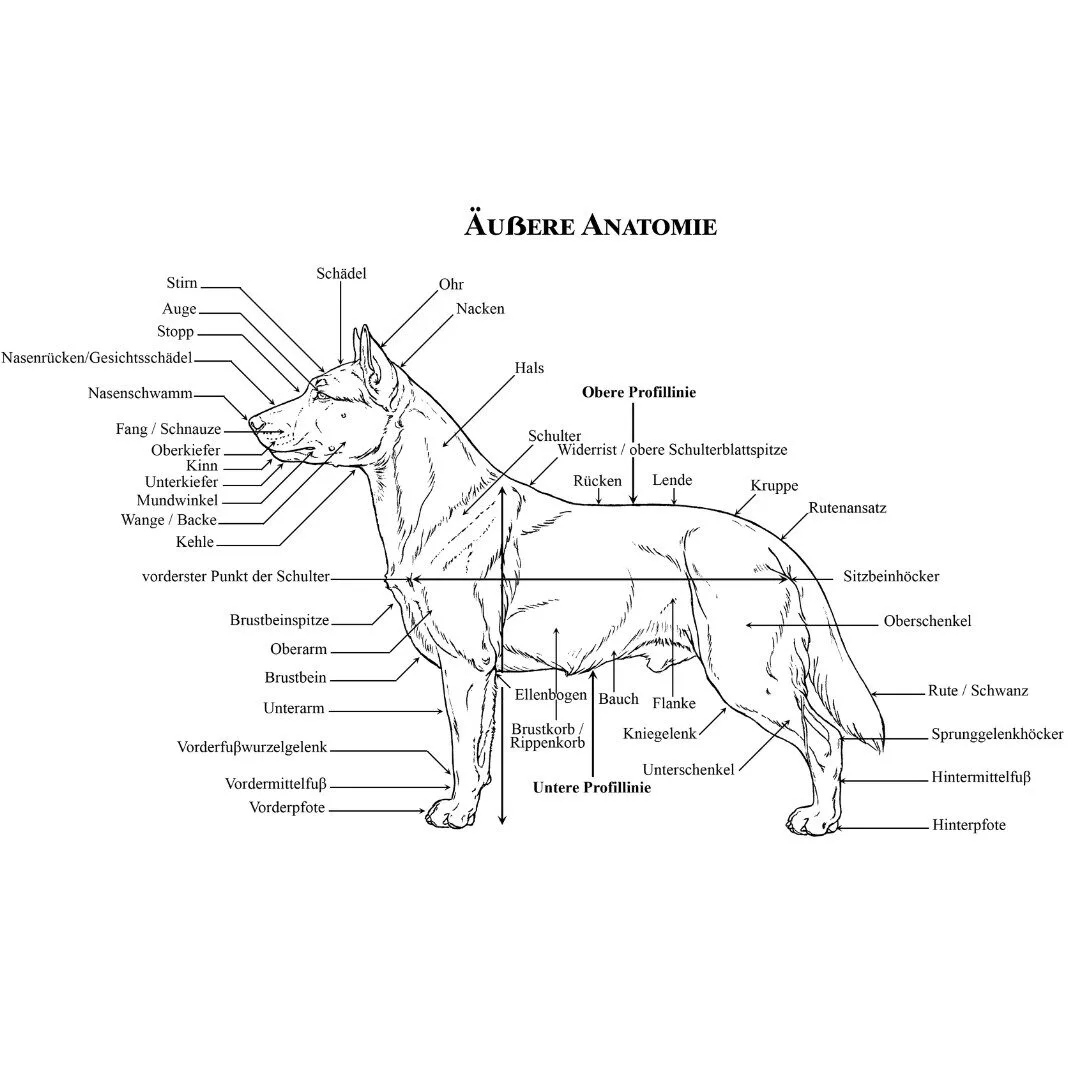
- The show line, on the other hand, has a very specific appearance in mind: steeply sloping backline, strongly angulated hindquarters, the so-called croup slope.
It is precisely these traits of the show line that are currently facing massive criticism – and not only because of the appearance, which many people find strange anyway, but because of what they do to the dogs.
Frequent Health Problems in German Shepherds
Overangulation of the Hindquarters and Steeply Sloping Back
Anyone who has seen a German Shepherd from the show line at a large dog show knows what is being talked about here: The hindquarters hang low, the rear end looks almost compressed, the dog shuffles rather than walks – and this sometimes already happens at the age of two or three years.
The exaggerated angulation of the hindquarters combined with a sloping croup (steeply inclined pelvis) changes the entire gait. Instead of moving forward powerfully and straight, many of these dogs drag their hind paws almost along the ground. What follows is predictable:
- Premature wear of the joints
- Increased susceptibility to orthopaedic diseases
- Permanent incorrect loading of the spine and hips
- Noticeable restrictions in mobility and quality of life

Diseases of the Locomotor System
Hip dysplasia (HD)
HD is one of the best-known and unfortunately most common problems in German Shepherds. The hip joint is not properly formed – this leads to instability, pain, restricted movement and, in severe cases, lameness. The disease is hereditary, but can certainly be reduced through consistent breeding selection. In the show line, however, this was often – and partly still is today – treated with neglect.
Elbow dysplasia (ED)
This joint disease also occurs frequently and can lead to chronic pain and early arthritis – another problem that could be influenced by targeted breeding selection.
Degenerative myelopathy (DM)
This disease is particularly insidious: It is incurable, affects the spinal cord and slowly but surely leads to paralysis of the hindquarters. Affected dogs drag their paws, stumble, lose control over their hind legs – and this is initially easily confused with orthopaedic problems. DM is hereditary, a genetic test exists, but it is not used comprehensively.
Are there any healthy representatives of this breed?
Yes, they do exist – and this is no empty hope. Particularly in performance breeding, much more emphasis is placed on health, functionality and temperament. Dogs from these lines generally have a straight back, moderate angulation and bring the willingness to work and nerve strength for which the breed was originally known.
There are certainly breeding facilities that consciously distance themselves from beauty ideals and breed consistently for health. However: Anyone looking for a German Shepherd must ask specifically for this and really inform themselves – buying because the puppy looks the prettiest is not enough here.
Conclusion German Shepherd: Breeding for Harmful Traits or Not?
The German Shepherd as a breed is not breeding for harmful traits per se. But certain breeding lines – there is no sugar-coating this – definitely are. Dogs with a strongly sloping topline and exaggerated hindquarter angulation often carry the consequences of purely appearance-motivated breeding selection with them throughout their lives.
Anyone who wants to acquire a German Shepherd should definitely pay attention to an origin from a performance-oriented, health-conscious breeding line. Then the German Shepherd remains what it always was and should be: a loyal, clever and versatile dog – useful, as Max von Stephanitz wanted.