In short
You calculate the daily requirement using RER (70 × kg⁰·⁷⁵) multiplied by the activity factor 1.2–2.0; protein quality and Ca:P ratio (1:1 to 2:1) complete the ration.
Content
- Energy Requirement: From Resting Value to Daily Requirement
- Protein: At Least 18 Percent in Dry Matter
- Fat: Energy carrier and satiety – but not unlimited
- Vitamins and trace elements: per kilogram of food, not per kilogram of dog
- Water: The underestimated component
- If something doesn’t fit: Body Condition Score
- Frequently asked questions
10 sourcesUpdated September 17, 2026Responsible editor: Roger Klein
In short: First calculate your dog’s resting energy requirement (RER = 70 × kg⁰·⁷⁵) and multiply it by the appropriate activity factor. This gives the actual daily requirement. The rest is regulated by protein quality, the calcium-phosphorus ratio and a weekly body condition check.
The most important points in brief
- You calculate the daily requirement (MER): RER times activity factor 1.2–2.0, depending on your dog’s exercise.
- Adult dogs need at least 18 percent crude protein in dry matter, puppies at least 22.5 percent.
- Vitamin and mineral values apply per kilogram of food dry matter – not per kilogram of body weight.
- The calcium-phosphorus ratio should be between 1:1 and 2:1; an inverse ratio harms bones in the long term.
- The body condition score (scale 1–9, target value 4–5) shows you more reliably than any ration formula whether the feeding is correct.
Feeding is the topic where dog owners get lost most quickly – between BARF forums, dry food studies, influencer recommendations and vet diets, the temptation is great to follow every new theory. This article does things differently. We go through the few factors that really matter: what your dog needs per day in terms of energy and protein, which nutrients must not be missing, and how you convert this into practice without having to start studying nutrition science every time.
The regulatory basis for this is laid down in Europe by the FEDIAF Nutritional Guidelines (European Pet Food Industry Federation, version September 2024). They define minimum contents for essential amino acids, vitamins and trace elements in every complete feed. Anyone using dry food, wet food or self-cooked rations should at least know the FEDIAF values as a guideline.
Energy Requirement: From Resting Value to Daily Requirement
The energy requirement of a dog consists of two parts. You calculate the resting energy requirement (Resting Energy Requirement, RER) with the formula RER = 70 × body weight in kg0.75. For a 25-kilogram dog, this results in 70 × 8.55 ≈ 598 kilocalories per day. This is the energy that the dog consumes at rest, without any activity.
You get the daily requirement (Maintenance Energy Requirement, MER) by multiplying with an activity factor: neutered or less active dogs are at 1.2 to 1.4; normally active family dogs at 1.4 to 1.8; very active working dogs or adolescent dogs in growth at 1.8 to 2.0 and more. Seniors and highly sedentary animals can also be below 1.2. For our 25-kg dog with normal activity, this results in an MER of 600 × 1.6 ≈ 960 kilocalories per day. The factors are guidelines – reality corrects itself via body weight: anyone who ribs weekly and uses the body condition score system sees early on whether the calculation is correct.
Protein: At Least 18 Percent in Dry Matter
The FEDIAF and AAFCO minimum requirement for adult dogs is 18 percent crude protein in dry matter (DM). Puppies in growth need more: AAFCO recommends at least 22.5 percent DM, in practice puppy food often works with 22 to 32 percent DM – this is the range in which growth and bone building are well supplied without overloading the kidneys.
What is important is not only the quantity, but also the quality. Dogs cannot produce ten amino acids themselves and depend on intake from food: arginine, histidine, isoleucine, leucine, lysine, methionine, phenylalanine, threonine, tryptophan and valine. High-quality animal protein sources – poultry, lamb, beef, fish – cover this profile well. Plant sources such as soy or legumes can supply individual amino acids in smaller quantities or with lower bioavailability and should be supplemented or combined in complete feeds.
A small peculiarity: unlike cats, dogs do not require taurin as an essential nutrient. Dogs synthesise it from the sulphur-containing amino acids cysteine and methionine. For grain-free diets with a high proportion of pulses and for some predisposed breeds (Golden Retriever, Doberman), the FDA has investigated a possible link between certain diets and dilated cardiomyopathy (DCM) since 2018. The data is not conclusive, but it is sufficient reason to have your vet check the taurin status if you feed BARF or pulse-heavy food and your dog belongs to one of the at-risk breeds.
Fat: Energy carrier and satiety – but not unlimited
Fat provides more than twice as much energy per gram (9 kilocalories) as protein or carbohydrates (4 kcal/g each). This makes it an efficient energy carrier, especially for active dogs. FEDIAF recommends a minimum content of 5.5% crude fat in the dry matter for adult dogs and 8.5% for puppies. The essential fatty acids are linoleic acid (omega-6) and, to a lesser extent, alpha-linolenic acid (omega-3). Fish oil as a source of EPA and DHA is recommended for certain conditions and for joint health.
An excessive fat content in the food can promote overweight and trigger pancreatitis in predisposed breeds such as Schnauzers or Cocker Spaniels. The rule here is: observe and adjust individually – do not follow the blanket rule of “the more fat, the better”.
Vitamins and trace elements: per kilogram of food, not per kilogram of dog
A common confusion in dog nutrition literature concerns the reference size for vitamin and mineral requirements. These values apply per kilogram of food dry matter, not per kilogram of dog body weight. FEDIAF 2024 states a minimum content of approximately 5,000 International Units per kilogram of food DM for vitamin A, and a minimum of approximately 500 IU per kg DM for vitamin D, with a safe upper limit of around 3,000 IU per kg DM. If you read values “per kg body weight”, you should be wary – this is usually a translation or conversion error and can quickly lead to drastic overdoses or underdoses.
For minerals, the calcium-phosphorus ratio is particularly important. FEDIAF and NRC recommend a ratio of 1:1 to 2:1 (calcium to phosphorus) for adult dogs. An inverse ratio – i.e., more phosphorus than calcium – can lead to nutritional hyperparathyroidism and bone problems in the long term. For puppies of large breeds, the absolute amount of calcium is additionally critical: too much leads to growth disorders, too little to rickets and osteopenia.
Water: The underestimated component
The water requirement of a healthy dog is approximately 40 to 60 ml per kilogram of body weight and day under normal conditions (MSD Veterinary Manual: around 44 to 66 ml/kg). In heat, with high activity, during lactation or with certain illnesses, the requirement can rise to 70 ml/kg or higher. Dry food significantly increases drinking requirements because it is supplied with about 8% residual moisture – wet or fresh feeding contributes considerably more water to the ration.
Permanent access to fresh water is non-negotiable. If you notice noticeably increased drinking (polydipsia) in your dog, you should have it checked by a vet – it can be an indication of diabetes, Cushing’s disease, kidney disease or other metabolic problems.
If something doesn’t fit: Body Condition Score
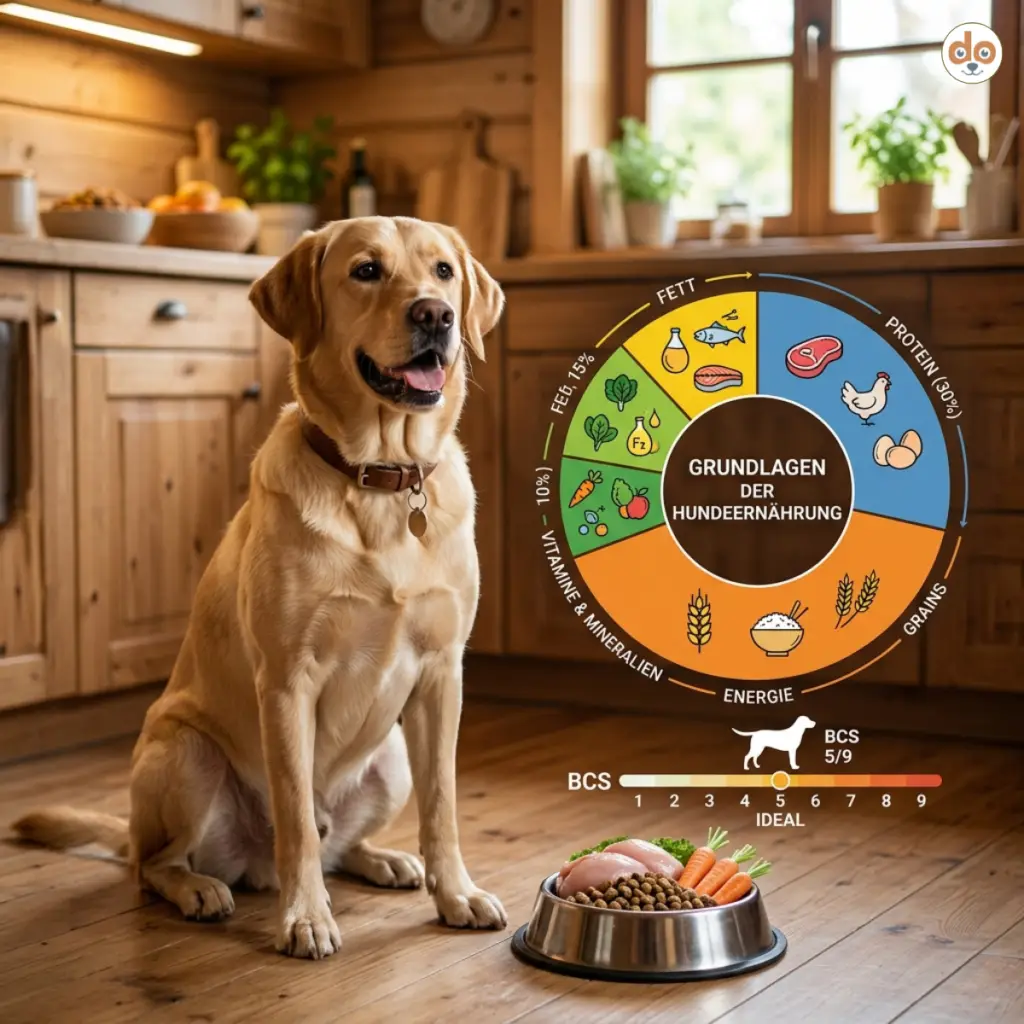
The most reliable way to check whether your ration calculation is correct in practice is not the scale alone, but the Body Condition Score (BCS). On a scale of 1 to 9, 4 to 5 is considered ideal: ribs can be felt without pressure, a slight waistline is visible from above, and a slight abdominal tuck from the side. A BCS of 6 or 7 indicates overweight, 8 or 9 indicates obesity. If you palpate briefly every week and take a photo from above and from the side every few weeks, you will see creeping weight gains before they become a problem.
Frequently asked questions
How many kilocalories does my dog need per day?
Calculate the resting energy requirement with RER = 70 × kg0.75 and multiply by the activity factor: 1.2–1.4 for less active, 1.4–1.8 for normally active, 1.8–2.0+ for very active dogs. Then correct according to the Body Condition Score.
How much protein must be in good dog food?
At least 18% crude protein in the dry matter for adult dogs, 22.5% or more for puppies. Quality (essential amino acids, bioavailability) is at least as important as the pure quantity.
Do dogs really need taurin?
Not necessarily – dogs synthesise taurin from cysteine and methionine. However, for grain-free, pulse-heavy diets and for predisposed breeds (Golden Retriever, Doberman), a vet check is worthwhile because the FDA has been investigating a possible link to DCM since 2018.
How much water does my dog need per day?
40 to 60 ml per kilogram of body weight under normal circumstances, up to 70 ml/kg in heat, with activity or when feeding dry food. Noticeably increased drinking (polydipsia) is a reason for veterinary investigation.
How do I recognise if my dog is at an ideal weight?
Body condition score on the 1–9 scale: ribs palpable without pressure, slight waist visible from above, slight abdominal tuck from the side corresponds to BCS 4–5 (ideal). Palpate weekly, take photos every few weeks – detect gradual changes early.