
Beware of the promises: How to recognise genuine low-calorie dog treats
Most dog treats advertised as "low calorie" are calorie traps. The crude fat content reveals the truth; genuine low-calorie treats have a maximum of 8% fat.
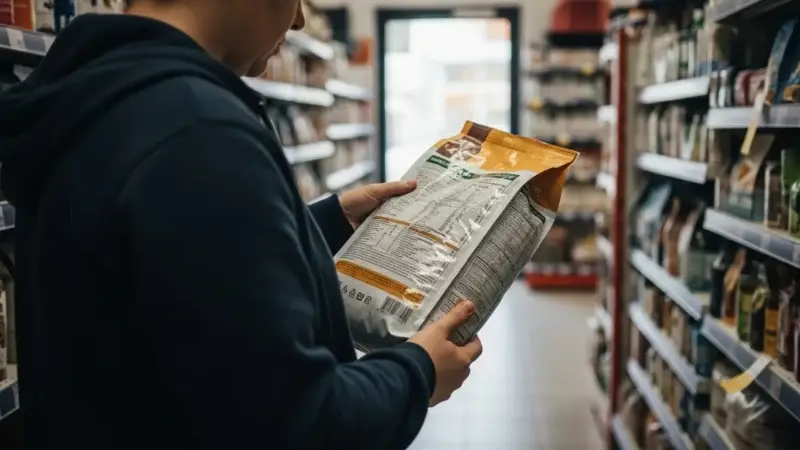 Source: legacy_text
 Content
- Which nutritional values make dog treats genuinely low-calorie?
- Why is the calorie content never stated on the pack?
- How do I spot hidden calorie bombs in the ingredients list?
- What crude protein content makes sense for low-calorie treats?
- Why crude fibre is crucial for low-calorie treats
- Does moisture content make a difference?
Your dog is sitting in front of you, waiting for its treat. You reach for the pack with the “low calorie” label, but wait. A look at the back shows: 15% crude fat, corn syrup in second place on the ingredients list. That is not a low-calorie treat.
Most dog owners fall for clever marketing. “Light”, “low calorie”, “suitable for diets” – these are advertising claims without clear definitions. The truth lies in the analytical constituents.
Which nutritional values make dog treats genuinely low-calorie?
A low-calorie dog treat contains a maximum of 8% crude fat. Anything above that unnecessarily drives up the calorie count.
Fat provides more than twice as many calories as protein or carbohydrates. A treat with 15% crude fat has about 60% more calories than one with 6% crude fat, for the same portion size. Your dog’s weight will notice this quickly.
Genuine low-calorie treats start at 5% crude fat or less. Between 5-8% is still acceptable if the other values are correct.
Why is the calorie content never stated on the pack?
In Germany, manufacturers do not have to print calorie information on dog food. That is no coincidence.
You have to calculate it yourself: Crude fat × 9 + crude protein × 4 + carbohydrates × 4 = calories per 100g (rough guideline). A treat with 12% crude fat, 20% crude protein and 45% carbohydrates provides about 388 calories per 100g. That is not “few calories”.
Genuine low-calorie treats stay below 320 calories per 100g. Ideally below 280.
How do I spot hidden calorie bombs in the ingredients list?
Corn syrup, molasses, glycerine, potato starch – these are calorie traps disguised as “natural ingredients”.
If these ingredients appear in the first five positions, the treat is not low-calorie. Not even if it says “Light” or “Diet”. The order of ingredients corresponds to their weight proportion; what is listed far ahead is present in large quantities.
Particularly tricky: “Cereals and plant by-products”. This can be anything, from rice flour to sugar beet pulp. Without specific details, this is a warning signal.
What crude protein content makes sense for low-calorie treats?
Between 15-25% crude protein is optimal for low-calorie dog treats.
Protein is more filling than carbohydrates and helps maintain muscle mass during a diet. But: Too much protein is also converted into energy. Treats with over 30% crude protein are usually no longer a low-calorie option.
18-22% crude protein works best in practice. The dog is satisfied, and the calories remain within limits.
Why crude fibre is crucial for low-calorie treats
Crude fibre has zero calories but promotes satiety. 4-8% crude fibre is optimal.
But beware: Not all fibres are equal. “Plant by-products” can be sawdust or peanut shells, cheap fillers with no nutritional value. High-quality fibres come from carrots, pumpkin or apple pomace.
If only “crude fibre” is listed without a specific source, leave the treat on the shelf. At 10% or more crude fibre, it usually becomes unpalatable for the dog.
Does moisture content make a difference?
Yes, definitely. Treats with 20-30% moisture have fewer calories per piece than bone-hard biscuits with 8% moisture.
This is pure physics: Where there is water, there is less room for calorie-dense ingredients. Semi-moist treats are also more filling; your dog needs fewer pieces for the same feeling of reward.
Dry treats are more practical on the go, but they are more calorie-dense. That is the compromise.
Are 2-3 low-calorie treats per day enough for training?
For basic obedience, yes. For intensive training, you need more rewards; then break them into smaller pieces.
Can I simply portion normal treats smaller?
This only works to a limited extent. The calorie density remains the same, only the piece size changes. For genuine calorie bombs, this helps little.
Are homemade treats automatically lower in calories?
Not automatically. Recipes with lots of peanut butter or cheese are just as calorie-dense as bought ones. But you have control over the ingredients.
Why do low-calorie treats often taste bland?
Less fat means fewer flavour carriers. High-quality manufacturers compensate for this with meat powder or yeast extract rather than sugar or salt.
Are there low-calorie treats that actually taste good?
There are, but they cost more. Freeze-dried liver or heart have an intense flavour with little fat. The research on flavour preferences for diet food is thin; here, testing on your own dog counts.