
What does nutrition by life stage mean for your dog?
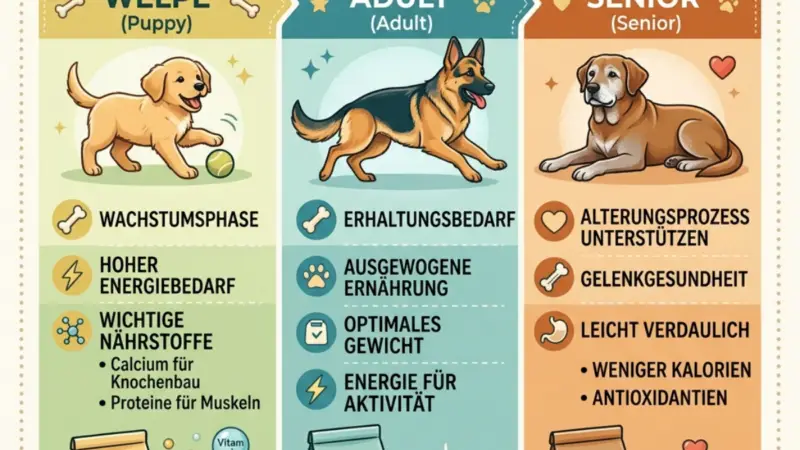
Dogs do not have constant biology. Their metabolism shifts with every life phase – and so does what really belongs in the bowl. Each phase requires a different nutrient composition: growth for puppies, maintenance for adult dogs, protection of muscle mass and joints for seniors.
A puppy‘s organism must reach up to 100 times its birth weight in just a few months. This is only possible with precise mineral supply and sufficient energy – but certainly not with too much of it. Overfeeding is no small matter: it leads to skeletal malformations that may not become apparent until months later.
An adult dog, on the other hand, needs stability. Maintaining body weight, nourishing coat and bones, keeping the immune system in good shape – this is no more exciting a task than the puppy phase, but one where mistakes (too many calories after neutering, too little protein) can also creep in quietly.
For seniors, it all comes down to one thing: protecting muscle mass. Older dogs metabolise less efficiently, they naturally lose muscle tissue – and therefore paradoxically need more protein with fewer calories.
The puppy phase: growth under optimal conditions
Puppies consume two to three times as much energy per kilogram of body weight as adult dogs. This sounds like “so feed a lot” – but it is not quite that simple.
The calcium-phosphorus ratio is the decisive lever here. Ideally, it lies between 1.3:1 and 1.5:1. If this is missed – either due to an incorrect ratio or simply excessive amounts – there is a risk of painful, partly irreversible skeletal diseases: hypertrophic osteodystrophy (HOD), osteochondrosis dissecans (OCD) or panostitis. Large breed puppies are particularly susceptible.
For large breeds, there is therefore specially formulated, energy-reduced puppy food. It deliberately slows down bone growth so that the skeletal structure can keep pace with the rest of the body – rather than outstripping it.
The adult phase: maintaining weight, preserving health
Adult dogs need less protein and minerals than puppies – but significantly more than was often assumed in the past. The FEDIAF standard specifies a minimum of 18 % crude protein (dry matter). For neutered animals or very active dogs, this shifts again.
Neutering is a real issue here that is often underestimated: energy requirements drop by up to 30 % after the procedure, while appetite increases by around 25 %. If you do not adjust the amount of food, you will often have an overweight animal after 12 months. From a Body Condition Score (BCS) of 6 on the 9-point scale, a dog is considered overweight – and with this, the risks for joint pain, diabetes and chronic inflammation increase noticeably.
The senior phase: protein protection instead of protein reduction
Here lies one of the most persistent misconceptions in dog nutrition: “Old dogs need less protein.” This is outdated – and in the worst case, harmful.
Yes, older dogs need about 25 % fewer calories. But the protein requirement increases. Modern nutritional therapy recommends at least 25 % crude protein (dry matter) for seniors to counteract natural sarcopenia – age-related muscle loss. A calorie-reduced senior food with high protein content is not a contradiction, but exactly what protects muscle strength and mobility in old age.
What many do not know: the point at which a dog is considered a senior depends heavily on breed size. Large breeds are already counted as such from 6–7 years of age, small breeds often only from 8–10 years.
Why is “All Life Stages” food problematic?
Many manufacturers offer “All Life Stages” formulas – a single food for puppies, adults and seniors. Practical? Yes. Nutritionally sensible? Rather not.
The problem is structural: puppy food must hit very different values for calcium and phosphorus than senior food. A compromise that tries to cover both extremes misses almost every dog in its own way. The puppy may get too much calcium, the neutered adult too many calories, the senior too little protein. No one is systematically provided for.
Anyone who wants to avoid vet costs and unnecessary suffering in the long term cannot do without life-phase-appropriate food.
Common mistakes and what really helps
A few mistakes keep cropping up in practice – and can be avoided if you know them.
The first: continuing to feed neutered dogs as before. The adjustment must begin a week before neutering, not after. Those who wait until the hunger noticeably increases are usually already too late.
The second: feeding seniors a low-protein diet. “Old dogs need less protein” is a rule of thumb from a time when we knew less. Energy reduction – yes. Protein reduction – no.
The third: aiming for rapid growth in large breed puppies. Slow, controlled growth with energy-reduced puppy food protects the skeleton. Those who are annoyed by the “sluggish” pace do not see the later problem.
A few more practical anchor points: feeding frequency should follow age – up to 3 months four times a day, from 3 to 6 months three times, from 6 months twice. Regularly check the amount of food, and every 6 to 12 months check whether the life phase is still correct. Dogs move into the next phase faster than you think.
When do you need professional support?
There are situations where a look at the food bag simply is not enough. A pet nutritionist or a vet with additional qualifications in the field of dietetics becomes sensible when:
your dog is already overweight, the transition from the puppy to the adult phase is approaching (particularly in large breeds), or a diagnosed condition – kidney disease, osteoarthritis, allergies – requires specific nutrient profiles.
A consultation is also worthwhile if there is visible muscle loss in a senior dog. Your vet can issue a referral or provide direct assistance.
FAQ: Life-stage-appropriate feeding
When can I switch my puppy to adult food?
This depends on the final size. Small dog breeds are fully grown at 10 to 12 months, medium breeds at 12 to 14 months, and large and giant breeds only at 18 to 24 months. Until then, puppy food belongs in the bowl – even if the dog no longer looks much like a puppy on the outside. The specialised mineral composition remains necessary.
Can I delay switching to senior food if my dog is still active?
Yes, age alone does not determine it. Activity level and metabolism play a real role. An 8-year-old Welsh Terrier with daily walks simply has different needs than an equally aged German Shepherd with osteoarthritis. Ask your vet for advice – they can assess this individually for your dog.
Why should I coordinate neutering and feeding in time?
Because the body reacts immediately after neutering: energy requirements drop, appetite increases. This is not imaginary, but biological. Those who switch to calorie-reduced food a week before the procedure catch this shift. If you wait until afterwards, weight gain is often already set in motion before you notice it.
Is there a critical time for switching from puppy to adult food?
Yes – particularly in large breeds. Here, the switch should only take place at 18 to 24 months. The longer mineral protection provided by specialised puppy food significantly reduces the risk of skeletal maldevelopment. After the switch, definitely adjust the amount of food: an adult dog will otherwise quickly get too much if you simply continue feeding the same amount as before.