
Why coffee wood and deer antlers are bad for dogs
Veterinarians warn: coffee wood and deer antlers can cause tooth fractures due to their extreme hardness. Beef hide chews and split water buffalo horn are safe alternatives.
Content
Coffee wood and deer antlers look like ideal chew toys at first glance – robust, natural, long-lasting. But cases are piling up in veterinary practices: tooth fractures that can be traced directly back to these hard materials. What is behind this?
Why is coffee wood dangerous for dog teeth?
Coffee wood measures 4–5 on the Mohs hardness scale – this corresponds roughly to granite. Sounds like a solid chewing partner, but it isn’t. Dog teeth consist largely of enamel, and that simply breaks under mechanical overload.
Imagine a 30-kg dog biting down: this generates forces of up to 180 kg per square centimetre. When this hits hard wood, the enamel slowly wears away. What remains invisible at first are microscopic cracks – which can eventually grow into a complete fracture.
In addition, there is a second problem that many do not have on their radar: pesticides such as chlorpyrifos and other organophosphates are often used on coffee plantations. According to manufacturer information, such substances can accumulate in the wood and enter the dog’s body when chewing.
What makes deer antlers a risk?
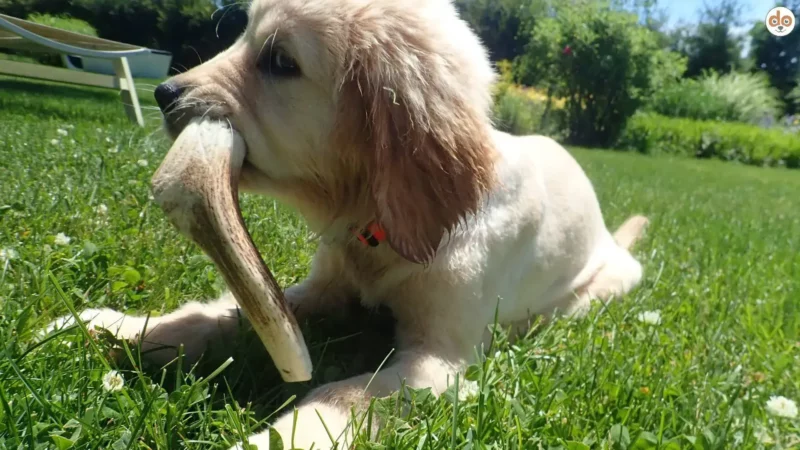
Deer antlers are even harder than coffee wood. The compact bone structure overloads even healthy dog teeth – no matter how strong the jaw is.
A fracture rate specifically for deer antlers has not been recorded; anyone who reads a percentage figure should ask about the source. However, dentally, antlers are considered a typical trigger for slab fractures on the upper fourth premolar, the largest molar in the upper jaw.
In addition, there is a mechanical risk: antler fragments can – especially with fast, greedy chewers – slip into the throat and get stuck. The sharp-edged fracture sites scratch gums and tongue in the process.
What safe alternatives are there?
Beef hide chews strike the right balance: hard enough for a dog to really enjoy chewing, but soft enough not to endanger the teeth. Pay attention to regional origin and ensure that the product is chemically untreated.
Water buffalo horn (split): Harder than beef hide, but significantly softer than deer antlers. The split variant is important – it prevents dangerous splinters from breaking off.
Chew roots (heather or olive): The natural fibres slowly dissolve when chewing, rather than splintering. A fine thing for moderate chewers.
Kong toys (Classic hardness): Probably the safest choice overall for strong chewers. The rubber gives way, relieves the teeth – and still withstands a lot.
How do I recognise tooth damage from hard chew toys?
A first sign is often changed chewing behaviour: if your dog suddenly starts chewing only on one side, or avoids its favourite chew toy, it is worth taking a closer look in the mouth. Specifically, look for yellowish or brownish discolourations on the tooth tips, small chips in the enamel, or bleeding gums.
A simple quick test: tap gently with your fingernail on the chew toy. Does it sound metallic? Then it is simply too hard for dog teeth.
How hard can a chew toy be at most?
The rule of thumb is simple and really works: a safe chew toy must be able to be indented with your fingernail. If the nail leaves no mark, the thing is too hard – get rid of it.
When does a chew toy become dangerous?
As soon as sharp edges or splinters form, the item belongs in the bin immediately. The same applies if the piece becomes smaller than a golf ball – then the risk of swallowing is real.
Which chew toys are suitable for puppies?
Puppy teeth are particularly sensitive and unforgiving. Frozen carrots, special puppy chew sticks or soft beef hide are the best choice here – anything else is risk without benefit.
Can damaged teeth heal again?
Unfortunately not. Tooth enamel does not regenerate – what is gone once, stays gone. Resulting fractures remain and can in the worst case lead to painful inflammation requiring veterinary treatment.
How often should I check my dog’s teeth?
If you regularly give hard chew items, check weekly. Otherwise a monthly check is sufficient – and don’t forget the back molars, which are most often overlooked.