
When the dog is blind: Causes, aids and tips for a fulfilling life
Progressive Retinal Atrophy is hereditary and rarer than often claimed. Concrete orientation aids and proven tools help your blind dog in everyday life.
Content
If your dog runs into the sofa or no longer reacts to thrown treats, your daily routine changes noticeably. The diagnosis of “blind” does not mean the end of a fulfilling dog life – but it presents you both with new challenges.
Why do dogs go blind?
Progressive Retinal Atrophy is a hereditary disease in which the photoreceptor cells of the retina die – first those for twilight vision, then all others. However, far fewer animals are affected than often reported: In an Italian evaluation of 133 tested Labrador Retrievers, only one was affected, while 15.79 per cent were healthy carriers. In Miniature Schnauzers, 25.32 per cent carried the predisposition, but none were affected. Those who read “every third Labrador” are therefore reading a carrier rate that has been mistaken for disease frequency – PRA is inherited recessively, and only those who have inherited both gene copies can become ill. The dog often does not notice it for months because it adapts to the gradual deterioration.
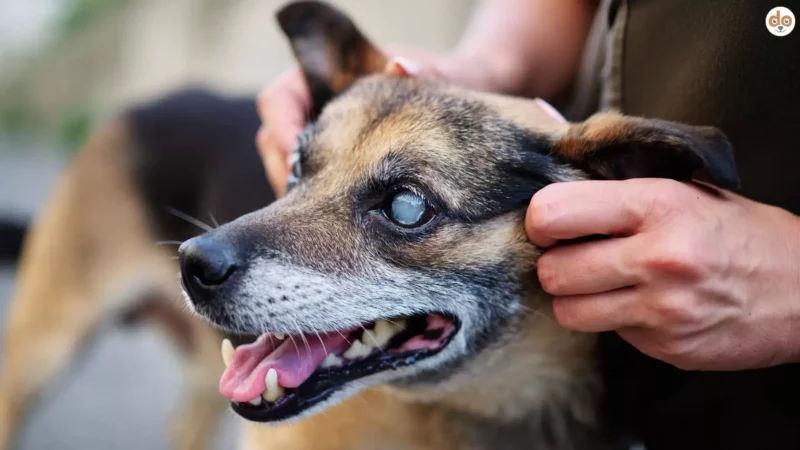
Cataracts usually develop between the sixth and tenth year of life. The lens becomes milky-opaque, as if someone were placing a film over the eyes. Unlike in humans, this operation can only be performed on dogs in specialised veterinary clinics – and costs between €2,000 and €4,000 per eye.
Injuries from branches during a walk in the woods or aggressive encounters with other animals can lead to immediate blindness. The insidious thing is: some eye injuries look harmless, while vision is already irreparably damaged.
How does a blind dog orient itself?
A blind dog builds up a scent map of its surroundings. Where you see the hallway, it smells the combination of shoe polish, your perfume and wood cleaner. This landscape of scents becomes its most important navigation aid.
Hearing takes over long-range reconnaissance. A blind dog’s ear can locate footsteps from a great distance and distinguish between the footsteps of different family members. Therefore, speak consciously when you enter a room – appearing silently startles blind dogs.
The snout becomes a white cane. Blind dogs hold their heads slightly lowered and feel ahead with their noses. This looks unusual, but it is their way of recognising obstacles in good time.
Which aids really work?
The Muffin Halo, a padded ring around the head, prevents collisions with table legs or door frames. It costs between 60 and 120 euros. According to our editorial experience, most dogs get used to it within two weeks.
Stair gates at the top and bottom of every staircase are mandatory. A fall down three steps can lead to serious injuries in a blind dog because it cannot cushion the impact. Plan for around 40 to 80 euros per gate.
Scent markers help with orientation in the house. A drop of lavender oil on the food bowl, peppermint at the front door – this is how you support your dog in building up its new mental map.
How do I meaningfully occupy a blind dog?
Sniffing games are particularly suitable as the main activity. Hide treats in crumpled paper or scatter them over a snuffle mat. This challenges the dog mentally and gives it a sense of achievement.
Fetch works with squeaking or scented toys. Throw the toy only short distances and let it squeak so that your dog can find it. Do not overdo it – five minutes of intensive searching work exhausts a blind dog more than half an hour of normal play.
How do I make walks safe?
Stick to the same two or three routes daily. Variety confuses blind dogs and stresses them. Choose paths without construction sites, bicycle traffic or other unpredictable elements.
Staying on a short lead is mandatory – off-leash walking is only possible in completely fenced areas without obstacles. A blind animal cannot recognise holes in the ground or approaching dangers in good time.
The stop command must be reliable. Your “stop” must take effect immediately – before kerbs, other dogs or unexpected obstacles. Practise this daily with positive reinforcement.
Can surgery restore vision?
In the case of cataracts: yes, usually. In an evaluation of 182 operated dog eyes, 86 per cent of the animals could see again at the last check-up – the follow-up period was on average half a year. The operation takes about one hour per eye and requires weeks of aftercare with eye drops. Not all dogs are candidates – diabetes or heart problems can be exclusion criteria.
In the case of progressive retinal atrophy: no. The photoreceptor cells have already died. Stem cell therapies are in research, but are not yet available.
In the case of injuries, it depends on the affected tissue. Corneal injuries sometimes heal by themselves, retinal damage is usually irreversible.
How do I recognise whether my dog is really blind?
The cotton ball test: drop a cotton ball in front of your dog’s face. A sighted dog blinks or dodges, a blind one does not react.
Moving furniture reveals blindness immediately. Move a chair by 50 centimetres. A sighted dog navigates around it without problems, a blind one walks into it.
All dogs are less well oriented at night – that is why first signs often only become apparent during the day. Pay attention to whether your dog hesitates or seems unsure in normal daylight.
How do I recognise pain in my blind dog?
Glaucoma (green cataract) causes severe headaches. The dog then rubs its face on furniture or avoids being touched on the head.
Which insurance covers blindness?
Pet health insurance covers treatment costs, but not preventive aids such as collars or harnesses.
Should I get a second dog as a guide dog?
Dogs do not develop a natural guiding relationship like guide dogs for humans. A second dog can even stress the blind dog additionally.
- Ghilardi S, Bagardi M, Frattini S, Baroniga GE, Brambilla PG, Minozzi G, Polli M (2023): Genotypic and allelic frequencies of progressive rod-cone degeneration and other main variants associated with progressive retinal atrophy in Italian dogs. Veterinary Record Open 10(2):e77
- Edelmann ML, Mohammed HO, Ledbetter EC (2022): Retrospective evaluation of phacoemulsification and aspiration in 182 eyes: Visual outcomes and CDE-predictive value. Veterinary Ophthalmology 25:316–325