
01Summary
In a paragraph
If you only have 30 seconds.
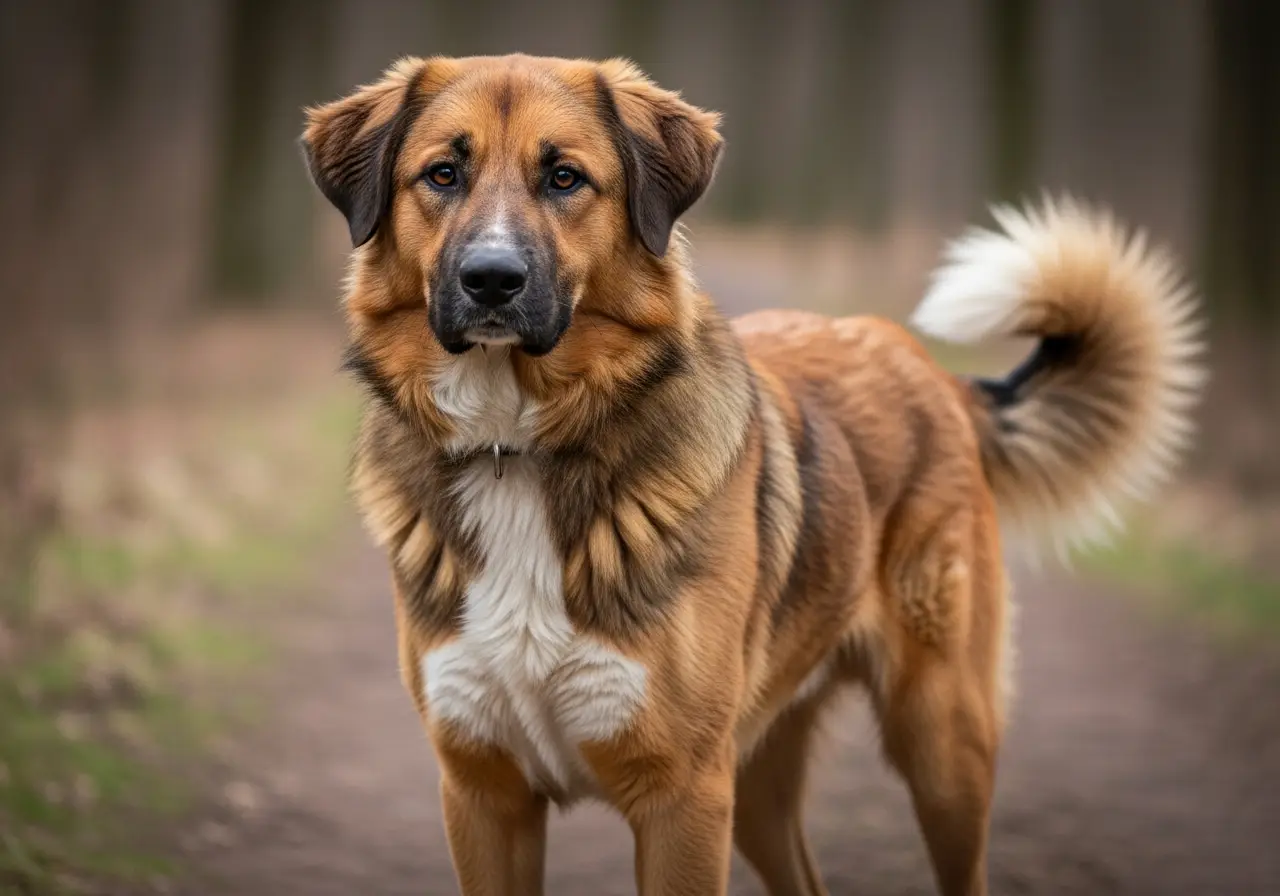
The Aidi is a North African watch and guard dog from the Atlas Mountains that thinks independently and requires a clearly defined territory. Its loyalty to its primary caregiver is pronounced, whereas it shows deep distrust towards strangers. Anyone keeping this dog takes responsibility for a serious working dog with strong protective behaviour, not for a sociable companion.
02Introduction
What makes the Aidi special
The Aidi is a Moroccan livestock guardian dog from the Atlas Mountains, FCI Group 2, sturdy and weather-resistant, with a withers height of 52–62 cm.
03Profile
Key facts and suitability
- Origin
- Marokko
- Original purpose
- Livestock guardian dog, guard dog in the Atlas Mountains
- FCI
- No. 247 · Group 2 · Sektion 2: Molossoide, Berghunde
- height at the withers
- 52–62 cm
- Weight
- 20–25 kg
- Life expectancy
- 10–13 Years
- Coat type
- Doppel
- Minimum exercise
- 90 min/day
- Puppy price
- 800–1'500 CHF
- Waiting period
- 9 months
- Sports
- Schutzhund · Mantrailing · Scent work
04Temperament
How the Aidi shows up in everyday life
When you come home, the Aidi does not greet you with an exuberant welcome ritual. It registers your arrival, briefly assesses the situation and then returns to its task: keeping an overview of its territory. This reaction is not disinterest; it is an expression of its working mentality.
Internally, the Aidi requires a high degree of mental stimulation and exercise. Its need for mental work lies significantly above that of many companion dogs. Anyone who only offers daily walks underestimates what this dog brings genetically. It wants to control, guard and judge independently. Nose work, field work or clearly structured tasks in its own territory correspond to its profile.
Externally, i.e. in terms of reaction to strangers, the Aidi shows a fundamentally different picture. It behaves reservedly to distrustfully towards unknown people. This behaviour is not poor training but genetically anchored. An Aidi that joyfully greets every visitor would not be a typical representative of its breed.
These two axes must not be confused: a high need for social contact with the reference group does not mean openness towards strangers in the Aidi. Anyone who overlooks this and uses the dog in changing social situations with many unknown people creates stress, both for the dog and in its environment.
In everyday life with his own family, he shows reliability and attentiveness. He handles children he has known since they were young calmly. Changing visitor situations, loud company or tight urban environments significantly increase the management effort.
05Needs
What this breed needs daily
The Aidi needs at least two hours of active enrichment daily, a considerable part of which should consist of tasks that challenge its mind. Pure walking rounds on familiar paths do not fully meet its needs.
Forms of exercise that correspond to its profile: extensive field work in difficult terrain, nose work with varying tasks, structured territory work on a secured property. Sports such as mantrailing or protection sports can be meaningful supplements but require experienced handling.
It tolerates being left alone for up to about five hours if its territory is clearly defined and secured. Permanent isolation without a task leads to undesirable territorial behaviour; the dog begins to set boundaries independently, which can become problematic in a household context.
A secured property is not an option but a prerequisite. The Aidi needs a clearly demarcated territory that it recognises as its own and can protect. Pure apartment keeping without a controllable outdoor area does not meet its basic needs.
Mentally, it needs an owner with calm, consistent handling and reliable structure. Pressure or inconsistent rules lead to it interpreting situations independently, with results that the owner cannot always foresee. Regular training sessions with a clear goal are more important than sporadic intensive enrichment.
Exercise
High
mental work
A lot
Social needs
Medium
training
Demanding
06Sport & Mental and Physical Stimulation
What sports the Aidi is suited for
Realistic in terms of physiology and genetics – not every breed suits every sport.
Structurally and physiologically suitable: CaniCross / bikejoring possible.
07Quick Check
08Suitability
Who this breed is suitable for – and who it isn't
✓Matches
The Aidi suits owners with proven experience in handling independently working guard or livestock guardian dogs. Anyone who has already handled a Kangal, a Caucasian Ovcharka or a comparable dog brings a relevant foundation.
Suitable owners have a secured, spacious property that offers the dog a clearly defined territory. At least two hours of active enrichment daily, a considerable part of which with mental work, must be guaranteed permanently.
Families in quiet, rural or suburban locations with manageable visitor traffic can live well with the Aidi if the leadership structure is clear and all household members consistently adhere to the same rules. Children who grow up in the household and have known the dog since puppyhood are generally accepted.
Owners who are willing to actively shape early and comprehensive socialisation, not delegate it, and who respect its protective instinct as a serious behavioural trait will find in it a reliable, loyal dog with a clear character. Experience with positive, consistent training methodology without pressure tools is a prerequisite.
×Doesn't match
The Aidi is not suitable for owners who are keeping a dog for the first time. Its protective behaviour, independence and distrust of strangers require experience in handling dogs, not just good intentions.
Anyone living in a densely populated city, without access to a secure outdoor area or regularly hosting many unfamiliar people in the household will be in permanent conflict with the Aidi. Its territorial behaviour cannot be completely suppressed by training; it can only be guided in a structured manner.
Owners looking for a sociable, friendly companion dog that behaves relaxedly in changing social situations will be disappointed by the Aidi. Anyone who interprets its reserved interaction with strangers as an upbringing problem and tries to correct it through forced social contact risks stress reactions and loss of trust.
Households where the dog is regularly left alone for more than five hours, without its territory being clearly secured and structured, do not meet its needs. Anyone who has little time for consistent training and daily tasks should consider another breed. The Aidi does not forgive inconsistency; it fills any resulting gaps independently.
10Line reality
Show line, working line, breeder market
A formalised differentiation between working and show lines does not exist for the Aidi in Europe to the extent that it is known, for example, for the German Shepherd or the Labrador Retriever. The breed is bred in too small numbers outside North Africa to establish distinct breeding lines with different performance profiles.
Regional variants exist in Morocco and Algeria that differ in size, coat structure and working intensity. Dogs from the high mountain regions of the Atlas tend to show a more robust constitution and more pronounced guarding behaviour than animals from lower altitudes. However, these regional differences are not systematically documented and rarely feed into European breeding decisions.
European specimens often come from imports with unknown or poorly documented origins. This means that anyone buying an Aidi in Europe does not know in many cases which regional context the dog comes from and what working profile its ancestors had. This uncertainty is a relevant factor when assessing individual character.
Anyone looking for an Aidi with traceable origins should specifically ask for breeders who maintain contacts with North African origin breeds and can document health checks.
11Health · Reality
What you need to plan for medically with your Aidi
The Aidi is considered a robust, primitive breed without the breed-typical civilisation problems documented in many modern breeding lines. The life expectancy is 10 to 13 years according to available information, although systematic long-term studies are lacking due to the small population size in Europe.
Hip dysplasia (HD) is the most frequently documented orthopaedic disease in large and medium-sized dogs. For the Aidi, there are no reliable breed-specific HD prevalence studies with a sufficient sample size. Due to the limited and partly poorly documented breeding base outside North Africa, an HD examination of both parent dogs before purchase is mandatory, not optional.
Skin problems can occur in poorly managed lines but are not classified as a main breed-typical problem. The medium-length, dense coat requires intensive care during the twice-yearly shedding periods and daily checks for matting and parasites.
Overweight is not a primary risk for sufficiently exercised Aidis kept in a species-appropriate manner. However, with restricted movement and incorrect feeding, it can develop quickly and exacerbate orthopaedic predispositions.
Preventive examinations that a responsible owner should plan for: annual veterinary check-up, HD screening of parent dogs before purchase, eye examination in puppyhood and regular dental checks. For imported dogs from North Africa, a complete parasitological examination is required immediately after entry.
12Structured data
Health by the numbers
Prone to diseases
Hip dysplasia; generally robust breed with few known hereditary diseases
Recommended health tests
Hip X-ray
13Myths ↔ Reality
What is often said incorrectly about this breed
Five myths, five realities, five sources.
The Aidi is a classic livestock guardian dog that lies quietly with the herd and only intervenes in an emergency.
Traditionally, the Aidi did not take on the passive protective role of a herd-lying dog, but acted actively as a guard of the surroundings. It patrols, assesses stimuli independently and reacts quickly. This active control behaviour is also shown in a household context; a quiet life without a task does not correspond to its profile.
Because the Aidi comes from a warm region, it cannot tolerate Central European climate.
The Atlas Mountains reach temperatures well below freezing and significant snowfall in winter. The Aidi was bred specifically for these conditions. Its dense, weather-resistant coat protects it from both cold and heat. A Central European climate does not pose a burden for a healthy Aidi.
The Aidi is aggressive and fundamentally unsuitable for family life.
Aggressiveness and protective behaviour are not the same thing. The Aidi shows pronounced loyalty and attachment towards its reference group. In a structured household with clear leadership and early socialisation, it can live stably in a family environment. What matters is the owner's experience, not the breed alone.
As a working dog, the Aidi requires little mental stimulation as long as it gets enough exercise.
The Aidi has a high need for mental work. Pure movement without a task does not meet its needs. Without meaningful enrichment (such as nose work, field work or clearly structured guard tasks in its own territory), it develops independent solutions that may be undesirable in a household context.
Because the Aidi is rare, all dogs available in Europe come from reputable breeding.
The rarity of a breed does not protect against unreliable sources; on the contrary. Many Aidis appearing in Europe come from unregulated imports from North Africa with unknown origins, missing health documentation and insufficient socialisation. For rare breeds in particular, a critical assessment of origin is especially important.
14animal welfare
The animal welfare perspective
Breeder market, designer versions, animal shelter reality — what no one writes in the puppy ad.
The Aidi is one of the rarest FCI-recognised breeds in Europe. This rarity does not protect against problems; it exacerbates them in certain areas.
The backyard breeder market deliberately exploits interest in exotic or rare breeds. Unlabelled imports from North Africa, often via informal channels or animal markets, end up on the market as purported Aidis without papers, without health checks and without traceable socialisation. Anyone acquiring such a dog does not know which breed they actually have in front of them, nor what behavioural imprints the dog experienced in its first weeks of life. The risk for owners and animals is significant.
Designer versions or crossbreeding trends currently do not exist to a relevant extent for the Aidi. This may change if the breed gains popularity through social media presence, a pattern already observed in other primitive breeds.
Breeding and keeping-related problems with the Aidi arise less from physical exaggerations than from mismatch: A dog with pronounced protective behaviour kept in an urban household without a task and without experienced guidance suffers and becomes a safety risk. Lack of socialisation in puppyhood permanently reinforces distrust towards environmental stimuli.
Rehoming via animal welfare organisations is a realistic option for the Aidi that should be seriously considered. Adult dogs from animal welfare allow for a more informed assessment of individual character than a puppy of unknown origin. Those who meet the requirements for an Aidi may find, through reputable rehoming centres, a dog that deserves a second chance.
15Costs · Transparency
What this breed realistically costs
The acquisition costs for an Aidi from serious, documented breeding in Europe are, where available, between 800 and 1,500 EUR. Offers significantly below this often originate from unregulated imports without health documentation; here, follow-up costs due to unknown pre-existing conditions must be factored in.
The annual living costs consist of: food (high-quality dry food or BARF for a medium to large dog) approx. 600–900 EUR/year, grooming (brushing, occasional professional care during coat change) approx. 100–200 EUR/year, basic equipment (lead, collar, transport box, sleeping area) one-off approx. 200–400 EUR.
Basic veterinary care (vaccinations, annual check-up, parasite prevention) is approx. 300–500 EUR/year. For imported dogs from North Africa, additional parasitological examinations should be planned in the first year (approx. 100–200 EUR).
Dog liability insurance is strongly recommended for a dog with pronounced protective behaviour; the annual premium is 80–150 EUR depending on the provider and coverage amount. Pet insurance or an emergency fund of at least 2,000–3,000 EUR for unforeseen veterinary interventions should be planned.
16Puppy search
What you need to consider when choosing a breeder
- Reputable Aidi breeders in Europe are rare.
- Anyone looking for a puppy must expect long waiting times and should use this time to thoroughly check the origin.
- Characteristics of reputable origins: The breeder is affiliated with a recognised association, such as the Club for South- and Eastern European Shepherd Dogs (KSOH) in the German-speaking area.
- Parent dogs have been tested for hip dysplasia (HD), and results are available in writing.
- The breeder allows a visit to the litter and shows the mother dog in a familiar environment.
- They ask questions about the living conditions and refuse a sale if the prerequisites are not met.
- Warning signs: Puppies without papers from unregulated imports from North Africa, offers with no possibility of a visit, sales via animal markets or classifieds portals without proof of breeding.
- Adoption through animal welfare organisations is an equally valid option for the Aidi.
- Adult dogs from animal shelters often come with a known history, which allows for a careful assessment of the individual character in a breed with pronounced protective behaviour.
- Experienced guidance from a dog training school familiar with livestock guardian and protection dogs is recommended in any case.
FAQ
Frequently asked questions about the Aidi
Is Aidi a family dog?
Aidi is considered suitable for families with good socialisation and species-appropriate care.
How much exercise does Aidi need?
At least around 90 minutes of exercise per day. As an active breed, more so — plus mental stimulation.
What is the size and weight of Aidi?
Fully grown, Aidi reaches about 52–62 cm at the withers and weighs around 20–25 kg.
What is the life expectancy of Aidi?
The life expectancy of Aidi is approximately 10–13 years.
Which diseases are common in Aidi?
Hip dysplasia; generally robust breed with few known hereditary diseases
17Breed clubs
Official breed clubs in DACH
19Related
Similar breeds – and their differences
You might also be interested in



Participate
Do you have a good photo of your Aidi?
We are looking for expressive images for our breed profiles. Submit yours; the editorial team reviews every submission before publication.
Does this breed suit you?
Territorial livestock guardian dog that requires consistent socialisation and experienced handling. Not a city dog – it needs space and a task.