
01Summary
In a paragraph
If you only have 30 seconds.
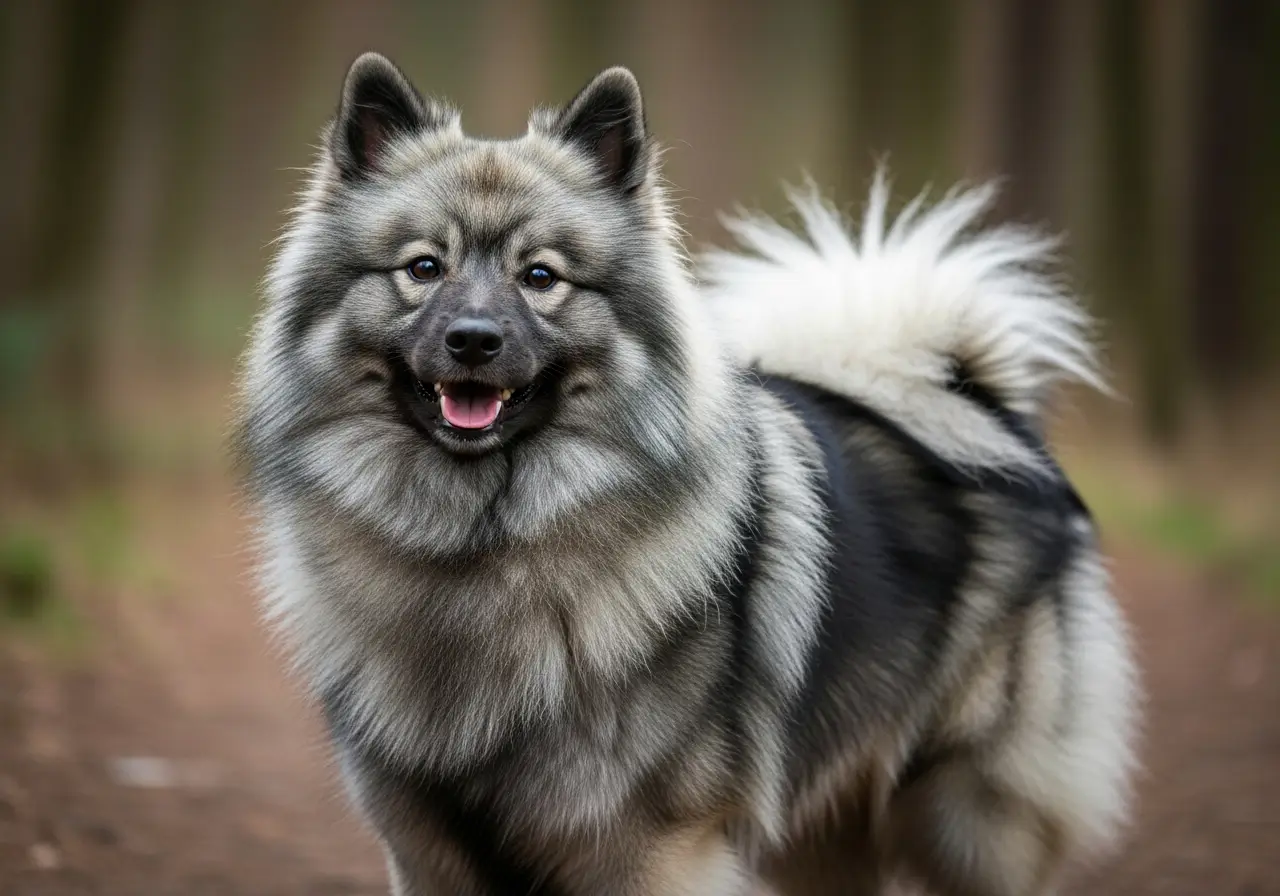
The Wolfspitz is the largest variety of the German Spitz, a robust, dense-coated watchdog with centuries-old tradition on farms and river ships. Its pronounced alerting behaviour is not a fault but a breeding characteristic. Anyone who underestimates this gives it up. Anyone who structures and guides it from the start receives an attentive, long-lived companion with strong family bonding and surprisingly little grooming effort compared to the coat mass.
02Introduction
What makes the Wolfsspitz special
Wolfsspitz: largest variant of the German Spitz family, alert, independent and with an impressive double coat
03Profile
Key facts and suitability
- Origin
- Deutschland
- Original purpose
- Guard and companion dog
- FCI
- No. 97 · Group 5 · Section 4
- height at the withers
- 43–55 cm
- Weight
- 17–20 kg
- Life expectancy
- 13–15 Years
- Coat type
- Doppel
- Minimum exercise
- 60 min/day
- Puppy price
- 1'500–2'500 CHF
- Waiting period
- 5 months
- Sports
- Agility Tricks
04Temperament
How the Wolfsspitz shows up in everyday life
When the front door opens in the morning and a neighbour enters the hallway, the Wolfsspitz alerts to this, loudly, clearly, immediately. This is not a mistake in training, but the result of centuries of targeted selection for alerting behaviour. Anyone who understands this can guide it. Anyone who ignores it will have a dog that reacts to every noise within six months.
Internally, the Wolfsspitz shows a high need for social contact: it is strongly oriented towards its key persons, seeks physical closeness and precisely registers mood changes in the household. Longer periods of being alone of more than four hours are stressful for most Wolfsspitze, not because they are separation-anxious, but because social inclusion counts as one of their basic needs.
Externally, the Wolfsspitz is reserved towards strangers. A Wolfsspitz that seeks contact immediately upon a stranger's first visit is the exception. The rule is: observe, alert, keep distance, and only approach after your own assessment. This reserve is not a sign of fear or lack of socialisation, but rather typical of the breed. It must not be confused with openness towards strangers.
On a walk, the Wolfsspitz shows moderate stamina. Two sessions of 30 to 45 minutes each per day cover its need for movement, supplemented by search games, nose work or structured obedience training. It is not purely an exercise dog. Its mind needs to be occupied just as much as its body.
It gets along well with children who handle it calmly and respectfully. Hectic activity and loud, unpredictable movements cause stress in it, which manifests as increased barking, not aggression.
05Needs
What this breed needs daily
The Wolfsspitz requires 60 to 90 minutes of active exercise daily, divided into at least two sessions. Pure off-leash areas without structure are not sufficient; the dog benefits from guided walks with changes of direction, search tasks or short training sequences that demand its focus.
Mental stimulation is not an optional extra. The Wolfsspitz was selected for alertness and a willingness to make decisions; a dog that stands in the garden for hours without a task will develop substitute activities, which are rarely desirable. Nose work, simple fetch exercises or trick training of 10 to 15 minutes daily measurably lower the threshold for barking behaviour.
Its alerting behaviour requires a clear rule from the start: one alert is allowed, silence on signal is mandatory. This rule must be applied consistently by all household members; inconsistency between people reinforces the behaviour.
The Wolfsspitz has a high need for social contact. It requires several hours daily in the company of its key persons. Being left alone can be trained, but cannot be extended indefinitely; four hours are considered a realistic maximum for a well-conditioned Wolfsspitz. Anyone who is regularly absent for longer periods needs a reliable care solution.
Outside of moulting periods, the coat requires two brushing sessions per week. During moulting, which occurs twice a year, daily brushing is advisable to prevent matting in the undercoat area. Ears and paws should be checked regularly.
Exercise
Medium
mental work
Medium
Social needs
High
training
Easy
07Quick Check
08Suitability
Who this breed is suitable for – and who it isn't
✓Matches
The Wolfsspitz suits owners who can plan at least 90 minutes daily for exercise and structured enrichment, divided into two sessions, not as a single evening walk.
Households with a regular daily rhythm and predominantly calm environment offer the Wolfsspitz optimal conditions. Anyone who works from home or can integrate the dog into their working day covers its need for social contact without additional effort.
Families with children from about eight years old, who treat the dog respectfully and do not rush at it uncontrollably, get along well with the Wolfsspitz. It is essential that all household members apply the same rules consistently, especially regarding alerting behaviour.
Owners who already have experience with independent or sensitive breeds will find a cooperative partner in the Wolfsspitz. First-time owners are not fundamentally excluded, but require a supporting dog training school and the willingness to actively guide barking behaviour from week one.
Anyone living in a house with a garden benefits from the additional opportunity for exercise, but the garden does not replace guided sessions. Keeping it in an apartment also works if alerting behaviour was structured early and the neighbourhood situation allows it.
×Doesn't match
The Wolfsspitz does not suit owners who are away from home for more than four hours daily and cannot organise a reliable care solution. Its high need for social contact is not a character flaw; it is genetically anchored and cannot be trained away.
Anyone who fundamentally finds barking behaviour disturbing and has no capacity to guide it in a structured way will be permanently dissatisfied with a Wolfsspitz. Alerting behaviour is typical of the breed and remains, even with good training, a characteristic of the dog. Anyone expecting absolute silence should choose a different breed.
Households with very young children under five years old, where hectic, unpredictable movements are part of everyday life, represent a source of stress for the Wolfsspitz. This does not necessarily lead to aggression, but to increased barking behaviour and withdrawal.
Anyone who buys a Wolfsspitz because of its impressive coat and assumes it is therefore an open, sociable dog towards strangers misunderstands the breed profile. Reserve towards strangers is not a training error; it is an expression of the external behavioural axis of this breed. Anyone looking for a dog that warmly greets every visitor immediately will not find it in the Wolfsspitz.
Owners who focus on physical endurance performance such as jogging over long distances or intense dog sports will find that the Wolfsspitz was not bred for this.
10Line reality
Show line, working line, breeder market
The Wolfsspitz is bred in Germany and Austria under the umbrella of the Verein für Deutsche Spitze e.V., and in the Netherlands under the Dutch Keeshond Club. A pronounced line differentiation between working and show lines, as exists for example with the German Shepherd Dog or Labrador Retriever, is not established for the Wolfsspitz.
The breed was historically not selected for protection work, hunting or field work, which is why no independent working line has emerged. All today's Wolfsspitze descend from a uniform breeding direction that is oriented towards type, coat and temperament according to FCI Standard No. 97.
Regional differences between German and Dutch lines are minor in practice. Dutch breeders traditionally place slightly more emphasis on the characteristic grey-black clouding pattern of the coat, whereas German breeders prioritise the overall type according to VDH standards. These differences are hardly relevant for the daily life of an owner.
Anyone acquiring a Wolfsspitz from abroad, particularly from Eastern European countries, should carefully check the breeding conditions and health screenings of the parent animals. There, there are occasionally populations without systematic health screenings, which increases the probability of hereditary diseases.
11Health · Reality
What you need to plan for medically with your Wolfsspitz
The Keeshond is considered a comparatively robust breed with a life expectancy of 12 to 15 years. This range is above average for a medium-sized dog and reflects the moderate breeding intensity of the breed.
Hip dysplasia (HD) occurs in Keeshonds, but it is less common than in large breeds. Reputable breeders have parent dogs radiologically examined for HD before breeding; an HD-free certificate for both parents is a minimum standard that you should demand when buying. Elbow dysplasia (ED) is less documented in Keeshonds, but lameness symptoms should be clarified by a vet.
Primary hyperparathyroidism (PHPT) is a genetically proven disease in the Keeshond/Wolfsspitz that leads to elevated calcium levels and kidney stones. A study by Cornell University (Skelly et al., 2005) identified the Keeshond as one of the few breeds with a frequent occurrence of this disease. A DNA test for PHPT is recommended before purchase; reputable breeders test their breeding dogs.
Eye diseases such as Progressive Retinal Atrophy (PRA) are documented. Parent dogs should have been examined by a veterinary ophthalmologist before breeding (ECVO examination).
The dense double coat carries an increased risk of skin problems if moisture is trapped under the undercoat, especially after bathing or in rain. Thorough drying after getting wet is important.
Overweight is a real risk for Keeshonds: the breed tends to gain weight with too high a calorie intake and insufficient exercise, which puts strain on joints and heart health. Regular weight checks by the vet, at least once a year, are advisable.
12Structured data
Health by the numbers
Prone to diseases
Hip dysplasia Eye problems
Recommended health tests
Hip X-ray Eye examination
13Myths ↔ Reality
What is often said incorrectly about this breed
Five myths, five realities, five sources.
"The Wolfsspitz only barks when it is really necessary.
The alerting behaviour of the Wolfsspitz is pronounced in a breed-typical manner and has been actively selected for over centuries. The dog acoustically alerts to almost every stimulus, doorbells, passers-by, noises from neighbouring flats. Without consistent guidance from puppyhood, this develops into a chronic barking problem that leads to conflicts in rented flats. According to reasons for return given to the VDH breeding club, underestimated barking behaviour is one of the most common causes for returns.
"The dense coat means enormous daily care effort.
The Wolfsspitz has a self-cleaning double coat that does not require daily care. Outside of the shedding periods, one to two brushing sessions per week are sufficient. The two annual shedding periods are critical, during which daily brushing is advisable to prevent matting. Clipping or trimming is not provided for according to the FCI Standard and permanently negatively alters the coat structure.
"As a guard dog, the Wolfsspitz also has a strong guarding instinct.
Watchfulness and guarding instinct are two different traits. The Wolfsspitz was selected for alerting behaviour, not for sharpness or guarding instinct. It shows reserve towards strangers and alerts acoustically; physical intervention or readiness to bite do not correspond to the breed profile. Anyone looking for a protection dog should choose a different breed.
"The Wolfsspitz is not an apartment dog because of its size.
With a height at the withers of 43 to 55 cm and a weight of 17 to 29 kg, the Wolfsspitz is a medium-sized dog. Keeping it in an apartment is possible if the alerting behaviour is structured early on and sufficient exercise as well as mental stimulation are ensured. The decisive factor is not the living space, but consistency in training and daily activity time.
"Wolfsspitze are beginner dogs because they are not dominant.
The Wolfsspitz is eager to learn and cooperative, which does not automatically make it an uncomplicated first-time dog. Its pronounced alerting behaviour, its sensitivity to inconsistency and its high need for social contact demand structured, calm leadership. Owners without experience in consistent training often underestimate how quickly unwanted behavioural patterns become entrenched. A supportive dog training school is expressly recommended for first-time owners.
14animal welfare
The animal welfare perspective
Breeder market, designer versions, animal shelter reality — what no one writes in the puppy ad.
The Keeshond ends up in animal shelters or is returned to breeding clubs disproportionately often, not due to aggression problems but because of underestimated barking behaviour. Owners who consider the alerting behaviour a temporary trait that will "settle down on its own" face a dog whose behaviour has become deeply ingrained after just a few months. This is not a failure of the dog.
On the backyard breeder market, the Keeshond is occasionally marketed as an "easy-to-care-for family dog with great fur", a portrayal that systematically omits its alerting behaviour and need for social contact. Puppies from such sources are often insufficiently socialised, which intensifies barking behaviour and reserve towards strangers. Missing health examinations of parent dogs (particularly for PHPT, HD and eye diseases) increase the risk of costly illnesses in adulthood.
Designer versions or crosses with Keeshond content, offered under names such as "Keeshond mix" or "Keeshond hybrid", are not subject to stud book registration or health standards. The behaviour of such dogs is harder to predict, and the risk of hereditary diseases is higher.
Keeshonds from animal shelters or via breed protection organisations are an equally valid option to buying a puppy, not the inferior one. Many of these dogs are adults, their temperament is assessable, and alerting behaviour can also be structured through consistent training in adult dogs. The Verein für Deutsche Spitze e.V. occasionally places returned dogs directly through the breeding club. An inquiry there is worthwhile before buying a puppy.
15Costs · Transparency
What this breed realistically costs
A Keeshond puppy from reputable VDH breeding costs between €1,200 and €1,800. Offers significantly below that, under €800, often come from backyard breeding without health screenings. The savings on purchase are often offset by higher vet costs in adulthood.
Annual living costs for a Keeshond are typically between €1,500 and €2,500, depending on food quality, insurance and grooming effort. High-quality dry food for a dog of this size costs €50 to €90 monthly. The coat does not require professional grooming; a good brush set (one-off €30 to €80) is sufficient for home care.
Vet costs in the first year of life (basic immunisation, deworming, chip, optional neutering) amount to €300 to €600. In adulthood, annual preventive examinations including blood tests should be calculated at €150 to €250. If a PHPT disease occurs, costs rise considerably due to medication and regular blood checks.
A dog liability insurance costs €50 to €120 annually for a Keeshond, depending on provider and coverage sum. A health insurance for the dog is optional, but worth considering for this breed due to the PHPT risk; annual premiums start at around €400.
16Puppy search
What you need to consider when choosing a breeder
- A reputable Wolfsspitz breeder is a member of the Verein für Deutsche Spitze e.V.
- (VDH) or an FCI-recognised partner association.
- Puppies from such breeding programmes are registered in the VDH stud book and receive an FCI pedigree certificate.
- The following points must be clarified during initial contact with a breeder: Have both parent dogs been tested for HD, PHPT and eye diseases (ECVO)?
- Are written certificates available?
- May the puppy be visited multiple times before collection, including visits to the mother dog?
- Are the puppies raised in the house rather than in kennels?
- Warning signs of dubious offers: puppies given away before eight weeks of age, no mother dog on site, sales via classified ad portals without a stud book number, prices significantly below €1,000 without a verifiable justification, pressure to make a quick decision.
- Placement through animal shelters or breed protection organisations is an equally valid alternative.
- Adult Keeshonds from placement bring an assessable temperament, their alerting behaviour is known, and their character is established.
- The Verein für Deutsche Spitze e.V.
- provides information on returned dogs and placement contacts upon request.
FAQ
Frequently asked questions about the Wolfsspitz
Is Wolfsspitz suitable for beginners?
Wolfsspitz is considered suitable for first-time dog owners.
Is Wolfsspitz a family dog?
Wolfsspitz is considered suitable for families with good socialisation and species-appropriate care.
How much exercise does Wolfsspitz need?
At least around 60 minutes of exercise per day.
Does Wolfsspitz suit an apartment?
With enough exercise and enrichment, Wolfsspitz can also be kept in an apartment.
What is the size and weight of Wolfsspitz?
Fully grown, Wolfsspitz reaches about 43–55 cm at the withers and weighs around 17–20 kg.
What is the life expectancy of Wolfsspitz?
The life expectancy of Wolfsspitz is approximately 13–15 years.
Which diseases are common in Wolfsspitz?
Hip dysplasia Eye problems
17Breed clubs
Official breed clubs in DACH
19Related
Similar breeds – and their differences
You might also be interested in
Participate
Do you have a good photo of your Wolfsspitz?
We are looking for expressive images for our breed profiles. Submit yours; the editorial team reviews every submission before publication.
Does this breed suit you?
Largest Spitz variant – less known than the Zwergspitz but more stable in size and character