
01Summary
In a paragraph
If you only have 30 seconds.
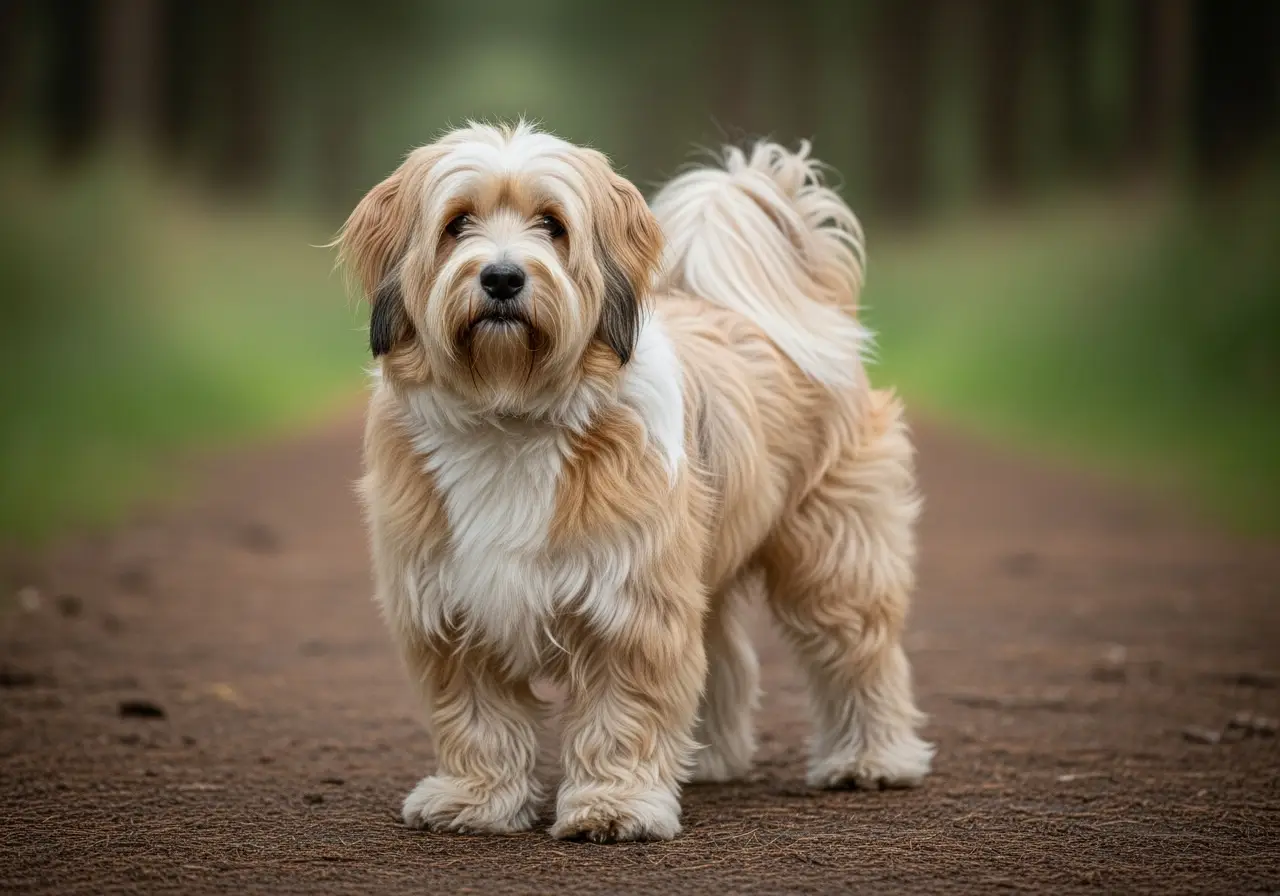
The Tibet Terrier originates from the Tibetan highlands, where it was used as a monastery and herding dog; it is no terrier, but rather a robust companion with an alert character. It bonds closely with its family, yet meets strangers with clear reserve. Its long coat requires daily care, and its mind demands regular enrichment. Anyone who underestimates these three axes (bonding, care, stimulation) will experience a dog that seeks its own path.
02Introduction
What makes the Tibetan Terrier special
Tibetan Terrier: neither a terrier nor an original hunting dog, a Tibetan companion dog with abundant coat and strong character
03Profile
Key facts and suitability
- Origin
- Tibet
- Original purpose
- Farm guard dog and companion
- FCI
- No. 209 · Group 9 · Section 5
- height at the withers
- 35–41 cm
- Weight
- 8–14 kg
- Life expectancy
- 12–15 Years
- Coat type
- Long-haired
- Minimum exercise
- 45 min/day
- Puppy price
- 1'200–2'000 CHF
- Waiting period
- 5 months
- Sports
- Agility Tricks
04Temperament
How the Tibetan Terrier shows up in everyday life
When a visitor enters the apartment, the Tibetan Terrier initially withdraws or observes from a safe distance. It barks clearly and purposefully. This is not a flaw but its historical working profile as a guard dog. Only after it has assessed the person does it approach—or perhaps not at all. This behaviour can be mitigated through early socialisation but cannot be trained away.
Towards its family, it behaves fundamentally differently. It seeks closeness, attentively accompanies daily routines, and registers changes in mood early on. Anyone sitting on the sofa in the evening will likely have it beside them—not because it was asked to be there, but because it wants to be.
On a walk, it shows endurance and curiosity. It likes to explore, follow scent trails, and react to movements in the surroundings. On a lead, it requires clear signals as it independently decides which direction interests it. It gratefully accepts off-lead exercise in secure terrain.
Internally (i.e., what it needs daily), the need for social contact comes first. Long periods alone are stressful for it. It also requires mental enrichment: search games, nose work, or structured training keep it balanced. Externally (i.e., in its reaction to the environment), it remains reserved towards strangers while getting along well with familiar conspecifics given good socialisation. Keeping these two axes distinct is crucial: A Tibetan Terrier can simultaneously be a very family-oriented dog and reserved towards strangers; this is not a contradiction but its profile.
05Needs
What this breed needs daily
The Tibetan Terrier requires 60 to 90 minutes of active exercise daily. Simple walks on paved paths are insufficient; it benefits from varied terrain that challenges its sure-footedness and curiosity. Trail runs, forest paths, or structured sniffing rounds at the dog park are well-suited.
Mental stimulation is equivalent to physical exercise. Nose work, search games, and simple training sessions with clear tasks keep it balanced. Without this component, many dogs of this breed develop behaviours indicating under-stimulation: persistent barking, restlessness, or excessive clinginess.
The need for social contact is high. The Tibetan Terrier is strongly oriented towards its primary caregiver and tolerates long periods alone poorly. Anyone who regularly leaves it alone for several hours should plan for a care solution. Being left alone can be built up gradually, but four hours daily should be considered the upper limit.
The coat requires daily grooming. An adult Tibetan Terrier with a full coat needs at least 15 to 20 minutes of brushing per day to prevent matting. Anyone unwilling to invest this time can have the coat clipped short, which significantly reduces the effort but does not correspond to the appearance specified in the FCI standard.
Training works best with calm consistency. The Tibetan Terrier reacts sensitively to pressure and impatience. Positive reinforcement with clear boundaries is more effective than repeated correction. Attending a dog training school during the first months of life helps establish basic structures.
Exercise
Medium
mental work
Medium
Social needs
High
training
Medium
07Quick Check
08Suitability
Who this breed is suitable for – and who it isn't
✓Matches
The Tibetan Terrier suits owners who can dedicate 60 to 90 minutes daily to exercise and additionally provide time for mental enrichment. Anyone working from home or with flexible working hours meets its need for social contact.
Families with children from around 8 years of age are suitable if the handling of the dog is respectful and calm. Toddlers who touch the dog unpredictably quickly overwhelm it.
Owners already experienced with sensitive or independent breeds will find a trainable, attentive companion in the Tibetan Terrier. First-time owners are also suitable provided they bring willingness for consistent, patient training and utilise a dog training school.
Anyone seeking an alert dog that announces visitors without reacting aggressively will find a reliable alarm in it. Its guarding behaviour is pronounced but controllable.
People who enjoy hiking, cycling with their dog, or discovering nose work as a shared hobby benefit from its endurance and curiosity. It is also suitable for quieter households as long as daily exercise is ensured and it does not remain alone permanently.
×Doesn't match
The Tibetan Terrier does not suit owners who are away from home for more than four hours daily and cannot organise a care solution. Its need for social contact is high; prolonged being left alone demonstrably stresses it.
Anyone wanting or able to invest little time in grooming should carefully weigh the decision for this breed. The long double coat requires daily attention; underestimating this risks skin problems and considerable care effort at the vet or dog groomer.
Owners seeking a dog that reacts openly and warmly towards strangers will be disappointed. The Tibetan Terrier is family-oriented, not sociable in the general sense. Anyone viewing its reserve towards visitors as a problem and attempting to train it away underestimates its genetic profile.
Households with very young children, where the dog is constantly exposed to unpredictable stimuli, are unfavourable for it. It requires retreat options and reliability in the daily routine.
Anyone looking for a dog that functions without structured training will not find the Tibet Terrier to be a suitable companion. Its independence requires consistent, patient leadership; a laissez-faire approach regularly leads to problems with barking, recall and daily structures in this breed.
10Line reality
Show line, working line, breeder market
The Tibet Terrier is bred primarily as a companion dog today and is not subject to a working test according to the FCI standard. A pronounced line differentiation between working and show lines, such as exists for retrievers or herding dogs, is not established for this breed.
Differences still exist within breeding that interested parties should know about. Breeders focused on exhibition success emphasise coat structure, proportions and gait according to the FCI standard. Breeders with a stronger focus on temperament and health prioritise character stability, social behaviour and preventive examinations.
In the DACH region, the breed is numerically manageable. The International Club for Tibetan Dog Breeds e.V. (KTR) and the Tibet Terrier Club of Switzerland (TTKS) coordinate breeding and maintain stud books. Litter numbers are low, so waiting times for puppies from reputable breeding are correspondingly longer.
Regional differences in breeding focus exist but are less pronounced than in breeds with a long tradition of working dogs. Anyone looking for a Tibetan Terrier should pay less attention to lineage labels and more to concrete health certificates, temperament tests of the parent dogs, and the breeder's transparency regarding precautionary examinations.
11Health · Reality
What you need to plan for medically with your Tibetan Terrier
The life expectancy of the Tibet Terrier is 12 to 15 years. This places it among the longer-lived medium-sized breeds, an advantage that, however, comes with a need for attention regarding breed-typical diseases.
Eye diseases are in the foreground. Progressive retinal atrophy (PRA) and lens luxation are genetically documented in the Tibet Terrier. The International Club for Tibetan Dog Breeds e.V. recommends eye examinations of breeding dogs before their use in breeding. Buyers should demand corresponding proof.
Hip dysplasia (HD) occurs in the breed, but is less frequent than in large breeds. Reputable breeders X-ray the parent dogs and disclose HD findings. An HD examination of the parent dogs is a minimum standard that buyers should demand.
The long double coat predisposes to skin problems if care is neglected. Matting leads to pressure points, skin irritation and, in severe cases, infections. Regular grooming is therefore not only aesthetic, but medically relevant.
Overweight is an underestimated risk in this breed. The Tibet Terrier shows a good willingness to eat; without controlled feeding and sufficient exercise, the weight increases quickly. Overweight puts strain on joints and demonstrably shortens life expectancy.
Preventive examinations that owners should plan for: annual eye examination by an ophthalmologist, weight check at the vet, dental check (the dentition tends towards crowding in some lines).
12Structured data
Health by the numbers
Prone to diseases
Hip dysplasia Eye problems
Recommended health tests
Hip X-ray Eye examination
13Myths ↔ Reality
What is often said incorrectly about this breed
Five myths, five realities, five sources.
"The Tibet Terrier is a terrier and therefore robust, independent and low-maintenance.
Taxonomically, the Tibet Terrier does not belong to the terrier breeds. The FCI standard classifies it in Group 9, Section 5 (Tibetan Dog Breeds) as a companion dog. Its long double coat requires daily care to prevent matting. Neglecting grooming risks skin problems and considerable pain when untangling later.
"Because it is so people-oriented, it is also open towards visitors and strangers.
High need for social contact with one's own family and reserve towards strangers are two different behavioural axes. The FCI standard explicitly describes the Tibet Terrier as 'reserved towards strangers'. Strong family bonding does not automatically mean openness towards unknown persons; this confusion frequently leads to misjudgements in everyday life.
"The Tibet Terrier is a calm lap dog that requires little stimulation.
The FCI standard describes it as 'lively' and 'alert' with the energy of a miniature guard dog. An adult Tibet Terrier needs 60 to 90 minutes of exercise daily as well as mental enrichment. Without sufficient stimulation, many dogs of this breed develop undesirable behaviour such as excessive barking or destructive activities.
"Tibet Terriers shed hardly at all, ideal for allergy sufferers.
The Tibet Terrier indeed loses little loose hair, as its coat follows a growth cycle similar to human hair. However, this does not make it a hypoallergenic dog: allergies are usually directed against the protein Can f 1 in saliva and skin flakes, not against the coat itself. No guarantee of suitability for allergy sufferers exists for any dog breed.
"As an old natural breed, the Tibet Terrier is free from hereditary diseases.
Breed-specific health risks also exist in old companion dog breeds. Progressive retinal atrophy (PRA), lens luxation and hip dysplasia (HD) are documented in the Tibet Terrier. Reputable breeders carry out appropriate preventive examinations and disclose results openly. The age of a breed does not protect against genetically determined diseases.
14animal welfare
The animal welfare perspective
Breeder market, designer versions, animal shelter reality — what no one writes in the puppy ad.
The Tibet Terrier appears less frequently in German-speaking animal welfare than moderate breeds such as the French Bulldog or Labrador. This does not mean that there are no cases of dogs being given up; it means that the reasons are specific and often predictable.
The most common reason for giving up a dog is underestimated grooming. Anyone who buys a Tibet Terrier as a "low-maintenance long-haired dog" will encounter reality at the latest after the first coat change: daily brushing, regular clipping or professional care by a dog groomer. Anyone who does not plan for this time faces a matted, unhappy dog, and the decision to give it up or incur significant vet costs.
The second common reason: misjudgement of character. The Tibet Terrier is sometimes described as a "small, calm companion dog" that fits into any life situation. In fact, it is alert, independent and strongly focused on its family. Anyone who does not expect this will experience a dog that barks, tests boundaries and does not tolerate being left alone.
Puppy farms and disreputable suppliers exploit the low awareness of the breed. Puppies from uncontrolled breeding without health certificates end up in rehoming situations more frequently because behavioural or health problems occur early on. A puppy without eye and HD findings for the parent dogs is a calculable risk.
Rehoming an adult Tibet Terrier from animal welfare or through the breed club is an equally valid option. Adult dogs already show their temperament; surprises regarding character are rarer than with puppies. Breed clubs such as the KTR or the TTKS occasionally rehome dogs from surrender situations and can help find a dog that fits into your daily routine.
15Costs · Transparency
What this breed realistically costs
A puppy from reputable breeding with club affiliation, health certificates and FCI papers costs between 1,200 and 1,800 EUR in the DACH region. Offers significantly below this often originate from uncontrolled breeding without preventive examinations; follow-up costs due to health problems regularly exceed the savings.
Ongoing costs per year: Food for a medium-sized Tibet Terrier ranges from 600 to 1,000 EUR depending on quality. Grooming by a professional dog groomer (three to four appointments annually) costs an additional 200 to 400 EUR. Those who groom the coat themselves save this expense but require suitable tools (brushes, comb, scissors: one-off investment approx. 80 to 150 EUR).
Average vet costs: Basic care (vaccinations, parasite prevention, annual check-up) amounts to 200 to 400 EUR annually. Eye examinations by an ophthalmologist cost 80 to 150 EUR per appointment depending on the practice. Dog health insurance for this breed costs between 40 and 90 EUR monthly depending on the provider and scope of benefits, significantly reducing financial risk in the event of unexpected illnesses.
Total costs in the first year (incl. getting a dog, basic equipment, vet, food, care): realistically 3,000 to 4,500 EUR. From the second year onwards: 1,500 to 2,500 EUR annually.
16Puppy search
What you need to consider when choosing a breeder
- Reputable breeders of the Tibet Terrier can be found through the International Club for Tibetan Dog Breeds e.V.
- (KTR) or the Tibet Terrier Club of Switzerland (TTKS).
- Both clubs maintain studbooks and require member breeders to adhere to minimum standards for health examinations.
- Specific criteria for a reputable breeder: The parent dogs have been tested for progressive retinal atrophy (PRA) and lens luxation, hip dysplasia X-rays are available, and the breeder discloses these results upon request.
- Puppies grow up in a home environment and are socialised early on.
- The breeder asks questions about your own daily routine and experience with dogs.
- Warning signs: puppies without a vaccination record, no personal conversation before purchase, handover under eight weeks of age, no opportunity to see the mother, offers via classifieds portals without club affiliation.
- Rehoming an adult Tibet Terrier through breed clubs or animal welfare organisations is an equally valid alternative.
- Adult dogs come with an already discernible temperament, which makes it easier to assess whether they fit into your daily routine.
- Waiting times for puppies from reputable breeding often amount to six to twelve months; this is normal for a numerically small breed and is not a sign of insufficient availability.
FAQ
Frequently asked questions about the Tibetan Terrier
Is Tibetan Terrier suitable for beginners?
Tibetan Terrier is considered suitable for first-time dog owners.
Is Tibetan Terrier a family dog?
Tibetan Terrier is considered suitable for families with good socialisation and species-appropriate care.
How much exercise does Tibetan Terrier need?
At least around 45 minutes of exercise per day.
Does Tibetan Terrier suit an apartment?
With enough exercise and enrichment, Tibetan Terrier can also be kept in an apartment.
What is the size and weight of Tibetan Terrier?
Fully grown, Tibetan Terrier reaches about 35–41 cm at the withers and weighs around 8–14 kg.
What is the life expectancy of Tibetan Terrier?
The life expectancy of Tibetan Terrier is approximately 12–15 years.
Which diseases are common in Tibetan Terrier?
Hip dysplasia Eye problems
17Breed clubs
Official breed clubs in DACH
19Related
Similar breeds – and their differences
You might also be interested in
Participate
Do you have a good photo of your Tibetan Terrier?
We are looking for expressive images for our breed profiles. Submit yours; the editorial team reviews every submission before publication.
Does this breed suit you?
Despite the name, not a classic terrier – adaptable and very suitable for active families