
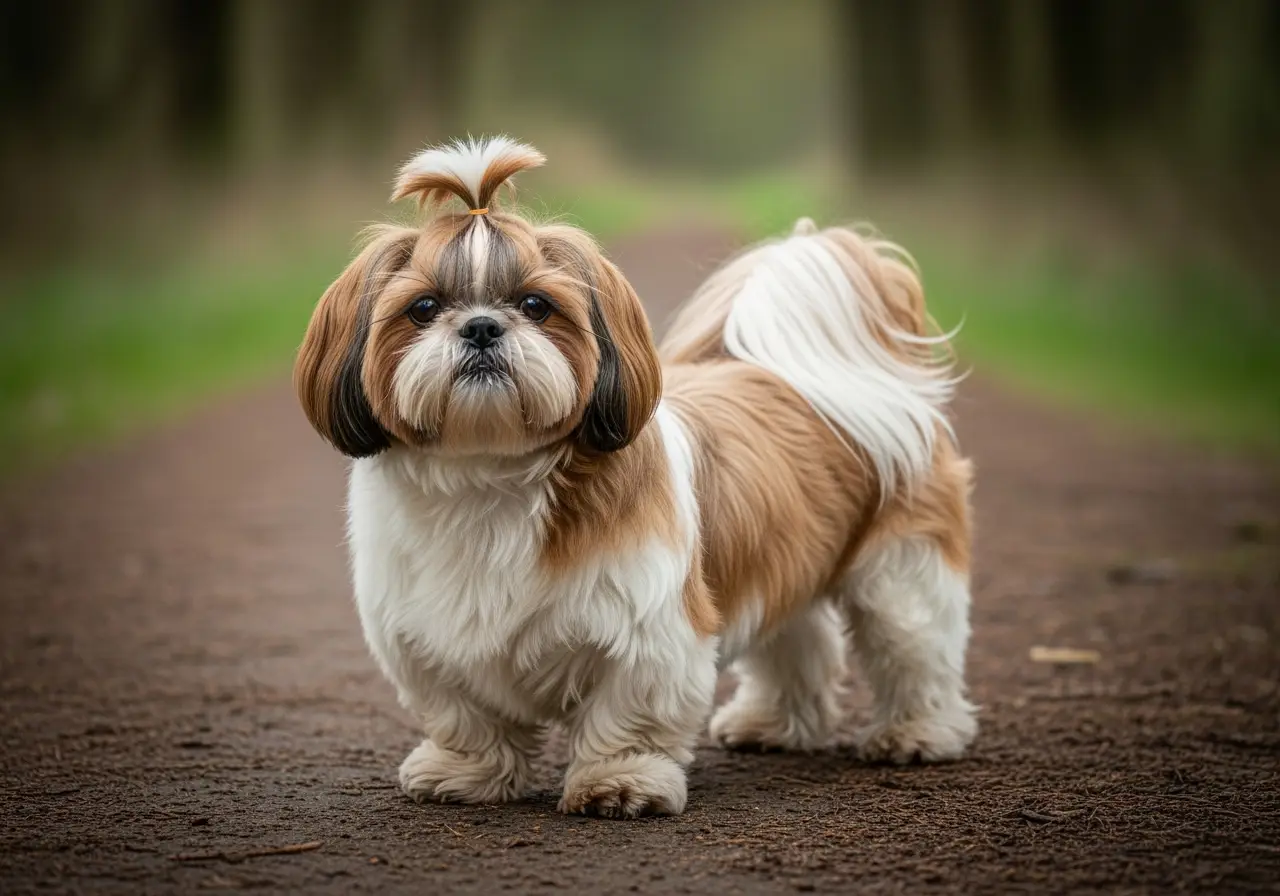
01Summary
In a paragraph
If you only have 30 seconds.
The Shih Tzu is a confident companion dog with a deep bond to humans and a coat that demands daily attention. Anyone expecting a low-maintenance lapdog underestimates it. The short snout carries real breathing risks that must be checked before purchase. With consistent guidance, sufficient closeness, and regular health prevention, it is a long-lived, character-strong companion.
02Introduction
What makes the Shih Tzu special
Shih Tzu: lively Chinese lapdog with a lavish coat, self-confidently affectionate and care-intensive
03Profile
Key facts and suitability
- Origin
- China/Tibet
- Original purpose
- Imperial companion dog
- FCI
- No. 208 · Group 9 · 5
- height at the withers
- 23–27 cm
- Weight
- 4–7 kg
- Life expectancy
- 10–16 Years
- Coat type
- Long-haired
- Minimum exercise
- 30 min/day
- Puppy price
- 1'200–2'500 CHF
- Waiting period
- 4 months
- Sports
- Tricks Therapy dog
04Temperament
How the Shih Tzu shows up in everyday life
When you come home, the Shih Tzu greets you emphatically: it makes its presence known, seeks eye contact, and expects a reaction. This is no coincidence; the dog has been selected for close human bonding over centuries. Its need for social contact is high (CCT value 4 out of 5). This means concretely: it wants to be in the same room, follows you through the apartment, and registers changes in mood.
At the same time, it decides itself when closeness occurs. Anyone who picks it up without asking will often receive a turning away or a short growl. This is not aggression but self-assertion, a character trait described by the FCI standard as "friendly and independent".
Towards strangers, it shows itself reserved to neutral (external axis: friendliness-strangers 3 out of 5). It observes first before allowing contact. Anyone who expects the dog to welcome every visitor warmly immediately will be disappointed. Well-socialised Shih Tzus tolerate visitors but rarely seek them out actively.
In everyday life with other dogs, it functions well with early socialisation. Prey drive plays a subordinate role; a certain alert behaviour, barking at noises or movement, is typical for the breed and should be trained early on.
On the walk, it moves leisurely, likes to explore with its nose, and tires quickly in heat. The brachycephalic anatomy limits endurance: at temperatures above 25 degrees Celsius, walks should be moved to the early morning or evening hours. This is not a recommendation; it is a physiological necessity.
05Needs
What this breed needs daily
The Shih Tzu needs 45 to 60 minutes of active exercise daily, divided into two to three sessions. Long endurance runs are contraindicated due to the brachycephalic anatomy; structured walks with sniffing opportunities and short play sequences better correspond to its movement profile.
Mental and physical stimulation is essential despite the low need for mental work (CCT score 2 out of 5). Short training sessions of five to ten minutes using positive reinforcement, scent work, or simple search games in the apartment are sufficient to prevent under-stimulation. Overstimulation through too intense training stimuli leads to refusal or stress in this breed.
The need for social contact is the decisive criterion: A Shih Tzu that is left alone regularly for more than four hours a day often develops restless behaviour or excessive barking. Anyone working full-time away from home needs a reliable care solution, such as a dog sitter, day care, or a second caregiver in the household.
Grooming is an independent time factor: The long, dense coat requires brushing for five to ten minutes daily to prevent matting. The eye and ear areas require weekly checks. Anyone keeping the dog in a short haircut reduces the effort but does not eliminate it. Regular baths every three to four weeks and professional trimming every eight to twelve weeks are part of the care programme.
Exercise
Low
mental work
Something
Social needs
High
training
Medium
06Sport & Mental and Physical Stimulation
What sports the Shih Tzu is suited for
Realistic in terms of physiology and genetics – not every breed suits every sport.
Structurally and physiologically suitable: not an endurance sport (brachycephaly / BOAS) · no jumping sports (risk of slipped disc).
07Quick Check
08Suitability
Who this breed is suitable for – and who it isn't
✓Matches
The Shih Tzu suits people who are mostly at home or have flexible working hours and can provide the dog with several hours of company daily. A calm household with a reliable daily routine suits its nature.
Suitable owners are those willing to plan time for grooming daily, including at least five to ten minutes of brushing and weekly eye and ear checks. Anyone keeping the dog in a short haircut should budget for professional care every eight to twelve weeks.
Families with children from about eight years old, who treat the dog respectfully and accept its boundaries, are suitable, provided adults take on consistent leadership. Seniors with a moderate activity level and sufficient presence in everyday life benefit from its willingness to bond. People who already have experience with confident small breeds will find a character-strong companion in the Shih Tzu, which appreciates clear guidance.
×Doesn't match
The Shih Tzu does not suit people who are away from home for eight or more hours daily and cannot organise a care solution. Its high need for social contact is not a trait that can be trained away.
Anyone who regards grooming as an occasional task underestimates the effort structurally. Mats form within a few days and then require extensive or painful dematting; this is an animal welfare problem, not a comfort issue.
Households with very small children under six years old, in which the dog would be constantly exposed to uncontrolled handling, are unsuitable: The Shih Tzu defends its space and communicates boundaries clearly. Anyone who misinterprets this signal as aggression and does not react accordingly risks escalation.
Sporty owners looking for a running companion or endurance sports partner will not be happy with this breed. The brachycephalic anatomy sets clear limits on physical resilience. Anyone who chooses the Shih Tzu primarily because of its appearance and regards character and care effort as secondary makes a decision that often ends in animal welfare surrenders.
10Line reality
Show line, working line, breeder market
The Shih Tzu is bred today predominantly as a show dog or pure companion dog. A working line in the classical sense does not exist; the breed was never selected for hunting, herding, or protection work. The FCI classification as a companion dog without a working trial reflects this.
However, differences can be observed among show dogs: lines bred for extreme head shortening and maximum coat abundance more frequently exhibit brachycephalic symptoms than lines that place greater emphasis on health traits. This difference is relevant for buyers but is rarely communicated transparently.
In some Eastern European and Asian countries, lines exist that are bred closer to the original Tibetan type, with a slightly longer muzzle and less exaggerated head structure. These dogs are rare in the DACH region but available. Anyone prioritising health robustness should actively ask for breeders who document BOAS scores and do not optimise exclusively for show placements.
11Health · Reality
What you need to plan for medically with your Shih Tzu
The life expectancy of the Shih Tzu is 12 to 16 years; well-managed dogs from healthy lines regularly reach the upper end of this range.
The central health risk is the brachycephalic anatomy. Brachycephalic Obstructive Airway Syndrome (BOAS) includes narrow nostrils, an elongated soft palate, and a narrowed trachea. A study by the University of Cambridge (Liu et al., 2017) showed that over 50% of the examined brachycephalic dogs had clinically relevant breathing restrictions without the owners noticing. Regular breathing function tests at the vet are therefore not an optional preventive measure for the Shih Tzu.
Eye problems are typical for the breed: The large, slightly protruding eyes are susceptible to corneal injuries, dry eye (keratoconjunctivitis sicca), and entropion. Annual eye checks at the vet are recommended.
Dental misalignments arise from the short jaw; regular dental care and veterinary dental checks from the second year of life reduce the risk of periodontosis.
Overweight exacerbates all brachycephalic symptoms measurably: Already 10% overweight significantly increases airway resistance. Weight control is not an aesthetic question for this breed.
Hip and elbow dysplasia play a minor role in the Shih Tzu compared to large breeds, but should be investigated if movement appears abnormal. Preventative examinations: BOAS test, eye examination, dental check-up, annually from the second year of life.
12Structured data
Health by the numbers
Prone to diseases
Eye problems Breathing problems Disc problems
Recommended health tests
Eye examination Respiratory check
13Myths ↔ Reality
What is often said incorrectly about this breed
Five myths, five realities, five sources.
"The Shih Tzu requires hardly any exercise; after all, it is a lap dog.
The Shih Tzu needs 45 to 60 minutes of active exercise daily, as well as mental enrichment. Lack of exercise promotes overweight, which exacerbates respiratory problems in brachycephalic breeds. Lap dog describes a historical function, not a care guideline.
"Shih Tzus are hypoallergenic and suitable for allergy sufferers.
No dog is completely low-allergen. Although the Shih Tzu loses comparatively little fur, it produces Can f 1 allergens in its saliva and skin. Allergy sufferers should consult an allergist before getting a dog and test the dog several times in their own home.
"The short muzzle is just about looks; breathing problems are the exception.
Brachycephaly is an anatomical change affecting the airways, palate, and nostrils. Studies show that a significant proportion of brachycephalic dogs have clinically relevant respiratory restrictions, even without visible symptoms. Regular veterinary respiratory function tests are not merely a precaution for this breed but standard practice.
"Shih Tzus are so small that training is hardly necessary.
According to the FCI standard, the Shih Tzu is intelligent, lively, and independent. A lack of boundary setting leads to resource guarding, excessive barking, and leash reactivity. Small body size reduces the risk of injury to third parties, not the need for training.
"A Shih Tzu with a short haircut saves on care effort.
Even in puppy or hygiene cuts, the Shih Tzu's coat requires regular brushing as it is prone to matting. Ears, the eye area, and paws require weekly inspection and care regardless of cut length. The time commitment decreases but does not disappear.
14animal welfare
The animal welfare perspective
Breeder market, designer versions, animal shelter reality — what no one writes in the puppy ad.
The Shih Tzu belongs to the breeds that are surrendered disproportionately frequently in German-speaking animal welfare organisations. The most common reasons: underestimated grooming effort, breathing problems due to unethical breeding and keeping errors caused by coddling. This is no coincidence, but a structural problem.
Backyard breeders and puppy farms exploit the consistently high demand for this breed. Puppies are sold without health documentation, without socialisation in the home and without contact with the mother dog, often via classifieds portals with professionally looking photos. Identifying features: no BOAS assessment of the parent dogs, no pedigree entry, handover at a neutral location, pressure to buy quickly.
Designer variants such as "Teddy-Shih-Tzu" or crosses with other brachycephalic breeds (e.g. Pug, French Bulldog) exacerbate anatomical risks without being controlled by breeding standards. A brand name does not replace an X-ray or a breathing test.
Obesity is a widespread keeping problem in Shih Tzus. The combination of low exercise requirements, high food motivation and brachycephalic anatomy makes overweight a real danger. Owners who provide the dog with treats as a substitute for affection risk a measurable deterioration in breathing function.
Adoption through reputable animal welfare organisations is a fully-fledged alternative to buying. Many rehomed Shih Tzus are adult, socialised and their character can be assessed. Organisations such as the German Animal Welfare Association or regional animal shelters conduct preliminary interviews and support the settling-in period. Anyone who takes in a Shih Tzu from animal welfare is not solving a problem, but giving a dog a second chance.
15Costs · Transparency
What this breed realistically costs
A Shih Tzu puppy from reputable breeding with pedigree, health documentation and BOAS assessment of the parent dogs costs between 1,200 and 2,200 EUR or CHF in the DACH region. Prices below 800 EUR are a warning signal; they indicate missing health examinations or backyard breeding.
Annual living costs amount to 1,800 to 3,200 EUR, depending on food quality, grooming effort and health status. Food for a Shih Tzu (approx. 5–7 kg body weight) costs 400 to 700 EUR per year with high-quality nutrition. Professional grooming every eight to twelve weeks adds up to 50 to 120 EUR per session, i.e. 250 to 600 EUR annually.
Veterinary costs: routine preventative care (vaccinations, parasite prevention, annual check-up) costs 200 to 400 EUR per year. BOAS checks and eye examinations are additional. Surgical BOAS correction costs 800 to 2,500 EUR depending on the findings. Dog health insurance with surgical cover for this breed is 40 to 90 EUR monthly, a calculable safeguard given the breed-typical risks.
16Puppy search
What you need to consider when choosing a breeder
- A reputable breeder has the parent dogs tested for brachycephalic obstructive airway syndrome (BOAS) and presents the corresponding findings.
- Actively ask for breathing function tests, eye examinations, and dental position findings for both parents.
- Anyone who does not provide these documents is not a contact person.
- Puppies should grow up in the breeder’s apartment, not in kennels or garages.
- The mother must be present and accessible.
- Reputable breeders ask questions about the living situation and reject buyers who do not give convincing answers.
- Membership in a breeding club (e.g., Kleinhunde Club Schweiz or a VDH-affiliated club) is an indicator but no guarantee.
- Breed registry number and pedigree are mandatory.
- Adoption through animal welfare organisations is an equally valid option.
- Shih Tzus often end up in animal welfare because owners have underestimated the care effort; these dogs are often socialised and character-wise established.
- Reputable adoption centres conduct preliminary interviews and support the settling-in period.
FAQ
Frequently asked questions about the Shih Tzu
Is Shih Tzu suitable for beginners?
Shih Tzu is considered suitable for first-time dog owners.
Is Shih Tzu a family dog?
Shih Tzu is considered suitable for families with good socialisation and species-appropriate care.
How much exercise does Shih Tzu need?
At least around 30 minutes of exercise per day.
Does Shih Tzu suit an apartment?
With enough exercise and enrichment, Shih Tzu can also be kept in an apartment.
What is the size and weight of Shih Tzu?
Fully grown, Shih Tzu reaches about 23–27 cm at the withers and weighs around 4–7 kg.
What is the life expectancy of Shih Tzu?
The life expectancy of Shih Tzu is approximately 10–16 years.
Which diseases are common in Shih Tzu?
Eye problems Breathing problems Disc problems
17Breed clubs
Official breed clubs in DACH
19Related
Similar breeds – and their differences
You might also be interested in
Participate
Do you have a good photo of your Shih Tzu?
We are looking for expressive images for our breed profiles. Submit yours; the editorial team reviews every submission before publication.
Does this breed suit you?
Brachycephaly can cause breathing problems – parent dogs should be BOAS-checked