
01Summary
In a paragraph
If you only have 30 seconds.
The Tibet Spaniel is not a lap dog for decoration. It descends from a long line of Tibetan monastery guardians, exhibits pronounced alert behaviour and forms a close bond with its primary caregiver. At the same time, it decides independently whom to trust. Anyone keeping one needs daily routine, consistent training and genuine social presence every day, not occasionally.
02Introduction
What makes the Tibetan Spaniel special
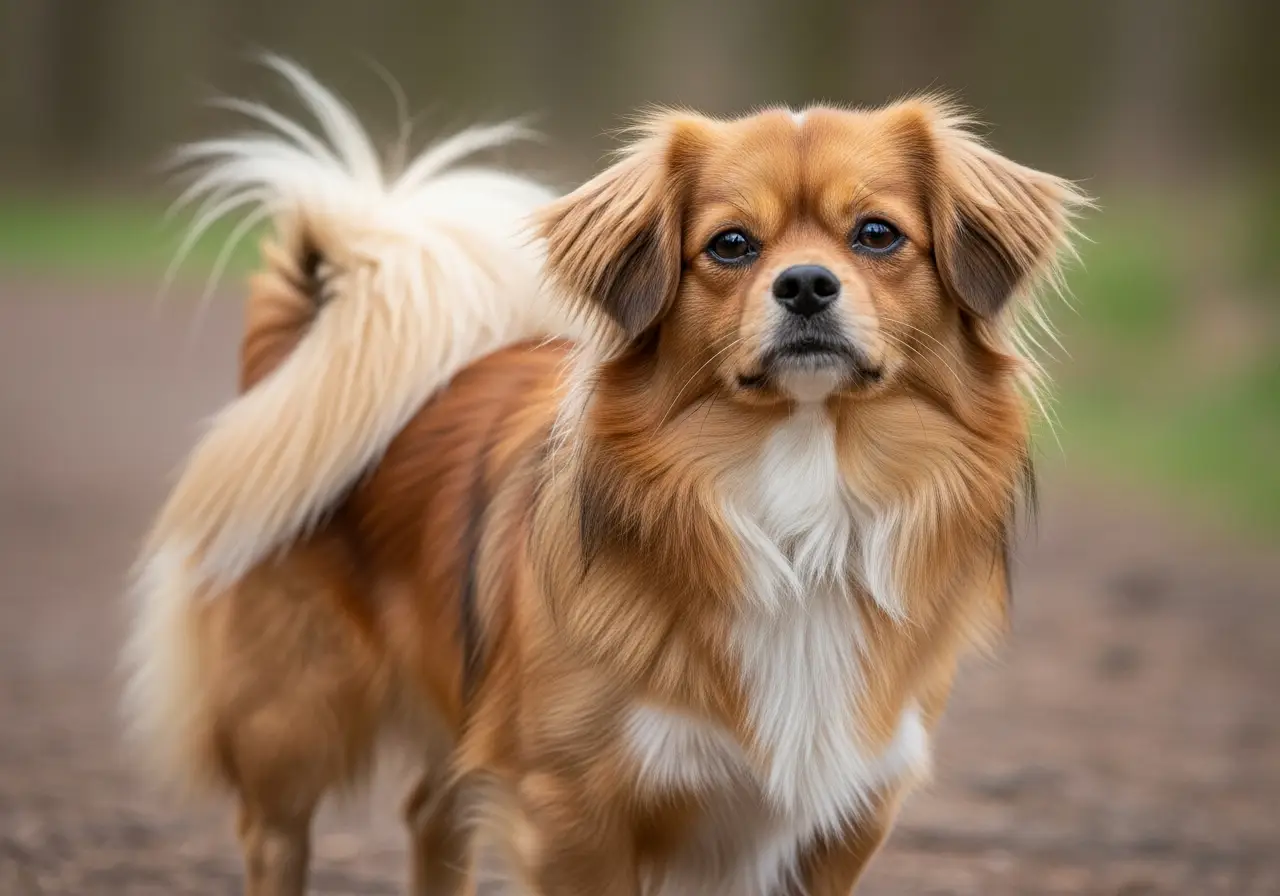
Tibetan Spaniel: small Tibetan monastery dog, not a classic spaniel but an independent watchdog with character
03Profile
Key facts and suitability
- Origin
- Tibet
- Original purpose
- Monastery guard
- FCI
- No. 231 · Group 9 · Section 5
- height at the withers
- 24–29 cm
- Weight
- 4–7 kg
- Life expectancy
- 12–15 Years
- Coat type
- Long-haired
- Minimum exercise
- 30 min/day
- Puppy price
- 1'000–1'800 CHF
- Waiting period
- 4 months
- Sports
- Tricks therapy dog
04Temperament
How the Tibetan Spaniel shows up in everyday life
When you come home, the Tibetan Spaniel shows what attachment means: it greets its primary caregiver attentively, observes the situation, gives a brief signal, and then returns to its usual observation post. No exuberant, constant barking, but a clear signal that it has registered who is coming and going.
On the walk, it moves attentively, without showing the urge to move of a terrier or retriever. It explores its surroundings with its nose, reacts to changes in the environment, and alerts you to anything unfamiliar. If it encounters a stranger, it initially keeps its distance; it only approaches when it has decided for itself that the situation is safe. This decision cannot be forced.
Internally, the Tibetan Spaniel needs social connection with its primary caregiver. It follows them through the apartment, seeks physical closeness, and reacts to mood changes in the household. However, this high need for social contact does not mean that it is open or sociable towards visitors; these are two different axes that should not be confused. A Tibetan Spaniel can be closely bonded to its owner while being distinctly reserved towards strangers.
In everyday life with children, it proves compatible if the interaction is respectful and calm. Loud, unpredictable interactions trigger withdrawal or alert behaviour. With other dogs, it is well-compatible if socialised early, but here too it shows a certain independence in initiating contact.
05Needs
What this breed needs daily
The Tibetan Spaniel needs 45 to 60 minutes of active exercise daily, divided into two to three sessions. Simple walks are sufficient as long as they are varied. Extended off-leash runs or intensive endurance sessions are not required and do not match its movement profile.
Mental stimulation is just as important as physical exercise. Nose work, search games in the garden or apartment, short training sessions with clear tasks – all of this covers its moderate need for mental work. It learns attentively but reacts sensitively to pressure or impatience. Short, positive training sequences of five to ten minutes yield better results than long sessions.
The Tibetan Spaniel’s need for social contact is high. It requires the physical proximity of its primary caregiver for large parts of the day. Being left alone is possible, but must be built up gradually and consistently. As a guideline, a maximum of four hours applies, assuming good training in being left alone. Anyone who is regularly absent for longer periods needs a reliable care alternative.
Its alert behaviour requires clear training work: the owner must teach the dog when alerting is appropriate and when quietness is expected. This is not achieved by ignoring it, but through consistent, calm reactions. A supporting dog training school with experienced trainers who know small breeds is recommended, especially in the first months.
Exercise
Low
mental work
Medium
Social needs
High
training
Medium
07Quick Check
08Suitability
Who this breed is suitable for – and who it isn't
✓Matches
The Tibetan Spaniel suits owners who work mostly from home or part-time and can offer their dog genuine social presence throughout the day. At least two active sessions daily as well as time for short training sequences should be planned in.
The breed is suitable for structured individuals or couples who are looking for an independent, attentive companion and have no need for a dog that is unconditionally sociable. Anyone who rarely receives visitors or introduces guests consistently will cope well with the Tibbie’s reserve.
Families with children from about eight years old, who handle the dog calmly and respectfully, are also suitable, provided that the parents take responsibility for leadership and enforce clear rules for interaction.
Owners with experience in training independent breeds have an advantage. First-time owners are not excluded, but need a supporting dog training school from the start and the willingness to actively engage with the alert behaviour and training structure. Keeping it in an apartment is possible if the need for exercise and social contact is reliably met.
×Doesn't match
The Tibetan Spaniel does not suit owners who are out of the house eight or more hours a day and cannot organise a care alternative. Its need for social contact is high; prolonged periods alone lead to stress and increased alert behaviour.
Anyone looking for a dog that is open and sociable towards strangers will not be happy with the Tibetan Spaniel. Its reserve is not a training error, but a breed characteristic. Households with frequent, changing visitors or loud, unpredictable everyday situations place a strain on it.
The breed is not suitable for owners who dismiss barking as trivial or do not wish to actively train the alert behaviour. Without clear reactions from the owner, the barking intensifies permanently, which burdens neighbours and the dog itself.
Anyone expecting a purely passive companion dog without training effort, or who misinterprets the Tibetan Spaniel’s independence as stubbornness and reacts with pressure, will fail with this breed. Families with very young children who have not yet learned to handle dogs calmly should also carefully weigh up their decision.
10Line reality
Show line, working line, breeder market
The Tibet Spaniel is now bred mainly as a companion dog, without pronounced line differentiation between working and show types, as exists for example with the Labrador Retriever or the Cocker Spaniel. The breed has no active working test anchored in the FCI standard.
However, there are differences in type expression within breeding: some lines emphasise a more compact, rounder head with a more pronounced lower jaw, while others show a slimmer, longer profile. These differences are relevant to breeders but have no direct influence on character or health, provided the breeding is based on health tests.
In Great Britain, where the breed arrived in Europe and the oldest breeding club exists, the breeding base is broader than in the German-speaking area. In Germany and Switzerland, the breed is rare, litter numbers are low, and reputable breeders are few in number. This means for interested parties: longer waiting times and the need to carefully check breeders before making a decision.
11Health · Reality
What you need to plan for medically with your Tibetan Spaniel
The life expectancy of the Tibet Spaniel is 12 to 15 years, a typical range for small breeds that is often reached with good keeping conditions and regular veterinary preventive care.
Among the breed-specific health risks is progressive retinal atrophy (PRA), a hereditary eye disease that can lead to blindness. Reputable breeders have their breeding stock examined by CAER-certified eye specialists (Certified Animal Eye Registry, formerly CERF). Anyone buying a puppy should request current eye certificates for both parent dogs.
Patellar luxation, the dislocation of the kneecap, occurs more frequently in small breeds. According to a study by the University of Bern (2017), the prevalence in small dogs ranges between 5 and 25 per cent depending on the breed. No large-scale breed-specific prevalence studies exist for the Tibet Spaniel, so breeder statements regarding patella assessments of the parent dogs should be considered a minimum standard.
Overweight is a real risk: The Tibet Spaniel has moderate exercise needs, and a calorie-rich diet without sufficient activity quickly leads to weight gain that strains joints and heart health. Weight should be monitored regularly; a visible waistline and palpable but not visible ribs serve as a guide.
Preventive check-ups at the vet should take place annually and include eyes, patella and dental status. The medium-length coat requires regular grooming but is less maintenance-intensive than long-haired breeds with an undercoat.
12Structured data
Health by the numbers
Prone to diseases
Eye problems kneecap problems
Recommended health tests
Eye examination kneecap check
13Myths ↔ Reality
What is often said incorrectly about this breed
Five myths, five realities, five sources.
„The Tibet Spaniel is a calm lap dog that makes few demands.
The Tibet Spaniel has a genetically anchored alert behaviour that was selectively bred for monastery use. It barks at strangers, unfamiliar noises and changes in the environment, consistently and clearly. Without clear training and daily structure, this behaviour intensifies. A passive owner who ignores or tolerates barking inadvertently reinforces the pattern.
„As a small dog, it needs little exercise or mental enrichment.
The Tibet Spaniel needs 45 to 60 minutes of active exercise daily as well as mental stimulation through search games, nose work or structured training. Its need for mental work is moderate; if it is chronically under-stimulated, it develops restlessness or increased alert behaviour as a substitute activity.
„Tibet Spaniels are friendly with all people and easy to socialise.
The Tibet Spaniel shows pronounced reserve towards strangers; this is not a training error but breed character. It decides for itself whom to trust and needs time and positive experiences to accept new people. Early, broad socialisation from puppyhood is essential, but it does not completely reduce the basic reserve.
„The breed is robust and does not require special health examinations.
The Tibet Spaniel has breed-specific predispositions for progressive retinal atrophy (PRA) and patellar luxation. Reputable breeders carry out eye examinations (CAER certificate) and patella assessments. Anyone who dispenses with this proof risks avoidable diseases in the dog and high follow-up costs.
„Tibet Spaniels are suitable for any household, including frequent travellers.
The Tibet Spaniel bonds closely with its primary caregiver and tolerates being alone only to a limited extent; a maximum of four hours is considered the guideline, built up gradually. Frequent absences without alternative care lead to stress and can trigger behavioural problems such as excessive barking or incontinence.
14animal welfare
The animal welfare perspective
Breeder market, designer versions, animal shelter reality — what no one writes in the puppy ad.
The Tibet Spaniel belongs to the rare breeds in the German-speaking region. It rarely appears in animal shelters and animal welfare organisations, with demand significantly exceeding the supply from reputable breeders. This creates a market exploited by unscrupulous providers.
On classified ad platforms, Tibet Spaniels are occasionally offered without papers, without health tests and without socialisation, often at prices far below the level of reputable breeders. Buying here finances structures that accept health problems and behavioural difficulties. The follow-up costs, both veterinary and training-related, regularly exceed the supposed savings.
Designer versions or crosses with the Tibet Spaniel exist in isolated cases but are not widespread. The breed has not yet become a target of deliberate hybrid breeding trends, which benefits it.
Breeding-related problems primarily concern the small breeding base in the DACH region: Small gene pools increase the risk of inbreeding and the accumulation of hereditary diseases. Interested parties should specifically ask for breeders who collaborate with international partners and place value on genetic diversity.
Finding a Tibet Spaniel through animal welfare organisations is rare but not excluded. Older dogs from dissolved breeding operations or due to the death of owners are occasionally rehomed through breed club contacts. Anyone open to an adult dog will find an equally valid option there, with the advantage that temperament and health status can already be assessed. The International Club for Tibetan Dog Breeds e.V. and the Tibetan Spaniel Club Switzerland TSCS are first points of contact for such rehoming.
15Costs · Transparency
What this breed realistically costs
A puppy from a reputable breeder with FCI papers, health tests of the parent dogs and initial veterinary care costs between 1,200 and 2,000 EUR or CHF in Germany and Switzerland respectively. Offers significantly below this, without papers or health certificates, signal missing breeding standards.
Annual living costs for a Tibet Spaniel are typically between 1,500 and 2,500 EUR, depending on food quality, grooming effort and vet costs. High-quality dry food or fresh food for a dog of this size costs between 40 and 80 EUR monthly. Grooming (regular brushing, occasional trimming) can be done at home or by a groomer, costing around 50 to 80 EUR per session.
Basic veterinary costs (vaccinations, parasite prevention, annual check-up) amount to 200 to 400 EUR annually. If an eye examination or patella check is added, costs rise accordingly. Pet insurance for small breeds costs between 30 and 70 EUR monthly, depending on coverage and provider. For a breed with known eye and joint risks, such cover is sensible to plan for.
16Puppy search
What you need to consider when choosing a breeder
- Reputable Tibetan Spaniel breeders are members of a recognised breed club; in Germany, this is the International Club for Tibetan Dog Breeds e.V.
- (KTR), and in Switzerland, the Tibetan Spaniel Club Switzerland (TSCS).
- Both clubs maintain breeder lists and set minimum standards for health tests and rearing conditions.
- Concrete features of reputable breeding: eye examination certificates (CAER) for both parent dogs, patella assessment, puppy socialisation in a family environment, the possibility to visit before purchase, and a minimum age of eight weeks at handover.
- Anyone who does not allow visits or shows puppies without their mother is not a reputable contact.
- Waiting periods of six to twelve months are common with reputable breeders, as the breed is rare and litter sizes are small.
- This waiting period is not a disadvantage but rather a mark of quality.
- Finding adult Tibet Spaniels through breed club contacts is an equally valid option.
- Older dogs have the advantage that their temperament and health status are already known.
- Anyone open to this possibility should contact the KTR or TSCS directly.
FAQ
Frequently asked questions about the Tibetan Spaniel
Is Tibetan Spaniel suitable for beginners?
Tibetan Spaniel is considered suitable for first-time dog owners.
Is Tibetan Spaniel a family dog?
Tibetan Spaniel is considered suitable for families with good socialisation and species-appropriate care.
How much exercise does Tibetan Spaniel need?
At least around 30 minutes of exercise per day.
Does Tibetan Spaniel suit an apartment?
With enough exercise and enrichment, Tibetan Spaniel can also be kept in an apartment.
What is the size and weight of Tibetan Spaniel?
Fully grown, Tibetan Spaniel reaches about 24–29 cm at the withers and weighs around 4–7 kg.
What is the life expectancy of Tibetan Spaniel?
The life expectancy of Tibetan Spaniel is approximately 12–15 years.
Which diseases are common in Tibetan Spaniel?
Eye problems kneecap problems
17Breed clubs
Official breed clubs in DACH
19Related
Similar breeds – and their differences
You might also be interested in

Participate
Do you have a good photo of your Tibetan Spaniel?
We are looking for expressive images for our breed profiles. Submit yours; the editorial team reviews every submission before publication.
Does this breed suit you?
Despite the name, not a classic spaniel – independent and vigilant