
01Summary
In a paragraph
If you only have 30 seconds.
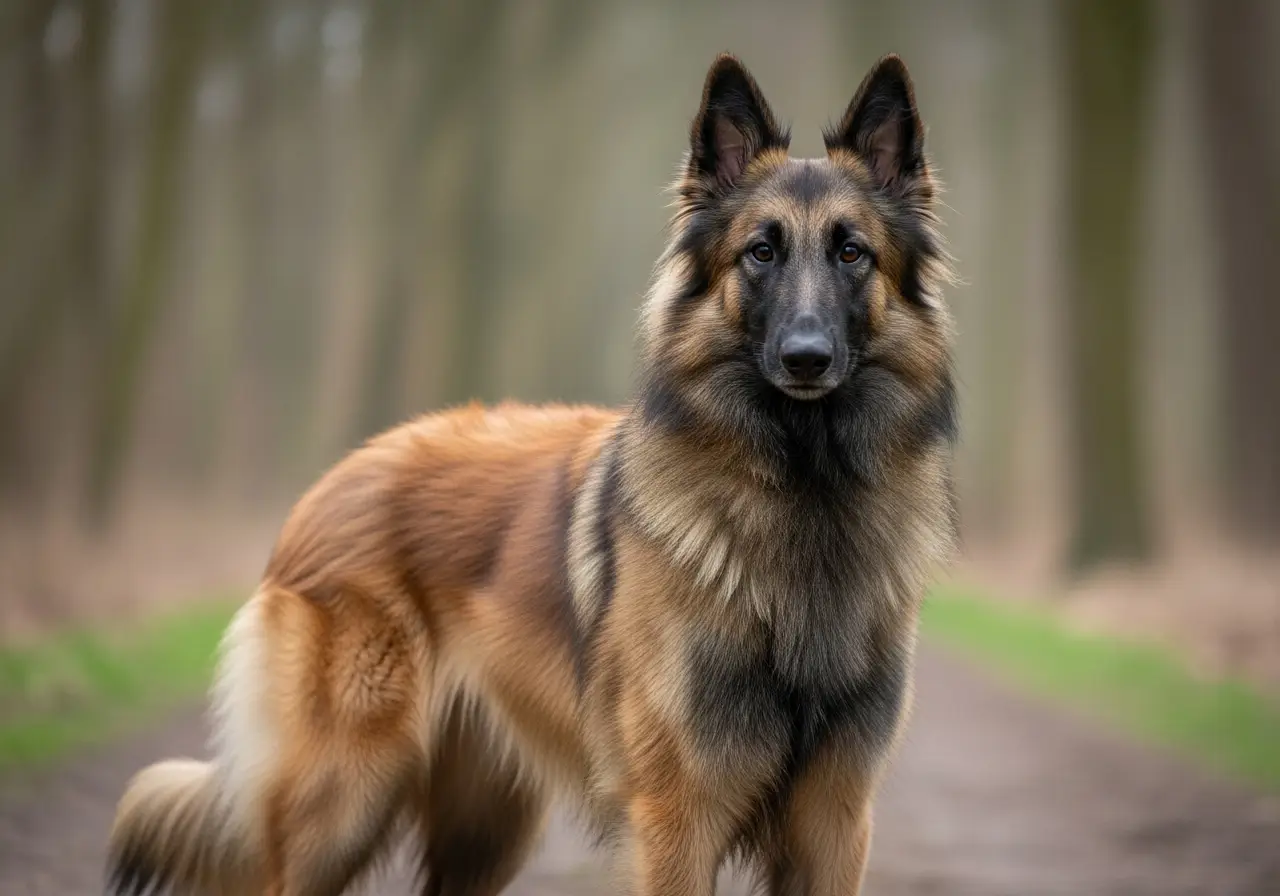
The Tervueren is the long-haired variety of the Belgian Shepherd Dog, selected for demanding working tasks, not for a relaxed everyday life. It combines high exercise needs with pronounced sensitivity and strong herding and guarding instincts. Anyone who does not provide daily structure, training and genuine stimulation will get a dog that finds its own entertainment, and rarely in a pleasant way.
02Introduction
What makes the Tervueren special
Tervueren: long-haired variant of the Belgian Shepherd, delicately powerful and an intense dog for consistent owners
03Profile
Key facts and suitability
- Origin
- Belgien
- Original purpose
- Herding and guarding service
- FCI
- No. 15 · Group 1 · Sektion 1: Schäferhunde, mit Arbeitsprüfung
- height at the withers
- 56–66 cm
- Weight
- 25–30 kg
- Life expectancy
- 10–14 Years
- Coat type
- Long-haired
- Minimum exercise
- 90 min/day
- Puppy price
- 1'800–3'000 CHF
- Waiting period
- 6 months
- Sports
- Guarding service Agility Obedience
04Temperament
How the Tervueren shows up in everyday life
During morning exercise, the Tervueren does not simply run alongside you; it observes, anticipates and reacts to every change of direction. This behaviour is no coincidence: The breed was selected to read movements and react independently.
**Internal axis, what the dog needs:** The need for social contact is high. The Tervueren seeks a close bond with its primary caregiver and wants to be actively involved in daily life. Being left alone for more than two to three hours is difficult for many individuals and must be built up systematically over months. The need for mental work is maximal: Without demanding mental tasks (tracking, obedience, nose work, protection work), it seeks enrichment independently, which is rarely in the owner's interest.
**External axis, how the dog reacts:** The Tervueren shows pronounced reserve towards strangers. It does not greet unknown people joyfully but observes them first. This is breed character, not a training error. It gets along well with well-socialised conspecifics but quickly shows readiness to react in unclear situations. The guarding instinct is clearly present and manifests itself in everyday life as increased vigilance towards unfamiliar stimuli.
These two axes must not be confused: a high need for social contact with the family does not mean that the dog is open to everyone. Anyone expecting the Tervueren to be a sociable all-rounder will be surprised by its selective bonding.
05Needs
What this breed needs daily
The Tervueren requires at least 120 minutes of active exercise daily, not as free roaming in the garden, but as guided, structured activity with the primary caregiver. Jogging, cycling, hiking or dog sports cover the physical needs.
Mental stimulation is at least as important. The breed has one of the highest requirements for mental work among herding dogs. Suitable activities include scent work, protection work (under expert guidance), obedience, agility, nose work or search and rescue dog work. Simple walks without cognitive demands are not sufficient.
Building up tolerance for being left alone requires special attention. Many Tervueren tolerate a maximum of two to three hours of solitude, and even this only after consistent, step-by-step training over weeks. Anyone who is regularly away from home for more than four hours must organise reliable care.
Calmness training is an independent training topic. The breed tends towards constant readiness for activation; the conscious practice of relaxation phases is part of basic training, not optional.
A structured daily routine with fixed training, exercise and rest phases stabilises behaviour. The Tervueren reacts sensitively to irregularities in everyday life. Clear routines reduce stress reactions and promote willingness to cooperate.
Exercise
Very high
mental work
A lot
Social needs
High
training
Demanding
06Sport & Mental and Physical Stimulation
What sports the Tervueren is suited for
Realistic in terms of physiology and genetics – not every breed suits every sport.
Structurally and physiologically suitable: Suitable for herding work, treibball and coursing · CaniCross / bikejoring possible.
07Quick Check
08Suitability
Who this breed is suitable for – and who it isn't
✓Matches
The Tervueren suits owners who already have experience with performance-oriented or high-drive dogs. First-time owners without prior knowledge of working dogs face a steep learning curve that is difficult to manage without professional support.
Suitable are active individuals or couples with at least two hours of daily activity time, who see dog sports or structured training work as an integral part of their everyday life. Families with children from about ten years old are suitable if both adults actively take on leadership responsibility and the dog is socialised consistently.
A rural or suburban environment with access to training grounds or natural areas is advantageous. Keeping the dog in an apartment is possible, but requires an even more consistent routine for stimulation.
Anyone who enjoys dog sports such as IGP, obedience, agility or search and rescue work will find a willing and enduring partner in the Tervueren. The breed demands a primary caregiver with clear body language, high readiness for training and the ability to remain calm and consistent even in stressful situations.
×Doesn't match
The Tervueren is not suitable for households where the dog regularly spends more than three hours alone daily without a reliable care solution existing. The breed quickly develops behavioural problems with prolonged isolation.
People looking for an uncomplicated companion dog for occasional walks will be overwhelmed by the intensity of the Tervueren. This also applies to owners who consider reserve towards strangers a problem and expect a socially open dog; structurally, the Tervueren is not that.
Anyone who equates sensitivity with compliance and dispenses with clear leadership structures risks a dog that develops its own rules. Households with very small children under six years old should realistically assess the high level of activation and the pronounced herding instinct of the breed.
City dwellers with exclusively urban infrastructure (without access to training grounds, dog sports clubs or sufficient open space) will quickly reach limits regarding stimulation. People who perceive dog sports or structured training as a burden rather than a pleasure should also consider another breed.
10Line reality
Show line, working line, breeder market
In the Tervueren, there are now recognisable differences between working lines and show lines, even though the division is less pronounced than in the Malinois.
Working lines are geared towards performance in IGP, protection work, tracking or search and rescue. Dogs from these lines generally show higher drive, faster reaction speed and more pronounced instinct intensity. They are designed for experienced owners with a clear sporting goal; in leisure keeping without an appropriate stimulation concept, they are difficult to handle.
Show lines place more emphasis on exterior and type consistency. The willingness to work is present but generally less pronounced. This does not mean that these dogs require less stimulation; the basic need of the breed remains.
When looking for a puppy, it is important to ask the breeder specifically about the focus of their breeding: Which tests have the parent dogs completed? Is the focus on performance sports or on companion dog breeding? These questions help you find a dog whose drive level fits your own daily life.
Regional differences in breeding focus exist; Belgian and Dutch lines are traditionally considered to have stronger instincts, while more moderate companion dog lines are also widespread in Germany and Switzerland.
11Health · Reality
What you need to plan for medically with your Tervueren
According to figures from the German Club for Belgian Shepherd Dogs, the life expectancy of the Tervueren is on average 12 to 14 years, a typical range for medium-sized working dogs.
Hip dysplasia (HD) and elbow dysplasia (ED) occur in the breed. Reputable breeding programmes require HD and ED X-ray examinations of both parent dogs before mating. The DKBS recommends these examinations as a prerequisite for breeding. When buying a puppy, X-ray results for both parents should be provided.
Epilepsy is documented in the Belgian Shepherd, including the Tervueren. A study by Ghent University (Berendt et al., 2008, published in the Journal of Veterinary Internal Medicine) identified idiopathic epilepsy as a relevant condition in the breed. Buyers should ask about the health history of the line for at least two generations.
Thyroid disorders (hypothyroidism) are occasionally reported in the breed. Regular blood tests from the sixth year of life onwards are advisable.
Preventive examinations relevant for the Tervueren include: HD/ED screening (parent dogs before breeding, offspring recommended from 12 months onwards), annual weight checks (overweight puts strain on joints), dental checks every six months, and eye examinations if symptoms are noticeable.
Overweight is an underestimated risk in the breed, as the high need for exercise is often not fully met in keeping conditions. A body condition score of 4–5 on the 9-point scale (according to WSAVA standards) is considered the target range.
12Structured data
Health by the numbers
Prone to diseases
Hip dysplasia Epilepsy Eye problems
Recommended health tests
Hip X-ray Eye examination Epilepsy screening
13Myths ↔ Reality
What is often said incorrectly about this breed
Five myths, five realities, five sources.
"The Tervueren is a family dog that is also suitable for quieter households."
The Tervueren has been selected over generations for herding work and protection duties. Its need for exercise amounts to at least 120 minutes of active stimulation daily, in addition to mental work. A quiet household without consistent enrichment typically leads to behavioural problems such as destructiveness, excessive barking or displacement activities. The breed is not suitable for passive forms of keeping.
"Because he is so sensitive, gentle training without clear boundaries is sufficient."
Sensitivity means that the Tervueren registers subtle signals from its primary caregiver and learns quickly, in both directions. Inconsistent handling without clear structure does not lead to a relaxed dog, but to one that develops its own rules. Sensitivity requires clarity, not leniency. Professional guidance by an experienced dog training school is recommended.
"The Tervueren is aggressive towards strangers."
The Tervueren typically shows reserve and vigilance towards strangers; this is breed character, not aggression. With consistent socialisation from puppyhood, it learns to distinguish between neutral situations and actual threats. Uncontrolled guarding instinct reactions usually arise from a lack of socialisation or incorrect training approaches, not solely from breed predisposition.
"Tervueren and Malinois are practically the same breed, the Tervueren is just the prettier one."
Both varieties share the same origin but have developed differently in breeding programmes. The Malinois is used more intensively today in protection work and the military and shows a higher drive in many lines. The Tervueren generally exhibits slightly more sensitivity and bonding intensity. The differences are real and relevant for the decision on how to keep the dog.
"A large garden replaces active stimulation."
A garden gives the Tervueren space but does not satisfy its need for work and exercise. The breed requires guided, structured activity with its primary caregiver; free running in the garden alone leads to boredom and frustration. Active interaction, training sessions and joint exercise cannot be replaced by open spaces.
14animal welfare
The animal welfare perspective
Breeder market, designer versions, animal shelter reality — what no one writes in the puppy ad.
The Tervueren is one of the breeds that regularly end up in animal shelters and with rescue organisations in the German-speaking region, not due to aggression problems, but because owners are overwhelmed. The most common reasons for surrendering are destructive behaviour from under-stimulation, excessive barking, displacement activities, and an intensity in daily life that first-time buyers have underestimated.
Backyard breeder market: The Tervueren is less affected by mass production than fashionable small dogs, but here too there are providers without pedigree registration, without health tests and without socialisation of the puppies. Cheap offers on classifieds platforms without club membership of the breeder are a warning sign.
Keeping-related problems: The biggest animal welfare-relevant challenge with the Tervueren is not breeding, but keeping. A dog with a mental workload requirement of 5/5 and an exercise requirement of 5/5, living in a household without sufficient stimulation, develops chronic stress. This manifests as behavioural abnormalities, which are then misinterpreted as character problems.
Adoption as an equally valid option: Adult Tervuerens from reputable rescue organisations are a real alternative to puppies. Many rescue dogs are well-trained and end up in rescue not due to behavioural deficits, but due to changed living circumstances of the owners. The advantage: character and drive intensity can already be assessed in an adult dog. Organisations such as the DKBS or specialised Belgian Shepherd rescue clubs provide breed-specific advice and professionally support the handover.
Anyone who takes a Tervueren from rescue makes a concrete contribution and often receives a dog whose profile is already known.
15Costs · Transparency
What this breed realistically costs
A puppy from reputable breeding with pedigree, health tests of the parent dogs and club membership typically costs between 1,200 and 1,800 EUR in Germany and Austria. Offers significantly below this, especially without pedigree registration or health certificates, indicate a lack of investment in health screening and socialisation.
The annual living costs for a Tervueren are estimated at between 1,800 and 3,000 EUR depending on the type of keeping. This includes high-quality food (approx. 600–900 EUR/year for a 25–30 kg dog), grooming needs (grooming for the long-haired type: regular brushing, occasional trimming, approx. 200–400 EUR/year), basic equipment and accessories, as well as dog sport membership (approx. 100–300 EUR/year).
Veterinary costs for routine care (vaccinations, parasite prevention, annual examination) average 300–500 EUR/year. For orthopaedic diseases such as HD, diagnosis and treatment can quickly reach 1,500–4,000 EUR.
Dog liability insurance is mandatory in several federal states and costs 50–120 EUR/year depending on the provider. Health insurance for the dog is optional, but can be sensible for a breed with known joint risks (approx. 400–800 EUR/year depending on tariff and excess).
16Puppy search
What you need to consider when choosing a breeder
- A reputable breeder is a member of a recognised breed club, in Germany for example the German Club for Belgian Shepherd Dogs (DKBS).
- Membership obliges compliance with breeding regulations, health examinations and litter intervals.
- Concrete characteristics of reputable breeding: both parent dogs have hip and elbow dysplasia assessments.
- The breeder allows a visit to the litter and shows the mother with the puppies.
- The puppies grow up in a home environment with everyday noises.
- The breeder asks questions about your own living situation; this is a good sign, not an obstacle.
- Warning signs: no pedigree certificate, no health tests of the parent dogs, puppies given away before the eighth week of life, sale via intermediaries or without personal contact.
- Adopting an adult Tervueren through breed-specific organisations is an equally valid option.
- With an adult dog, drive intensity and character are already assessable, an advantage over a puppy.
- The DKBS and specialised Belgian Shepherd rescue organisations accompany adoptions with expertise.
- No reputable platform recommends individual breeders by name; research via the breed club and personal inspections are the most reliable approach.
FAQ
Frequently asked questions about the Tervueren
Is Tervueren a family dog?
Tervueren is considered suitable for families with good socialisation and species-appropriate care.
How much exercise does Tervueren need?
At least around 90 minutes of exercise per day. As an active breed, more so — plus mental stimulation.
What is the size and weight of Tervueren?
Fully grown, Tervueren reaches about 56–66 cm at the withers and weighs around 25–30 kg.
What is the life expectancy of Tervueren?
The life expectancy of Tervueren is approximately 10–14 years.
Which diseases are common in Tervueren?
Hip dysplasia Epilepsy Eye problems
17Breed clubs
Official breed clubs in DACH
19Related
Similar breeds – and their differences
You might also be interested in
Participate
Do you have a good photo of your Tervueren?
We are looking for expressive images for our breed profiles. Submit yours; the editorial team reviews every submission before publication.
Does this breed suit you?
Sensitive Belgian Shepherd – needs lots of guidance and stimulation not a beginner dog