
01Summary
In a paragraph
If you only have 30 seconds.
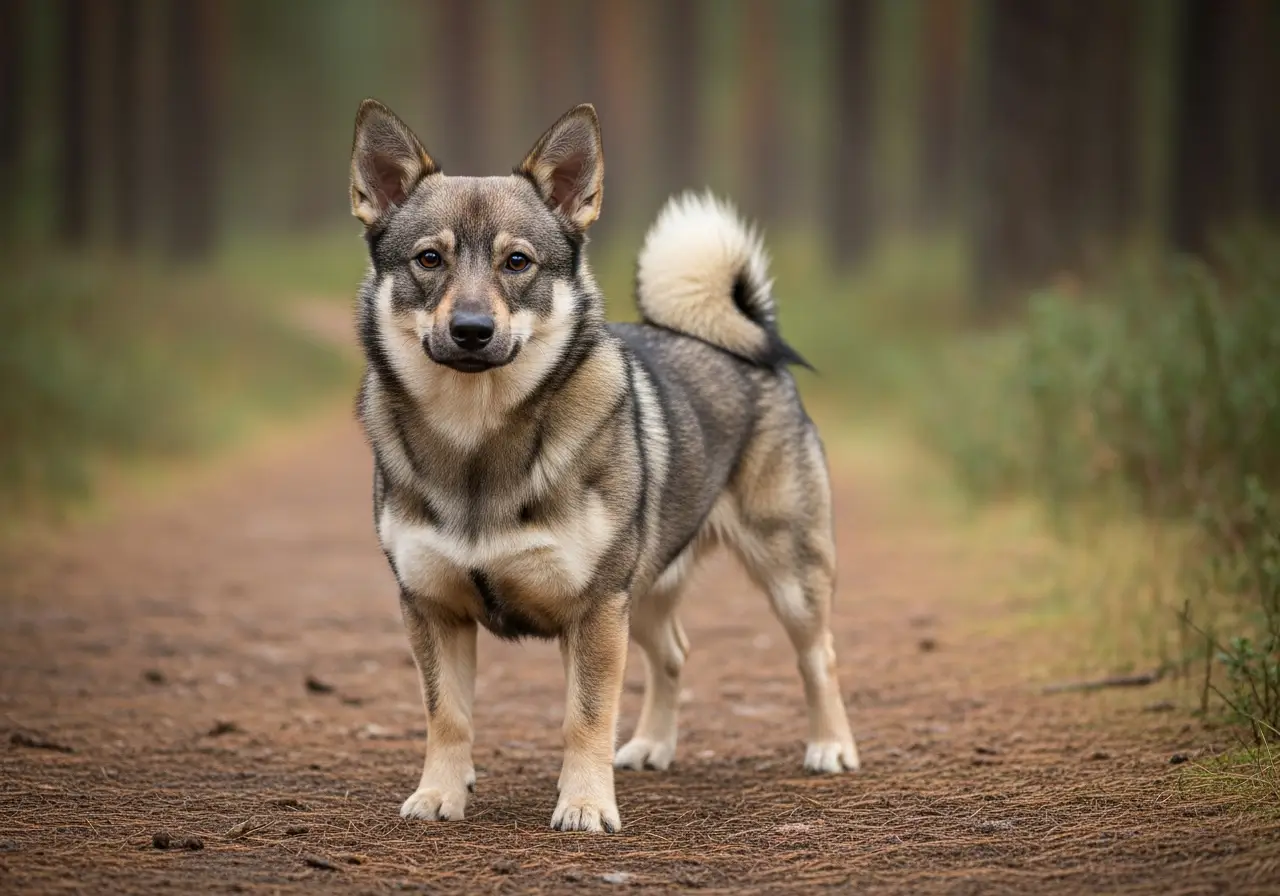
The Swedish Wallhund (Västgötaspets) is a short-legged Nordic driving dog with a pronounced herding instinct and high willingness to work. Anyone looking for a compact, robust dog that is content with little enrichment is mistaken about this breed. However, anyone who enjoys structured training, an active everyday life, and a close working relationship will find a reliable, attentive companion in the Västgötaspets.
02Introduction
What makes the Swedish Farmdog special
Swedish Farmdog (Västgötaspets): short-legged Nordic driving dog, lively and self-confident, closely linked to Swedish livestock farming
03Profile
Key facts and suitability
- Origin
- Schweden
- Original purpose
- Driving dog for cattle
- FCI
- No. 14 · Group 5 · Section 3
- height at the withers
- 31–35 cm
- Weight
- 11–16 kg
- Life expectancy
- 12–14 Years
- Coat type
- Short-haired
- Minimum exercise
- 60 min/day
- Puppy price
- 1'200–2'000 CHF
- Waiting period
- 5 months
- Sports
- Agility Herding work Obedience
04Temperament
How the Swedish Farmdog shows up in everyday life
During morning exercise, the Västgötaspets does not simply run alongside you; it observes, anticipates and reacts to every change of direction. This dog works with you, not just alongside you.
Internally, it requires daily mental stimulation at a high level (need for mental work: 4/5) and physical activity of at least 60 to 90 minutes. The need for social contact is pronounced: the Wallhund orients itself closely towards its primary caregiver and actively seeks shared tasks. Anyone who leaves it alone for hours risks alert behaviour; persistent loud barking is among the most common complaints from owners who have underestimated the need for social contact. Being left alone for more than four hours is a strain on this breed that must be built up gradually and systematically.
Externally, the Västgötaspets behaves watchfully and reservedly towards strangers (friendliness towards strangers: 3/5). This is not a defect, but typical of the breed: as a Nordic guarding and herding dog, it registers unknown people precisely without reacting aggressively. Anyone who expects the dog to greet every visitor joyfully will be disappointed. Anyone who understands the reserve for what it is – an attentive temperament – can work well with it.
The herding instinct manifests concretely in everyday life: children running, bicycles on the pavement, joggers in the park; the Wallhund registers movement and has the impulse to control it. Without impulse control training, this can become a challenge in urban daily life. With consistent training and clear structure, this behaviour can be managed well.
The Wallhund is compatible with conspecifics if socialised early and broadly. The combination of a high need for social contact with humans and reserved behaviour towards strangers must not be confused: being a close family dog does not mean being an open sociable dog.
05Needs
What this breed needs daily
The Västgötaspets requires at least 60 to 90 minutes of active exercise daily, not just walking, but activities involving changes of direction, tasks and interaction. Free running on secure terrain, fetching work, nose work or agility cover its need for movement better than simple leash walks.
Mental work is not an optional addition, but equal in rank to physical stimulation. Daily training sessions of 10 to 20 minutes, divided into two to three sequences, keep the dog mentally balanced. Suitable forms include: nose work (mantrailing, search games), obedience, trick training or herding sports. The Wallhund learns quickly and with nuance; repetitions without variation bore it.
The need for social contact demands a present primary caregiver. The dog orients itself closely towards its human and requires shared activity, not just physical proximity. Being left alone for more than four hours constitutes a strain and should be compensated for by dog care or daily structure.
Impulse control training is particularly relevant for this breed. The herding instinct reacts to movement stimuli in everyday life; without targeted training, undesirable behaviours such as jumping up, barking at things or chasing can arise. Calmness training, the conscious practice of relaxation on command, should be part of training from the beginning.
Keeping in an apartment is possible if exercise, mental work and social contact are guaranteed daily. A garden does not replace active enrichment, but makes everyday life easier. Dog sports clubs offering agility, obedience or nose work are a sensible addition for owners who wish to provide the dog with a structured field of activity.
Exercise
High
mental work
A lot
Social needs
High
training
Medium
06Sport & Mental and Physical Stimulation
What sports the Swedish Farmdog is suited for
Realistic in terms of physiology and genetics – not every breed suits every sport.
Structurally and physiologically suitable: no jumping sports (risk of slipped disc) · Suitable for herding work, treibball and coursing · CaniCross / bikejoring possible.
07Quick Check
08Suitability
Who this breed is suitable for – and who it isn't
✓Matches
The Västgötaspets suits owners who can plan 60 to 90 minutes of active exercise with the dog daily, not as an exception, but as a fixed part of everyday structure. Anyone who enjoys joint training, considers dog sports (agility, obedience, nose work) and wishes to build a close working relationship with the dog will find a motivated partner in this breed.
Families with children from about eight years old are suitable if the handling of the dog is respectful and structured and adults take on the leadership role. The herding instinct towards running children must be actively addressed through training.
Owners with prior experience in handling drive-strong or herding breeds are clearly at an advantage. First-time owners can also be successful with the Wallhund if they use a supportive dog training school from the start and are willing to invest time in education and impulse control training.
Anyone living in an apartment is not fundamentally excluded, provided that exercise and mental work are offered daily and consistently. An environment with access to secure free-running areas is a distinct advantage. Owners who are absent for a maximum of four hours daily or can organise reliable dog care meet the basic requirement for this breed being left alone.
×Doesn't match
The Västgötaspets is not suitable for owners looking for a calm companion dog that is content with short walks and little interaction. Anyone who chooses the dog primarily because of its compact size or Nordic appearance, without planning for its working character, will find everyday life overwhelming.
Households where the dog is regularly left alone for more than four hours and no care solution exists are unsuitable. The high need for social contact is not a trait that disappears through habituation; it is genetically anchored.
Anyone who views the reserve towards strangers as a problem and expects an openly friendly dog that warmly greets every visitor should consider another breed. Interpreting the wallhund as "shy" and attempting to "open it up" through forced social contacts increases stress, not openness.
Owners without a willingness for consistent impulse control training should bear in mind that the herding instinct becomes a burden in urban everyday life (towards children, cyclists, joggers) without training. Anyone who expects the drive to regulate itself fundamentally underestimates the breed profile of this breed. Households with very small children under five years of age, where consistent supervision and structuring are not possible, are also poorly suited.
10Line reality
Show line, working line, breeder market
The Västgötaspets is not bred into clearly separated working and show lines, as is the case with the Border Collie or German Shepherd, for example. The FCI classification (Group 5, Section 3, without working test) reflects that a formal separation has not taken place in the breed's history.
In Sweden, the country of origin, reputable breeders place value on preserving the working disposition; herding instinct, stamina and willingness to cooperate are regarded as breeding goals alongside physical appearance. A split into pure show dogs without any desire to work has not yet been documented in this small breed, but remains a risk under increasing pressure from popularity.
In the DACH region, the breeding base is very narrow. Litter numbers are low, and most active breeders are based in Sweden or the Netherlands. Anyone looking for a Wallhund in the German-speaking area must expect long waiting times and possibly import from Scandinavia.
Regional lines in the strict sense do not exist. Owners who wish to use the dog in dog sports (such as agility, obedience or herding sports) should specifically ask about willingness to work and nerve structure when choosing a breeder, as individual differences within the breed can be noticeable.
11Health · Reality
What you need to plan for medically with your Swedish Farmdog
Compared to many other breeds, the Västgötaspets is considered robust, but it has breed-specific health risks that should be known before purchase.
Intervertebral disc disease (IVDD) is a relevant risk due to chondrodystrophy — the genetically determined short-leggedness. Chondrodystrophic breeds have a statistically increased risk of IVDD; a study by the University of Bern (2020) puts the lifetime risk for chondrodystrophic breeds at up to 19% compared to under 2% in normally legged breeds. Joint-sparing exercise during growth, no jumping from furniture and stairs in the first 12 months, and avoiding overweight are preventive measures.
Progressive retinal atrophy (PRA) is a hereditary eye disease that can lead to blindness. Reputable breeders have parent animals examined ophthalmologically before breeding (ECVO eye examination). When buying a puppy, current eye certificates for both parent animals should be available.
Hip dysplasia (HD) occurs occasionally. An HD X-ray examination of the parent animals is a minimum standard in reputable breeding.
According to information from the Swiss Västgötaspets Club, life expectancy is 12 to 15 years. Overweight demonstrably shortens this span and additionally increases the risk of IVDD; weight should be checked regularly. Annual veterinary preventive examinations including dental checks are recommended.
12Structured data
Health by the numbers
Prone to diseases
Hip dysplasia Progressive retinal degeneration
Recommended health tests
Hip X-ray Eye examination
13Myths ↔ Reality
What is often said incorrectly about this breed
Five myths, five realities, five sources.
„The Swedish Farmdog is a cosy lap dog because of its short legs.
The short limbs are a functional adaptation to driving work under cattle hooves, not an indication of low exercise needs. The Västgötaspets requires 60 to 90 minutes of active exercise plus mental stimulation daily. Without sufficient enrichment, it shows alert behaviour, nervousness or destructive activities.
„The Västgötaspets is the same as a Welsh Corgi, just from Sweden.
Both breeds resemble each other externally, but are genetically and historically independent. Modern cynological research assumes that the Västgötaspets developed independently in Sweden. The FCI lists it as its own breed (Standard No. 14), the Pembroke Welsh Corgi as Standard No. 39 and the Cardigan Welsh Corgi as Standard No. 38.
„Small dogs like the farmdog are easy to train and suitable for dog beginners.
The Västgötaspets has a pronounced herding instinct, high intelligence and strong willingness to work. This combination demands consistent guidance, varied training and a primary caregiver with experience in handling high-drive dogs. Understimulation or inconsistent leadership quickly leads to undesirable behaviour.
„The Swedish Farmdog is a robust breed without significant health problems.
Although the Västgötaspets is considered relatively healthy compared to many other breeds, breed-specific risks exist: eye diseases (including progressive retinal atrophy) and hip dysplasia are documented. Due to chondrodystrophy, the genetically determined short-leggedness, intervertebral disc disease (IVDD) is also a relevant risk that must be taken into account in breeding selection and daily life.
„The herding instinct of the farmdog is harmless and only shows itself on the farm.
The herding and control instinct is active in everyday life and is directed at moving stimuli, children, bicycles, joggers or other dogs. Without targeted training and impulse control work, this behaviour can become problematic in an urban environment. The drive is not an exception, but a central characteristic of the breed.
14animal welfare
The animal welfare perspective
Breeder market, designer versions, animal shelter reality — what no one writes in the puppy ad.
The Swedish Wallhund is an exception in German-speaking animal welfare. The breed practically does not occur in animal shelters and placement organisations; the low prevalence in the DACH region and the manageable breeding base ensure that hardly any dogs of this breed are given up. Anyone specifically looking for a Västgötaspets will rarely find one through animal welfare channels. An enquiry with Swedish animal welfare organisations or specialised herding dog placements is still worthwhile.
The backyard breeder market for this breed is not well developed in the DACH region due to low demand. The risk of encountering dubious providers nevertheless exists: anyone who uses the rarity of the breed as a sales argument and offers puppies without health certificates or the possibility of a visit is not acting in the interest of the animals. Platforms such as classifieds portals should be used with caution.
A specific animal welfare problem for this breed arises from mismatch: the wallhund is occasionally chosen because of its compact, "cute" appearance without the working character and high need for enrichment being factored in. Dogs that are permanently under-stimulated or kept incorrectly end up being given away sooner or later, even if this is rarely documented for this breed.
Breeding-related problems in the sense of cruel breeding traits are not known for the Västgötaspets. Chondrodystrophy is a breed standard trait with health implications (IVDD risk) that should be taken into account in breeding through health screenings, providing another argument to buy exclusively from breeders who can provide proof of health examinations of the parent animals.
For those open to an alternative to new breeding: older dogs from surrender or rehoming are equally valid options. An adult dog already shows its character, which often makes it easier to find a good match between dog and owner.
15Costs · Transparency
What this breed realistically costs
A puppy from a reputable breeder costs between 1,200 and 1,800 EUR in the DACH region based on experience; when importing from Sweden or the Netherlands, transport costs of 200 to 400 EUR may be added. Offers significantly below 1,000 EUR without proof of health are a warning sign.
The annual living costs for a Västgötaspets amount to approximately 1,500 to 2,500 EUR depending on the form of keeping. High-quality food (dry or wet food, BARF) adds up to 600 to 1,200 EUR per year. Care is relatively uncomplicated for this breed; the short to medium-length coat requires regular brushing but no professional trimming service.
Veterinary costs for basic care (vaccinations, parasite prophylaxis, annual examination) amount to 300 to 600 EUR annually. Additional possible costs for IVDD treatments can reach 500 to 1,500 EUR in conservative cases and 3,000 to 6,000 EUR in surgical cases. Pet insurance with surgery cover costs between 40 and 90 EUR monthly for this breed depending on the provider and scope of coverage, and is a sensible consideration given the IVDD risk.
Dog sport membership, training costs, and accessories (leash, harness, transport box) are further items that can be estimated at 300 to 600 EUR in the first year.
16Puppy search
What you need to consider when choosing a breeder
- The Swedish Wallhund is a rare breed in the DACH region with very low litter numbers.
- Reputable breeders are predominantly based in Sweden and the Netherlands; specialised breeders are rare in the German-speaking area.
- Waiting times of one year or more should be considered realistic.
- A reputable breeder allows visits to the puppies with the mother dog in her familiar environment, answers questions about health checks (eye screening, hip X-rays), and provides proof of breeding approval.
- Puppies are given away no earlier than eight weeks of age.
- Sales contracts with a return clause are a quality feature.
- Warning signs for dubious offers: no on-site visit possible, puppies from multiple breeds available simultaneously, no proof of health checks for the parent animals, handover before the eighth week of life, or suspiciously low prices.
- The German Club for Nordic Dogs e.
- (DCNH) and the Swiss Västgötaspets Club maintain breeder directories and can assist with the search.
- As the breed practically does not occur in animal welfare, placement via rescue organisations is rare; however, if there is specific interest, it is still worth enquiring with specialised herding dog placements or Swedish animal welfare organisations.
FAQ
Frequently asked questions about the Swedish Farmdog
Is Swedish Farmdog suitable for beginners?
Swedish Farmdog is considered suitable for first-time dog owners.
Is Swedish Farmdog a family dog?
Swedish Farmdog is considered suitable for families with good socialisation and species-appropriate care.
How much exercise does Swedish Farmdog need?
At least around 60 minutes of exercise per day.
Does Swedish Farmdog suit an apartment?
With enough exercise and enrichment, Swedish Farmdog can also be kept in an apartment.
What is the size and weight of Swedish Farmdog?
Fully grown, Swedish Farmdog reaches about 31–35 cm at the withers and weighs around 11–16 kg.
What is the life expectancy of Swedish Farmdog?
The life expectancy of Swedish Farmdog is approximately 12–14 years.
Which diseases are common in Swedish Farmdog?
Hip dysplasia Progressive retinal degeneration
17Breed clubs
Official breed clubs in DACH
19Related
Similar breeds – and their differences
You might also be interested in
Participate
Do you have a good photo of your Swedish Farmdog?
We are looking for expressive images for our breed profiles. Submit yours; the editorial team reviews every submission before publication.
Does this breed suit you?
Agile driving dog – similar to Welsh Corgis in function and type