
01Summary
In a paragraph
If you only have 30 seconds.
The Lapphund is a Finnish driving dog that has controlled reindeer herds under arctic conditions for centuries. Anyone keeping it today takes on a genetic work programme: pronounced herding instinct, high exercise needs and a head that constantly wants to be occupied. Without structured stimulation, problems arise, not because the dog is difficult, but because it does exactly what it was bred for.
02Introduction
What makes the Lapland Herding Dog special
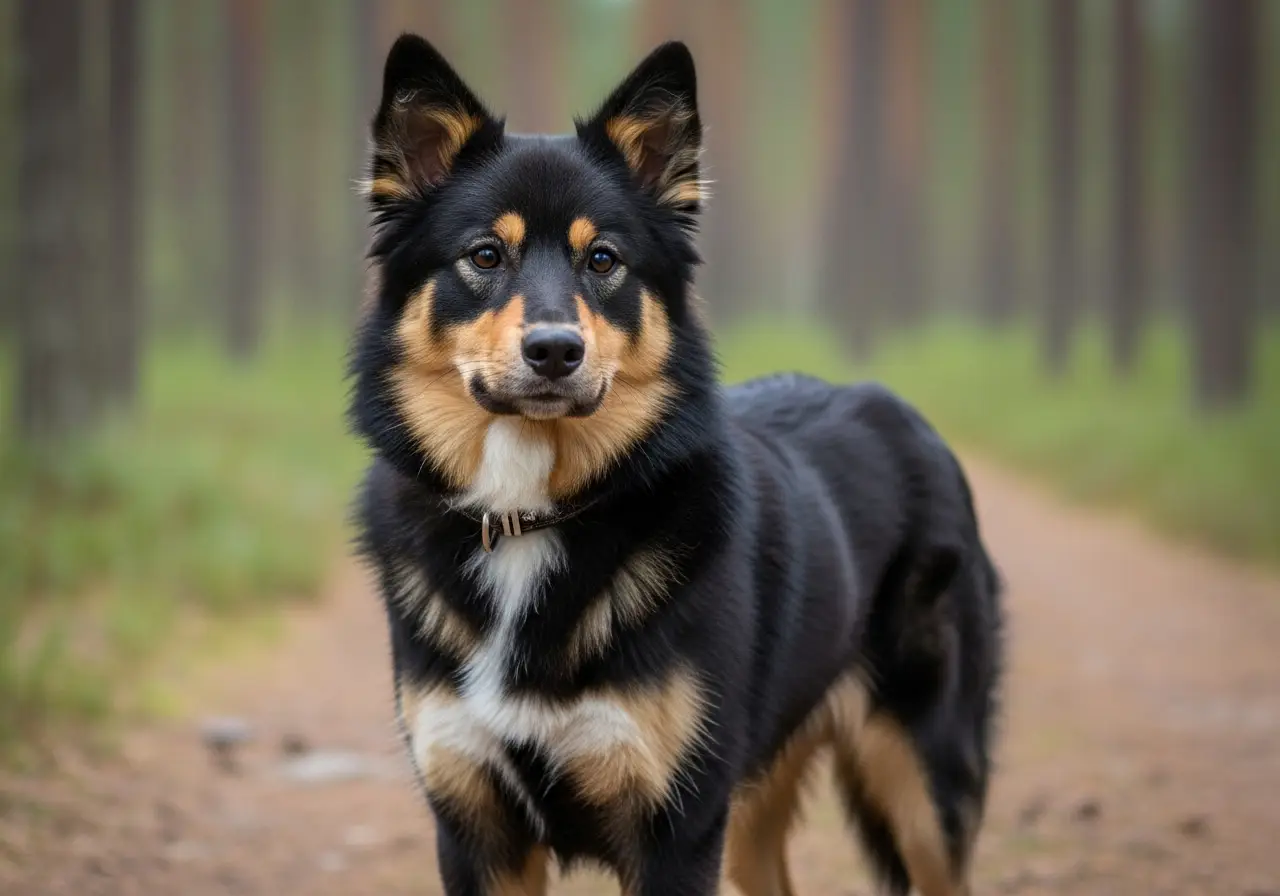
The Lapland Herding Dog is a Finnish Sami herding dog, FCI Group 5, friendly and cold-resistant, withers height 44–51 cm.
03Profile
Key facts and suitability
- Origin
- Finnland
- Original purpose
- Reindeer herd herding dog of the Sami
- FCI
- No. 284 · Group 5 · Sektion 3: Nordische Wachhunde und Hirtenhunde
- height at the withers
- 44–51 cm
- Weight
- 15–24 kg
- Life expectancy
- 12–15 Years
- Coat type
- Doppel
- Minimum exercise
- 60 min/day
- Puppy price
- 1'200–2'000 CHF
- Waiting period
- 9 months
- Sports
- Agility · Obedience · Herding work
04Temperament
How the Lapland Herding Dog shows up in everyday life
During the morning run in the forest, the Lapland Herding Dog shows what his genetic programme means: he scans the terrain, reacts to movement at the edge of the forest and moves towards every moving object, not out of aggression, but out of herding instinct. This drive is not a mistake, it is the foundation of the breed.
Internally, the dog needs high-level mental stimulation daily. A walk without a task is not enough. Anyone who comes home in the evening and simply lets the dog into the garden will find that the dog starts to structure the situation himself, by running along the fence, by herding behaviour towards children or by persistent barking. This is not a training problem; this is a dog looking for his job.
Externally, the dog reacts to strangers with a friendliness that often surprises visitors (CCT score 4 out of 5). He is accessible and not shy. However, this external openness must not be confused with low internal need; the dog appears uncomplicated on first contact, but places high demands on structure and stimulation in everyday life.
With conspecifics, he shows tolerance with good socialisation. In multi-dog households, he functions well if the hierarchy is clear and all dogs receive sufficient enrichment.
In everyday family life with children, it becomes apparent that the dog tends to „gather" children while playing, a classic herding behaviour that can escalate without training work. With consistent training and clear boundaries, this behaviour can be channelled well.
05Needs
What this breed needs daily
The Lapphund requires at least 90 to 120 minutes of active exercise daily, not as a walk, but as structured stimulation. Free running on secure terrain, herding work, agility, mantrailing or intensive nose work meet its requirements. Pure leash walks do not cover the need.
The mental workload is at a high level (CCT value 4 out of 5). The dog requires daily tasks that challenge its problem-solving skills. Short training sessions of 10 to 15 minutes, distributed several times a day, are more effective than one long session in the evening.
The need for social contact is pronounced (CCT value 3 out of 5). The dog requires regular contact with its primary caregiver and tolerates being alone only to a limited extent; a maximum of four hours serves as a guideline. Anyone who is regularly away from home for longer periods needs a reliable care solution.
The coat requires daily care, especially during moulting. The dense double coat is adapted to the arctic climate and sheds intensively twice a year. An undercoat rake and regular brushing prevent matting.
Regarding training: The dog reacts sensitively to inconsistent signals. Calm, clear communication with predictable rules builds trust. Punishment-based methods lead to insecurity and withdrawal. A supporting dog training school with experience in working dogs is recommended for newcomers to the breed.
Exercise
High
mental work
A lot
Social needs
Medium
training
Medium
06Sport & Mental and Physical Stimulation
What sports the Lapland Herding Dog is suited for
Realistic in terms of physiology and genetics – not every breed suits every sport.
Structurally and physiologically suitable: Suitable for herding work, treibball and coursing · CaniCross / bikejoring possible.
07Quick Check
08Suitability
Who this breed is suitable for – and who it isn't
✓Matches
The Lapphund suits owners who can plan 90 to 120 minutes of structured stimulation daily, not as an exception, but as a fixed part of everyday life. Sportily active people with an interest in dog sports (agility, herding work, mantrailing) will find a motivated partner in it.
Families with children from about eight years old, in which at least one person brings experience in dealing with high-drive dogs, can successfully keep the breed, provided that the herding behaviour towards children is trained consistently.
Owners who live in a rural environment or have direct access to extensive terrain benefit from the natural stimulation opportunities. People who are actively involved in animal husbandry or agriculture will also find a willing working companion in it.
Anyone who already has experience with Nordic breeds or herding dogs and knows how to assess the initiative of these dogs is clearly at an advantage. The willingness for regular training and a supporting dog training school in the first two years is a realistic basic requirement.
×Doesn't match
The Lapphund does not suit owners who are away from home for more than four hours daily and cannot organise a reliable care solution. Its limited potential for being left alone (maximum four hours) is not a trainable trait that can be extended arbitrarily.
Anyone who interprets the dog's external friendliness towards strangers as an indication of low maintenance requirements underestimates the internal demand structure. An approachable dog on first contact is not automatically a low-demand dog in everyday life; this confusion leads to chronic under-stimulation.
Households without prior experience with high-drive or work-motivated dogs face a steep learning curve. Without a clear training structure and consistent guidance, the dog develops initiative in the form of undesirable behaviour.
Anyone who lives exclusively in a city apartment without regular access to free-running areas and does not plan any dog sports will not find a suitable companion in this breed. Owners looking for a calm, independently relaxing dog will also not be happy with the Lapphund.
10Line reality
Show line, working line, breeder market
The Lapland Herding Dog still shows a functional separation in Finland between dogs actively working in reindeer husbandry and dogs bred primarily for shows or as companion dogs. This distinction is relevant for interested parties in DACH, even if it is less formalised than, for example, with retriever breeds.
Working line: Dogs that are actively used in Finnish reindeer husbandry generally show a more pronounced herding instinct, higher endurance and stronger initiative. These dogs are more demanding for owners without experience with working dogs.
Companion dog-oriented breeding: In DACH breeding facilities, the focus is often on temperament balance and suitability for everyday life. The herding instinct remains present, but is often less intense than in pure working lines.
Anyone who buys a puppy from Finnish working breeding should be aware of the higher stimulation requirement. A conversation with the breeder about the specific use of the parent dogs provides information about the expected drive profile. Show successes of the parent dogs alone are not a reliable indicator of the working character of the puppy.
11Health · Reality
What you need to plan for medically with your Lapland Herding Dog
The Lapphund is considered a robust breed with a life expectancy of 12 to 15 years. Reliable breed-specific health statistics for DACH are limited due to the small population size.
Hip dysplasia (HD) occurs in the breed, but is not as widespread as in larger working dogs. Reputable breeders X-ray both parent animals before breeding and publish the results openly. Buyers should actively request HD reports of the parent animals; a breeder without X-ray evidence is a warning sign.
Eye diseases, particularly progressive retinal atrophy (PRA), are documented in Nordic breeds. An eye examination of the parent dogs by a specialist vet (ECVO standard) is part of the minimum standard for serious breeding.
The dense double coat effectively protects the dog from cold, but increases the risk of overheating in summer temperatures and under intense exertion. Owners in warmer regions should schedule training sessions for the morning or evening hours and ensure adequate water supply.
Overweight is a real risk if the need for exercise is not met. An under-stimulated dog with an unchanged food intake gains weight quickly, which puts strain on joints and the cardiovascular system. Regular weight checks at the vet, at least once a year, are recommended. Preventative examinations on an annual basis, booster vaccinations according to the vet's recommendation, and a dental check-up from the fifth year of life onwards are part of health management.
12Structured data
Health by the numbers
Prone to diseases
Hip dysplasia, progressive retinal atrophy, thyroid problems
Recommended health tests
Hip X-ray, eye examination, thyroid screening
13Myths ↔ Reality
What is often said incorrectly about this breed
Five myths, five realities, five sources.
„The Lapland Herding Dog is a calm Nordic breed that is content with little exercise.
The FCI standard describes the breed as energetic and willing to work. The dog was bred for enduring driving work over long distances. A daily exercise requirement of 90 to 120 minutes of active stimulation corresponds to the genetic profile, not a recommendation, but a minimum requirement. If the workload falls below this framework permanently, the dog shows restlessness, herding behaviour towards people or objects and other avoidance behaviours.
„Because he appears friendly, he is also suitable for first-time owners without dog experience.
Friendliness towards strangers (CCT score 4 out of 5) describes the external reaction pattern, not the effort required for keeping. Internally, the dog requires a mental workload of 4 out of 5 and an exercise requirement of 4 out of 5. Anyone who underestimates this internal requirement because the dog appears accessible on first contact risks chronic under-stimulation. First-time owners without a clear training structure and experience with high-drive dogs face a steep learning curve.
„The Lapland Herding Dog and the Finnish Lapphund are the same breed.
Both breeds share a common origin in Sami dog breeding, but were officially separated in 1966. The Finnish Lapphund developed more strongly into a companion dog type; the Lapland Herding Dog retained its clear working orientation as a driving dog. FCI Standard No. 284 defines both as independent breeds with different purposes and exteriors.
„A garden replaces daily stimulation.
A garden offers freedom of movement, but no structured enrichment. The Lapland Herding Dog needs specific tasks, herding work, agility, nose work or comparable dog sports. Without task assignment, the dog does not use the garden for self-stimulation, but develops initiative in the form of undesirable behaviour: running along fences, herding behaviour towards children or vehicles, excessive barking.
„The breed is so rare that you should take any available puppy.
Rarity does not justify compromises in the assessment of breeding facilities. Precisely because the breed is hardly widespread in DACH, a market exists for unreliable suppliers who respond to demand. Health tests (hip dysplasia, eye examinations), access to pedigrees and personal contact with the breeder are minimum standards, regardless of waiting times.
14animal welfare
The animal welfare perspective
Breeder market, designer versions, animal shelter reality — what no one writes in the puppy ad.
The Lappland Herding Dog is practically non-existent in animal shelters in Germany, Austria and Switzerland. The breed is too rare to represent a systematic animal welfare problem in the classical sense. Nevertheless, there are specific risks that prospective owners should be aware of.
Backyard breeder market: The low availability of the breed in DACH creates incentives for dubious providers who respond to demand without carrying out health tests or sufficiently socialising puppies. Offers without a pedigree, without HD and eye tests on the parent dogs, or with very short waiting times should be viewed with caution. Imports from Eastern European countries without studbook documentation are a known pattern in rare breeds.
Surrenders due to keeping conditions: The most common reason for surrenders in this breed is underestimating the need for activity. Owners who judge the dog as uncomplicated because of its friendly appearance encounter reality after a few months: a dog that demands structured stimulation daily and exhibits behaviour that burdens everyday life when under-stimulated. These surrenders are avoidable through honest prior information, not by condemning the owners.
Designer versions: Crosses with the Lappland Herding Dog as a basis for "Nordic designer dogs" are marginal but present in DACH. Such dogs often carry the drive profile of the breed without buyers being informed about it.
Adoption as an option: Breed-specific adoption organisations for Nordic dogs, including the DCNH, occasionally place adult dogs. An adult dog has the advantage that temperament and drive profile can already be assessed. This is not a stopgap solution, but an equally valid decision.
15Costs · Transparency
What this breed realistically costs
The acquisition costs for a puppy from serious VDH breeding typically lie between 1,200 and 1,800 EUR in DACH. Offers significantly below this range without verifiable breeding documentation are a warning sign.
Running costs per year (guideline values): Food for a medium-sized active dog costs between 600 and 1,000 EUR, depending on food quality and body weight. Grooming (brushing, occasional professional grooming during coat change) adds 100 to 300 EUR annually.
Vet costs: Routine examinations, vaccinations and parasite prevention cost between 200 and 400 EUR annually. Unplanned treatments (lameness, eye problems, injuries during sport) can quickly reach 500 to 2,000 EUR per incident.
Dog liability insurance is mandatory for many breeds in Germany (depending on the federal state) and costs between 50 and 150 EUR annually. A health insurance policy for the dog costs between 400 and 1,200 EUR per year depending on the tariff and scope of benefits, and can be sensible for an active sporting breed.
Dog sports and training: Anyone who provides the breed with appropriate stimulation invests in courses, training groups or herding work, realistically 200 to 600 EUR annually.
16Puppy search
What you need to consider when choosing a breeder
- Reputable breeders of the Lapphund in DACH can be found via the German Club for Nordic Dogs (DCNH).
- A breeder affiliated with the VDH is subject to breeding regulations, health tests and litter inspections; this is a minimum standard, not a quality feature alone.
- Specific check points when contacting the breeder: HD and ED X-ray reports of both parent animals, eye examination according to ECVO standards, access to the pedigree, possibility of a personal visit to the breeding facility before reservation.
- A breeder who sells puppies without the possibility of viewing or without health certificates is not a reputable contact.
- Waiting times of six to twelve months are realistic for this rare breed.
- Anyone who finds a puppy within a few weeks should check the origin particularly carefully.
- Adoption as an equally valid option: The DCNH occasionally places adult Nordic dogs.
- An adult Lapphund with a known temperament and assessable drive profile can be the more suitable choice for experienced owners than a puppy with unknown development.
FAQ
Frequently asked questions about the Lapland Herding Dog
Is Lapland Herding Dog suitable for beginners?
Lapland Herding Dog is considered suitable for first-time dog owners.
Is Lapland Herding Dog a family dog?
Lapland Herding Dog is considered suitable for families with good socialisation and species-appropriate care.
How much exercise does Lapland Herding Dog need?
At least around 60 minutes of exercise per day. As an active breed, more so — plus mental stimulation.
What is the size and weight of Lapland Herding Dog?
Fully grown, Lapland Herding Dog reaches about 44–51 cm at the withers and weighs around 15–24 kg.
What is the life expectancy of Lapland Herding Dog?
The life expectancy of Lapland Herding Dog is approximately 12–15 years.
Which diseases are common in Lapland Herding Dog?
Hip dysplasia, progressive retinal atrophy, thyroid problems
17Breed clubs
Official breed clubs in DACH
19Related
Similar breeds – and their differences
You might also be interested in
Participate
Do you have a good photo of your Lapland Herding Dog?
We are looking for expressive images for our breed profiles. Submit yours; the editorial team reviews every submission before publication.
Does this breed suit you?
Friendly, adaptable Sami reindeer herding dog. Popular as a family dog in Scandinavia.