3 sourcesUpdated September 12, 2026Responsible editor: Roger KleinText: Roger Klein
01Summary
In a paragraph
If you only have 30 seconds.
The Smooth Fox Terrier is a British hunting terrier bred for earthwork and fox work, and it brings this heritage with it every day. Anyone who keeps one gets an alert, enduring dog with a pronounced prey drive and the self-confidence to make its own decisions. This works well if structure, consistency and genuine stimulation are in place. Without these foundations, you quickly end up with a dog that pursues its own plan.
02Introduction
What makes the Smooth Fox Terrier special
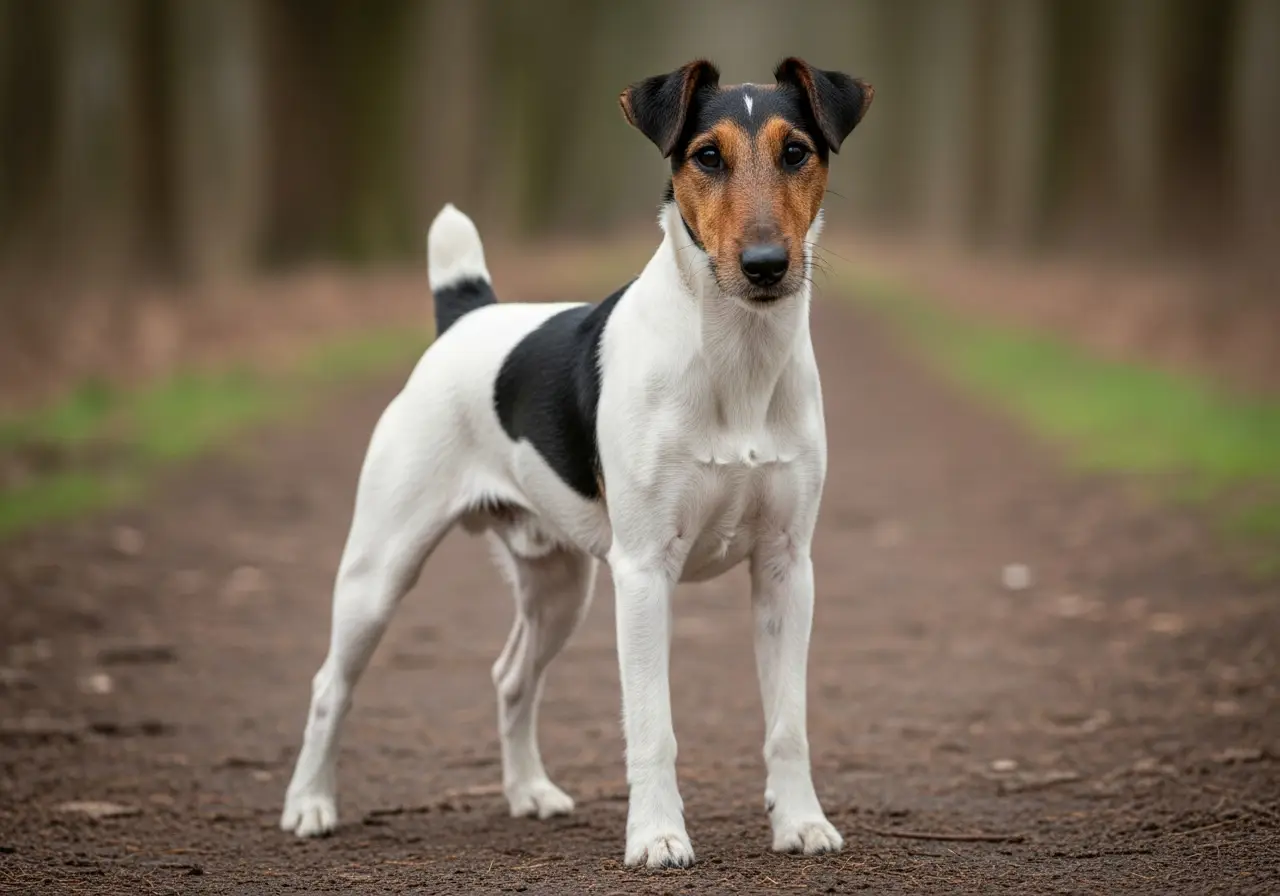
The Smooth Fox Terrier is a British hunting terrier, FCI Group 3, lively and easy to care for, with a withers height of 38–39 cm.
03Profile
Key facts and suitability
- Origin
- Grossbritannien
- Original purpose
- Fox hunting, earthdog work
- FCI
- No. 12 · Group 3 · Section 1
- height at the withers
- 38–39 cm
- Weight
- 7–9 kg
- Life expectancy
- 12–15 Years
- Coat type
- Glatt
- Minimum exercise
- 60 min/day
- Puppy price
- 1'000–1'800 CHF
- Waiting period
- 9 months
- Sports
- Agility · Earthdog trials · Obedience
04Temperament
How the Smooth Fox Terrier shows up in everyday life
The morning walk reveals what makes the Smooth Fox Terrier unique: The nose goes straight to the ground, the body tenses up, and every movement in the bushes draws full attention. This is not a distraction problem; this is work mode. This dog needs genuine daily stimulation: exercise, nose work, training sessions with varying tasks. It responds to monotonous routines with disinterest or independent solutions.
Towards strangers, it behaves cautiously and watchfully. A Smooth Fox Terrier that runs joyfully towards an unknown person is the exception. This reserve is not a deficiency; it is breed-typical and differs significantly from the high need for social contact it shows towards its primary caregiver. It is important to distinguish between these two sides: The dog seeks an intense bond with its owner but is not automatically open to every person.
At home, it is present and attentive. It observes, registers changes, and alerts if something is amiss. Being left alone should be built up gradually; four hours are a realistic maximum for a well-conditioned dog. Anyone absent for longer requires a reliable care solution.
Living together works well with children who act calmly and respectfully. Unpredictable interactions, loud roughhousing, or restricting the dog lead to clear reactions. The Smooth Fox Terrier communicates its boundaries clearly; this is not an aggression problem but a trait that owners must know and manage.
05Needs
What this breed needs daily
The Smooth Fox Terrier needs at least 90 minutes of active exercise daily, spread over several sessions, not as a single block. Free running on secure terrain is valuable but does not replace guided training sessions with clear tasks.
Mental stimulation is equally important as physical exercise. Nose work, search games, fetch training, or agility provide meaningful outlets for its work drive. Without this enrichment, it develops strategies for self-entertainment, usually at the expense of the household or neighbours.
The prey drive requires permanent management: loose-leash walking in open areas, consistent recall training, and a realistic view of when off-leash freedom is possible. A fenced garden offers security but does not replace structured enrichment.
Socially, the Smooth Fox Terrier needs a clear primary caregiver who leads consistently and calmly. It actively tests boundaries, not out of malice, but because it has learned independent thinking as a working dog. Inconsistency in leadership is taken as a signal to make its own decisions.
Being left alone can be trained but is limited. Four hours are considered a realistic maximum. Longer absences require a care solution. The dog also needs regular contact with its owner, not as constant occupation, but as reliable structure in the daily routine.
Exercise
High
mental work
A lot
Social needs
Medium
training
Demanding
06Sport & Mental and Physical Stimulation
What sports the Smooth Fox Terrier is suited for
Realistic in terms of physiology and genetics. Not every breed suits every sport.
Structurally and physiologically suitable: Suitable for mantrailing, dummy work and tracking · CaniCross / bikejoring possible.
07Quick Check
08Suitability
Who this breed suits and who it doesn't
✓Matches
The Smooth Fox Terrier suits owners who can plan at least 90 minutes of active exercise daily and enjoy structured training. Experience with confident or high-drive dogs is a clear advantage; anyone who has already handled a terrier or a hunting dog knows the dynamics.
Active individuals or couples with flexible routines who want to involve the dog in sports or nose work will find an enduring partner in it. Families with children from about eight years old, who handle animals calmly and respectfully, are also suitable, provided the adults take on consistent leadership.
Those living in the countryside or in an environment with secure open space have structural advantages. Keeping it in the city is possible but requires several daily sessions and a realistic approach to managing prey drive.
Owners who value an alert, quick-reacting dog and wish to live with an animal that brings independence will appreciate the Smooth Fox Terrier. The willingness to invest permanently in training and enrichment is not optional; it is a prerequisite.
×Doesn't match
The Smooth Fox Terrier is not suitable for owners who can devote little time to daily exercise and training. Anyone who is regularly away from home for eight hours or more and has no care solution in place will not do justice to the dog.
Households looking for a calm, uncomplicated companion dog that occupies itself and requires little guidance will not be happy with this breed. The Smooth Fox Terrier demands active engagement; it does not passively wait for enrichment.
Anyone who underestimates the prey drive as a trait or believes it can be fully controlled through occasional training risks lasting stress in everyday life, particularly in areas with wildlife crossings or on unsecured terrain.
Families with very young children who have not yet shown calm interaction with dogs should carefully weigh the decision. The dog communicates boundaries clearly and physically, which requires supervision and experience.
Owners who perceive consistency in training as a burden or wish to forgo corrections will find that the Smooth Fox Terrier consistently exploits this leeway for its own decisions. Anyone who sees the breed’s independence as a problem rather than a trait should choose a different breed.
09Related
Similar breeds and how they differ



10Line reality
Show line, working line, breeder market
The Smooth Fox Terrier today shows a clear division between show lines and working lines, a development that accelerated over the course of the 20th century due to the breed's popularity in dog shows.
Show-oriented lines were selected for exterior and type consistency. These dogs often show a somewhat calmer baseline temperament, yet retain the breed-typical prey drive and self-confidence. In everyday life, they are easy to handle if structure and stimulation are in place.
Work-oriented lines, which are still selected for earthwork or underground work (e.g., in the context of hunting trials), generally show a more intense prey drive, higher readiness to react, and greater independence. These dogs require experienced owners who can handle high-drive terriers.
In practice, line affiliation is not always communicated transparently at the time of purchase. A reputable breeder will provide information on whether their line is selected for showing, hunting, or both, and what consequences this has for everyday life. Anyone keeping a Smooth Fox Terrier as a companion dog without using it for hunting should ask this question explicitly, as differences in drive behaviour can be significant.
11Health · Reality
What you need to plan for medically with your Smooth Fox Terrier
The Smooth Fox Terrier is considered a robust breed with a life expectancy of 12 to 15 years. This range is well documented and lies in the upper bracket for dogs of comparable size.
Breed-specific health risks primarily include eye diseases (particularly cataracts and lens luxation), deafness (congenital deafness is genetically proven in white-based terriers) and patellar luxation. According to data from the German Fox Terrier Association e.V., eye and hearing tests are used as preventive examinations in reputable breeding.
Patellar luxation occurs in small to medium-sized breeds with a frequency of up to 7% (Source: University of Veterinary Medicine Hannover, Orthopaedic Study 2018). For the Smooth Fox Terrier, there are no breed-specific prevalence figures available that indicate a higher burden than the breed average; however, regular orthopaedic check-ups are still advisable.
Overweight is an underestimated risk: the Smooth Fox Terrier is an active dog that rarely tends towards obesity when given sufficient exercise. However, if exercise is reduced, for example due to illness or changed living conditions, the risk rises quickly. Weight checks at the vet every six months are recommended.
Preventive examinations include: BAER testing (hearing) before sale, eye examination by a specialist vet (recommended annually), patella assessment for breeding use. Owners should ask for existing examination results of the parent animals when purchasing.
12Structured data
Health by the numbers
Prone to diseases
Legg-Calvé-Perthes disease, eye problems, epilepsy
Recommended health tests
Eye examination
13Myths ↔ Reality
What is often said incorrectly about this breed
Five myths, five realities, five sources.
"The Smooth Fox Terrier is an easy-to-care-for city dog due to its size.
Body size says nothing about the need for exercise and stimulation. The Smooth Fox Terrier needs at least 90 minutes of active exercise plus mental enrichment daily. City living is possible, but requires consistent structure and several daily sessions, no less than with medium-sized herding dogs.
"Its prey drive can be completely switched off through good training.
The prey drive of the Smooth Fox Terrier is genetically anchored and was selectively reinforced over generations. It can be managed and channelled through training, but not eliminated. A reliable recall in areas with free-roaming wildlife requires years of consistent training and remains situation-dependent.
"Fox Terriers are family dogs that get along easily with toddlers.
The Smooth Fox Terrier tolerates respectful handling, but reacts sensitively to unpredictable movements and loud noises from small children. It actively enforces boundaries. Living together with toddlers requires consistent supervision and clear rules; it is not a given, but a matter of socialisation and management.
"The Smooth Fox Terrier automatically gets along well with other dogs.
Towards conspecifics, the Smooth Fox Terrier appears self-confident to dominant, especially towards dogs of the same sex. Early, broad socialisation reduces conflicts, but does not eliminate the breed-typical self-confidence. In multi-dog households, careful selection and observation are necessary on a permanent basis.
"Short coat means minimal grooming effort.
The smooth, dense coat of the Fox Terrier sheds continuously and adheres well to textiles. Regular brushing reduces shedding in the household. The grooming effort is less than for long-haired breeds, but not negligible, especially during moulting periods.
14animal welfare
The animal welfare perspective
Breeder market, designer versions, animal shelter reality: what no one writes in the puppy ad.
The Smooth Fox Terrier regularly ends up in animal welfare, and the reasons are well documented. Underestimated prey drive, lack of consistency in training and a daily routine that does not meet the exercise needs are the most common reasons for surrender. This is no coincidence but a structural problem: the breed appears accessible due to its compact size and groomed appearance, while the actual demands are underestimated.
The Smooth Fox Terrier appears less frequently on the backyard breeder market than trendy designer breeds, but is not completely absent. Offers without pedigree, without health certificates for the parent animals and at very low prices are a reliable warning sign. Reputable breeding of Smooth Fox Terriers includes eye and hearing tests for the breeding animals; anyone who cannot or will not provide these certificates is breeding without regard for the health of the puppies.
Designer variants or crosses under the label “Fox Terrier Mix” are occasionally marketed as more uncomplicated. The opposite is often the case: drive behaviour and independence remain, while the predictability of behaviour decreases.
Adopting an adult Smooth Fox Terrier from animal welfare is an equally valid option and, in some cases, the more honest one. An adult dog shows its true character, and experienced animal welfare organisations can assess whether the dog fits a specific household. Anyone interested in this option can find dogs via the German Fox Terrier Association e.V. as well as through specialised terrier animal welfare organisations.
15Costs · Transparency
What this breed realistically costs
A puppy from reputable breeding with a pedigree, health certificates and vaccination book costs between 1,200 and 1,800 EUR in Germany. Offers significantly below this, particularly without proof of parent health tests, are a warning sign.
Annual living costs average 1,500 to 2,500 EUR. This includes: high-quality food (approx. 400–700 EUR/year depending on the type of food), basic equipment and consumables (leashes, toys, sleeping area), as well as regular veterinary costs for vaccinations, parasite prevention and annual check-ups (approx. 300–500 EUR/year).
Unforeseen veterinary costs, such as those for patellar luxation or eye diseases, can quickly reach 1,000 to 3,000 EUR. Pet insurance for this breed costs between 40 and 90 CHF/EUR per month depending on the provider and scope of cover, significantly reducing financial risk in the event of serious illness.
If you plan to attend dog training school, nose work courses or agility classes, budget an additional 200 to 600 EUR per year. For the Smooth Fox Terrier, these costs are not a luxury option but part of appropriate keeping.
16Puppy search
What you need to consider when choosing a breeder
- A reputable breeder of Smooth Fox Terriers is a member of the German Fox Terrier Association e.V.
- and breeds under VDH licence.
- They provide health certificates for the parent animals (at least BAER testing for hearing and an eye examination) and give information on line affiliation (show or working).
- Viewings before purchase are standard: a reputable breeder shows the mother with the puppies in their familiar environment.
- Puppies offered without the mother or at a neutral handover location are a clear warning sign.
- Waiting periods of several months are normal for this niche breed.
- Anyone who can buy a puppy immediately should scrutinise the origin particularly critically.
- Adopting an adult dog via the German Fox Terrier Association e.V.
- or specialised terrier animal welfare organisations is an equally valid alternative.
- Adult dogs show their true character, which makes it easier to assess whether the dog fits your daily routine.
- No reputable platform recommends individual breeders by name; researching through the association is the most reliable starting point.
FAQ
Frequently asked questions about the Smooth Fox Terrier
Is Smooth Fox Terrier suitable for beginners?
Smooth Fox Terrier is considered suitable for first-time dog owners.
Is Smooth Fox Terrier a family dog?
Smooth Fox Terrier is considered suitable for families with good socialisation and species-appropriate care.
How much exercise does Smooth Fox Terrier need?
At least around 60 minutes of exercise per day. As an active breed, more so — plus mental stimulation.
Does Smooth Fox Terrier suit an apartment?
With enough exercise and enrichment, Smooth Fox Terrier can also be kept in an apartment.
What is the size and weight of Smooth Fox Terrier?
Fully grown, Smooth Fox Terrier reaches about 38–39 cm at the withers and weighs around 7–9 kg.
What is the life expectancy of Smooth Fox Terrier?
The life expectancy of Smooth Fox Terrier is approximately 12–15 years.
Which diseases are common in Smooth Fox Terrier?
Legg-Calvé-Perthes disease, eye problems, epilepsy
Participate
Do you have a good photo of your Smooth Fox Terrier?
We are looking for expressive images for our breed profiles. Submit yours; the editorial team reviews every submission before publication.
Does this breed suit you?
Lively terrier with very easy-to-care-for coat. Energy is enormous despite small stature. For active owners.