
01Summary
In a paragraph
If you only have 30 seconds.
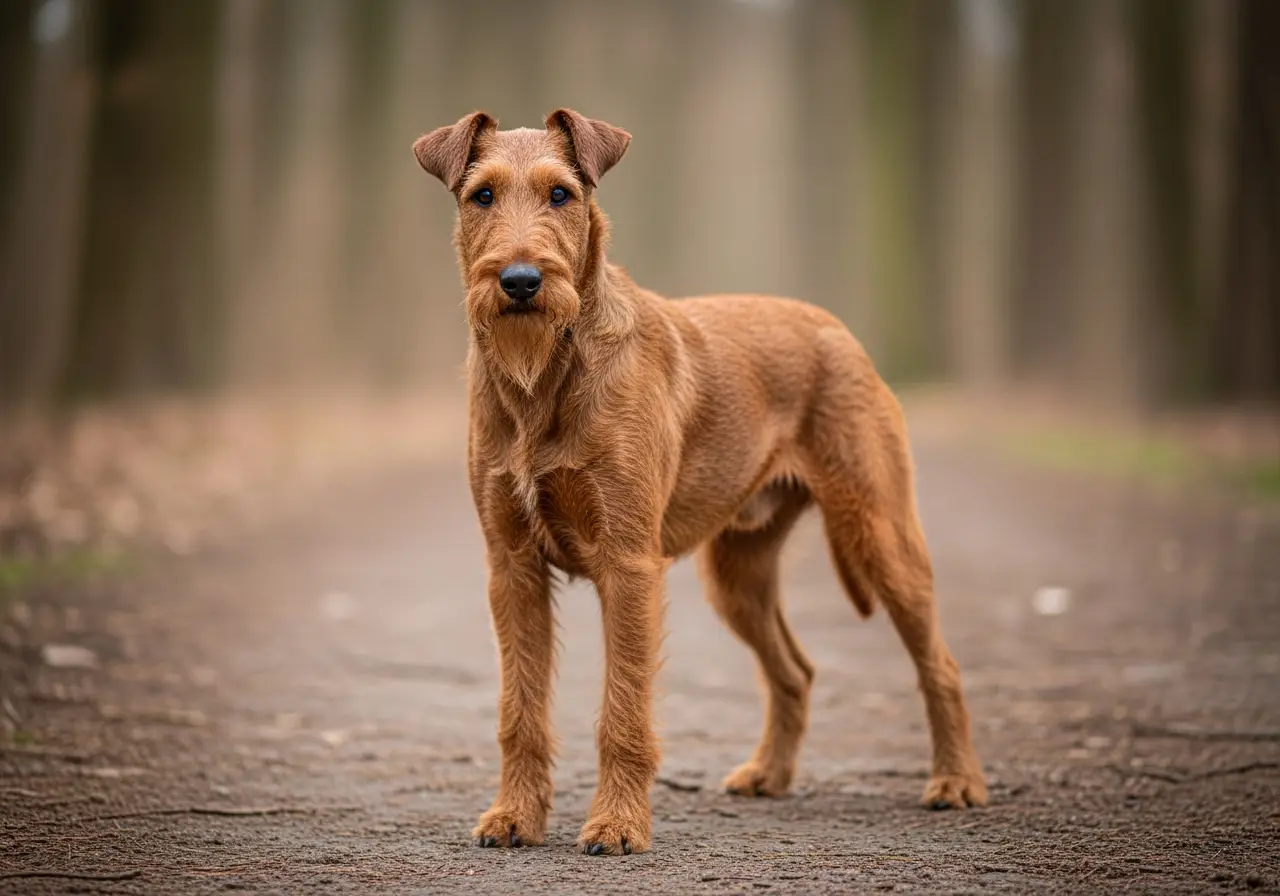
The Irish Terrier is a fiery, wire-haired working terrier from Ireland with a bright red coat and a self-confidence that tolerates no half-measures. It requires at least 90 minutes of active exercise daily, consistent training and a primary caregiver who does not mistake terrier temperament for stubbornness, but factors it in as an inherent trait. Those who bring this to the table receive a loyal, long-lived companion with genuine character.
02Introduction
What makes the Irish Terrier special
The Irish Terrier is a fiery Irish working terrier, FCI Group 3, hypoallergenic and long-lived, withers height 44–47 cm.
03Profile
Key facts and suitability
- Origin
- Irland
- Original purpose
- Hunting, guarding, ratting
- FCI
- No. 139 · Group 3 · Sektion 1: Hochläufige Terrier
- height at the withers
- 44–47 cm
- Weight
- 11–12 kg
- Life expectancy
- 13–16 Years
- Coat type
- Wire-haired
- Minimum exercise
- 60 min/day
- Puppy price
- 1'200–2'000 CHF
- Waiting period
- 9 months
- Sports
- Agility · Obedience · Earthdog work · Hunting
04Temperament
How the Irish Terrier shows up in everyday life
Upon returning home, the Irish Terrier greets its primary caregiver with genuine presence, not with uncontrolled exuberance, but with alert interest and clear devotion. This bond is deep, but not clingy. The dog does not follow on every step; it observes, positions itself, and waits for the next cue.
On a walk, the internal focus becomes clearly apparent: the Irish Terrier needs mental stimulation just as much as physical exercise. A sniffing trail through unfamiliar terrain occupies it more than a second lap on the usual route. If a stimulus appears (rustling in the bushes, a mouse in the grass), the prey drive kicks in immediately. The external reaction to this stimulus is quick and decisive; whoever does not have a firm recall at this moment loses control.
Towards strangers, the Irish Terrier behaves watchfully to reservedly. This is not shyness, but typical terrier self-assurance: it decides for itself whom to trust. This external axis differs clearly from the high need for social contact within its own family; an Irish Terrier that is open and loyal towards its primary caregiver does not automatically have to be so towards every visitor.
With children who handle it calmly and respectfully, it shows patience. Hectic activity, loud commotion, or unpredictable movements activate its readiness to react. Clear rules in family life are therefore not a nice-to-have, but a prerequisite.
Towards other dogs, it appears self-confident. Encounters with dogs of the same sex require attention, especially during the settling-in phase. Whoever keeps several dogs should introduce them gradually and in a controlled manner.
05Needs
What this breed needs daily
The Irish Terrier needs at least 90 minutes of active exercise daily, not as a leisurely walk, but as genuine physical exertion. Running alongside a bicycle, extensive terrain tours, or structured fetch training correspond to its endurance profile. A short walk around the block is not sufficient.
Mental stimulation is at least equally important. The need for mental work is high: the Irish Terrier needs daily tasks that challenge it. Nose work, search games, mantrailing, or varied obedience training are suitable formats. It rejects monotonous repetitions; whoever always trains the same thing loses its attention.
It tolerates being left alone for up to about four hours, provided this has been built up gradually. Longer absences without preparation lead to frustration, which can manifest in destructive behaviour. A structured build-up of being left alone is part of basic training.
Recall deserves special attention: due to the pronounced prey drive, this must be trained consistently over months and refreshed regularly. Off-lead exercise in unsecured terrain is only justifiable when the recall works reliably even under distraction.
Social interaction with the family is important to the Irish Terrier; it needs inclusion in daily life, not merely provision of care. Whoever keeps it permanently in a kennel or in isolation significantly underestimates its need for social contact.
A dog training school with terrier experience supports the development of a stable basic education and helps to avoid typical errors in consistency.
Exercise
High
mental work
A lot
Social needs
Medium
training
Demanding
06Sport & Mental and Physical Stimulation
What sports the Irish Terrier is suited for
Realistic in terms of physiology and genetics – not every breed suits every sport.
Structurally and physiologically suitable: Suitable for mantrailing, dummy work and tracking · CaniCross / bikejoring possible.
07Quick Check
08Suitability
Who this breed is suitable for – and who it isn't
✓Matches
The Irish Terrier suits owners with prior experience in handling independent or temperamental dogs. Whoever has already handled a terrier, a herding dog, or another independent breed brings the necessary foundation.
Suitable are active individuals or families with an exercise quota of at least 90 minutes daily, distributed across genuine activity, not just walks. A garden is helpful, but not a mandatory criterion, as long as daily life provides sufficient stimulation.
Families with children from about eight years of age, who are trained in dealing with dogs and adhere to clear rules, qualify as owners. The decisive factor is that all family members handle the dog consistently and uniformly.
Those who enjoy structured training (nose work, obedience, mantrailing) will find a motivated partner in the Irish Terrier, provided the sessions are varied.
Owners who are prepared to build up recall over the long term and consistently, and who factor in prey drive as an inherent trait, can also keep the dog in rural environments with opportunities for off-leash exercise. Those who rarely have visitors or can cope with the dog remaining reserved towards strangers will not be surprised by this external reaction.
×Doesn't match
The Irish Terrier is not suitable for owners keeping a dog for the first time and who do not wish to use a dog training school or experienced support. Its temperament demands clear structures from the start; uncertainty in leadership reinforces unwanted behaviours.
Those who are away from home for more than four hours daily and have no reliable care solution underestimate the need for social contact of this breed. Prolonged being left alone leads to frustration and destructive behaviour.
Owners looking for a calm, low-demand companion dog will not be happy with the Irish Terrier. Its need for physical exercise and mental stimulation is high; those who view this as an option rather than a necessity do neither themselves nor the dog a favour.
Those who regard prey drive as a negligible detail or assume that recall will develop on its own are taking a real safety risk. Off-leash exercise without a solid foundation in recall is not a justifiable option for this breed.
Households with very young children under six years of age, where supervision of the interaction between child and dog cannot be ensured, should carefully weigh up the decision. Those who also expect the dog to greet every visitor warmly misunderstand the external reaction axis: reserve towards strangers is not a training error, but a breed characteristic.
10Line reality
Show line, working line, breeder market
The Irish Terrier does not exhibit a pronounced differentiation between working and show lines, as is known, for example, with the German Shepherd or the Labrador Retriever. The breed was historically bred as a versatile utility dog (hunting, guarding, and ratting were combined in one role), and this versatility is reflected in a comparatively uniform character type.
In the FCI standard, the breed is listed without a working test. This does not mean that working traits are absent (prey drive, endurance, and courage remain firmly ingrained in its character), but rather that no formal line separation has been institutionalised through testing systems.
In practice, individual differences still emerge between breeders who primarily select for show success and those who place value on working traits and robustness of character. Owners looking for an Irish Terrier for dog sports or nose work should specifically ask the breeder about the character orientation of the parent dogs and request to see proof of work or character assessments.
Regionally, the breed is rare in the German-speaking area. The Klub für Terrier von 1894 e.V. and the Schweizer Club für Terrier SCFT are the responsible breeding associations and can provide information on active breeders and their focus.
11Health · Reality
What you need to plan for medically with your Irish Terrier
The Irish Terrier is considered robust compared to other breeds. According to figures from the Klub für Terrier von 1894 e.V., life expectancy is between 12 and 15 years, an above-average range for medium-sized dogs that suggests a relatively low burden of breed-specific hereditary diseases.
Known health risks include skin conditions, including allergy-induced dermatitis, as well as a genetically determined metabolic disorder: cystinuria, a disorder of amino acid metabolism that can lead to the formation of urinary stones. Affected dogs show symptoms such as frequent urination, blood in the urine or pain when urinating. Breeders who test for this condition are considered reputable.
Hip and elbow dysplasia (HD/ED) are less prominent in this breed than in large breeds, but should not be ignored in breeding selection. Specific population-wide HD rates for the Irish Terrier are not publicly documented for the German-speaking region; a breeder who provides X-ray results of the parent dogs is acting transparently.
Preventive examinations that should be requested before purchase: cystinuria test of the parent dogs, hip X-ray report, eye examination. Annual veterinary check-ups and dental care are standard. The wire coat requires regular stripping, two to three times a year, which is not a health issue but a grooming effort that must be factored in.
Overweight poses a lower risk for actively kept Irish Terriers than for less exercise-oriented breeds, but should be actively monitored if activity levels decrease with age.
12Structured data
Health by the numbers
Prone to diseases
Hip dysplasia, skin problems
Recommended health tests
Hip X-ray
13Myths ↔ Reality
What is often said incorrectly about this breed
Five myths, five realities, five sources.
„The Irish Terrier is aggressive and quarrelsome towards other dogs.
The FCI standard explicitly states that this assessment is incorrect. The Irish Terrier does not avoid a confrontation if the circumstances require it, but it does not actively seek one. With consistent socialisation and clear leadership, it is an amiable household dog. Dogs of the same sex require more attention during introduction, but this is not a unique feature of this breed.
„Terriers train themselves over time if you give them enough freedom.
The opposite is true. The Irish Terrier questions monotonous routines and actively tests consistency. Without a clear, varied training structure and a reliable primary caregiver, it develops its own solutions, which rarely align with the owner's expectations. Freedom without leadership reinforces unwanted behaviours rather than reducing them.
„The Irish Terrier is hypoallergenic and therefore unrestrictedly suitable for allergy sufferers.
The wire hair of the Irish Terrier sheds little fur, which can reduce allergen load in the household. However, there is no guarantee of suitability for allergy sufferers: dog allergens are found not only in the coat but also in saliva, skin flakes and urine. Allergy sufferers should consult an allergist and carry out contact tests before getting a dog.
„A garden replaces the daily walk for the Irish Terrier.
A garden offers space for movement but does not replace either the mental stimulation or the structured activity that the Irish Terrier needs daily. Without active enrichment (search tasks, training, guided walks), boredom and frustration develop, which manifest in unwanted behaviour. The garden is a supplement, not a replacement.
„The Irish Terrier cannot be walked off-lead due to its prey drive.
The prey drive is genetically ingrained and distinctly pronounced in the Irish Terrier. A reliable recall therefore requires consistent, long-term training, but it is achievable. Many owners with terrier experience walk their Irish Terriers off-lead in secure areas. The key factors are a solid foundation for recall and a realistic assessment of the environment.
14animal welfare
The animal welfare perspective
Breeder market, designer versions, animal shelter reality — what no one writes in the puppy ad.
The Irish Terrier is a rare breed. On the one hand, this protects it from the mass market; on the other hand, it makes finding reputable breeders more difficult and increases the risk of falling for backyard breeders who exploit the low availability to drive up prices.
You cannot identify backyard breeders by price alone. Anyone who does not provide health test results for the parent animals, does not allow insight into the rearing conditions, and gives away puppies before their eighth week of life is not acting in the interest of the animals. A puppy price of 1,500 to 2,500 euros is realistic with reputable breeders in the DACH region; significantly cheaper offers from unknown sources should be questioned critically.
Designer versions of the Irish Terrier (such as crosses marketed under fantasy names) exist on the market, but are less common than with more popular breeds. The fundamental problem remains the same: without a stud book and health tests, there is no basis for a serious assessment of the puppy.
A frequent reason for surrender in animal welfare is the underestimated training effort. Owners who misunderstand the temperament of the Irish Terrier as stubbornness and do not establish consistent leadership often give up the dog after just a few months. This is not a failure of the dog, but an information problem prior to purchase.
Animal welfare organisations and breed rescues, such as those via the Klub für Terrier von 1894 e.V., occasionally place adult Irish Terriers. An adult dog has the advantage that its character and health status are already assessable. Anyone open to this option is making an equally valid decision, not a second-rate one.
15Costs · Transparency
What this breed realistically costs
The acquisition costs with reputable breeders in the DACH region range between 1,500 and 2,500 euros. Offers significantly below this range, particularly from Eastern Europe without proof of stud book registration, are often associated with missing health tests and poor rearing conditions.
The annual living costs consist of food (high-quality dry food or BARF for a medium-sized dog: approx. 600–1,000 euros/year), grooming through professional trimming (two to three times a year, approx. 80–150 euros per session) as well as basic equipment, dog training school and accessories in the first year (approx. 500–800 euros one-off).
Veterinary costs vary greatly. Routine examinations, vaccinations and parasite prevention amount to approx. 200–400 euros annually. If an illness such as cystinuria or a skin disease occurs, diagnosis and treatment can quickly reach 500–2,000 euros per incident.
Dog health insurance costs approx. 40–100 euros monthly for an Irish Terrier, depending on the provider and scope of benefits. Surgery insurance is cheaper (approx. 20–50 euros/month) and covers at least the greatest individual risks. The total costs over the dog's lifetime, at 12 to 15 years, realistically lie between 25,000 and 45,000 euros.
16Puppy search
What you need to consider when choosing a breeder
- Reputable Irish Terrier breeders can be found through the Klub für Terrier von 1894 e.V.
- (Germany) and the Schweizer Club für Terrier SCFT (Switzerland/Austria).
- Both associations maintain stud books and require their members to adhere to minimum standards in health and rearing.
- Characteristics of reputable breeding: The parent dogs have been tested for cystinuria, X-ray results for the hips are available, the puppies grow up within the family unit and are not given away before eight weeks of age.
- The breeder asks questions about the planned keeping and refuses to hand over a puppy if the prerequisites do not match.
- A take-back guarantee is another quality feature.
- Warning signs: No insight into rearing, no health certificates, puppies from the boot or from mediation platforms without stud book documentation.
- Adopting an adult Irish Terrier through animal welfare organisations or breed rescue groups is an equally valid option.
- Reasons for rehoming are often related to living conditions rather than character; many of these dogs are healthy and well-socialised.
- Contact with the breed associations clarifies whether there are currently dogs available for adoption.
- No specific breeder recommendations are made here; the associations maintain current stud lists.
FAQ
Frequently asked questions about the Irish Terrier
Is Irish Terrier suitable for beginners?
Irish Terrier is considered suitable for first-time dog owners.
Is Irish Terrier a family dog?
Irish Terrier is considered suitable for families with good socialisation and species-appropriate care.
How much exercise does Irish Terrier need?
At least around 60 minutes of exercise per day. As an active breed, more so — plus mental stimulation.
Does Irish Terrier suit an apartment?
With enough exercise and enrichment, Irish Terrier can also be kept in an apartment.
What is the size and weight of Irish Terrier?
Fully grown, Irish Terrier reaches about 44–47 cm at the withers and weighs around 11–12 kg.
What is the life expectancy of Irish Terrier?
The life expectancy of Irish Terrier is approximately 13–16 years.
Is Irish Terrier suitable for allergy sufferers?
Irish Terrier is considered relatively hypoallergenic. There’s never a guarantee — test direct contact beforehand.
Which diseases are common in Irish Terrier?
Hip dysplasia, skin problems
17Breed clubs
Official breed clubs in DACH
19Related
Similar breeds – and their differences
You might also be interested in
Participate
Do you have a good photo of your Irish Terrier?
We are looking for expressive images for our breed profiles. Submit yours; the editorial team reviews every submission before publication.
Does this breed suit you?
Fiery, loyal terrier. Hypoallergenic, robust, long-lived. Can display dominance-oriented behaviour towards other dogs.