
01Summary
In a paragraph
If you only have 30 seconds.
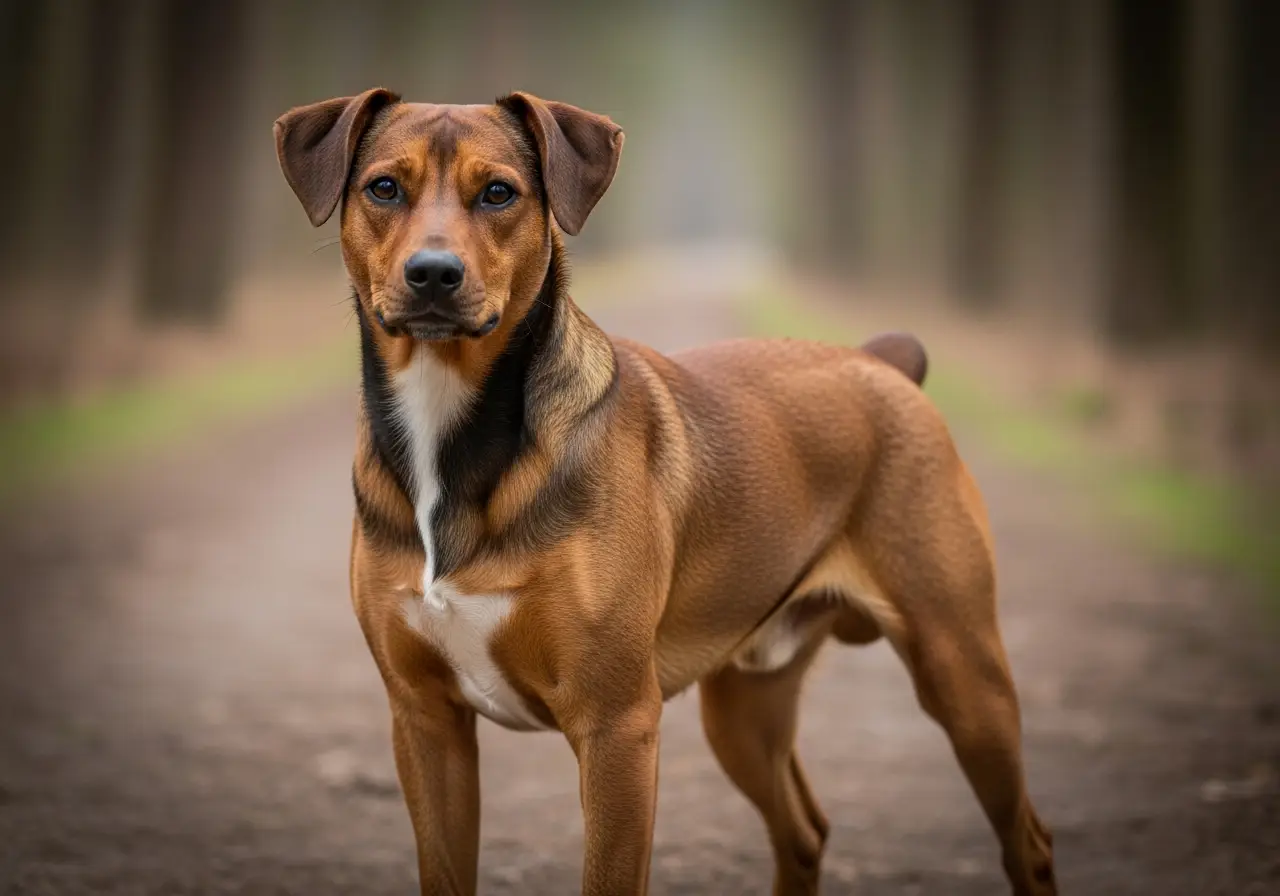
The Austrian Pinscher is a robust, independent farm dog from old Central Europe, rare, authentic and with pronounced guarding behaviour. It bonds closely with its family but meets strangers with clear reserve. To do it justice, you need a house with a garden, consistent leadership and at least 90 minutes of active exercise daily. Not a dog for urban frequent travellers.
02Introduction
What makes the Austrian Pinscher special
Austrian Pinscher: lively farm dog from Austria, rare but robust and with the authentic character of a working dog
03Profile
Key facts and suitability
- Origin
- Österreich
- Original purpose
- Farm and guard dog
- FCI
- No. 64 · Group 2 · Sektion 1.1: Pinscher
- height at the withers
- 42–50 cm
- Weight
- 12–18 kg
- Life expectancy
- 12–14 Years
- Coat type
- Short-haired
- Minimum exercise
- 60 min/day
- Puppy price
- 1'200–2'000 CHF
- Waiting period
- 4 months
- Sports
- Agility Tricks Nose work
04Temperament
How the Austrian Pinscher shows up in everyday life
When you come home, the Austrian Pinscher greets its family with palpable intensity; it registers every change in the household rhythm and reports it. If the doorbell rings, it is there before you are. This is not a mistake, but its core programme: guard dog.
In everyday family life, it shows a close, almost exclusive bond to its reference persons. Anyone who works with it daily, trains and walks with it, experiences an attentive, willing-to-learn dog. Anyone who leaves it to itself gets a dog that finds its own tasks, and usually does so noisily.
Here the two axes separate clearly: Internally, it needs a lot of involvement, exercise and mental stimulation (high need for social contact, high exercise requirement). Externally, it reacts to strangers with reserve up to distrust; this is not a lack of socialisation, but breed-typical guarding behaviour. These two poles must not be confused: An Austrian Pinscher that is affectionate towards its family is by no means open to every visitor for that reason.
It gets on well with children who treat it respectfully and know clear rules. Toddlers who handle it unpredictably overwhelm it. With other dogs, it is compatible if socialised early, but it acts self-confidently; it does not back down.
In the garden, it independently carries out patrol rounds. This is not play behaviour, but territorial behaviour. A securely fenced property is therefore not an option, but a basic requirement.
05Needs
What this breed needs daily
The Austrian Pinscher requires at least 60 to 90 minutes of active exercise daily, not just walks, but activities with a task-oriented character. Scent work, retrieval exercises, cross-country runs or structured training sessions suit its working profile as a former farm dog better than simple leash rounds in the park.
Mental stimulation is just as important as physical exercise. The need for mental work is at a medium to high level. Nose work, search games and consistent obedience training provide it with the structure it needs. Without this engagement, it develops restlessness and barking problems.
Being left alone works for up to about five hours if it has a clearly defined territory and starts the day well exercised. Longer absences without preparation and without a retreat area overwhelm it.
A house with a securely fenced garden corresponds to its original area of use. The garden serves as its territory, which it controls independently. Pure apartment keeping without outdoor space is incompatible with its behavioural profile.
Training requires consistency and calmness. The Austrian Pinscher reacts sensitively to body language and mood; it exploits inconsistent handling, not out of malice, but because it thinks independently. Attending a dog training school from puppyhood is recommended, particularly for owners without prior experience with independent breeds.
Exercise
High
mental work
Medium
Social needs
Medium
training
Demanding
06Sport & Mental and Physical Stimulation
What sports the Austrian Pinscher is suited for
Realistic in terms of physiology and genetics – not every breed suits every sport.
Structurally and physiologically suitable: CaniCross / bikejoring possible.
07Quick Check
08Suitability
Who this breed is suitable for – and who it isn't
✓Matches
The Austrian Pinscher suits owners with a house and a securely fenced garden in a rural or semi-rural location. Anyone who devotes at least 90 minutes daily to active exercise and structured training meets its requirements.
Families with children from about eight years of age, who are experienced in dealing with dogs and adhere to clear rules, get along well with its character. Individuals or couples with an affinity for independent, alert dogs find a reliable companion in it.
Owners with prior experience in handling territorial or independent breeds are clearly at an advantage. Anyone who enjoys having a dog that thinks along, takes on tasks and takes its territory seriously will appreciate its character.
It is also suitable for active seniors with a garden and sufficient time budget, provided their physical fitness allows for daily active sessions. Anyone who regularly receives visitors and expects an uncomplicated interaction with strangers should realistically plan for the external behavioural axis (reserve towards strangers) and work on socialisation early on.
×Doesn't match
The Austrian Pinscher does not suit owners who are away from home for more than five hours daily and cannot organise dog care. Its need for social contact and its territorial behaviour do not tolerate long, regular absences without compensation.
Apartments without a garden and urban multi-storey buildings with thin walls and frequent visitor traffic are difficult to reconcile with its guarding behaviour and love of barking. Anyone looking for a dog that reacts openly and warmly towards strangers confuses its close family bond (internal axis) with general sociability (external axis); this is a common misconception.
First-time owners without guidance from an experienced dog training school should carefully consider the breed. Its independent thinking and guarding instinct require clear leadership from the start. Anyone who cannot or does not wish to maintain consistency in everyday life will have difficulties with it.
Households with toddlers under six years of age, where no quiet retreat for the dog is guaranteed, are also critical. Anyone who keeps several dogs and has little experience with self-confident breeds should clarify compatibility issues in advance with an expert.
10Line reality
Show line, working line, breeder market
The Austrian Pinscher does not have a pronounced line differentiation in the sense of working lines versus show lines, as documented for example in the German Shepherd Dog or the Labrador Retriever. The breed is too rare and the breeding base too narrow for independent lines with different performance profiles to have established themselves.
The breeding goal has been uniform since systematic pure breeding began in 1921: a robust, vigilant farm dog with a stable character structure. Beauty breeding in the sense of a pure show line has not developed; the FCI standard emphasises function and character over exterior.
Regional differences in breeding exist but are not systematically documented. Most active breeders in the German-speaking region work under the umbrella of the Austrian Kennel Club (ÖKV) and orient themselves towards FCI Standard No. 64. The low number of puppies per year makes line differentiation difficult in practice anyway.
Anyone looking for an Austrian Pinscher should pay less attention to line affiliation and more to temperament tests of the parent animals, socialisation within the litter, and the breeder's transparency regarding health examinations. This is the decisive quality indicator for this breed.
11Health · Reality
What you need to plan for medically with your Austrian Pinscher
The Austrian Pinscher is considered a robust, primitive breed with relatively few documented breed-specific diseases. According to the Austrian Kennel Club, life expectancy averages 12 to 14 years, a value that lies in the upper range for medium-sized dogs.
Specific health data such as HD/ED rates are not available for the Austrian Pinscher to the same extent as for more common breeds due to the small population size. This does not mean that joint problems are ruled out; hip dysplasia (HD) and elbow dysplasia (ED) can fundamentally occur in medium-sized dogs. Reputable breeders have parent dogs examined radiologically and disclose the results.
Heart diseases, particularly heart valve defects, are described sporadically in Pinscher breeds. A cardiological pre-examination of parent dogs is recommended but not standard in all breeding lines.
Overweight poses a real risk for this breed if the need for exercise is not met. An Austrian Pinscher with insufficient stimulation tends to gain weight, which places strain on joints and the cardiovascular system.
Preventive examinations at the vet should take place at least once a year, and every six months from the eighth year of life. Dental care is important for this breed; tartar and gum diseases occur more frequently in Pinschers than in the breed average. Regular tooth brushing or chew toys with a cleaning effect demonstrably reduces the risk.
12Structured data
Health by the numbers
Prone to diseases
Heart problems Patellar problems
Recommended health tests
Heart examination Patella check
13Myths ↔ Reality
What is often said incorrectly about this breed
Five myths, five realities, five sources.
"The Austrian Pinscher is like a small shepherd dog, so it is also suitable for city apartments.
The comparison with the shepherd dog applies to the willingness to work, not to the housing requirements. The FCI standard describes it as a guard and companion dog with pronounced territorial behaviour. Pure apartment keeping without a garden and without a clear territory does not meet its basic needs. Barking enthusiasm and guarding behaviour are difficult to manage in multi-storey buildings.
"Pinschers are aggressive by nature.
The FCI standard describes the Austrian Pinscher as character-stable, lively and particularly affectionate towards familiar people. It shows distrust towards strangers; this is guarding behaviour, not aggression. Well-socialised dogs of this breed are compatible with conspecifics and stable in everyday family life. Misbehaviour usually arises from a lack of socialisation or inconsistent handling, not from breed-typical aggression.
"The breed is so rare that you cannot find a reputable breeder.
The Austrian Pinscher is indeed a rare breed with a low number of puppies per year. However, this does not mean that reputable breeding does not exist. The Austrian Kennel Club (ÖKV) lists recognised breeders who work according to the FCI standard. Long waiting times are realistic, but they are no argument for buying from unrecognised multipliers.
"Because it is small and robust, it requires little stimulation.
The Austrian Pinscher's exercise needs are significantly higher than its body size might suggest. As a former farm dog, it was active on large areas and worked independently. An exercise requirement of 60 to 90 minutes daily plus mental enrichment corresponds to its genetic profile. Under-stimulated dogs of this breed develop barking problems and restlessness.
"The prey drive is always strongly pronounced in Pinschers.
The FCI standard explicitly states that the prey drive in the Austrian Pinscher is only weakly pronounced. This distinguishes it from many other working dogs. In open terrain, it is nevertheless attentive and responsive; however, off-leash walking without secure fencing remains risky, as its guarding instinct prompts independent action.
14animal welfare
The animal welfare perspective
Breeder market, designer versions, animal shelter reality — what no one writes in the puppy ad.
The Austrian Pinscher rarely appears in organised animal welfare. The breed is rare, the breeding base is narrow, and there is currently no large-scale backyard breeder market for this breed. This is one of the few positive consequences of low popularity.
Nevertheless, there are risks that potential owners should be aware of. Because the breed is so rare, some interested parties look abroad, particularly in Eastern European countries, where controls by recognised breeding associations are not always guaranteed. Puppies from such sources often arrive without adequate socialisation, without health examinations of the parent dogs, and without reliable pedigrees. The risk of temperament instability and undetected hereditary diseases is increased.
A specific designer variant of the Austrian Pinscher does not exist. The breed is not a trend dog and never was. This protects it from the excesses that other breeds have experienced through sudden popularity, such as hasty breeding, loss of quality, and temperament instability.
Keeping-related problems arise with the Austrian Pinscher primarily when its territorial behaviour and need for exercise are underestimated. A dog kept in an apartment without outdoor access and without clear guidance develops behavioural problems; this is not a breed defect but a consequence of keeping.
Adopting an adult Austrian Pinscher through animal welfare organisations or breed-specific rehoming centres is a fully valid alternative to buying a puppy. Adult dogs come with an assessable temperament, which can be a genuine advantage for a breed with pronounced guarding behaviour. The ÖKV and FCI member associations can assist in finding dogs available for rehoming.
15Costs · Transparency
What this breed realistically costs
A puppy from a reputable breeder recognised by the VDH or ÖKV usually costs between 1,200 and 1,800 euros. Prices significantly below this without a comprehensible explanation are a warning signal. Due to the low number of puppies, there is no established market price as with more common breeds; transparency from the breeder is therefore particularly important.
Annual keeping costs consist of several items. Food for a medium-sized dog of this weight class (12–18 kg) ranges from 600 to 1,200 euros per year depending on quality. Grooming is low-maintenance for the Austrian Pinscher; the wire coat does not require professional clipping, occasional brushing and ear checks are sufficient.
Veterinary costs for routine care (vaccinations, parasite prevention, annual preventive examination) range from 300 to 600 euros annually in the DACH region. Unforeseen treatments can quickly reach 1,000 to 3,000 euros. Pet insurance or a health savings plan is recommended; monthly premiums range between 40 and 90 euros depending on the provider and scope of benefits.
Dog training school, accessories (leash, collar, transport box, toys) and care costs during absence sum up to an additional 500 to 1,000 euros in the first year. Total costs in the first year: realistically 3,000 to 5,000 euros; in subsequent years 1,500 to 2,500 euros.
16Puppy search
What you need to consider when choosing a breeder
- The Austrian Pinscher is a rare breed; the number of puppies per year in the German-speaking region is low.
- This means: waiting times of one year or more are realistic and normal with reputable breeders.
- Reputable breeders operate under the auspices of the Austrian Kennel Club (ÖKV) or a recognised FCI member association.
- They provide health certificates for the parent animals, allow visits to the litter and ask questions about the living situation; this is not mistrust, but responsibility.
- Warning signs: immediate availability without waiting time, no visit to the breeder possible, missing pedigree, prices significantly below €1,000 without explanation.
- Puppies from abroad via intermediary portals without contact with the breeder carry increased risk.
- Adopting an adult Austrian Pinscher through animal welfare organisations is an equally valid option.
- Adult dogs come with an assessable character, which can be an advantage, especially for a breed with pronounced territorial behaviour.
- Breed-specific adoption centres and the ÖKV can assist in the search.
- rundum.dog fundamentally does not provide named breeder recommendations.
FAQ
Frequently asked questions about the Austrian Pinscher
Is Austrian Pinscher suitable for beginners?
Austrian Pinscher is considered suitable for first-time dog owners.
Is Austrian Pinscher a family dog?
Austrian Pinscher is considered suitable for families with good socialisation and species-appropriate care.
How much exercise does Austrian Pinscher need?
At least around 60 minutes of exercise per day.
Does Austrian Pinscher suit an apartment?
With enough exercise and enrichment, Austrian Pinscher can also be kept in an apartment.
What is the size and weight of Austrian Pinscher?
Fully grown, Austrian Pinscher reaches about 42–50 cm at the withers and weighs around 12–18 kg.
What is the life expectancy of Austrian Pinscher?
The life expectancy of Austrian Pinscher is approximately 12–14 years.
Which diseases are common in Austrian Pinscher?
Heart problems Patellar problems
17Breed clubs
Official breed clubs in DACH
19Related
Similar breeds – and their differences
You might also be interested in
Participate
Do you have a good photo of your Austrian Pinscher?
We are looking for expressive images for our breed profiles. Submit yours; the editorial team reviews every submission before publication.
Does this breed suit you?
Rare Austrian farm dog – vital and independent with pronounced guarding instinct