
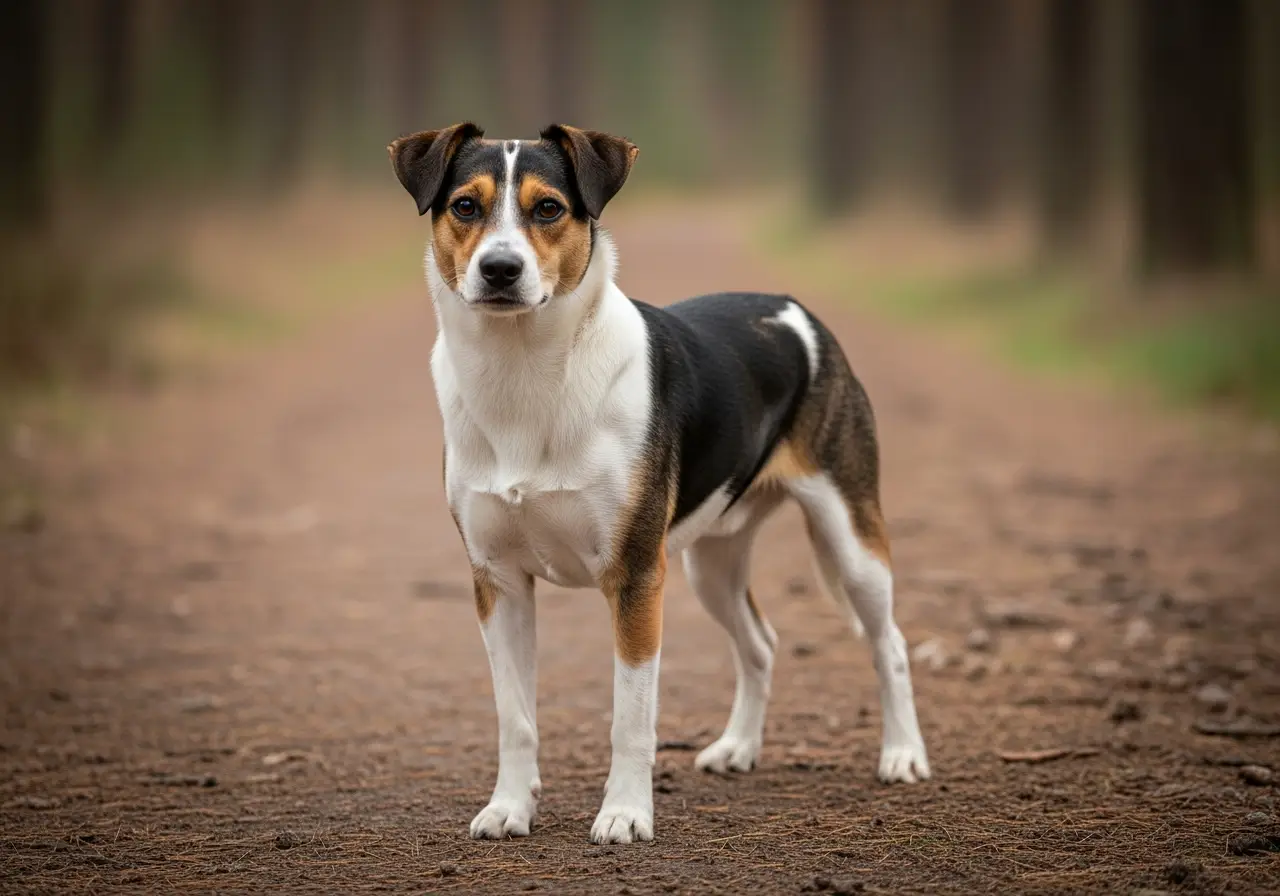
01Summary
In a paragraph
If you only have 30 seconds.
The Danish-Swedish Farmdog is a compact Scandinavian farm dog that worked for centuries as a ratter, guardian, and all-rounder on farms. Its body is small, but its drive is not. Anyone who underestimates it gets a dog that occupies itself in ways that are rarely desired. With clear leadership and sufficient stimulation, it is a reliable, keen-to-learn companion.
02Introduction
What makes the Danish-Swedish Farmdog special
The Danish-Swedish Farmdog is a Scandinavian small dog, FCI Group 2, robust and eager to learn, withers height 32–40 cm.
03Profile
Key facts and suitability
- Origin
- Dänemark/Schweden
- Original purpose
- Rat and mouse catching on farms
- FCI
- No. 356 · Group 2 · Sektion 1.1: Pinscher
- height at the withers
- 32–40 cm
- Weight
- 7–12 kg
- Life expectancy
- 11–13 Years
- Coat type
- Short-haired
- Minimum exercise
- 45 min/day
- Puppy price
- 800–1'500 CHF
- Waiting period
- 6 months
- Sports
- Agility · Obedience · Earthdog work
04Temperament
How the Danish-Swedish Farmdog shows up in everyday life
During the morning walk, the Farmdog shows what defines it: the nose works, the eyes scan, and as soon as a bird moves in the bushes, the lead goes taut. Its prey drive towards small animals and moving stimuli is not an occasional impulse; it is its baseline state.
Internally, this dog needs daily enrichment on two levels: physical exercise and mental stimulation. A walk without a task is not enough. Nose work, trick training or structured retrieving fill the mind. Without this stimulation, behavioural patterns such as excessive barking, scratching or chasing shadows arise.
Externally, the Farmdog behaves alertly but not shyly towards strangers. It reliably announces visitors; this is guarding instinct, not a fault. It greets familiar people lively and affectionately. This openness towards trusted individuals and the simultaneous alertness towards unknowns are two different axes that should not be confused: a high need for social contact with one’s own family does not mean that the dog immediately relaxes with every stranger.
In everyday family life with children, it works well if interaction is respectful and calm. Hectic, loud situations activate its guarding mode. With conspecifics, it generally shows compatibility, provided socialisation during the puppy phase was broad. Towards small animals in the household, prey drive remains a permanent factor requiring supervision.
05Needs
What this breed needs daily
The Danish-Swedish Farmdog needs 60 to 90 minutes of active exercise daily. It is not just the duration that counts, but the quality: sniffing courses, search games, retrieving exercises or agility units challenge it more than a uniform walk. At least one session per day should be specifically aimed at mental stimulation.
Its need for social contact is high. The Farmdog is geared towards close bonding with its reference persons and tolerates being alone only to a limited extent; a maximum of four hours is considered the guideline, with gradual building up. Anyone regularly absent for longer needs a reliable care solution.
Mental and physical stimulation is not an option but a prerequisite. Nose work, trick training, and structured training sessions keep the mind occupied and reduce unwanted self-initiated behaviours. The farm dog learns quickly, which also means it will quickly spot and exploit any gaps in leadership.
The pronounced prey drive demands consistent lead training and a secure off-lead area. A garden with a sturdy fence is sensible but does not replace joint activity. Recall under distraction must be built up over months and refreshed regularly.
Training works best with positive reinforcement, clear consistency, and varied training sessions. Monotony leads to disinterest. Attending a dog training school during the puppy and young dog phase is recommended to solidify the basics early on.
Exercise
Medium
mental work
Medium
Social needs
High
training
Easy
06Sport & Mental and Physical Stimulation
What sports the Danish-Swedish Farmdog is suited for
Realistic in terms of physiology and genetics – not every breed suits every sport.
Structurally and physiologically suitable: Suitable for mantrailing, dummy work and tracking.
07Quick Check
08Suitability
Who this breed is suitable for – and who it isn't
✓Matches
The farm dog suits active individuals or families with children from around eight years old who can provide at least 60 to 90 minutes of structured exercise and mental enrichment daily. A garden with a secure fence is a clear advantage but not mandatory; what matters is the time spent on joint activities.
Owners who enjoy training and nose work and are prepared to consistently build up recall under distraction will find a keen-to-learn partner in the farm dog. The breed is also suitable for owners without prior experience, provided they attend a dog training school from the start and are willing to provide consistent daily leadership.
Households where someone works mostly from home or has flexible working hours cater to the dog's need for social contact. Anyone keeping small animals such as rabbits or guinea pigs must plan integration carefully and supervise it permanently. For people looking for a small, robust dog with genuine willingness to work who can factor in Scandinavian imports and longer waiting times, this breed is a substantial choice.
×Doesn't match
The farm dog does not suit owners who are away from home for more than four hours daily and cannot organise reliable care. Its high need for social contact is incompatible with permanent isolation.
Anyone looking for a calm, low-maintenance companion dog will be disappointed by this dog. The farm dog is not a lap dog; its prey drive, alertness, and need for exercise are traits that cannot be compensated for with occasional walks.
Households that mistake its need for social contact for general friendliness underestimate the breed: a close family bond does not mean the dog immediately relaxes around every stranger. Anyone unwilling to invest time in consistent training or expecting the dog to regulate itself creates the conditions for barking problems and prey-chasing incidents.
For households with very young children under six who have not yet learned calm interaction with dogs, combining them with the lively, quick-reacting farm dog is challenging. Anyone keeping small animals and unable to guarantee permanent supervision should assess integration realistically. Owners who rely on immediate availability will also face structural hurdles with this rare breed.
10Line reality
Show line, working line, breeder market
The Danish-Swedish Farmdog does not exhibit a pronounced line division in the sense of working lines versus show lines, as is known, for example, with retrievers or herding dogs. The breed was historically bred functionally and remains to this day a comparatively small population without the split into specialised breeding directions typical for larger breeds.
Within the breeding population, differences nevertheless exist between Scandinavian kennels that select more strongly for working traits (prey drive, alertness, endurance) and those primarily focused on conformation and show success. These differences are subtle but noticeable in everyday life: a dog from a kennel focusing on working traits generally brings more drive and higher prey drive than a dog from a pure show kennel.
Since the breed is hardly prevalent in the DACH region, most dogs come directly from Danish or Swedish kennels. Prospective owners should specifically ask the breeder about the working traits of the parent animals and have the breeding goals explained to them. A look at show successes alone is not sufficient to assess the character of the litter.
11Health · Reality
What you need to plan for medically with your Danish-Swedish Farmdog
The Danish-Swedish Farmdog is considered a robust breed with a life expectancy of 12 to 14 years. Breed-specific diseases with high prevalence are not documented, which is also due to the small breeding population and limited research status.
Patellar luxation is the most frequently mentioned orthopaedic abnormality in small to medium-sized dogs of this body type. Reliable breed-specific prevalence figures for the farm dog are not available; rates of 5–10 % of examined animals are cited in the literature for related pinscher types (Veterinary Surgery, 2016). A patellar luxation screening for both parent animals should be available before purchase.
Dental problems, particularly tartar formation and misalignments, occur more frequently in compact small dogs. Regular dental checks by the vet and daily tooth brushing from puppyhood reduce the risk. Annual veterinary preventive examinations are recommended.
Overweight is less common in this active breed than in smaller dogs that are less keen on exercise, but it is not ruled out. A structured feeding plan without free-feeding and regular weight checks, at least twice a year, are advisable.
As the breed is rare in the DACH region, not all vets have breed-specific experience. Owners benefit from seeking a vet with knowledge of Scandinavian small dog breeds or asking the breed club for recommendations.
12Structured data
Health by the numbers
Prone to diseases
Patellar luxation, generally robust
Recommended health tests
Patella screening
13Myths ↔ Reality
What is often said incorrectly about this breed
Five myths, five realities, five sources.
“The Farmdog is a low-maintenance small dog for quiet households.
The Danish-Swedish Farmdog was bred for physical work and hunting small animals. Its exercise requirement amounts to 60–90 minutes of active stimulation daily, supplemented by mental enrichment. Quiet households lacking structure and activity often produce dogs with barking problems or destructive behaviour.
“Small dogs have no significant prey drive.
The Farmdog was explicitly used as a ratter. Its prey drive towards small animals and moving stimuli is deeply ingrained genetically and shows clearly in everyday life, on the lead, in the garden and when off-lead. A reliable recall requires targeted, consistent training over months.
“Anyone importing a Farmdog from Scandinavia automatically receives a healthy dog.
Country of origin and health are not synonymous. Even among Scandinavian breeders, the quality of health screenings varies. Before purchase, proof of patellar luxation screening and dental status should be available. The small breeding population increases the risk of inbreeding effects if studbook management is not consistent.
“The Farmdog gets along with all other dogs without any problems.
The Farmdog generally shows good social compatibility with conspecifics if it was socialised early and broadly. However, its prey drive towards small animals (cats, rabbits, rodents) should not be underestimated. Integration with small animals requires careful habituation and permanent supervision.
“As a rare breed, the Farmdog is particularly exclusive and valuable.
Rarity is not a quality feature. The low prevalence in the DACH region primarily means: few experienced vets, long waiting times with reputable breeders and an increased risk of encountering unscrupulous providers who exploit demand. Anyone choosing this breed should plan realistically for the particularities of acquisition.
14animal welfare
The animal welfare perspective
Breeder market, designer versions, animal shelter reality — what no one writes in the puppy ad.
The Danish-Swedish Farmdog is an exceptionally rare breed in Germany, Austria and Switzerland. This rarity protects it from the mass market on the one hand, but opens doors to unscrupulous providers who exploit demand on the other.
Puppies occasionally appear on classifieds platforms, offered as "farm dogs" or "Scandinavian farm dogs" without pedigree registration, without health certificates and at prices well below those of reputable breeders. Such offers are often made by backyard breeders who neither carry out health screenings nor ensure socialisation during the puppy stage. A puppy from such sources carries an increased risk of behavioural problems and health issues.
Designer versions or trend crosses with the farm dog are not currently widespread; the breed is too unknown to function as a fashion dog. This could change if the breed gains popularity through social media attention. Owners looking for a farm dog today should keep this trend in mind.
Breeding and keeping-related problems with the farm dog arise less from anatomical extremes than from misjudging its character. A dog acquired as a calm small dog but requiring 90 minutes of mental and physical stimulation daily and consistent handling is more often rehomed than expected. Obesity due to under-exercise is a real risk if the need for movement is underestimated.
Rehoming an adult farm dog through animal welfare organisations is rare but possible, particularly via Scandinavian rehoming agencies. An adult dog offers the advantage of a known character profile. This option deserves the same serious consideration as searching for a puppy from a breeder.
15Costs · Transparency
What this breed realistically costs
A puppy from a reputable breeder costs between 1,200 and 2,000 EUR in Scandinavia, plus import costs (transport, entry documents, vet costs prior to entry) of 200 to 500 EUR. Offers significantly below 1,000 EUR without pedigree registration are a warning sign.
Annual living costs consist of food (high-quality dry food or fresh meat diet for a dog of this size: 400–700 CHF/EUR per year), grooming needs (short coat, low effort: 50–100 CHF/EUR), accessories and replacements (lead, collar, toys, transport box: 150–300 CHF/EUR annually).
Average vet costs: Annual preventive check-up with booster vaccination 80–150 CHF/EUR. Dental cleaning under anaesthesia, depending on findings every 2–4 years: 300–600 CHF/EUR. Pet insurance is recommended for unexpected illnesses or accidents; annual premiums for dogs of this size range from 300–600 CHF/EUR depending on provider and coverage.
Dog training school during the puppy and young dog phase: 200–400 CHF/EUR for a basic course. Total costs in the first year including getting a dog realistically: 3,000–5,000 CHF/EUR.
16Puppy search
What you need to consider when choosing a breeder
- Reputable breeders of the Danish-Swedish Farmdog are hardly found in the DACH region; most litters are born in Denmark or Sweden.
- Waiting times of a year or more are not exceptional.
- Anyone coming across an offer with immediate availability should check particularly critically.
- Characteristics of reputable breeding: The breeder is affiliated with a recognised association, provides health certificates for both parent animals (at least patellar luxation screening), shows the puppies in their rearing environment, and asks counter-questions about the living situation.
- A reputable breeder does not pressure you into buying and will take the dog back in an emergency.
- Warning signs: No proof of parent animals, handover before the eighth week of life, sale via animal markets or without personal contact, suspiciously low prices.
- Placement via animal welfare organisations is rare for this breed due to its small population.
- Nevertheless, it is worth enquiring with Scandinavian animal welfare associations or breed-specific placement agencies.
- An adult dog from a shelter offers the advantage that character and health status are already known.
- Going through the breed club, in Switzerland via the SKG, enables contact with tested breeders registered in the stud book.
FAQ
Frequently asked questions about the Danish-Swedish Farmdog
Is Danish-Swedish Farmdog suitable for beginners?
Danish-Swedish Farmdog is considered suitable for first-time dog owners.
Is Danish-Swedish Farmdog a family dog?
Danish-Swedish Farmdog is considered suitable for families with good socialisation and species-appropriate care.
How much exercise does Danish-Swedish Farmdog need?
At least around 45 minutes of exercise per day.
Does Danish-Swedish Farmdog suit an apartment?
With enough exercise and enrichment, Danish-Swedish Farmdog can also be kept in an apartment.
What is the size and weight of Danish-Swedish Farmdog?
Fully grown, Danish-Swedish Farmdog reaches about 32–40 cm at the withers and weighs around 7–12 kg.
What is the life expectancy of Danish-Swedish Farmdog?
The life expectancy of Danish-Swedish Farmdog is approximately 11–13 years.
Which diseases are common in Danish-Swedish Farmdog?
Patellar luxation, generally robust
17Breed clubs
Official breed clubs in DACH
19Related
Similar breeds – and their differences
You might also be interested in
Participate
Do you have a good photo of your Danish-Swedish Farmdog?
We are looking for expressive images for our breed profiles. Submit yours; the editorial team reviews every submission before publication.
Does this breed suit you?
Rare but gentle. Eager-to-learn Scandinavian farm dog. Suitable for families and seniors.