
01Summary
In a paragraph
If you only have 30 seconds.
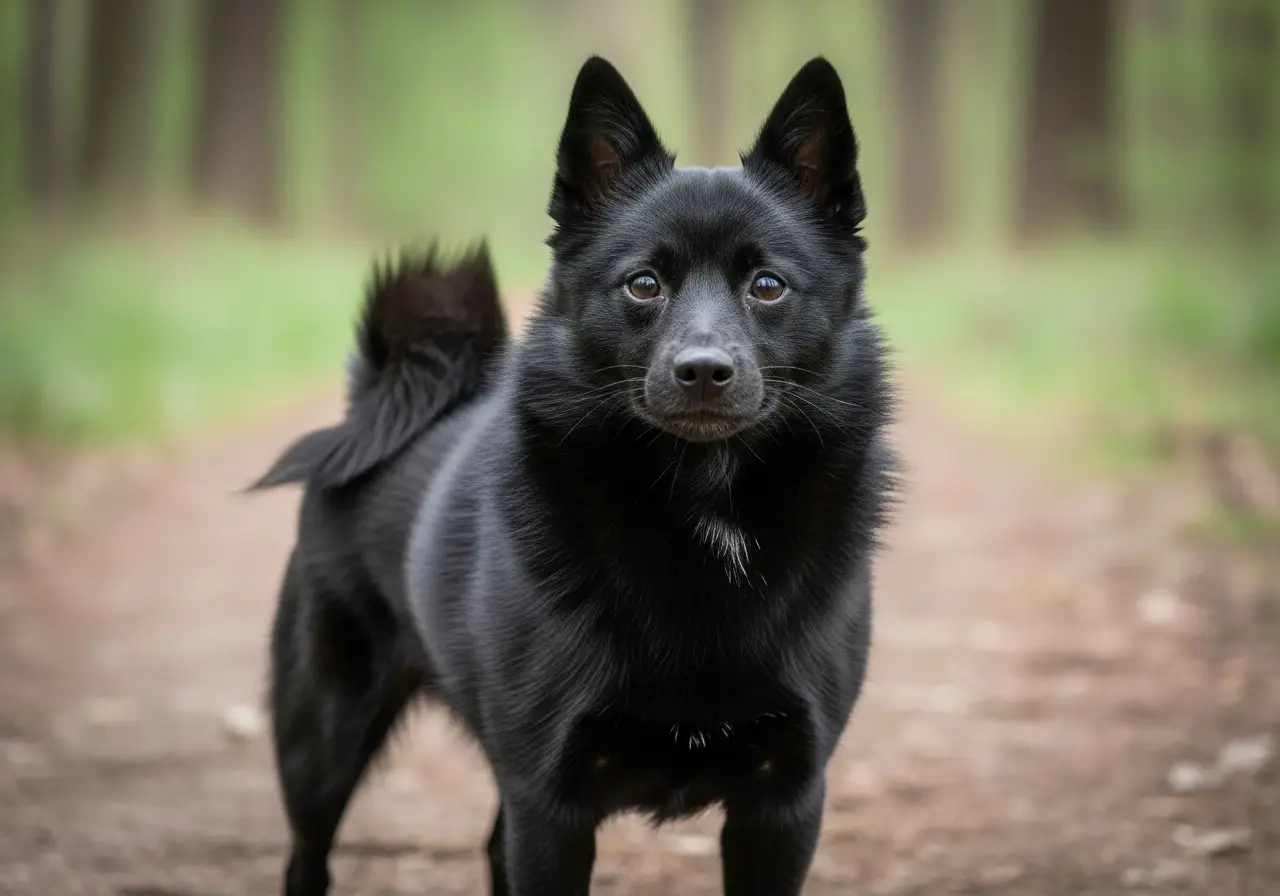
The Schipperke is a small Belgian watchdog with a wolf-like head, dense black coat and a personality that goes far beyond its physical size. It alerts reliably, thinks independently and consistently tests boundaries. Anyone who underestimates it gets a dog that organises the house according to its own rules. Anyone who understands it gains an alert, loyal companion with exceptional stamina.
02Introduction
What makes the Schipperke special
Schipperke: small Belgian barge dog with a wedge-shaped body, curiously vigilant and living longer than many breeds
03Profile
Key facts and suitability
- Origin
- Belgien
- Original purpose
- Rat hunting Watchdog on canal boats
- FCI
- No. 83 · Group 1 · Section 1
- height at the withers
- 22–33 cm
- Weight
- 3–9 kg
- Life expectancy
- 13–17 Years
- Coat type
- Doppel
- Minimum exercise
- 45 min/day
- Puppy price
- 1'200–2'000 CHF
- Waiting period
- 4 months
- Sports
- Agility Tricks Obedience
04Temperament
How the Schipperke shows up in everyday life
When you get up in the morning, the Schipperke is already awake and has long since assessed the situation in the house. It registers every sound, every movement behind the window and every visitor approaching the property. This is no coincidence, it is its working profile.
Internally, the Schipperke needs daily mental stimulation. A walk alone is not enough. Nose work, search games, training sessions with clear tasks or trick training keep its head occupied. Without this stimulation, it finds a task for itself, and that rarely turns out as owners wish.
Its need for social contact is directed towards the reference persons in the household. It observes, follows and positions itself so that it has everything in view. This is not attachment in the classic sense, but control out of a sense of responsibility. Being left alone is difficult for it if it has not been built up gradually.
Externally, it shows clear reserve towards strangers. When the doorbell rings, it announces loudly. Visitors it does not know are initially observed and assessed, not greeted. This reserve is not a lack of socialisation, but breed character according to the FCI standard. Anyone who sees this as a problem has the wrong expectation of the breed.
With children who handle him calmly and respectfully, he shows patience. However, hectic, noisy situations trigger increased alertness. With other dogs, he is compatible if socialised early, but displays a pronounced hunting instinct towards small animals, a direct legacy of his work as a rodent exterminator on canal boats.
05Needs
What this breed needs daily
The Schipperke requires 60 to 90 minutes of active exercise daily. This is not about pure distance, but quality: trail runs, sniffing rounds with varying stimuli or retrieving exercises challenge him more than a monotonous city walk.
Mental stimulation is at least equally important. The need for mental work is high, an assessment shared by breed experts and behaviour specialists. Nose work, search games, introductory-level mantrailing or structured trick training are suitable formats. Short, varied training sessions of 10 to 15 minutes several times a day are also more effective than one long session in the evening.
His guarding instinct demands clear boundary setting. This means: the owner decides when alerting is appropriate and when it is not. Without this structure, barking behaviour escalates. Attending a dog training school with experienced trainers who are familiar with independent breeds is particularly useful in the first few months.
Being left alone must be built up gradually. Four hours are a realistic guideline, provided the dog has been systematically accustomed to periods of absence. Anyone who is regularly away from home for longer needs a reliable care solution.
The Schipperke requires a primary caregiver with clear body language, calm consistency and a willingness to invest time daily in training and enrichment. Unstructured keeping without tasks reliably leads to problems in this breed.
Exercise
Medium
mental work
A lot
Social needs
Medium
training
Medium
07Quick Check
08Suitability
Who this breed is suitable for – and who it isn't
✓Matches
The Schipperke suits owners who can plan 60 to 90 minutes of active exercise plus additional mental work daily. Experience with independent or alert breeds is a clear advantage.
Suitable are active individuals or couples who enjoy structured training and bring consistency as a basic attitude, not as an occasional measure. A garden is helpful but not mandatory; the daily quality of enrichment is decisive.
Families with children from about 8 years old, who know and respect how to handle dogs, are also suitable. The prerequisite is that parents take on the leadership role and actively control the dog's alerting behaviour.
Anyone interested in dog sports (such as agility, obedience or nose work) will find a motivated partner in the Schipperke. The breed benefits from clear tasks and regular challenges.
Owners who rarely receive visitors or live in a quiet environment have it easier: the reserve towards strangers and the pronounced alerting behaviour are easier to manage in a low-stimulus daily routine than in a household with constantly changing people.
×Doesn't match
The Schipperke does not suit owners who are keeping a dog for the first time and do not plan support from an experienced dog training school. His independence and guarding instinct require clear structures from the start.
Anyone who is away from home for more than four hours daily and cannot organise reliable care should not choose this breed. Being left alone can be trained, but it is not infinitely extendable.
Households with small animals such as rabbits, guinea pigs or birds should be viewed critically. The Schipperke's hunting instinct towards small animals is typical of the breed and cannot be trained away.
Anyone looking for a sociable, stranger-friendly dog who warmly greets visitors will not be happy with the Schipperke. The reserve towards strangers is not a training problem; it is breed character. Anyone who perceives this as a deficit has the wrong expectation.
People who consider barking a minor issue or live in a rented flat with thin walls without actively working on the dog's impulse control should consider another breed. The Schipperke's alerting behaviour is pronounced and requires consistent management.
10Line reality
Show line, working line, breeder market
The Schipperke is bred today primarily as a companion and show dog. A pronounced working line in the sense of protection sports or herding sports lines does not exist. The selection of recent decades has focused on type, coat and character according to the FCI standard.
Within show breeding there are regional differences in the interpretation of the standard. Belgian and Dutch breeders are considered guardians of the original type, compact body build, wedge-shaped head, dense black coat with pronounced neck ruff. In other countries, lines with a somewhat lighter body build or less pronounced coat have occasionally emerged.
What is relevant for owners is primarily the question of whether the breeder selects for character and health or primarily for show success. A Schipperke from a line with proven health tests — particularly for Mucopolysaccharidosis Type IIIB (MPS IIIB) and thyroid function — is preferable to a dog from breeding focused purely on appearance.
Field work or dog sport lines in the narrower sense do not exist for this breed. Individual owners successfully train their Schipperkes in agility or nose work, but this is an individual decision and not a breeding selection goal.
11Health · Reality
What you need to plan for medically with your Schipperke
The Schipperke is considered a long-lived breed. According to the Swiss Club of the Belgian Shepherd and Schipperke (SKBS) as well as international breed experts, life expectancy is 13 to 15 years, in individual cases even longer.
The most significant breed-specific hereditary disease is Mucopolysaccharidosis Type IIIB (MPS IIIB), a lysosomal storage disorder that progressively damages the nervous system. Affected dogs show coordination disorders, behavioural changes and cognitive impairments from middle age onwards. A DNA test for the defect is available. Reputable breeders test both parent animals and issue certificates. This certificate must be demanded before purchasing a puppy.
Further documented health risks include hypothyroidism (underactive thyroid) as well as eye diseases such as progressive retinal atrophy (PRA). Exact prevalence figures for the total population are not publicly available for the German-speaking region; international breeding associations recommend eye examinations by a specialist vet before breeding.
Overweight is a real risk in this breed, which is often underestimated. The compact build leads to weight gain being noticed late. Overweight puts strain on joints and promotes metabolic problems. Regular weight checks at the vet, at least once a year, are recommended.
Preventive examinations: annual general check-up, eye check by specialist vet, thyroid values in case of behavioural changes or weight fluctuations, DNA test for MPS IIIB before purchase.
12Structured data
Health by the numbers
Prone to diseases
MPS IIIB (Sanfilippo syndrome) Thyroid problems Eye problems
Recommended health tests
MPS genetic test Thyroid test Eye examination
13Myths ↔ Reality
What is often said incorrectly about this breed
Five myths, five realities, five sources.
„The Schipperke is an easy-to-care-for beginner's dog due to its size.
Body size says nothing about the care effort required. The Schipperke has a pronounced guarding instinct, high mental workload and strong independence. Without consistent guidance and daily mental stimulation, it develops behaviours such as excessive barking or resource guarding. Specialist associations and breed experts classify it as a dog for experienced owners.
„The Schipperke is a barge dog, i.e. a water worker with maritime origins.
The term 'Schipperke' is derived from the Flemish word for 'little sheepdog', not from 'Schipper' in the sense of boatman. Its ancestor was a sheepdog of the old breed. Work on cargo barges was one of several working roles; guarding and rodent control were in the foreground. The FCI standard classifies it in Group 1 (Sheepdogs), not as a utility dog for shipping.
„Small dogs bark little, the Schipperke is no exception.
The opposite is true. The FCI standard explicitly describes the Schipperke as an 'excellent sentinel' with a 'clear voice'. Guarding behaviour and acoustic alerting are genetically deeply ingrained. Without targeted training and clear boundary setting, barking behaviour can become a serious problem in residential areas.
„The Schipperke is robust and requires no special health checks.
Although the breed is considered long-lived, it is known for Mucopolysaccharidosis Type IIIB (MPS IIIB), a hereditary metabolic disease affecting the nervous system. Reputable breeders test their breeding stock for this defect. In addition, thyroid problems and eye diseases can occur. A health certificate of the parent animals must be demanded before purchasing a puppy.
„Towards strangers, the Schipperke is open and friendly after a short period of adjustment.
The FCI standard explicitly describes behaviour towards strangers as 'reserved'. This reserve is not an upbringing error, but breed character. Good socialisation can moderate the reaction, but the basic caution towards unknown people remains a stable trait. Owners who expect a sociable all-round dog will be disappointed.
14animal welfare
The animal welfare perspective
Breeder market, designer versions, animal shelter reality — what no one writes in the puppy ad.
The Schipperke is a rare breed in the German-speaking region. This means: the market is manageable, but not free from problems.
Backyard breeders and dubious offers
Because the breed has a certain exotic status, offers occasionally appear that advertise with the charm of rarity but do not provide health tests. Puppies without MPS-IIIB test certificates for the parent animals are a clear warning sign. Reputable breeders are usually organised through the SKBS (Switzerland) or the VDH (Germany) and document their health checks transparently.
Breed-specific keeping problems
The most common reasons for surrendering Spitz and guard dog breeds are underestimated barking behaviour and insufficient mental stimulation. Both apply in particular to the Schipperke. Owners who consider the breed uncomplicated due to its size quickly reach their limits. A dog whose guarding instinct is not guided develops behaviours that can lead to serious conflicts in rented flats or densely populated areas.
Adoption as an equally valid option
Although the Schipperke is rarely found in animal shelters, there are breed-specific adoption organisations and breeders who give up returnees or older dogs. An adult Schipperke from adoption has the advantage that its character is already assessable. Those who take the time to search specifically may find a dog whose temperament is already known, a real advantage over the puppy phase with all its unknowns.
Breeding trends
Designer variants or colour breeding outside the FCI standard (e.g. white or chocolate Schipperkes) are occasionally offered. These dogs are not recognised and are sold without pedigree registration. Health tests are often completely missing in these cases. The classic black Schipperke according to FCI standard is the only recognised colour variant.
15Costs · Transparency
What this breed realistically costs
A puppy from a reputable breeder with association membership, health tests and pedigree costs between 1,200 and 1,800 EUR in the German-speaking region. Offers significantly below this, especially without MPS-IIIB test certificates, should be viewed with caution.
The annual living costs for a Schipperke are typically between 1,500 and 2,500 EUR. This includes high-quality food (approx. 400–700 EUR/year depending on the feeding method), grooming (the dense coat requires regular care especially during moulting; professional grooming 2–4 times a year at 40–80 EUR each), basic equipment, accessories and training costs.
Vet costs in routine operation (annual preventive care, vaccinations, parasite prevention) amount to approx. 200–400 EUR/year. In case of illness or surgery, individual costs can quickly reach 1,000–3,000 EUR.
Dog health insurance for a Schipperke costs between 30 and 80 EUR/month depending on the provider and scope of benefits (as of 2025). Given the possible MPS-IIIB disease and long life expectancy, it is sensible to consider coverage.
16Puppy search
What you need to consider when choosing a breeder
- A reputable breeder is organised through a recognised association, in Switzerland through the SKBS, in Germany through a VDH member club.
- They provide proof of the MPS-IIIB DNA test for both parent animals and document eye and thyroid examinations.
- Puppies leave the litter no earlier than eight weeks old, are chipped, vaccinated and dewormed.
- Warning signs: no test proof, puppies under eight weeks, multiple litters available simultaneously, no personal meeting with the mother, handover at a neutral meeting point.
- Adopting an adult Schipperke is an equally valid alternative.
- Breed experts and breeders occasionally give up return dogs or older dogs whose character is already known.
- This significantly reduces the risk of a wrong decision.
- Animal welfare organisations with a breed focus or the SKBS can assist with the search.
- No reputable platform recommends individual breeders by name.
- Searching via the official association lists is the most reliable starting point.
- A personal visit to the breeder, where puppies and mother can be observed in their familiar environment, is indispensable before making a decision.
FAQ
Frequently asked questions about the Schipperke
Is Schipperke suitable for beginners?
Schipperke is considered suitable for first-time dog owners.
Is Schipperke a family dog?
Schipperke is considered suitable for families with good socialisation and species-appropriate care.
How much exercise does Schipperke need?
At least around 45 minutes of exercise per day.
Does Schipperke suit an apartment?
With enough exercise and enrichment, Schipperke can also be kept in an apartment.
What is the size and weight of Schipperke?
Fully grown, Schipperke reaches about 22–33 cm at the withers and weighs around 3–9 kg.
What is the life expectancy of Schipperke?
The life expectancy of Schipperke is approximately 13–17 years.
Which diseases are common in Schipperke?
MPS IIIB (Sanfilippo syndrome) Thyroid problems Eye problems
17Breed clubs
Official breed clubs in DACH
19Related
Similar breeds – and their differences
You might also be interested in

Participate
Do you have a good photo of your Schipperke?
We are looking for expressive images for our breed profiles. Submit yours; the editorial team reviews every submission before publication.
Does this breed suit you?
MPS genetic test before breeding mandatory – despite size, not a quiet dog; requires consistent guidance