
01Summary
In a paragraph
If you only have 30 seconds.
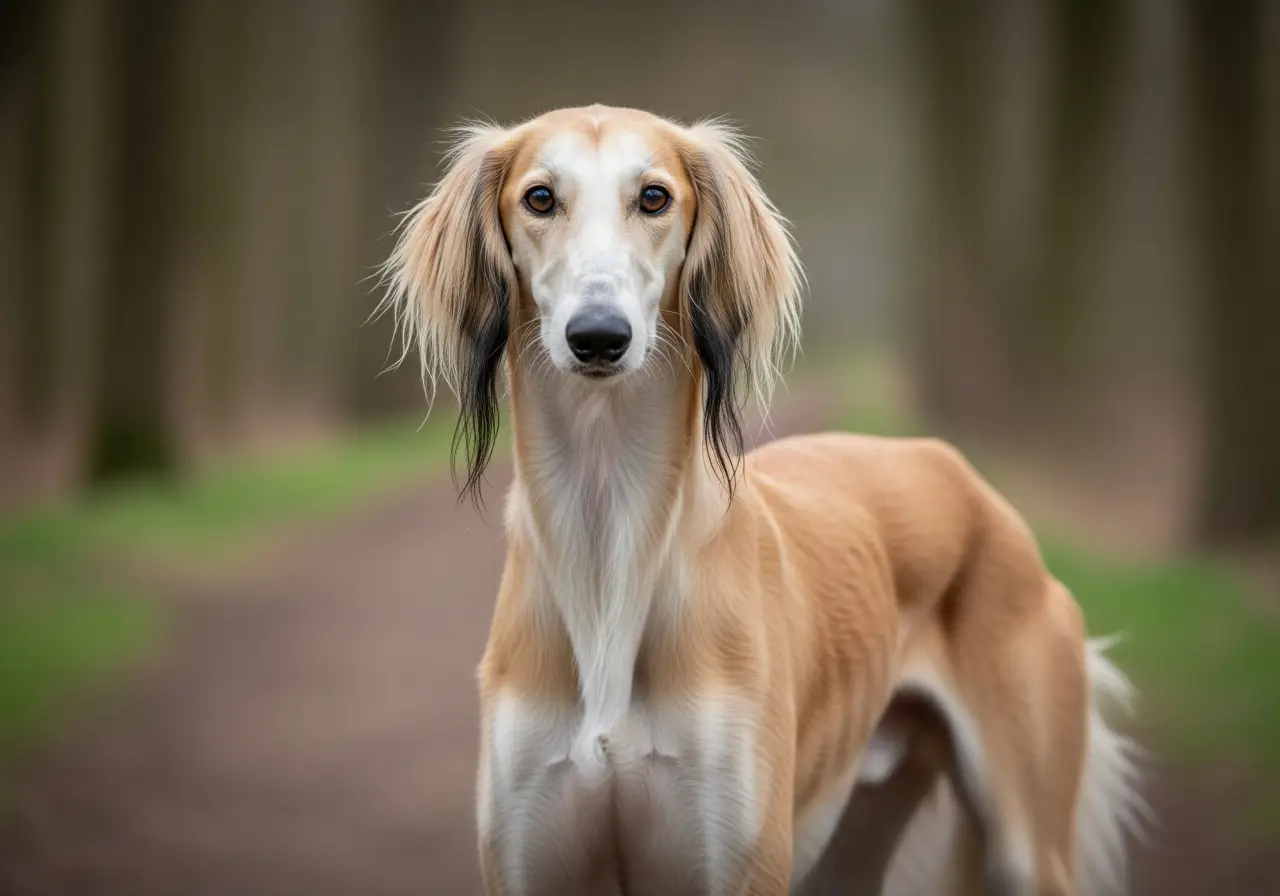
The Saluki is one of the oldest documented dog breeds in the world. Millennia of selection for coursing and independence have shaped a dog that combines dignity and reserve with an intense bond to its primary caregiver. Anyone who underestimates this combination (strong prey drive, wariness towards strangers, high exercise needs) will fail with this dog. Those who understand it gain an exceptional companion.
02Introduction
What makes the Saluki special
Saluki: ancient Arabian sighthound, slender and noble, with an independence that requires consistent ownership
03Profile
Key facts and suitability
- Origin
- Naher Osten
- Original purpose
- Gazelle hunting
- FCI
- No. 269 · Group 10 · Section 1
- height at the withers
- 58–71 cm
- Weight
- 16–29 kg
- Life expectancy
- 12–14 Years
- Coat type
- Short-haired
- Minimum exercise
- 90 min/day
- Puppy price
- 1'500–2'500 CHF
- Waiting period
- 6 months
- Sports
- Lure Coursing Agility
04Temperament
How the Saluki shows up in everyday life
When you come home, the Saluki does not show an exuberant greeting. It rises, approaches calmly, sniffs briefly, and then returns to its resting place. Interpreting this as indifference misunderstands the breed. The bond with the primary caregiver is intense; it just does not express itself loudly.
Internally, what the dog needs: The Saluki's need for social contact is medium to high but selective. It seeks the proximity of its primary caregiver, not the company of every visitor. It can tolerate long periods alone of up to about four hours if sufficiently stimulated. Mental work in the form of nose work or calm search tasks complements physical exercise sensibly; it rejects drill and repetitive exercises.
Externally, in terms of how the dog reacts: The Saluki behaves reservedly and expectantly towards strangers. It does not retreat in panic, but it also does not seek contact. This distance is not a training failure, but a breed characteristic according to the FCI standard. On the street or in the park, this means: The Saluki will not let itself be touched by unknown people without prior approach on its own terms.
The prey drive is the dominant external reaction pattern. A deer running past, a fleeing hare, a ball rolling quickly – the Saluki switches into chase mode in fractions of a second. In this state, recall is practically impossible. Secured off-leash exercise on fenced-in land is therefore not a matter of comfort, but a safety necessity.
In everyday life, the Saluki shows itself as a calm, dignified companion who avoids noise and chaos and appreciates structured daily routines. Hectic households with constantly changing visitors stress it persistently.
05Needs
What this breed needs daily
The Saluki needs at least 90 minutes of active exercise daily, divided into several sessions. Walks on a lead are not sufficient. At least three times a week, it needs the opportunity to sprint freely on secured, fenced-in land. A fence of at least 1.80 metres in height is the minimum requirement here, as the Saluki is an exceptional jumper.
Coursing and lure coursing provide species-appropriate stimulation that is close to the original hunting behaviour. Many Saluki owners use these sports regularly; the DWZRV organises corresponding events in the German-speaking region.
Mentally, the Saluki does not need high-performance obedience exercises. Nose work, calm search games and mantrailing suit its disposition better than fetching exercises or complex obedience programmes. Drill and repetition frustrate it because it prefers independent thinking to following commands.
The Saluki needs retreat options in the house, a fixed, quiet place that children and visitors respect. Its need for sleep is high; it recovers during long rest phases between activities.
Grooming remains limited for the smooth-haired variety. The feathered variety requires regular brushing of the hair on the ears, tail and legs to avoid tangles; two to three times a week is usually sufficient. Special attention should be paid to sensitivity to cold: As a dog with low body fat content, the Saluki freezes quickly and needs a well-fitting dog coat at low temperatures.
Exercise
High
mental work
Medium
Social needs
Medium
training
Demanding
06Sport & Mental and Physical Stimulation
What sports the Saluki is suited for
Realistic in terms of physiology and genetics – not every breed suits every sport.
Structurally and physiologically suitable: Suitable for mantrailing, dummy work and tracking · CaniCross / bikejoring possible.
07Quick Check
08Suitability
Who this breed is suitable for – and who it isn't
✓Matches
The Saluki suits owners with experience in handling sighthounds or other independent breeds. Anyone who has already understood that recallability in sight hounds in areas rich in wildlife is an illusion brings the right basic attitude.
Concrete profiles that suit well: Owners with access to secured off-leash land (fenced, at least 1.80 m high) in a rural or suburban location. People who appreciate coursing or lure coursing as a leisure activity. Calm households without constantly changing visitor frequency. Individuals or couples who live a structured daily routine with fixed exercise sessions. Families with children from about ten years old who respect the dog as an independent being and do not expect physical playmates.
Anyone who is professionally flexible and leaves the dog alone for a maximum of four hours a day creates a good starting point. A household in which at least one person can organise 90 minutes of active exercise plus sprint sessions daily meets the basic requirement. Affinity with nature and interest in the history and culture of the breed considerably facilitate access to breeders and the Saluki community.
×Doesn't match
The Saluki does not suit owners who expect an accessible, friendly dog towards strangers. Anyone who wants to impress guests with a warmly greeting dog will be disappointed; reserve towards strangers is not a training issue, but innate disposition.
The breed is unsuitable for households without secured off-leash opportunities nearby. Anyone living in a large city without access to fenced-in land and relying on loose-leash walking as the only form of exercise permanently falls short of the minimum requirement. The same applies to owners who rely on reliable off-leash exercise in areas rich in wildlife without a fence; the prey drive makes this a safety issue.
People looking for a dog that works on command and completes obedience exercises with enthusiasm will fail due to the Saluki’s independence. Anyone who confuses need for social contact with friendliness towards strangers (i.e., assumes that a strongly bonded dog is automatically open to everyone) fundamentally misunderstands the dual axis of this breed.
Households with toddlers under six years old, in which quiet retreat options for the dog cannot be guaranteed, as well as owners who have little experience with sensitive, independent breeds and do not wish to use a supporting dog training school, should consider another breed.
10Line reality
Show line, working line, breeder market
The Saluki does not have a classic working line-show line division in the sense of Labrador or Golden Retriever. The variety of types within the breed has different roots: it is geographically determined, not breeding-strategy driven.
The FCI standard distinguishes two varieties: the feathered (long-haired) and the smooth-coated variety (short-haired variety). Both are identical in all characteristics, differing only in coat. In practice, both varieties are represented in DACH breeding, with the feathered variety being more common.
Regional types: Within the breed, there are noticeable differences between dogs from various regions of origin; Persian, Egyptian, Yemenite, and Syrian types differ in body structure, head shape, and coat. The FCI standard explicitly accepts this range of variation as typical for the breed. In European breeding, these regional differences have been partially preserved but are less sharply defined due to international matings than in the countries of origin.
Coursing-oriented breeding: Some breeders place particular emphasis on running and endurance performance and regularly participate in coursing events. These dogs differ little from show dogs in everyday life but are generally particularly well-conditioned for movement and activity. A strict division into performance and beauty lines does not exist for the Saluki to the extent observed in other breeds.
11Health · Reality
What you need to plan for medically with your Saluki
The Saluki is considered a robust breed with a life expectancy of 12 to 14 years, which is above average for a medium to large dog. Breed-typical diseases are less common than in many other breeds; nevertheless, specific risks exist that owners must know.
Heart disease: Cases of dilated cardiomyopathy (DCM) have been documented in Salukis. A study by the University of California Davis (2018) identified sighthounds as an overrepresented group for certain arrhythmias. Regular cardiological examinations from the fifth year of life are recommended.
Anaesthetic sensitivity: The low body fat percentage of the Saluki, like all sighthounds, significantly alters the metabolism of barbiturate-based anaesthetics. Propofol or isoflurane are considered safer alternatives. The vet must be informed about sighthound physiology before every anaesthetic; this is not a precautionary measure but standard practice.
Eyes: Progressive retinal atrophy (PRA) and other eye diseases occur occasionally. An eye examination of the parent animals by a specialist vet before breeding is common practice among reputable breeders.
Cold sensitivity: With a body fat percentage of under ten percent, the Saluki freezes quickly at temperatures below five degrees Celsius. A well-fitting dog coat on winter walks is not an exaggeration but animal welfare.
Overweight is rarely a problem in this breed; the Saluki usually regulates its food intake itself. Nevertheless, weight should be checked regularly, as being overweight increases joint stress and impairs heart health.
12Structured data
Health by the numbers
Prone to diseases
Heart problems PRA Autoimmune diseases
Recommended health tests
Cardiac examination Eye examination Blood count
13Myths ↔ Reality
What is often said incorrectly about this breed
Five myths, five realities, five sources.
"The Saluki is a calm lap dog that requires little exercise.
The Saluki often appears calm and reserved in the house, which masks its actual need for movement. As a coursing hunter, it needs at least 90 minutes of exercise daily plus regular opportunities to sprint on secure terrain. Underestimating this requirement risks behavioural problems due to pent-up energy.
"Salukis are easy to train like all sighthounds because they are so sensitive.
Sensitivity does not mean controllability. The Saluki is genetically designed for independent decision-making when hunting; it reacts to the sight of game with an instinct that temporarily overrides training. Consistent, pressure-free training with realistic expectations regarding recall in areas rich in wildlife is essential.
"A Saluki that is reserved towards strangers was poorly socialised.
Reserve towards strangers is a breed characteristic according to the FCI standard: 'reserved towards strangers, but not shy or aggressive.' This trait is genetically anchored and not a deficit in socialisation. A well-socialised Saluki remains reserved; it does not become an open greeting dog.
"Salukis cannot tolerate anaesthesia; a vet visit is life-threatening.
Salukis and other sighthounds are more sensitive to certain anaesthetics, particularly barbiturates, because their low body fat content alters metabolism. This does not mean that anaesthesia is inherently dangerous; an experienced vet informed about sighthound-specific physiology can safely administer anaesthesia. However, informing the vet in advance is mandatory.
"The Saluki is a family dog that gets along easily with toddlers.
The Saluki tolerates calm, respectful children but is not a robust playmate. Its sensitivity and need for retreat spaces make it less suitable for households with very young children who do not understand boundaries. Older children from about ten years old, who respect the dog as an independent being, are a better match for this breed.
14animal welfare
The animal welfare perspective
Breeder market, designer versions, animal shelter reality — what no one writes in the puppy ad.
The Saluki is one of the rarest dog breeds in the German-speaking region. This rarity partly protects it from the pressure of the mass market, but only partly.
Backyard breeder market: Because the Saluki is considered exotic and noble, there is a small but active market for puppies without club affiliation. Listings on classifieds platforms with immediate availability, no waiting list, and no questions about living conditions are a clear warning sign. Puppies from such sources often enter the market without health screenings of the parent animals and without socialisation in a structured environment.
Designer versions: The Saluki is occasionally crossed with other sighthounds to produce specific colour variants or sizes. These crosses are sometimes marketed under fanciful names. Anyone looking for a purebred Saluki should check the FCI pedigree.
Breeding and keeping-related problems: The Saluki itself is not a cruelly bred breed. The biggest animal welfare issues arise from improper keeping: lack of off-lead opportunities, underestimating the prey drive, and overburdening the dog in hectic households. According to sighthound welfare organisations, reasons for rehoming sighthounds are in most cases attributable precisely to these factors, not to aggression problems or diseases.
Adoption as an equally valid option: Sighthound-specific welfare organisations in the DACH region regularly rehome Salukis and Saluki crossbreeds, often from the Middle East or Spain, where sighthounds are abandoned after the hunting season. An adult dog from a rehoming scheme comes with a known temperament, completed socialisation, and often an already clarified health status. For experienced owners, this is a fully valid alternative to a puppy from a breeder, without waiting time and with the knowledge of giving a dog a second chance.
15Costs · Transparency
What this breed realistically costs
A Saluki puppy from reputable, club-affiliated breeding costs between 1,200 and 2,000 euros in the German-speaking region. Offers significantly below this usually come from non-club-affiliated breeding without health screenings of the parent animals.
Ongoing costs per year (guidance values for Germany/Austria/Switzerland):
Food: 600–900 euros (high-quality dry food or BARF for a medium-sized Saluki). Grooming: 100–200 euros (feathered variety, occasional trim visit). Basic vet costs (vaccinations, parasite prevention, annual check-up): 300–500 euros. Dog liability insurance: 60–150 euros per year depending on provider and federal state. Health insurance (optional but recommended due to anaesthetic risk): 400–800 euros per year.
One-off acquisition costs in addition to the puppy price: Basic equipment (lead, collar, bed, transport box): 200–400 euros. Well-fitting dog coat (sighthound-specific fit): 60–120 euros.
Coursing sport as a regular activity incurs additional costs for entry fees and travel. Anyone without their own fenced garden should factor in rental costs for dog meadows or off-lead areas, 10–30 euros per hour in urban areas.
16Puppy search
What you need to consider when choosing a breeder
- Reputable Saluki breeders in the German-speaking region can be found via the German Sighthound Breeding and Racing Association (DWZRV) and the Swiss Club of Oriental Sighthounds (SCOW).
- As the breed is rare, waiting times of a year or more are not exceptional; this is a quality feature, not a problem.
- Characteristics of reputable breeding: The breeder asks counter-questions about housing conditions, off-leash opportunities and experience.
- Puppies stay with the mother for at least eight weeks.
- Parent animals are tested for breed-typical health characteristics.
- The breeder allows several visits before handover and remains contactable after purchase.
- Warning signs: Immediate availability without a waiting list, lack of club membership, no interest in the buyer’s housing conditions, sale via animal markets or without personal contact.
- Adoption as an equally valid option: Salukis rarely end up in animal shelters, but sighthound welfare organisations occasionally rehome Salukis or Saluki crossbreeds from abroad, particularly from the Middle East and Spain.
- An adult dog from a rehoming scheme offers the advantage that temperament and health status are already known.
- Sighthound-specific rehoming organisations in the DACH region can be found via breed club websites.
FAQ
Frequently asked questions about the Saluki
Is Saluki a family dog?
Saluki is considered suitable for families with good socialisation and species-appropriate care.
How much exercise does Saluki need?
At least around 90 minutes of exercise per day. As an active breed, more so — plus mental stimulation.
What is the size and weight of Saluki?
Fully grown, Saluki reaches about 58–71 cm at the withers and weighs around 16–29 kg.
What is the life expectancy of Saluki?
The life expectancy of Saluki is approximately 12–14 years.
Which diseases are common in Saluki?
Heart problems PRA Autoimmune diseases
17Breed clubs
Official breed clubs in DACH
19Related
Similar breeds – and their differences
You might also be interested in
Participate
Do you have a good photo of your Saluki?
We are looking for expressive images for our breed profiles. Submit yours; the editorial team reviews every submission before publication.
Does this breed suit you?
One of the oldest dog breeds – very independent Off-lead only in absolutely secure areas