
01Summary
In a paragraph
If you only have 30 seconds.
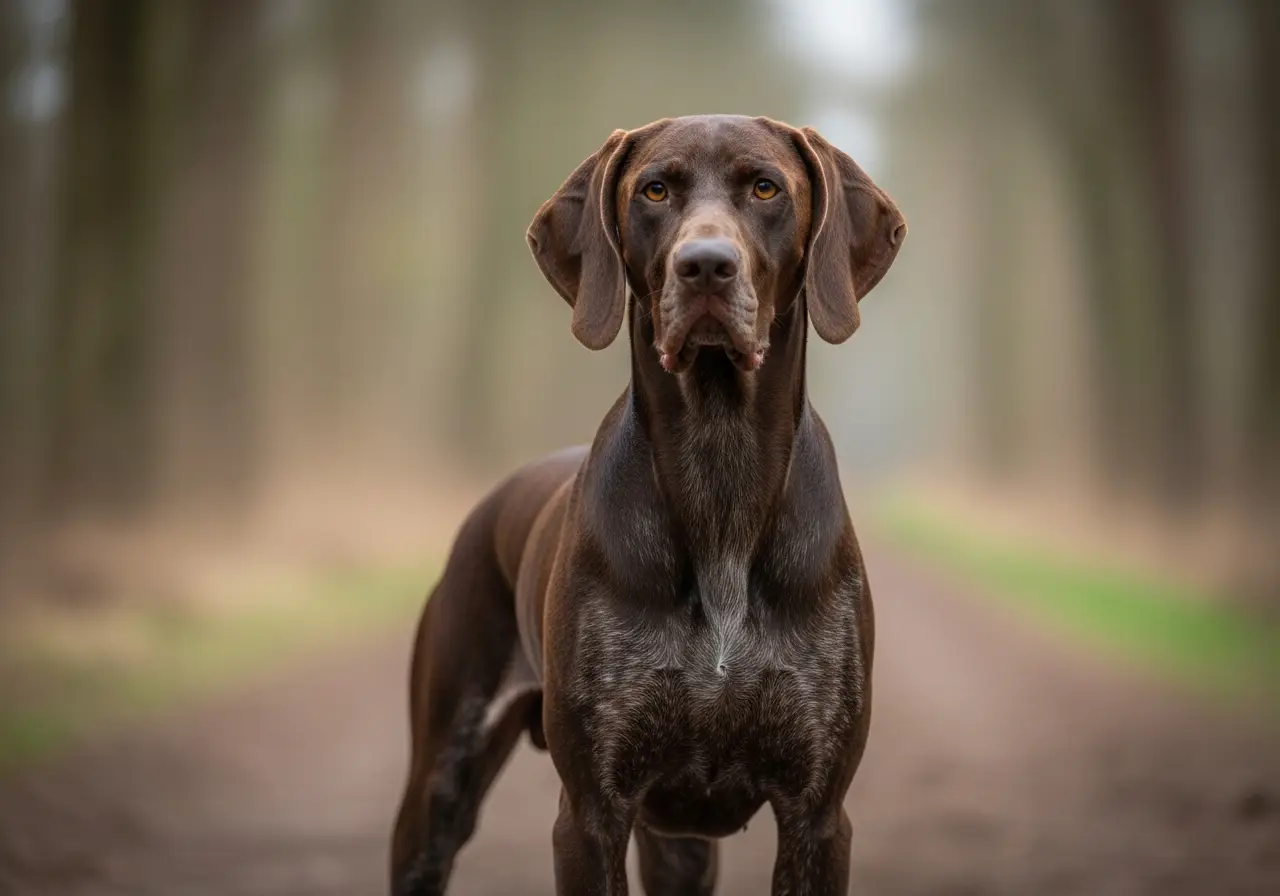
The German Shorthaired Pointer is a versatile hunting dog that was bred for consistent work in the hunting grounds, not for everyday life on the sofa. If you do not provide it with structured tasks, you will get a dog that seeks its own stimulation. This reliably leads to behavioural problems. Experience with performance-oriented dogs is not a recommendation, but a prerequisite.
02Introduction
What makes the Deutsch Kurzhaar special
The Deutsch Kurzhaar is a versatile German hunting pointer, FCI Group 7, athletic and enduring, withers height 58–66 cm.
03Profile
Key facts and suitability
- Origin
- Deutschland
- Original purpose
- Versatile hunting dog
- FCI
- No. 119 · Group 7 · Sektion 1.1: Kontinentale Vorstehhunde, Typ Braque
- height at the withers
- 58–66 cm
- Weight
- 20–32 kg
- Life expectancy
- 12–14 Years
- Coat type
- Short-haired
- Minimum exercise
- 120 min/day
- Puppy price
- 1'200–2'000 CHF
- Waiting period
- 9 months
- Sports
- Hunting · Agility · Canicross · Field trials · Retrieving
04Temperament
How the Deutsch Kurzhaar shows up in everyday life
The morning run reveals what defines the German Shorthaired Pointer: it does not run beside you, it works. Its nose goes straight to the ground, every wind direction is registered, every rustle in the bushes triggers concentration. This is not a distraction problem, but a genetic programme.
At home, the German Shorthaired Pointer is closely focused on its primary caregiver. It follows movements in the room, seeks eye contact and signals readiness to cooperate. This high need for social contact is directed primarily at the familiar person, not at every visitor. It meets strangers with a neutral to watchful attitude. Anyone expecting a dog that warmly greets every guest will be disappointed here.
With conspecifics, the German Shorthaired Pointer is compatible provided there is early and consistent socialisation. In hunting use, it also works in a pack. Without sufficient socialisation, dominant tendencies can arise.
Prey drive is the defining element of daily life. A free-roaming German Shorthaired Pointer without a reliable recall is a safety risk for wildlife, other animals and road traffic. Recall must be trained under distraction and checked regularly. This is not a one-off training goal, but a permanent task.
In the evening, after full mental and physical stimulation (scent work, dummy training or hunting use), the German Shorthaired Pointer shows what it can also be: a calm, satisfied dog that relaxes. It reaches this state only if the day has provided what it was bred for.
05Needs
What this breed needs daily
The German Shorthaired Pointer requires at least 120 minutes of active exercise daily, and this is the lower limit, not a recommendation for good days. On days without structured work, the need increases further.
Exercise alone is not enough. The mind must be engaged too. Scent work, dummy training, nose work, field work or preparation for hunting trials are not extras; they are basic care. A German Shorthaired Pointer that only runs is physically tired but mentally under-stimulated. The result is a dog that finds ways to occupy itself, rarely in a way that pleases the owner.
Being left alone is limited to a maximum of four hours with sufficient mental and physical stimulation. An under-stimulated dog tolerates being alone significantly worse. Anyone who is regularly away from home for more than four hours needs a reliable care solution.
The need for social contact with the primary caregiver is high. The German Shorthaired Pointer seeks active cooperation, not passive company. It requires an owner who invests time, not just for walks, but for structured joint training.
A rural or at least suburban environment with access to open land is advantageous. Keeping the dog in a city apartment without daily access to fields, forest or water significantly increases the effort required for sufficient mental and physical stimulation. A garden does not replace structured work; it merely complements it.
Exercise
Very high
mental work
A lot
Social needs
High
training
Demanding
06Sport & Mental and Physical Stimulation
What sports the Deutsch Kurzhaar is suited for
Realistic in terms of physiology and genetics – not every breed suits every sport.
Structurally and physiologically suitable: Suitable for mantrailing, dummy work and tracking · CaniCross / bikejoring possible.
07Quick Check
08Suitability
Who this breed is suitable for – and who it isn't
✓Matches
The German Shorthaired Pointer suits owners with proven experience in handling performance-oriented hunting dogs. Anyone who has already handled a pointing dog or similar working dog and realistically assesses the demands will find an exceptionally cooperative partner in it.
Active hunters who use their dog in the hunting grounds and aim for hunting trials correspond most directly to the breeding goal of this breed. The dog thereby receives exactly what it was selected for.
Owners without a hunting licence are also suitable if they can ensure at least two hours of structured mental and physical stimulation with mental content daily: scent work, mantrailing, demanding dog sports at competition level. Half-hearted solutions are not enough.
Families with children from about ten years old are possible if both parents have experience with the breed and the mental and physical stimulation does not depend on family routine. The dog requires reliable structures, regardless of whether school holidays, illness or holidays change daily life.
A rural environment with direct access to open land significantly facilitates keeping the dog. Anyone who is able to reach fields, forest or water daily and who is willing to consistently align their own daily planning with the needs of this dog will find an enduring, eager-to-learn and closely bonding dog.
×Doesn't match
The German Shorthaired Pointer does not suit first-time owners without experience with hunting or working dogs. Anyone who has not yet handled a performance-oriented dog typically underestimates both the training effort and the consistency that this breed demands daily.
Anyone who is regularly away from home for more than four hours daily and cannot organise a reliable care solution should not choose this breed. The high need for social contact and the low frustration tolerance when under-stimulated are not character weaknesses; they are breed characteristics.
Anyone who views the German Shorthaired Pointer as a "large, friendly family dog" that is satisfied with daily walks will fail with this expectation. Confusing the high need for social contact with the primary caregiver with general sociability towards strangers is a typical mistake and leads to disappointment on both sides.
City dwellers without daily access to open land face a structural problem: the effort required for sufficient mental and physical stimulation increases significantly in urban environments. Anyone who cannot or does not want to make this effort daily is making a poor decision with this breed.
Anyone looking for a dog that regulates itself with little guidance is fundamentally mistaken with the German Shorthaired Pointer. Inconsistency is immediately registered and exploited by this breed.
10Line reality
Show line, working line, breeder market
The Deutsch Kurzhaar has no pronounced show line in the sense of a breeding direction separated from the working type, which distinguishes it from breeds such as the Labrador or Golden Retriever. Breeding remains predominantly performance-oriented and tied to hunting examinations. The FCI standard stipulates the working test as a condition for breeding approval.
Nevertheless, differences exist within the breed. Dogs from active hunting operations with regular examination use generally show higher drive intensity and greater independence in the field. Dogs from breeding lines primarily oriented towards show success, although rarer than in other breeds, can vary in drive strength and work motivation.
For prospective owners, the question of the parents’ examination history is therefore relevant. A breeder who presents both parents in hunting examinations and can show documented results provides more reliable information about the expected working profile of the puppy than pure show success.
Regional differences play a subordinate role. The Deutsch-Kurzhaar-Verband e.V. coordinates breeding nationwide according to uniform breeding and examination regulations. In Switzerland, the Schweizerische Vorstehhund-Club SVC fulfils this function. Both associations require the working test as standard, ensuring a certain uniformity of type.
11Health · Reality
What you need to plan for medically with your Deutsch Kurzhaar
The life expectancy of the German Shorthaired Pointer is 12 to 14 years, a solid range for a medium to large working dog, which however depends on keeping, stimulation and preventive care.
Hip dysplasia (HD) is the most frequently documented hereditary disease of the breed. The Deutsch-Kurzhaar-Verband e.V. mandates an HD X-ray examination for breeding dogs before approval for breeding. Elbow dysplasia (ED) is also recorded. Anyone buying a puppy should request the HD/ED findings of both parent dogs; a breeder without this documentation is not a reputable contact.
Eye diseases occur typically for the breed. Progressive retinal atrophy (PRA) and cataracts are known risks. An ophthalmological examination of the parent dogs is recommended.
In hunting use, there is an increased risk of injury: cuts from undergrowth, strains, paw injuries. Pet health insurance with accident cover is sensible for actively used dogs.
Overweight is less of a structural problem in this breed than in less active breeds; however, if the dog is not exercised sufficiently and fed normally, the risk increases. A body condition score should be checked regularly.
Preventive examinations: Annual veterinary check-up, HD/ED X-rays before breeding, ophthalmological examination for breeding dogs, dental check from the fifth year of life. In case of lameness, decline in performance or changed behaviour, a timely veterinary assessment is indicated; do not wait and see.
12Structured data
Health by the numbers
Prone to diseases
Hip dysplasia, heart problems, eye problems
Recommended health tests
Hip X-ray, cardiac examination
13Myths ↔ Reality
What is often said incorrectly about this breed
Five myths, five realities, five sources.
“The Deutsch Kurzhaar is a versatile family dog that can be kept without problems even without hunting.”
The Deutsch Kurzhaar has been selected over generations for hunting work. Its prey drive, stamina and work motivation are genetically anchored and cannot be switched off by training. Without structured work tasks (hunting, tracking work, demanding dog sports), many dogs of this breed develop behavioural problems such as destruction, excessive barking or uncontrollable escape attempts. Animal welfare organisations regularly report surrenders due to under-stimulation.
“A large garden replaces the daily exercise for a Deutsch Kurzhaar.”
A garden offers freedom of movement but does not replace structured stimulation. The Deutsch Kurzhaar requires at least 120 minutes of active movement with mental content, tracking work, dummy training or hunting exercises daily. A dog left to its own devices in the garden typically moves significantly less than assumed and develops frustration-related behaviour.
“Deutsch Kurzhaar dogs are easy to train because of their intelligence.”
High intelligence means fast learning, in both directions. The Deutsch Kurzhaar recognises inconsistency immediately and exploits it. Without clear leadership, professionally sound training and consistent rules, problems arise that are difficult for inexperienced owners to correct. The breed is explicitly considered unsuitable for first-time owners without experience with performance-oriented hunting dogs.
“The Deutsch Kurzhaar is robust and requires little veterinary preventive care.”
Although the breed is hardy, it has breed-specific health risks. Hip dysplasia (HD) and elbow dysplasia (ED) are documented. There is an increased risk of injury during hunting use. Regular preventive examinations, particularly HD/ED X-rays and eye examinations, are mandatory for breeding animals and recommended for all dogs of this breed.
“Because the Deutsch Kurzhaar appears friendly, it is also open and uncritical towards strangers.”
The Deutsch Kurzhaar typically shows a neutral to watchful attitude towards strangers. A high need for social contact with the primary caregiver does not automatically mean openness towards unknown people. These two axes, internal bonding intensity and external reaction to strangers, run independently of each other in the Deutsch Kurzhaar and must not be equated.
14animal welfare
The animal welfare perspective
Breeder market, designer versions, animal shelter reality — what no one writes in the puppy ad.
The German Shorthaired Pointer regularly ends up in animal welfare shelters. The most common reasons for surrender are behavioural problems due to under-stimulation, uncontrollable prey drive and the overburdening of owners who have underestimated the working character of the breed. This is no coincidence; it is a structural problem that begins with the purchase decision.
Backyard breeders and unreliable offers
The German Shorthaired Pointer is not a fashion breed in the strict sense, but its athletic appearance and reputation as a "versatile dog" also attract backyard breeders who cannot present test results or health documentation. Puppies without HD/ED findings of the parent dogs, without breeding book entry and without proof of testing are a warning sign, regardless of the price.
Designer versions and crosses
Crosses with the German Shorthaired Pointer, for example with pointers or other pointing dogs, are occasionally marketed as "milder" or "more family-friendly". Reliable data on this is lacking. The prey drive is not reliably reduced in pointer crosses; health documentation is generally poorer.
Breeding and keeping-related problems
The breed is not affected by breeding for harmful traits (Qualzucht) characteristics such as brachycephaly or extreme coat structure. The main problem lies on the keeping side: A German Shorthaired Pointer that is not sufficiently stimulated develops behavioural problems that are hardly correctable for inexperienced owners. This cycle (purchase, overburdening, surrender) burdens animal shelters and harms the dog.
Rehoming as an equally valid option
Breed-specific animal welfare organisations and the Deutsch-Kurzhaar-Verband e.V. regularly rehome dogs from surrender. An adult German Shorthaired Pointer from rehoming has the advantage that character and drive profile are already assessable. Anyone who meets the requirements of the breed will find there a dog that urgently seeks a competent primary caregiver; this is not an emergency solution, but an informed decision.
15Costs · Transparency
What this breed realistically costs
A puppy from a reputable breeder with club membership, pedigree and health documentation costs between 1,200 and 2,000 EUR or CHF in Germany and Switzerland. Offers significantly below this often originate from backyard breeding without proof of testing; the follow-up costs due to health problems or behavioural therapy regularly exceed the savings.
The annual living costs for an actively kept German Shorthaired Pointer are typically between 2,000 and 3,500 EUR. High-quality food for a dog of this size and activity level costs 60 to 120 EUR per month. Grooming is minimal for the short-haired variant; regular brushing and occasional bathing after hunting use suffice.
Veterinary costs for basic care (vaccinations, parasite prevention, annual check-up) are 300 to 600 EUR per year. If an injury from hunting use is added, individual treatments can quickly cost 500 to 2,000 EUR.
A pet insurance policy with surgical cover costs between 40 and 80 EUR per month for this breed and size class, representing sensible coverage for actively working dogs. Hunting equipment, examination fees and dog training school are additional items that must not be overlooked in budget planning.
16Puppy search
What you need to consider when choosing a breeder
- A reputable breeder of the German Shorthaired Pointer is a member of the Deutsch-Kurzhaar-Verband e.V.
- or the Schweizerischer Vorstehhund-Club SVC and is subject to their breeding and trial regulations.
- This means concretely: both parent dogs have documented HD/ED findings, a studbook entry and proven test results in hunting trials.
- Before purchasing, demand to see the pedigree, the health documents of both parent dogs and, if possible, the test certificates.
- A breeder who does not provide or cannot provide these documents is not a suitable contact.
- Reputable breeders ask questions in return.
- Anyone who sells you a puppy without asking about your experience, your daily routine and your ability to provide sufficient stimulation is not selecting for suitable owners; this is a warning sign.
- Waiting periods of several months are normal with responsible breeders.
- Puppies available immediately from unknown sources, offers on classifieds portals without club membership and suspiciously low prices are indications of backyard breeders without quality standards.
- The rehoming of adult dogs via the Deutsch-Kurzhaar-Verband e.V.
- or breed-specific animal welfare organisations is an equally valid option.
- Adult dogs come with an assessable drive profile, which considerably facilitates the decision for experienced owners.
FAQ
Frequently asked questions about the Deutsch Kurzhaar
Is Deutsch Kurzhaar suitable for beginners?
Deutsch Kurzhaar is considered suitable for first-time dog owners.
Is Deutsch Kurzhaar a family dog?
Deutsch Kurzhaar is considered suitable for families with good socialisation and species-appropriate care.
How much exercise does Deutsch Kurzhaar need?
At least around 120 minutes of exercise per day. As an active breed, more so — plus mental stimulation.
What is the size and weight of Deutsch Kurzhaar?
Fully grown, Deutsch Kurzhaar reaches about 58–66 cm at the withers and weighs around 20–32 kg.
What is the life expectancy of Deutsch Kurzhaar?
The life expectancy of Deutsch Kurzhaar is approximately 12–14 years.
Which diseases are common in Deutsch Kurzhaar?
Hip dysplasia, heart problems, eye problems
17Breed clubs
Official breed clubs in DACH
19Related
Similar breeds – and their differences
You might also be interested in
Participate
Do you have a good photo of your Deutsch Kurzhaar?
We are looking for expressive images for our breed profiles. Submit yours; the editorial team reviews every submission before publication.
Does this breed suit you?
One of the most popular hunting dogs worldwide. Also suitable as an active family dog. Requires plenty of daily exercise.