
01Summary
In a paragraph
If you only have 30 seconds.
The Braque d'Auvergne is a French pointing dog from the Auvergne region that has been selectively bred for hunting small game for centuries. Its prey drive, highly developed sense of smell and willingness to cooperate with humans are genetically hard-wired. Anyone keeping this dog takes responsibility for an animal that needs meaningful work daily, not as a bonus, but as a prerequisite for its well-being.
02Introduction
What makes the Braque d’Auvergne special
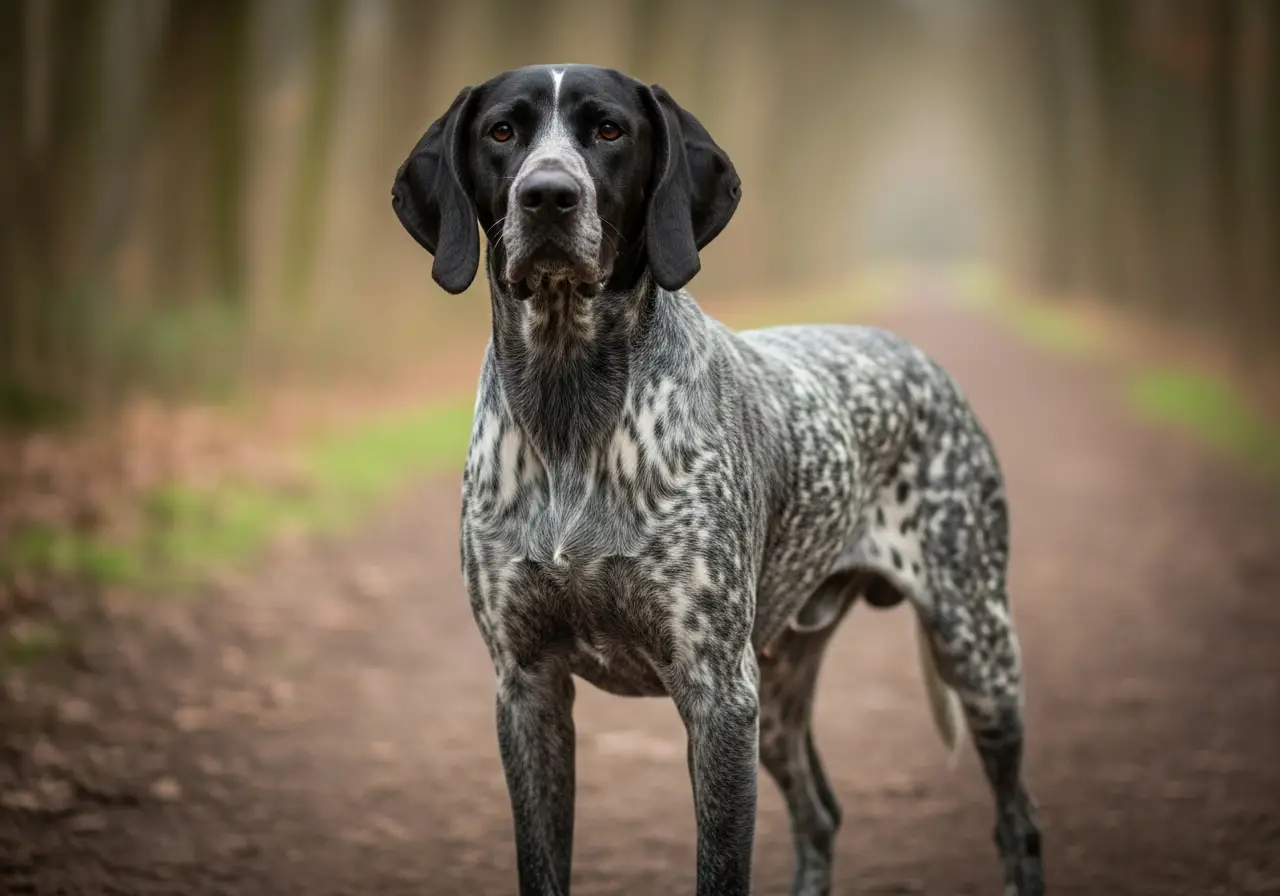
The Braque d'Auvergne is an elegant French pointing dog, FCI Group 7, with a black-and-white spotted pattern, shoulder height 53–63 cm.
03Profile
Key facts and suitability
- Origin
- Frankreich
- Original purpose
- Pointing dog in the Auvergne
- FCI
- No. 180 · Group 7 · Sektion 1.1: Typ Kontinentale Vorstehhunde, mit Arbeitsprüfung
- height at the withers
- 53–63 cm
- Weight
- 22–28 kg
- Life expectancy
- 12–15 Years
- Coat type
- Short-haired
- Minimum exercise
- 90 min/day
- Puppy price
- 1'000–1'800 CHF
- Waiting period
- 9 months
- Sports
- Hunting · Field trials · Retrieving · Tracking
04Temperament
How the Braque d’Auvergne shows up in everyday life
When you come home, a Braque d'Auvergne greets its primary caregiver with clear joy, physically, vocally, and persistently. This intensity is not an isolated incident but an indication of its high need for social contact. The dog actively seeks closeness to its people and follows them around the house. Left alone in the garden, it does not occupy itself; it waits, or it finds a task that the owner has not planned.
Internally, what the dog needs: The Braque d'Auvergne has a need for social contact of 4 out of 5, a need for mental work of 4 out of 5, and a need for movement of 4 out of 5. This means concretely: at least 90 minutes of active exercise daily, supplemented by structured nose work, dummy training, or tracking work. A walk on a lead through the park does not meet this need.
Externally, how the dog reacts to its environment: Towards strangers, it usually appears open and neutral, with a friendliness rating of 4 out of 5. It is neither a guard dog nor a suspicious dog. In the field, its prey drive activates significantly; it works independently, searches widely, and follows a scent trail with high endurance. This independence in the field and the close willingness to cooperate in training are two sides of the same breed that should not be confused.
It gets along well with children who handle dogs calmly and respectfully. Toddlers who disturb it during its rest phase overwhelm it. It then withdraws; it rarely escalates, but it signals boundaries.
05Needs
What this breed needs daily
The Braque d'Auvergne needs at least 90 minutes of active exercise daily, not as a guideline but as a minimum threshold. Below this, it shows restlessness, vocalisation, or destructive behaviour in the house. Suitable forms of exercise include free running on secure terrain, fetch training, tracking work, and hunting guidance.
Nose work is not an optional addition. The Braque d'Auvergne's sense of smell is its primary tool; it has been selected over generations to pick up, follow, and indicate scents. Mantrailing, dummy search, or structured field work meet this need. Those without a hunting background will find a suitable entry point in dummy work or nose work courses.
The need for mental work is high. Pure physical stimulation without mental challenge is not sufficient. Combination units, for example, a tracking session followed by fetch exercises, are more efficient than two hours of running without a task.
Being left alone is possible but must be built up gradually. The dog tolerates being alone for up to four hours if it has been sufficiently stimulated beforehand and if being alone has been trained systematically from the start. Abruptly leaving the dog alone for several hours often leads to separation anxiety in this breed.
A rural environment with access to free-running areas is advantageous. Keeping it in an apartment works if daily stimulation is ensured consistently, not occasionally but daily, even in bad weather.
Exercise
High
mental work
A lot
Social needs
High
training
Medium
06Sport & Mental and Physical Stimulation
What sports the Braque d’Auvergne is suited for
Realistic in terms of physiology and genetics – not every breed suits every sport.
Structurally and physiologically suitable: Suitable for mantrailing, dummy work and tracking · CaniCross / bikejoring possible.
07Quick Check
08Suitability
Who this breed is suitable for – and who it isn't
✓Matches
The Braque d'Auvergne suits owners who can plan at least two hours of active dog enrichment daily, including nose work or hunting guidance. Hunters looking for a cooperative pointing dog with a fine nose will find a reliable working partner in this breed.
Active people without a hunting background are also suitable if they are prepared to take dummy work, tracking work, or mantrailing seriously, not as an occasional variation but as a fixed part of everyday life.
Families with children from about eight years old, in which at least one person takes care of the daily stimulation, can live well with this breed. The prerequisite is that the dog receives clear rest phases and is not constantly played with by children.
Owners with experience in handling high-drive dogs have an advantage. The breed reacts sensitively to inconsistency; those who provide clear, positive, and consistent guidance receive a cooperative, eager-to-learn dog. Those who enjoy collaborating with the dog and understand this collaboration as part of their own daily life will be satisfied with the Braque d'Auvergne in the long term.
×Doesn't match
The Braque d'Auvergne does not suit owners who can offer less than 90 minutes of active enrichment daily. Those who are away from home for eight hours and do not organise a dog sitter or day care structurally overwhelm this dog, regardless of good intentions.
Those looking for a dog that occupies itself in the garden or is satisfied with a short walk make the wrong choice with this breed. The Braque d'Auvergne needs meaningful tasks, not open space without structure.
Owners who equate the gentle, people-oriented character of the breed with low maintenance requirements underestimate the internal axis: the need for social contact and work motivation are high, regardless of how friendly the dog reacts to strangers. These two axes must not be confused.
City dwellers without regular access to free-running areas or nose work opportunities should not choose this breed. Owners who perceive consistency in training as a burden are better advised with a lower-drive dog. The Braque d'Auvergne does not forgive inconsistency permanently; it develops displacement behaviour.
10Line reality
Show line, working line, breeder market
The Braque d'Auvergne is bred predominantly in a performance-oriented line in France. The FCI classification with a working test reflects this requirement: nose work, pointing and cooperation in the field are breeding criteria, not optional extras.
A pronounced show line, as exists in other pointing dog breeds, has not established itself for the Braque d'Auvergne in the German-speaking region. The breed is too rare to observe a clear division between working and exhibition breeding lines. Anyone looking for a puppy will generally encounter breeders who name hunting performance as their primary breeding goal.
This has practical consequences: A Braque d'Auvergne from reputable breeding comes with a pronounced prey drive, regardless of whether the owner hunts themselves. Anyone wishing to keep the breed purely as a companion dog must channel this drive through structured nose work or dummy training. The alternative, ignoring the drive, leads to behavioural issues.
Field trial lines exist in France but are hardly represented in the DACH region. Interested parties looking for a dog for field use should contact French breeding associations directly and check the performance records of the parent animals.
11Health · Reality
What you need to plan for medically with your Braque d’Auvergne
The Braque d'Auvergne is considered a robust working breed with a life expectancy of 12 to 14 years. This range is based on information from the Verein für Französische Vorstehhunde (vbbfl.de) and corresponds to the average for comparable medium-sized pointing dog breeds.
Hip dysplasia (HD) is the most frequently documented hereditary health problem. No breed-specific HD prevalence studies with large case numbers are available for the Braque d'Auvergne, an indication of the low prevalence of the breed. Reputable breeders provide X-ray findings for both parent dogs (HD grade A or B according to FCI assessment). If no proof is provided, you should not finalise the purchase.
Ear problems are structurally more common in drop-eared breeds. The restricted air circulation in the ear canal favours otitis externa. Weekly ear checks and cleaning after water exposure are mandatory, not just a recommendation.
Overweight is an underestimated risk for this breed. A Braque d'Auvergne that is sufficiently exercised generally maintains its weight stably. If the exercise requirement is not met, the risk of obesity increases, with consequential strain on joints and the cardiovascular system.
Preventive examinations: check HD screening of parent dogs before purchase, annual veterinary check-up, check ears weekly, have eyes checked immediately if abnormalities are noticed. A health certificate from the breeder does not replace your own veterinary examination of the puppy before handover.
12Structured data
Health by the numbers
Prone to diseases
Hip dysplasia, eye problems
Recommended health tests
Hip X-ray, eye examination
13Myths ↔ Reality
What is often said incorrectly about this breed
Five myths, five realities, five sources.
„The Braque d'Auvergne is a gentle family dog that is content with little exercise.
The FCI standard describes the breed as a pointing dog that can endure all day on hard terrain. Its need for movement is high and genetically anchored. A Braque d'Auvergne that receives less than 90 minutes of active stimulation plus nose work daily often develops behavioural issues such as excessive barking, destructive behaviour or restlessness in the house.
„Pointing dogs do not have a strong prey drive because they were bred for cooperation.
Cooperation and prey drive do not exclude each other; in the Braque d'Auvergne, they condition each other. The breed was selected to independently locate game, point and indicate it to the hunter. The prey drive is pronounced. Without hunting guidance or structured nose work as a substitute, the dog seeks its own enrichment, usually in a way that owners experience as problematic.
„Due to its gentleness, the Braque d'Auvergne is easy for first-time owners.
The FCI standard describes the character as gentle, cuddly and compliant; these traits refer to interaction with people, not to the effort required for keeping. The breed reacts sensitively to inconsistency and pressure. Those without experience with high-drive working dogs often underestimate the training effort and the consistency this dog requires in everyday life.
„Floppy ears on a pointing dog are purely aesthetic and require no special care.
The drooping, slightly inward-turned ears of the Braque d'Auvergne restrict air circulation in the ear canal. This increases the risk of otitis externa (ear canal inflammation), especially after water exposure or intensive field use. Regular ear checks, at least weekly, are not an optional care step but part of basic maintenance.
„As a rare breed, the Braque d'Auvergne is free from hereditary diseases.
Rarity does not protect against hereditary diseases. In the Braque d'Auvergne, hip dysplasia (HD) and elbow dysplasia (ED) are known risks, as with most medium to large pointing dogs. Reputable breeders provide X-ray results for both parent animals. If you do not receive proof, you should reconsider the purchase.
14animal welfare
The animal welfare perspective
Breeder market, designer versions, animal shelter reality — what no one writes in the puppy ad.
The Braque d'Auvergne is a pronounced rarity in the German-speaking region. This protects the breed from the pressure of the mass market, but not completely. Anyone searching online for puppies occasionally comes across offers from abroad within the EU that are offered without proof of working tests, without HD screening of the parent dogs and without club membership. These puppies are not automatically sick, but the lack of transparency is a warning signal.
Designer versions or hybrid crosses with the Braque d'Auvergne hardly exist in the DACH region. The risk lies less in trend crosses than in false expectations: anyone looking for a "gentle, people-oriented dog" and underestimating the work requirement structurally overloads the animal. This is not a reproach to the owner; it is an information problem that can be solved by better education before purchase.
Breeding-related problems such as brachycephaly or extreme changes in body structure are not an issue for the Braque d'Auvergne. The breed has a functional, athletic build designed for endurance. This is an advantage over many modern breeds.
Adoption as an equally valid option: Braque d'Auvergne rarely appear in animal shelters in the German-speaking region. Anyone looking for an adult dog can contact specialised pointer rescue stations or the Verein für Französische Vorstehhunde. An adult dog has the advantage that character and health status are already easier to assess than with a puppy. The waiting time for a puppy from a reputable breeder is often a year or more; this time can be used meaningfully to prepare for keeping the dog.
15Costs · Transparency
What this breed realistically costs
A puppy from a reputable breeder with VDH/FCI papers costs between 1,200 and 1,800 EUR in the German-speaking region. Offers significantly below this without club membership and HD proof of the parent dogs are a warning signal.
The annual living costs for an adult Braque d'Auvergne (22–28 kg) are typically between 1,800 and 3,000 EUR. This includes high-quality food (approx. 600–900 EUR/year), basic grooming, accessories and regular vet visits.
Veterinary costs: The annual basic care (vaccinations, parasite prevention, routine examination) is 300–500 EUR. Ear problems, which occur more frequently in drop-eared breeds, can cause additional treatment costs of 100–400 EUR per incident. Treating or operating for hip dysplasia can cost 2,000–6,000 EUR.
Pet insurance (surgery insurance) costs between 40 and 90 CHF/EUR monthly for this breed and size class, depending on the provider and scope of benefits. It is particularly useful if there are no savings set aside for larger veterinary costs.
Nose work or dummy courses, which are recommended for this breed, cost 150–400 EUR per course depending on the region and provider.
16Puppy search
What you need to consider when choosing a breeder
- Reputable Braque d'Auvergne breeders are members of a recognised breed club; in the German-speaking area, this is the Verein für Französische Vorstehhunde (vbbfl.de) or an association affiliated with the VDH.
- They provide hip dysplasia X-ray reports for both parent dogs, allow viewing of the mother dog in her home environment, and issue a vaccination record and proof of pedigree.
- Waiting periods of six to twelve months or longer are normal for this rare breed.
- Those who can buy a puppy immediately should check the origin particularly critically.
- Adoption is an equally valid option.
- Adult Braque d'Auvergne rarely end up in animal shelters, but specialised pointer rescue organisations or the breed club can provide further assistance.
- An adult dog allows for a more realistic assessment of character, prey drive intensity and health status.
- Before buying or taking on a dog: honestly assess whether you can ensure this breed's daily exercise requirements in the long term, i.e.
- for ten to fourteen years.
- A conversation with the breeder or breed club will reveal whether the breed suits your own life situation.
FAQ
Frequently asked questions about the Braque d’Auvergne
Is Braque d’Auvergne suitable for beginners?
Braque d’Auvergne is considered suitable for first-time dog owners.
Is Braque d’Auvergne a family dog?
Braque d’Auvergne is considered suitable for families with good socialisation and species-appropriate care.
How much exercise does Braque d’Auvergne need?
At least around 90 minutes of exercise per day. As an active breed, more so — plus mental stimulation.
What is the size and weight of Braque d’Auvergne?
Fully grown, Braque d’Auvergne reaches about 53–63 cm at the withers and weighs around 22–28 kg.
What is the life expectancy of Braque d’Auvergne?
The life expectancy of Braque d’Auvergne is approximately 12–15 years.
Which diseases are common in Braque d’Auvergne?
Hip dysplasia, eye problems
17Breed clubs
Official breed clubs in DACH
19Related
Similar breeds – and their differences
You might also be interested in
Participate
Do you have a good photo of your Braque d’Auvergne?
We are looking for expressive images for our breed profiles. Submit yours; the editorial team reviews every submission before publication.
Does this breed suit you?
Good-natured, versatile pointing dog. Also suitable as a family dog if sufficiently stimulated in terms of hunting.