
01Summary
In a paragraph
If you only have 30 seconds.
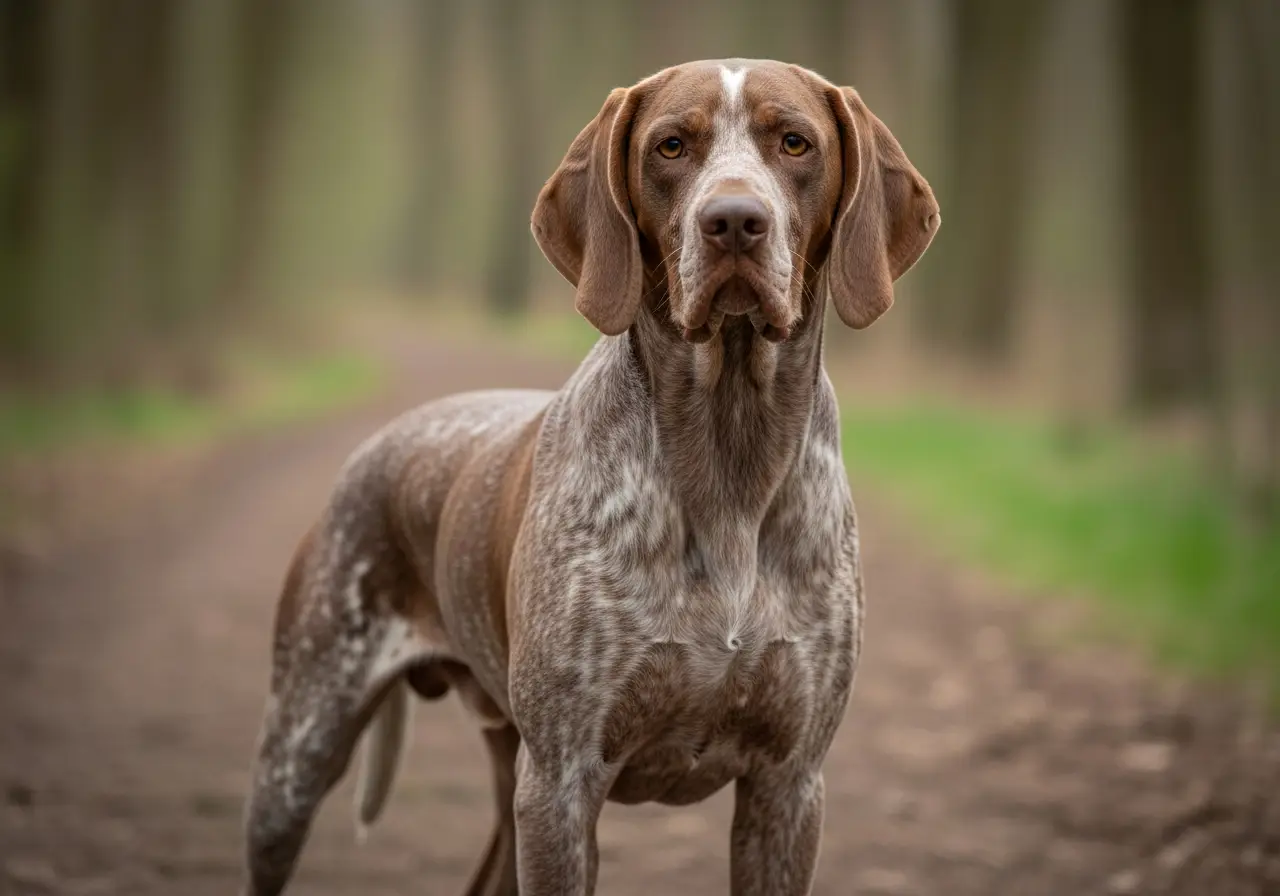
The Braque du Bourbonnais is a compact French pointing dog with a speckled coat, a natural tendency towards a short tail, and a genetically ingrained working motivation that becomes visible in daily life. It seeks close cooperation with its owner, responds sensitively to guidance, and demands structured stimulation, not as a bonus, but as a basic requirement. Anyone who meets these conditions receives an enduring, sensitive companion with genuine willingness to work.
02Introduction
What makes the Braque du Bourbonnais special
The Braque du Bourbonnais is a rare French pointing dog, FCI Group 7, with characteristic pink-liver markings and a natural tendency towards a docked tail, standing 51–57 cm at the withers.
03Profile
Key facts and suitability
- Origin
- Frankreich
- Original purpose
- Pointing dog, retrieving
- FCI
- No. 179 · Group 7 · Section 1
- height at the withers
- 51–57 cm
- Weight
- 16–25 kg
- Life expectancy
- 12–15 Years
- Coat type
- Short-haired
- Minimum exercise
- 90 min/day
- Puppy price
- 1'000–1'800 CHF
- Waiting period
- 9 months
- Sports
- Hunting · Field trials · Retrieving
04Temperament
How the Braque du Bourbonnais shows up in everyday life
Anyone who gets up in the morning will notice it immediately: the Braque du Bourbonnais is already awake, alert and waiting for a signal. It follows its owner through the apartment, not intrusively, but present. This close orientation towards humans is no coincidence; it is the result of centuries of cooperative hunting work.
On the walk, the internal axis becomes clearly visible: the dog actively searches, its nose works permanently, it paces in front of the owner and waits for directional decisions. Without a clear task (a search game, a dummy, a scent trail), idleness arises, which it fills itself. This means in everyday life: free running without structure is not enough.
Towards strangers, it behaves openly and curiously, rarely reserved. The external axis (friendliness towards strangers: high) and the internal axis (need for social contact: high, strong bond with humans) run in the same direction here, making it approachable in everyday life, but this does not mean that it requires less guidance.
With children in the household, it works well with clear structure. It is not effusive, but patient. It accepts other dogs without problems if socialised early. Its prey drive is pronounced; off-leash walking in wildlife areas without a reliable recall command is a real risk that must be trained before the situation arises.
In the evening, it is calm and affectionate, but only if the day has provided sufficient work. An under-stimulated Braque du Bourbonnais is not a calm dog, but a restless one.
05Needs
What this breed needs daily
The Braque du Bourbonnais requires at least 90 minutes of active exercise daily, a considerable part of which should consist of structured work. Free roaming on the meadow does not meet its needs. Nose work, scent trail work, dummy training or hunting guidance correspond to its genetic profile and keep it mentally balanced.
Exercise: Two to three longer sessions daily, at least one of which involves active use of the nose or retrieving behaviour. Stamina is present; short walks are more likely to frustrate it than to tire it out.
Mental work: The need for mental work is high (value 4 out of 5). Mantrailing, search games, structured retrieving or field work are not extras, but fixed components of the weekly programme. Without mental stimulation, behavioural problems arise, not out of malice, but from unused capacity.
Social structure: The need for social contact is also high. The dog requires genuine interaction with its primary caregiver, not just physical presence. It works best when it experiences its owner as a reliable partner; this presupposes regular joint training.
Being left alone: A maximum of four hours is realistic if being left alone has been built up consistently. Longer absences without preparation lead to stress in this human-oriented breed.
Environment: A rural or at least suburban environment with access to terrain is advantageous. Keeping it in an apartment is possible, but requires consistent daily stimulation.
Exercise
High
mental work
A lot
Social needs
High
training
Easy
06Sport & Mental and Physical Stimulation
What sports the Braque du Bourbonnais is suited for
Realistic in terms of physiology and genetics – not every breed suits every sport.
Structurally and physiologically suitable: Suitable for mantrailing, dummy work and tracking · CaniCross / bikejoring possible.
07Quick Check
08Suitability
Who this breed is suitable for – and who it isn't
✓Matches
The Braque du Bourbonnais suits owners who can combine at least 90 minutes of active exercise with structured work daily, and not just on weekends. Hunting guidance, dummy work, mantrailing or scent trail work should be a fixed part of everyday life, not an occasional variation.
Suitable are active individuals or families with children from about eight years old who bring experience in dealing with highly motivated dogs or are willing to attend a dog training school focusing on nose work. A garden or regular access to open terrain is advantageous.
Anyone living in a rural or suburban environment, who enjoys working together with the dog and understands consistency as a leadership principle, will find an enduring, cooperative partner in this breed. Owners who are actively involved in hunting or aim for a companion dog test with nose work also benefit from its genetic orientation.
As it reacts openly towards strangers, it is suitable for households with regular visitor traffic. It is important that the primary caregiver is present and ready to train daily, not just as a provider of care, but as an active working partner.
×Doesn't match
The Braque du Bourbonnais does not suit owners who are away from home for more than four hours daily and cannot organise reliable care. Its high need for social contact and bond with humans do not tolerate permanent long absences without preparation.
Anyone who equates friendliness towards strangers with low training effort underestimates the internal axis of this breed: an open, approachable character does not mean that the dog requires less structure, less consistency or less daily work. Anyone looking for a dog that is content with two short walks daily will be permanently overwhelmed by this pointing dog, and the dog by its owner.
The breed is also unsuitable for city dwellers without access to terrain and without willingness for regular nose work. Keeping it in an apartment in a large city without structured compensation reliably leads to behavioural problems in a dog with a mental work requirement of 4 out of 5.
Owners who are keeping a dog for the first time and do not plan to receive guidance from an experienced dog training school should assess the demands of this breed realistically before deciding on a puppy.
10Line reality
Show line, working line, breeder market
The Braque du Bourbonnais is bred within a comparatively small but consistent breeding population. A pronounced split into show and working lines, as is known for example in the German Shorthaired Pointer or the Labrador Retriever, does not exist to a comparable extent in this breed. Breeding has remained work-oriented since its reconstruction in the 1970s.
Nevertheless, regional differences exist: French breeders traditionally place great emphasis on hunting trial performance (pointing, searching, retrieving from water). Swiss and German breeders also work with proof of performance, although the focus is partly more on versatility and suitability for everyday life.
Anyone looking for a Braque du Bourbonnais should specifically ask for breeding facilities that can provide performance records of the parent dogs, not just show results. A puppy from a line with documented nose work and field trials will, with high probability, possess the genetic prerequisites described in the breed profile. A puppy from a line without performance records may deviate from this, in either direction.
As the overall breeding base is small, active breeding clubs (CS-BB in Switzerland, VBBFL in Germany) know most litters personally. Contacting the club directly before searching for a puppy makes sense.
11Health · Reality
What you need to plan for medically with your Braque du Bourbonnais
The Braque du Bourbonnais is considered a robust working breed with a life expectancy of 12 to 14 years on average. This range is realistic for a medium-sized pointing dog and is confirmed by statements from the breed clubs.
Hip dysplasia (HD): As with most medium-sized pointing dogs, HD also occurs in the Braque du Bourbonnais. Exact population-wide prevalence figures for this rare breed are not available in published studies. Reputable breeders have both parent animals X-rayed and provide the HD result (OFA or FCI scheme) in writing. This certificate should be requested before purchase.
Eye health: Hereditary eye diseases are documented in the breed. An ophthalmological examination of the parent animals by a specialist vet is standard practice in responsible breeding. Buyers should review the examination report.
Weight and overweight: As a working dog, the Braque du Bourbonnais is designed for a lean weight. Overweight puts strain on joints and reduces endurance. The ribs should be palpable with light pressure; this is considered a simple everyday test.
Preventive care: Annual vet check-ups, dental care, and regular parasite prevention (ticks, heartworm when travelling to endemic areas) are standard. In cases of lameness, vision changes, or persistent drops in performance, early veterinary investigation is indicated, not only when symptoms become chronic.
12Structured data
Health by the numbers
Prone to diseases
Hip dysplasia, eye problems
Recommended health tests
Hip X-ray, eye examination
13Myths ↔ Reality
What is often said incorrectly about this breed
Five myths, five realities, five sources.
“The Braque du Bourbonnais is a calm companion dog that is content even without hunting or training.
The breed has a genetically ingrained drive to work, which discharges into undesirable behaviours such as restlessness, searching behaviour in the house and excessive barking if it does not receive structured stimulation. At least 90 minutes of active exercise daily plus scent or retrieving work are not optional but a basic prerequisite for a balanced dog.
“The short tail is the result of docking.
The Braque du Bourbonnais naturally has a short or absent tail; it is a genetically determined trait (natural brachyury) that is explicitly described in FCI Standard No. 179. Docking is neither common nor necessary in the breed and has been banned in Germany since 1998.
“As a rare breed, the Braque du Bourbonnais is particularly healthy and free from hereditary diseases.
Rarity does not automatically protect against hereditary diseases. In small breeding populations, there is even an increased risk of inbreeding effects. Hip dysplasia (HD) and eye diseases are documented in the breed. Reputable breeders provide HD X-ray reports and eye examinations, which should be requested before purchase.
“Due to its friendliness, the Braque du Bourbonnais is an easy dog for beginners.
Friendliness towards people and trainability are two different axes. Although the Braque du Bourbonnais responds openly to strangers (external axis: high friendliness), it places high internal demands on consistency, training structure and daily stimulation. Anyone who underestimates these requirements risks having a permanently under-stimulated dog.
“Because he is so people-oriented, he stays alone without problems.
Strong human bonding and tolerance of being alone often exclude each other. The Braque du Bourbonnais requires a gradual, consistent build-up of staying alone. Without this build-up, strongly people-oriented pointing dogs frequently show separation stress, with corresponding behavioural consequences such as vocalisation or destructive behaviour.
14animal welfare
The animal welfare perspective
Breeder market, designer versions, animal shelter reality — what no one writes in the puppy ad.
The Braque du Bourbonnais is a rarity in animal welfare within the German-speaking region. The breed rarely appears in shelters and rehoming platforms, which is due on the one hand to the small total population, and on the other to the fact that most owners acquire the breed through breed clubs and often receive support from the club when problems arise.
Backyard breeder market: Because the breed is rare and sought after by experts, there is a risk of irresponsible breeding outside the clubs. Puppies without the breeder’s club membership, without health certificates, and at prices significantly lower than the market average should be critically questioned. The small breeding base makes inbreeding effects more likely with uncontrolled multiplication.
Housing-related problems: The most common animal welfare-relevant factor for this breed is not breeding for harmful traits (Qualzucht), but rather mismatching: A Braque du Bourbonnais that is insufficiently stimulated daily will develop behavioural problems that overwhelm owners. Returns to breeders or handovers to third parties usually do not arise from malicious intent, but from underestimated effort. Anyone who assesses the demands of this breed realistically before purchase protects themselves and the dog from this situation.
Rehoming as an option: Anyone considering an adult Braque du Bourbonnais can contact CS-BB or VBBFL directly. Occasionally, returned dogs or retired breeding animals are rehomed. An adult dog with a known character and documented health history is not a compromise solution; for experienced owners, it is often the better choice than a puppy with an unknown development trajectory.
15Costs · Transparency
What this breed realistically costs
A puppy from a reputable breeder with club membership, health certificates, and pedigree costs between 1,200 and 1,800 EUR in the German-speaking region. Offers significantly below this without certificates should be critically assessed.
Ongoing costs per year (guidance values):
- Food (quality dry food or BARF for a 20–25 kg dog): approx. 600–1,000 EUR/year
- Vet (routine examinations, vaccinations, parasite prevention): approx. 300–500 EUR/year
- Dog training school / training (recommended, especially in the first year): approx. 300–600 EUR
- Care (coat, claws, ears): low, due to short hair, approx. 50–100 EUR/year
Vet special costs: HD X-ray for the puppy (recommended from 12 months): approx. 150–250 EUR. Eye examination: approx. 80–150 EUR. In the case of surgical interventions or chronic diseases, costs can quickly rise into the four-figure range.
Insurance: A dog health insurance policy for this weight class costs approx. €40–80/month (€480–960/year), depending on the provider and scope of cover. Dog liability insurance is compulsory in most German federal states and costs approx. €50–100/year.
16Puppy search
What you need to consider when choosing a breeder
- The Braque du Bourbonnais is one of the rare breeds in the German-speaking region.
- Waiting periods of a year or more are not unusual with reputable breeders.
- Anyone who can buy a puppy immediately should regard this as a warning sign.
- Reputable breeders are members of the Club Suisse du Braque du Bourbonnais (CS-BB) or the Verein für französische Vorstehhunde e.V.
- (VBBFL) and provide health certificates for the parent animals: hip dysplasia (HD) X-ray results, eye examinations and, where available, performance records from field trials.
- A visit to the breeder before the puppy is handed over, during which the mother and puppies can be observed together, is standard practice in responsible breeding.
- For those considering an adult dog: Although the Braque du Bourbonnais rarely appears in animal welfare contexts, it is worth contacting the breed clubs; occasionally, returned dogs or breeding animals are rehomed.
- An adult dog with a known history can be an equally valid option, particularly for owners who already have experience with pointing dogs.
- Purchase offers via general classifieds portals without club membership and without health certificates should generally be questioned.
FAQ
Frequently asked questions about the Braque du Bourbonnais
Is Braque du Bourbonnais suitable for beginners?
Braque du Bourbonnais is considered suitable for first-time dog owners.
Is Braque du Bourbonnais a family dog?
Braque du Bourbonnais is considered suitable for families with good socialisation and species-appropriate care.
How much exercise does Braque du Bourbonnais need?
At least around 90 minutes of exercise per day. As an active breed, more so — plus mental stimulation.
What is the size and weight of Braque du Bourbonnais?
Fully grown, Braque du Bourbonnais reaches about 51–57 cm at the withers and weighs around 16–25 kg.
What is the life expectancy of Braque du Bourbonnais?
The life expectancy of Braque du Bourbonnais is approximately 12–15 years.
Which diseases are common in Braque du Bourbonnais?
Hip dysplasia, eye problems
17Breed clubs
Official breed clubs in DACH
19Related
Similar breeds – and their differences
You might also be interested in


Participate
Do you have a good photo of your Braque du Bourbonnais?
We are looking for expressive images for our breed profiles. Submit yours; the editorial team reviews every submission before publication.
Does this breed suit you?
Rare, affectionate pointing dog with a natural docked tail. Almost saved from extinction. Suitable as a family dog.