
01Summary
In a paragraph
If you only have 30 seconds.
The Miniature Pinscher is not a miniature lap dog, but an independent pinscher with a pronounced guarding instinct and clear opinions. It bonds closely with its primary caregiver, approaches strangers cautiously, and announces itself loudly. Anyone who keeps this breed without experience and without a clear leadership structure systematically underestimates it and quickly ends up at the animal shelter.
02Introduction
What makes the Miniature Pinscher special
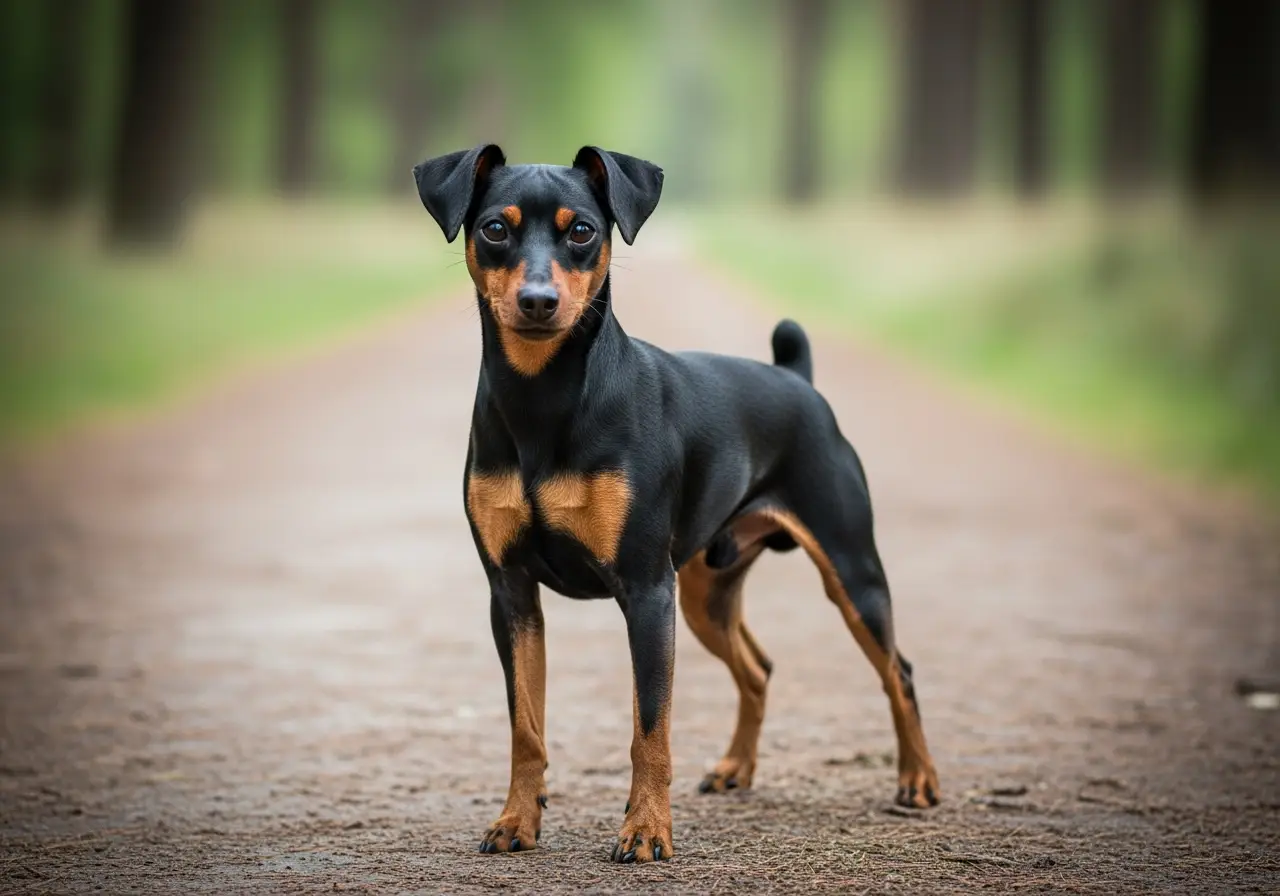
Miniature Pinscher: compact, self-assured companion dog from Germany, lively, alert and full of personality
03Profile
Key facts and suitability
- Origin
- Deutschland
- Original purpose
- Guard and rat catcher
- FCI
- No. 185 · Group 2 · Section 1
- height at the withers
- 25–30 cm
- Weight
- 4–6 kg
- Life expectancy
- 12–14 Years
- Coat type
- Short-haired
- Minimum exercise
- 45 min/day
- Puppy price
- 1'200–2'000 CHF
- Waiting period
- 4 months
- Sports
- Agility Tricks
04Temperament
How the Miniature Pinscher shows up in everyday life
When the Miniature Pinscher wakes up in the morning, it is immediately present. No slow start-up, no sluggish stretching; it is awake, alert, and expects the day to begin. When you return home, it registers every step on the stairs before the apartment door opens and announces itself accordingly.
Here, the distinction between internal needs and external behaviour becomes clear: Internally, the Miniature Pinscher has a high need for social contact; it wants to be with its primary caregiver, participate in activities, and be mentally included. Externally, it reacts reservedly to strangers, up to mistrustfully. A high need for social contact does not mean that this breed warmly greets every visitor. It greets its people; strangers are initially observed and announced.
On a walk, it does not simply follow along. It scans the environment, registers movements early, and reacts quickly to stimuli. A bicycle coming from behind, a dog charging towards it – the Miniature Pinscher decides for itself how to react if there is no clear signal from the primary caregiver. Therefore, leadership on walks is not an option but a prerequisite.
In daily life with other dogs, it shows itself confident, sometimes dominant, regardless of the size of the counterpart. Early and broad socialisation reduces conflicts but does not override the basic character.
It gratefully accepts mental stimulation through nose work, search games, or structured training. Without this enrichment, it seeks its own tasks, which rarely align with the owner’s expectations.
05Needs
What this breed needs daily
The Miniature Pinscher requires at least 60 to 90 minutes of active exercise daily. This does not refer to leisurely city strolls, but rather forms of movement involving stimuli: sniffing rounds in the terrain, fetching units, leash work with direction changes, or controlled off-leash running on secure terrain.
In addition to physical exercise, it requires mental enrichment. Nose work, search games, simple trick training sessions, or basic Mantrailing are well-suited. The need for mental work is moderate; it is not a Border Collie that falls apart without a task, but a dog that becomes restless and noisy without any mental challenge.
Its need for social contact is high. It requires close integration into the daily life of its primary caregiver. Long periods alone, more than four hours daily, overwhelm it without prior systematic preparation. Anyone who is regularly away from home for long periods must organise reliable care solutions.
The short coat offers little protection against the cold. Below approximately 5 degrees Celsius, the Miniature Pinscher requires a well-fitting dog jacket that covers the belly and back. Sensitivity to cold is not a weakness but a physiological reality of this breed, which must be taken into account in daily planning.
Training and guidance are not one-off investments but ongoing tasks. The Miniature Pinscher tests boundaries, not out of malice, but because it is a self-confident, independently thinking animal. Clear, calm, and reliable guidance by an experienced primary caregiver is the basic prerequisite for a balanced coexistence.
Exercise
Medium
mental work
Medium
Social needs
High
training
Medium
07Quick Check
08Suitability
Who this breed is suitable for – and who it isn't
✓Matches
The Miniature Pinscher suits owners who already have experience with self-confident or alert dog breeds and understand that guidance must be practised daily. Active individuals or couples who can devote at least 90 minutes a day to exercise and training are suitable.
Families with children from around eight years of age are suitable if the children are trained in dealing with dogs and the dog always has opportunities to retreat. A quiet home with a clear daily structure significantly supports the well-being of the dog.
Those living in an apartment can keep a Miniature Pinscher, provided that exercise and enrichment are consistently moved outdoors and barking behaviour is trained early on. Houses with a garden are not essential but make everyday life easier.
Owners who are willing to invest in a supportive dog training school and actively shape barking behaviour and social contacts will be rewarded with a loyal, attentive, and lively companion. Anyone who takes the breed for what it is – a Pinscher with working dog heritage – and not as a miniature dog without demands, finds a reliable everyday partner in it.
×Doesn't match
The Miniature Pinscher does not suit owners who are keeping a dog for the first time and do not plan to receive guidance from an experienced dog training school. Anyone who expects a dog to regulate itself or become calm and socially compatible with little effort will fail with this breed.
The breed is not suitable for households where the dog is left alone for more than four hours a day and no care solution exists. Its high need for social contact and its alerting behaviour lead to separation stress and neighbourhood conflicts in such situations.
Anyone who misinterprets the reserved behaviour towards strangers as temporary shyness and refrains from broadly socialising the dog risks ending up with a dog that overreacts in social situations. The external axis (how the Miniature Pinscher reacts to strangers, unknown dogs, and new stimuli) diverges significantly from its internal need for social contact with its own primary caregiver. Anyone who confuses these two levels makes incorrect housing decisions.
Households with very young children under six years of age, where continuous supervision is not guaranteed, are also unsuitable. Owners who tolerate barking behaviour or do not wish to actively train it should also not choose this breed.
10Line reality
Show line, working line, breeder market
The Miniature Pinscher is listed by the FCI without a working test and, compared to hunting or herding dogs, lacks clearly defined working and show lines with strongly diverging characteristics. Nevertheless, practical breeding differences exist that are relevant for potential buyers.
Breeders who primarily select for show success focus on exterior: square build, coat colour, head shape and gait according to the FCI standard. Behaviourally, this can lead to dogs that visually meet the standard but vary in temperament and resilience.
Breeders focusing on temperamental stability and suitability for everyday life select more strongly for balanced temperament, social compatibility and resilience in urban environments. These dogs are not necessarily inferior in exterior, but the priorities in breeding selection are different.
Another factor is the regional breeding base: In Germany and Switzerland, active breeding clubs exist (including the Swiss Club for Schnauzers and Pinschers) that conduct temperament tests and breeding suitability examinations. Dogs from club-affiliated breeding generally undergo stronger selection for temperament than dogs from non-club-affiliated reproduction.
Potential buyers should specifically ask for temperament test results of the parent dogs and not rely solely on show titles.
11Health · Reality
What you need to plan for medically with your Miniature Pinscher
The life expectancy of the Miniature Pinscher is 12 to 15 years, a typical value for a small breed, which however depends heavily on keeping conditions, nutrition, and breeder care.
Patellar luxation is the most common orthopaedic disease in small breeds and also occurs in Miniature Pinschers. According to an evaluation by the Orthopedic Foundation for Animals (OFA), the prevalence in small dogs ranges between 5 and over 20 percent depending on breed and breeding line (OFA, as of 2023). Reputable breeders have parent dogs examined for patellar luxation and provide findings upon request.
Heart diseases, particularly mitral valve insufficiency, occur more frequently in small dog breeds with increasing age. Regular cardiological check-ups from the fifth year of life are recommended. The European Society of Veterinary Cardiology (ESVC) recommends annual auscultations by a vet for breeds with an increased heart risk.
The short coat makes the Miniature Pinscher sensitive to cold. Hypothermia during prolonged exposure below 5 degrees Celsius is a real risk that can be minimised by appropriate protective clothing.
Overweight is an underestimated risk in this breed. Miniature Pinschers are active and have a good appetite; without adjusted food quantities and regular weight checks, many dogs develop overweight in middle age, which additionally strains joints and heart health.
Preventive examinations: patella check before purchase, annual weight check, cardiological control from the fifth year of life, and tartar prophylaxis (small breeds are disproportionately frequently affected).
12Structured data
Health by the numbers
Prone to diseases
Heart problems Patellar problems Eye problems
Recommended health tests
Heart examination Patella check
13Myths ↔ Reality
What is often said incorrectly about this breed
Five myths, five realities, five sources.
"The Miniature Pinscher is a low-maintenance small dog for beginners.
The Miniature Pinscher has pronounced alertness, strong alarm behaviour and an independent character. Without clear leadership structure, it quickly develops undesirable behaviours such as excessive barking or resource guarding. Specialist associations and breeders explicitly classify it as a breed that requires experience in handling self-assured dogs.
"Small dogs need little exercise; the Miniature Pinscher is fine with a short walk.
The Miniature Pinscher needs 60 to 90 minutes of active exercise daily, plus additional mental stimulation. Its exercise requirement is high relative to its body size. Insufficient stimulation manifests as restlessness, increased barking and destructive behaviour.
"The Miniature Pinscher is a miniature version of the Doberman.
The Miniature Pinscher is an independent, older breed. The Doberman was only bred at the end of the 19th century, among other things by crossing in Pinscher blood. The Miniature Pinscher existed as a farm and stable dog significantly earlier and is not a derivative of the Doberman, but an independent representative of the Pinscher family.
"Miniature Pinschers are ideal for families with toddlers.
The Miniature Pinscher tolerates children if treated respectfully and has clear retreat options. However, toddlers who handle or crowd the dog unsupervised quickly overwhelm it. Its self-assured temperament and low threshold for unpredictable movements make continuous supervision necessary.
"Miniature Pinschers are easy to leave alone; they are small and need little.
The Miniature Pinscher has a high need for social contact and bonds closely with its primary caregiver. Being left alone must be built up systematically and early. Without this preparation, many dogs of this breed develop separation anxiety or increased barking behaviour, which can lead to significant conflicts in multi-unit buildings.
14animal welfare
The animal welfare perspective
Breeder market, designer versions, animal shelter reality — what no one writes in the puppy ad.
The Miniature Pinscher ends up in animal shelters and adoption platforms disproportionately often, not because it is a difficult dog, but because it is systematically misjudged. Owners who expect a calm, undemanding small dog encounter a temperamental, watchful pinscher with pronounced alert behaviour. This discrepancy is the most common reason for surrender.
Backyard breeder market: Miniature Pinschers are regularly offered on relevant classifieds platforms without club membership, without health examinations of the parent dogs, and without socialisation. Prices below 500 euros are a clear warning signal. Anyone who buys here finances structures that systematically prioritise animal welfare secondarily, and simultaneously risks acquiring a dog with health or behavioural problems, the treatment of which costs many times the purchase price.
Breeding- and keeping-related problems: The Miniature Pinscher is not a fashion breed in the strict sense. Nevertheless, breeding risks exist: dogs from uncontrolled multiplication more frequently show unstable temperament, increased aggression, or pronounced fearfulness. Overweight due to poor nutrition and lack of exercise is a widespread keeping problem that damages joints and heart health in the long term.
Adoption as an equally valid option: Miniature Pinschers in animal shelters and with breed rescue organisations are not second-class problem dogs. Many were surrendered because their owners were overwhelmed, not because the dogs themselves have a structural problem. Anyone who brings experience with the breed will often find well-socialised, adult dogs whose character is already assessable through adoption. The Schweizerischer Club für Schnauzer und Pinscher as well as German breed club networks regularly facilitate rehoming of dogs into new homes.
15Costs · Transparency
What this breed realistically costs
A Miniature Pinscher from reputable, club-affiliated breeding costs between 1,200 and 2,000 euros in the DACH region. Prices significantly below this indicate missing health examinations, inadequate socialisation, or backyard breeder origins. Dogs from animal shelters or breed rescues are available for a fee of 200 to 500 euros.
The annual living costs amount to approximately 1,500 to 2,500 euros depending on the form of keeping. Included are: food (quality dry food or fresh meat, approx. 400–700 euros/year), grooming needs (short hair, low, approx. 100–200 euros/year), dog training school and training (approx. 300–600 euros/year, particularly recommended in the first two years), as well as basic equipment (leash, harness, coat, transport box).
Basic veterinary costs (vaccinations, annual preventative care, parasite treatment) amount to approximately 300–500 euros per year. In addition, potential treatment costs for patellar luxation (conservative 200–500 euros, surgical 1,500–3,000 euros per joint) or heart disease in old age must be considered.
Pet insurance for a Miniature Pinscher costs between 30 and 80 euros per month (360–960 euros/year), depending on the provider and scope of cover. Given potential surgical costs, it is particularly worth considering surgery cost insurance for this breed.
16Puppy search
What you need to consider when choosing a breeder
- A reputable breeder is a member of a recognised breed club (e.g.
- Pinscher-Schnauzer-Klub 1895 e.
- or Schweizerischer Club für Schnauzer und Pinscher) and, upon request, provides health certificates for the parent dogs, at least patellar findings, ideally a cardiological examination.
- The litter is registered in the club's stud book, and the puppies receive an FCI pedigree certificate.
- Viewings take place at the breeder’s premises, never on neutral ground or via delivery.
- The puppies grow up in a home environment and are accustomed to everyday noises, people, and as many different stimuli as possible.
- A breeder who asks no questions and sells immediately is not a good sign.
- Adoption through animal shelters or breed rescue organisations is an equally valid option.
- Adult dogs have the advantage that their character and health status can already be assessed.
- The Schweizerischer Club für Schnauzer und Pinscher as well as German breed club networks maintain adoption lists.
- Interested buyers should critically assess offers on classifieds platforms that lack club affiliation, do not allow viewing at the breeder’s premises, and feature very low prices.
- No specific breeder recommendation is made here; rundum.dog links to approved listing pages.
FAQ
Frequently asked questions about the Miniature Pinscher
Is Miniature Pinscher suitable for beginners?
Miniature Pinscher is considered suitable for first-time dog owners.
Is Miniature Pinscher a family dog?
Miniature Pinscher is considered suitable for families with good socialisation and species-appropriate care.
How much exercise does Miniature Pinscher need?
At least around 45 minutes of exercise per day.
Does Miniature Pinscher suit an apartment?
With enough exercise and enrichment, Miniature Pinscher can also be kept in an apartment.
What is the size and weight of Miniature Pinscher?
Fully grown, Miniature Pinscher reaches about 25–30 cm at the withers and weighs around 4–6 kg.
What is the life expectancy of Miniature Pinscher?
The life expectancy of Miniature Pinscher is approximately 12–14 years.
Which diseases are common in Miniature Pinscher?
Heart problems Patellar problems Eye problems
17Breed clubs
Official breed clubs in DACH
19Related
Similar breeds – and their differences
You might also be interested in
Participate
Do you have a good photo of your Miniature Pinscher?
We are looking for expressive images for our breed profiles. Submit yours; the editorial team reviews every submission before publication.
Does this breed suit you?
Small guard dog with lots of energy – not to be confused with the Doberman despite similar appearance