
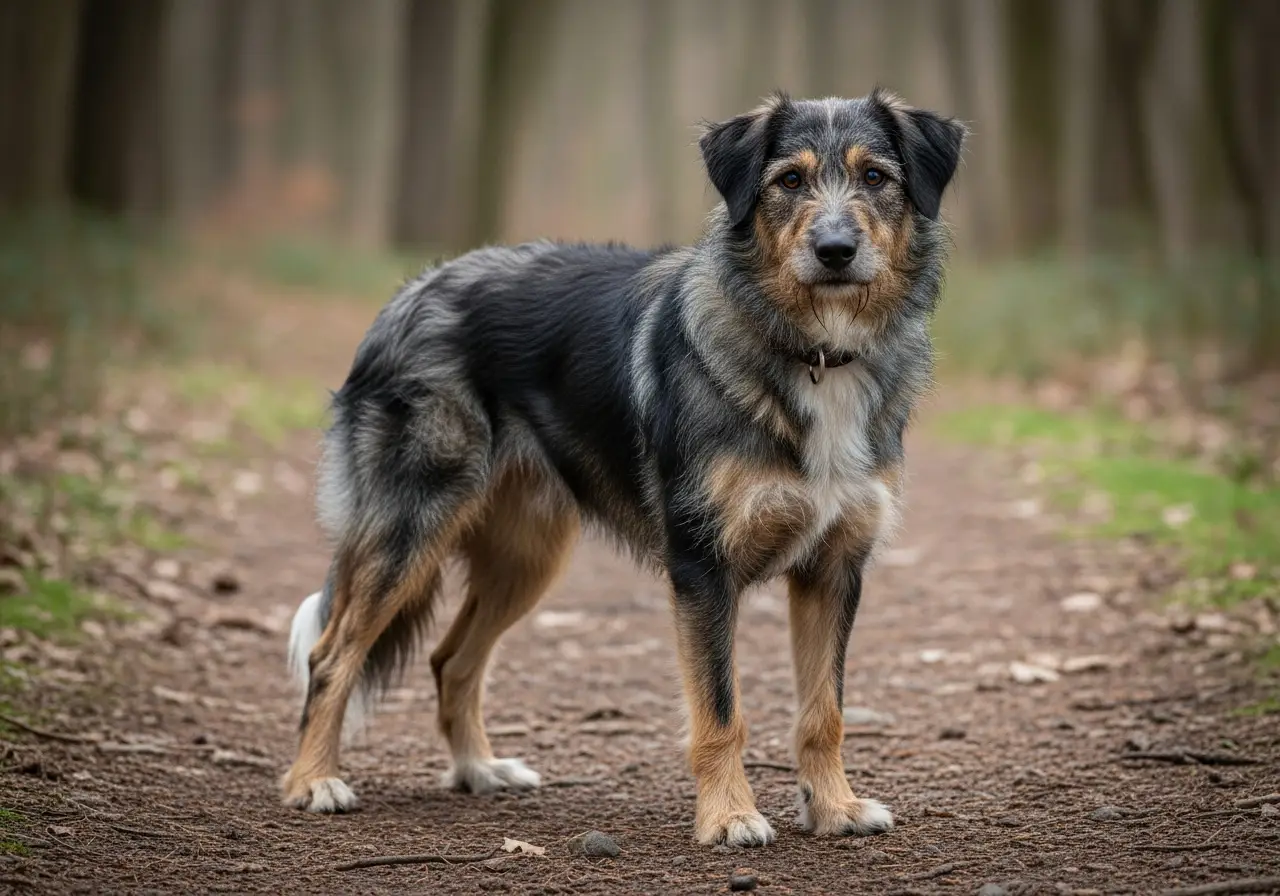
01Summary
In a paragraph
If you only have 30 seconds.
The Long-haired Pyrenean Shepherd is not a dog for quiet evenings on the sofa. It originates from the French Pyrenees, where it drove sheep herds over steep mountain terrain, quickly, independently, and nervously charged. Anyone keeping one today takes on a genetic work programme: high exercise needs, pronounced mental work, strong bond with the primary caregiver, and clear reserve towards strangers. If you underestimate this, the dog will show it.
02Introduction
What makes the Long-haired Pyrenean Shepherd special
The Long-haired Pyrenean Shepherd is the fastest herding dog in the world over short distances, FCI Group 1, energetic, withers height 40–53 cm.
03Profile
Key facts and suitability
- Origin
- Frankreich
- Original purpose
- Sheep herding in the Pyrenees
- FCI
- No. 141 · Group 1 · Sektion 1: Schäferhunde
- height at the withers
- 40–53 cm
- Weight
- 8–18 kg
- Life expectancy
- 12–16 Years
- Coat type
- Long-haired
- Minimum exercise
- 90 min/day
- Puppy price
- 1'000–1'800 CHF
- Waiting period
- 9 months
- Sports
- Agility · Herding work · Obedience
04Temperament
How the Long-haired Pyrenean Shepherd shows up in everyday life
When returning home, the Long-haired Pyrenean Shepherd registers every change immediately, a strange noise, an unfamiliar face at the door, a new object in the hallway. It reports. It assesses. Then it decides.
This reaction speed is not a temperament flaw, but the result of centuries of herding work in the high mountains. Internally, the dog needs a high degree of mental work and exercise; the need for mental work is at the highest level. If you do not give it a task, it will invent one: herding children, monitoring visitors, circling moving objects.
Externally, it behaves reserved to distrustful towards strangers. This is not aggression, but neither is it shyness; it is alertness. A visitor the dog does not know will initially be observed, not greeted. These two axes, high internal need for social contact with the primary caregiver and low external openness towards unknown people, must not be confused. The dog is not a distant loner; it is completely devoted to its primary caregiver and actively seeks cooperation.
In everyday life, this means: the dog follows its primary caregiver through the apartment, observes every action and waits for a signal. On the walk, it works ahead, returns, checks – classic herding behaviour that quickly becomes a problem without a task. In structured training sessions, it shows exceptional learning speed and joy in precision.
05Needs
What this breed needs daily
The Long-haired Pyrenean Shepherd needs at least 90 to 120 minutes of active enrichment every day, and this is a minimum, not a recommendation. Simple walks are not enough. The exercise units must contain a mental component: changes of direction, tasks, signals, interaction.
The requirement for mental work is rated at the highest level. This means concretely: the dog requires structured thinking tasks daily. Herding work with sheep or goats corresponds most directly to its genetic profile. Agility, obedience, treibball, or demanding nose work are equivalent alternatives for owners without access to livestock.
Being left alone should be built up gradually and not regularly exceed four hours. The dog bonds closely with its primary caregiver; longer absences without preparation cause stress, which is discharged through vocalisations or herding behaviour towards other pets.
Rest phases are just as important as active phases. A permanently overstimulated Pyrenean Shepherd loses stability. Daily life requires clear structures: fixed training times, defined rest zones, predictable routines. Spontaneous sensory overload (loud parties, unstructured streams of visitors, chaotic households) is poorly tolerated by this breed.
Grooming requires regular attention: the long, slightly felt-prone coat must be combed several times a week, especially during moulting. Mats form quickly and can lead to skin problems.
Exercise
Very high
mental work
A lot
Social needs
High
training
Demanding
06Sport & Mental and Physical Stimulation
What sports the Long-haired Pyrenean Shepherd is suited for
Realistic in terms of physiology and genetics – not every breed suits every sport.
Structurally and physiologically suitable: Suitable for herding work, treibball and coursing · CaniCross / bikejoring possible.
07Quick Check
08Suitability
Who this breed is suitable for – and who it isn't
✓Matches
The Long-haired Pyrenean Shepherd suits owners who can plan at least two hours of active, structured enrichment daily, not as an exception, but as part of everyday life. Sporty individuals or couples with access to open land who actively engage in dog sports or have an interest in herding work meet the requirements profile of this breed.
Families with children from about ten years old are suitable if the adults take on leadership and consistently accompany the dog’s herding behaviour towards children. A garden is helpful but does not replace structured stimulation.
Owners with dog experience, particularly with herding or working dogs, find an exceptionally trainable partner in this breed. Anyone willing to use a supporting dog training school from the start and work consistently on socialisation can also be successful as a first-time owner with this breed, provided the time resources are right.
People who work from home or have flexible working hours benefit from being able to integrate the dog into their daily routine. The dog needs presence and tasks; both can be well fulfilled in a structured everyday life with sufficient time.
×Doesn't match
The Long-haired Pyrenean Shepherd does not suit owners who are regularly away from home for eight or more hours and cannot organise reliable care solutions. The close bond with the primary caregiver and the limited framework for being left alone of about four hours are non-negotiable.
Anyone who chooses the dog because of its appearance and regards the working disposition as a secondary aspect fundamentally underestimates the breed. The herding instinct is not occasional behaviour; it is the dominant behavioural pattern. Anyone who does not actively channel this will end up with a dog that drives children, controls visitors, and creates unrest in the household.
Households with very young children under six years old, where no adult can permanently accompany the interaction between dog and child, are unsuitable. Herding behaviour towards quickly moving children is typical of the breed and requires consistent guidance.
Anyone looking for an open, sociable dog that warmly greets strangers is also mistaken with this breed. The external reserve towards strangers is not a training problem but a breed characteristic. Anyone who perceives this as a deficiency should choose another breed.
10Line reality
Show line, working line, breeder market
The Long-haired Pyrenean Shepherd is still bred in France today in two functional contexts: as an active working dog on sheep pastures and as a show dog according to FCI standard. This distinction is relevant for potential buyers.
Working line dogs from active herding operations generally show a more pronounced herding instinct, higher reaction speed and greater independence. They are conditioned to work with livestock and require particularly consistent guidance and tasks in a household context.
Show lines are not necessarily lower in drive, but the selection places greater emphasis on type consistency, coat quality and standard conformity. The temperament remains breed-typical; the differences between the lines are gradual, not fundamental.
In Germany and Switzerland, the breeding base is narrow. The Club Berger des Pyrénées 1983 e.V. (Germany) and the Club Suisse du Berger des Pyrénées (Switzerland) are the responsible breed clubs. Anyone looking for a puppy will generally be referred to French breeders or have to plan for longer waiting times. A pronounced field trial line does not exist in any significant extent in the German-speaking area.
11Health · Reality
What you need to plan for medically with your Long-haired Pyrenean Shepherd
The Long-haired Pyrenean Shepherd is considered a robust breed in comparison with other breeds, with a life expectancy of 13 to 15 years. This range is above average for medium-sized herding dogs and reflects the traditional selection for endurance and working ability.
Hip dysplasia (HD) occurs in the breed but is documented less frequently than in larger herding dogs. Concrete population-wide HD rates for this breed are not available in sufficient density in German-language specialist literature; however, reputable breeders provide HD X-ray findings for both parent animals (OFA or SV evaluation). Prospective buyers should actively request these documents.
Eye diseases, particularly progressive retinal atrophy (PRA), are known in herding dogs of FCI Group 1. A current eye certificate for the parent animals (not older than twelve months at the time of mating) is a minimum standard in responsible breeding.
The risk of overweight is low in this highly active breed, provided that exercise needs and food intake are in balance. This can change with persistent under-stimulation and constant food intake.
Preventive examinations: Annual general check-up, HD screening before breeding, eye screening, dental check. The long coat requires regular inspection for skin changes, parasites, and matting, which can predispose to skin problems.
12Structured data
Health by the numbers
Prone to diseases
Hip dysplasia, epilepsy, progressive retinal atrophy
Recommended health tests
Hip X-ray, eye examination
13Myths ↔ Reality
What is often said incorrectly about this breed
Five myths, five realities, five sources.
“The Pyrenean Shepherd is a cosy dog because of its shaggy coat.
The coat is deceptive. The FCI standard explicitly describes a dog that radiates maximum liveliness despite minimal weight. The breed belongs to the most reactive herding dogs of all. Anyone looking for a calm companion is fundamentally mistaken with this dog.
“Small dogs need little exercise, which also applies to the Pyrenean Shepherd.
The Long-haired Pyrenean Shepherd needs at least 90 to 120 minutes of active enrichment every day. Its need for movement is based on its function as a working dog in the high mountains, not on its body size. Understimulation manifests as nervousness, herding behaviour towards people, or destruction.
“He is a family dog that gets along well with all people.
The FCI standard explicitly states that the Pyrenean Shepherd often reacts with distrust towards strangers. The external behavioural axis (friendliness towards strangers) is significantly low. This is not a training error, but a breed-typical characteristic that must be consistently taken into account during socialisation and in everyday life.
“Because he is a herding dog, free running on a meadow is sufficient for stimulation.
Free exercise without a task does not cover the mental work needs of this breed. The Pyrenean Shepherd requires structured enrichment: herding work, agility, nose work or comparable tasks that appeal to its problem-solving instinct. Pure physical exercise without a mental component leads to behavioural problems in the long term.
“The breed is robust and requires little veterinary preventive care.
Although the Long-haired Pyrenean Shepherd is considered healthy compared to many other breeds, regular check-ups for hip dysplasia and eye diseases are recommended. The narrow breeding base outside France increases the risk of genetic bottlenecks. Reputable breeders provide health certificates for the parent animals.
14animal welfare
The animal welfare perspective
Breeder market, designer versions, animal shelter reality — what no one writes in the puppy ad.
The Long-haired Pyrenean Shepherd is a rare breed in Germany and Switzerland. This limits supply on the one hand, but protects the breed from the mass market on the other. Large-scale commercial breeding hardly exists for this breed because demand is too low. This is not a free pass: Even with rare breeds, there are unscrupulous providers who sell puppies without health tests and without socialisation.
A puppy of unknown origin (without HD proof for the parents, without eye certificate, without insight into rearing conditions) is not a bargain. It is a calculated risk that can result in veterinary costs and behavioural problems.
Designer versions or crosses with the breed name are marginal in the German-speaking area. The risk lies rather in another direction: owners who choose the breed for its appearance and underestimate its working character. Surrenders to rehoming organisations occur, according to breed club experience, predominantly due to underestimated exercise and stimulation needs or due to undesirable herding behaviour towards children and other pets. This is not a failure of the dog; it is a wrong decision at purchase.
Rehoming is an equally valid option for this breed. Because the population is small, rehoming dogs are rare, but they exist. Breed club contacts (CBP Germany, CSBP Switzerland) occasionally rehome dogs from surrenders. An adult dog from rehoming has the advantage that its character is already assessable, a real advantage over a puppy with an uncertain development course in a breed with this strength of character.
15Costs · Transparency
What this breed realistically costs
A puppy from a reputable breeder with papers, health tests and vaccination protection costs between 1,200 and 2,000 euros in the German-speaking area. Waiting periods of six to twelve months are usual due to the small breeding base. Offers significantly below 800 euros without proof for the parent animals are a warning signal.
Annual living costs for a medium-sized, active dog of this size class are typically between 1,500 and 2,500 euros. Included: high-quality food (approx. 600–900 euros/year), grooming accessories or professional grooming (approx. 150–300 euros/year), basic equipment and wear-and-tear items.
Basic veterinary costs (vaccinations, parasite prevention, annual examination) average 300–500 euros per year. In addition to unforeseen treatments, a reserve of 1,000–2,000 euros or pet health insurance (costs: approx. 30–80 euros/month depending on provider and coverage) is recommended.
Dog sports and training are not optional expenses for this breed. Course fees for agility, obedience or herding work range from 15 to 40 euros per session. Anyone keeping the breed in a species-appropriate manner plans these costs in from the start.
16Puppy search
What you need to consider when choosing a breeder
- Reputable breeders of the Long-haired Pyrenean Shepherd are members of the Club Berger des Pyrénées 1983 e.V.
- (Germany) or the Club Suisse du Berger des Pyrénées (Switzerland).
- Both associations run stud book programmes and require minimum health certificates before mating.
- A breeder search via the association websites is the most reliable starting point.
- Characteristics of reputable breeding: The parent animals are visible on site, HD and eye certificates are available in writing, the litter is registered with the VDH or SKG, the puppies are handed over at the earliest at eight weeks of age and are vaccinated and dewormed.
- The breeder asks questions; they want to know if the owner suits the breed.
- Warning signs: No insight into the rearing, no papers for the parent animals, immediate availability without waiting time, prices significantly below 800 euros.
- Adoption is an equally valid option.
- Breed club contacts occasionally place dogs from surrenders.
- An adult dog allows a more realistic assessment of temperament and energy level, which is a relevant advantage for this breed.
- General animal welfare organisations rarely have Pyrenean Shepherds in their stock, but an enquiry is worthwhile.
FAQ
Frequently asked questions about the Long-haired Pyrenean Shepherd
Is Long-haired Pyrenean Shepherd a family dog?
Long-haired Pyrenean Shepherd is considered suitable for families with good socialisation and species-appropriate care.
How much exercise does Long-haired Pyrenean Shepherd need?
At least around 90 minutes of exercise per day. As an active breed, more so — plus mental stimulation.
What is the size and weight of Long-haired Pyrenean Shepherd?
Fully grown, Long-haired Pyrenean Shepherd reaches about 40–53 cm at the withers and weighs around 8–18 kg.
What is the life expectancy of Long-haired Pyrenean Shepherd?
The life expectancy of Long-haired Pyrenean Shepherd is approximately 12–16 years.
Which diseases are common in Long-haired Pyrenean Shepherd?
Hip dysplasia, epilepsy, progressive retinal atrophy
17Breed clubs
Official breed clubs in DACH
19Related
Similar breeds – and their differences
You might also be interested in
Participate
Do you have a good photo of your Long-haired Pyrenean Shepherd?
We are looking for expressive images for our breed profiles. Submit yours; the editorial team reviews every submission before publication.
Does this breed suit you?
Fastest herding dog in the world over short distances. Intense, independent character. Needs lots of mental stimulation.