
01Summary
In a paragraph
If you only have 30 seconds.
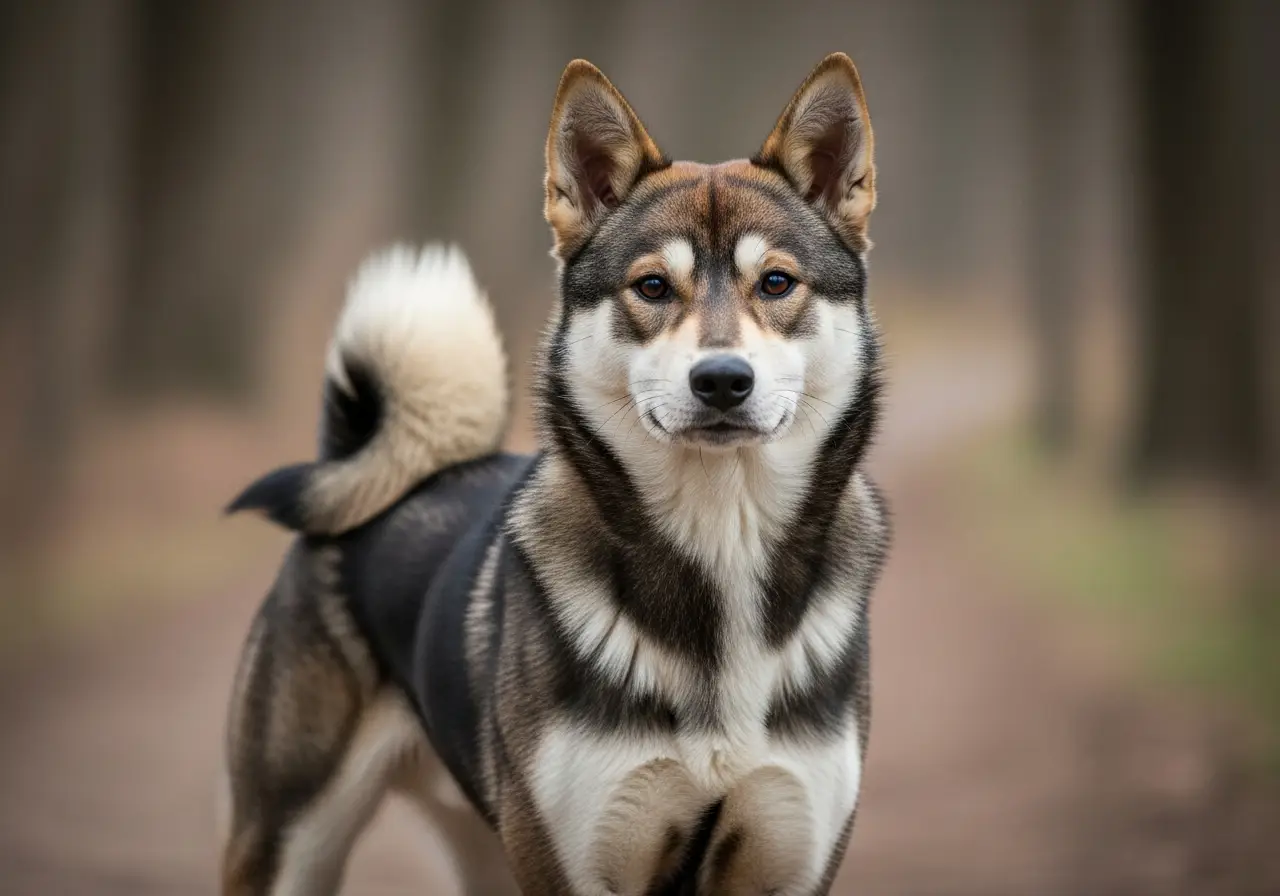
The Korean Jindo is a medium-sized hunting and guard dog from South Korea, which has been bred for independence and loyalty towards a single primary caregiver for centuries. It learns quickly, questions instructions and does not follow out of obedience, but out of conviction. Anyone who underestimates it gets a dog that makes its own decisions, in the hunt, in its territory and in everyday life.
02Introduction
What makes the Korean Jindo special
The Korean Jindo is a South Korean cultural monument, FCI Group 5, loyal and independent, with a withers height of 45–55 cm.
03Profile
Key facts and suitability
- Origin
- Südkorea
- Original purpose
- Hunting on Jindo Island, guard dog
- FCI
- No. 334 · Group 5 · Sektion 5: Asiatische Spitze und verwandte Rassen. Ohne Arbeitsprüfung.
- height at the withers
- 45–55 cm
- Weight
- 15–23 kg
- Life expectancy
- 11–13 Years
- Coat type
- Doppel
- Minimum exercise
- 90 min/day
- Puppy price
- 1'000–2'500 CHF
- Waiting period
- 12 months
- Sports
- Agility · Scent work · Hunting
04Temperament
How the Korean Jindo shows up in everyday life
When returning home, the Jindo greets its primary caregiver with calm attention, no exuberant jumping, no constant barking. It registers the return, shows joy in its own way and then returns to its observer role. This behaviour is not disinterest. It is an expression of its character structure: loyal, but not affectionate in the classical sense.
Internally, what the dog needs: The Jindo has a high need for mental work (CCT value 4 out of 5) and an equally high exercise requirement. It needs at least 90 minutes of active exercise daily as well as structured tasks that challenge its sense of orientation and independence. Nose work, field work or controlled search tasks correspond to its working profile. Anyone who offers it exclusively walks on asphalt fundamentally underestimates its needs.
Externally, how the dog reacts: The Jindo shows clear reserve towards strangers (friendliness-strangers: 2 out of 5). A visitor entering the apartment is initially observed, not greeted. It responds to intrusive approach with withdrawal or clear body language. This is not an aggression problem, it is breed character. Anyone who frequently receives visitors and expects a sociable greeting dog is mistaken about the Jindo.
These two axes must not be confused: A high need for social contact with the primary caregiver does not mean openness towards strangers in the Jindo. The dog bonds intensely with one person and remains selective towards all others. Its pronounced prey drive makes off-leash walking without secure fencing unrealistic. Smaller animals in the household are a considerable risk.
05Needs
What this breed needs daily
The Jindo needs at least 90 minutes of active exercise daily, not as a walk, but as structured stimulation. Field runs, search tasks and controlled nose work correspond to its genetic profile as a hunting dog that has made independent decisions in the field.
Mental work is not an option, but a basic requirement. The need for mental work is 4 out of 5. A Jindo without mental stimulation develops behaviours stemming from under-stimulation: increased irritability, escape attempts, destructive behaviour. Nose work, mantrailing or structured obedience exercises with clear logic are suitable; tricks without context less so.
Off-leash walking is only realistic in securely fenced areas. A fence under 180 cm in height does not present a serious obstacle for a motivated Jindo. Its prey drive is genetically deeply rooted and cannot be eliminated by training, only channelled and managed.
The maximum duration for being left alone is approximately 5 hours. Beyond this, stress signals arise that manifest in vocalisations or restlessness. Stable ability to be left alone requires a solid bond and gradual habituation, not an apartment with toys.
The guarding instinct is pronounced. The Jindo takes its watch function seriously and reacts to changes in its territory with attention. This makes it a reliable guard dog, and a dog that needs clear leadership so that this instinct does not escalate uncontrollably. Consistent, calm leadership without harshness is the only method that works sustainably with this breed.
Exercise
High
mental work
A lot
Social needs
Medium
training
Demanding
06Sport & Mental and Physical Stimulation
What sports the Korean Jindo is suited for
Realistic in terms of physiology and genetics – not every breed suits every sport.
Structurally and physiologically suitable: Suitable for mantrailing, dummy work and tracking · CaniCross / bikejoring possible.
07Quick Check
08Suitability
Who this breed is suitable for – and who it isn't
✓Matches
The Jindo suits owners with proven experience in handling independent, primitive breed types, i.e., people who have already handled hunting dogs, Spitz breeds or similar breeds and understand that independence is not a training error.
Specific profiles: Individuals or couples without small children, who can ensure at least 90 minutes of active stimulation daily. Owners with access to securely fenced land (fence min. 180 cm) or regular use of dog sports facilities. People who actively engage in nose work, field work or structured dog sports, or are willing to learn this.
Families with children from around 12 years old are possible if the children are trained in dealing with reserved dogs and the main handling is clearly with an adult primary caregiver. The Jindo bonds with one person, not a group.
Owners who receive little visitors and offer a calm, structured environment correspond to its social profile. Anyone who wants to use their dog as a companion in changing social situations (café, city stroll, dog park) needs a different breed type. The Jindo tolerates such situations with good socialisation, but does not seek them out.
×Doesn't match
The Jindo is unsuitable for first-time owners without experience with independent hunting dogs. Anyone who has never handled a dog that questions instructions will get into constant conflicts with the Jindo, not because the dog is malicious, but because its thinking pattern works fundamentally differently than that of a cooperative family dog.
Unsuitable for owners who are out of the house for 8 hours daily and cannot organise reliable care. The maximum alone-stay value is about 5 hours; beyond this, stress arises that affects the bond in the long term.
Unsuitable for households with small animals such as cats, rabbits or birds. The pronounced prey drive makes safe coexistence without permanent management practically impossible.
Unsuitable for owners looking for a sociable, stranger-friendly dog. Anyone who expects their dog to greet visitors warmly or interact with everyone in the dog park without problems confuses the Jindo's internal bonding intensity with external openness; these are two different traits. Anyone who does not understand this difference will permanently misjudge the dog.
Unsuitable for urban environments without access to securely fenced land and without realistic off-lead alternatives through structured dog sports.
10Line reality
Show line, working line, breeder market
The Korean Jindo does not know a division into working and show lines in the classical sense, as documented for breeds such as the German Shepherd or the Labrador Retriever. The breeding base outside Korea is too small for independent lines to have become established.
Within Korea, however, two recognised body types exist: the Tonggol type (compact, muscular build) and the Hudu type (slender, elongated build). Both types comply with the FCI standard but differ in proportions and appearance. Which type underlies an imported dog can often only be traced through documentation of origin.
For owners in Europe, this means that the line differentiation, which serves as a guide for other breeds, hardly applies to the Jindo. More decisive than the body type is the quality of socialisation and breeding selection in the source population. Since export from Korea is state-regulated, seriously imported dogs come from documented stocks; this is a quality feature that should be actively queried when looking for a puppy.
11Health · Reality
What you need to plan for medically with your Korean Jindo
The Korean Jindo is considered one of the less overbred breeds in the FCI spectrum. The millennia-old isolation on the island of Jindo and functional breeding selection have preserved a robust basic type. Reliable epidemiological studies specifically on the Jindo hardly exist for Europe; the breeding base is too small for statistically valid statements.
Life expectancy: The documented figures range between 12 and 15 years. This value corresponds to the average of medium-sized dogs without pronounced brachycephaly or known hereditary diseases with early onset.
Hip dysplasia (HD): As with all medium-sized dogs, there is a basic risk. Specific HD prevalence studies on the Jindo are not available for Europe. Reputable breeders have parent dogs examined radiologically; an HD finding of the parents (OFA or SV scheme) should be available before purchase.
Preventive examinations: Annual check-ups at the vet, dental status (Spitz breeds tend to form tartar), eye health and weight control are recommended. The Jindo is considered a frugal eater; overweight is rarer with species-appropriate keeping than in food-motivated breeds, but not excluded.
Vaccination status and parasite prevention follow the general recommendations of the German Federal Association of Veterinary Chambers (stand 2024). For imported dogs from Korea, a complete check of the vaccination passport and exclusion of imported parasites (heartworm, Leishmania) by the vet is recommended.
12Structured data
Health by the numbers
Prone to diseases
No known breed-specific hereditary diseases, very robust
Recommended health tests
No specific mandatory examinations
13Myths ↔ Reality
What is often said incorrectly about this breed
Five myths, five realities, five sources.
“The Jindo is like a shepherd dog, loyal and therefore also obedient.
Loyalty and obedience are two different concepts. The Jindo shows pronounced loyalty towards its primary caregiver but questions instructions and decides independently in case of doubt. Anyone expecting a dog that executes commands reflexively will be in permanent conflict with the Jindo.
“As Korea’s national dog, the Jindo is particularly well-socialised and people-friendly.
The status as a natural monument describes cultural significance, not a behavioural trait. The FCI standard explicitly describes the Jindo as cautious towards strangers. Without consistent socialisation from puppyhood, it shows clear reserve to mistrust towards unknown people.
“The Jindo gets on well with other dogs because it is a pack animal.
The FCI standard states that the Jindo generally does not particularly like other animals, especially males. Same-sex conflicts are typical for the breed. Keeping multiple dogs requires careful introduction, consistent leadership and realistic expectations.
“Because it is so clean and unpretentious, the Jindo is a low-maintenance dog.
The Jindo is indeed considered a tidy dog with moderate food requirements. However, this relates exclusively to hygiene and nutrition, not its need for stimulation. A Jindo with insufficient exercise and lack of mental work develops behavioural issues that are far more labour-intensive to correct than a daily bath.
“The Jindo is so rare that it plays no role in animal welfare.
In Europe, the Jindo is indeed very rare. Nevertheless, imported dogs occasionally end up in emergency shelters because owners have underestimated its prey drive and independence. The small number makes the problem invisible, not non-existent.
14animal welfare
The animal welfare perspective
Breeder market, designer versions, animal shelter reality — what no one writes in the puppy ad.
The Korean Jindo is an exceptional breed in Europe. It practically does not appear in German-speaking animal welfare; the total number of dogs outside Korea is too small for a significant placement market to have formed. This does not mean, however, that no problems exist.
Backyard breeder market: Because the Jindo is considered exotic and rare, there is an incentive for unscrupulous providers to sell dogs without provenance documentation or with forged import papers. South Korea's state export regulation makes legal imports cumbersome; anyone offering a Jindo at a conspicuously low price should be questioned critically.
Designer versions: Crossbreeds with the term "Jindo mix" or similar designations occasionally circulate on classified ad platforms. These dogs may exhibit behavioural traits of the Jindo without the provenance documentation necessary for a serious assessment.
Breeding and keeping-related problems: The most common reason why imported Jindos end up in rescue shelters is not aggression, it is being overwhelmed. Owners who have underestimated the prey drive and independence reach their limits after a few months. A Jindo that ends up in a rescue shelter once is difficult to rehome: its reserve towards strangers makes the transition to a new household lengthy and demanding.
Adoption as an equivalent option: Anyone looking for a Jindo should actively inquire with specialised animal welfare organisations for Asian breeds. Occasionally, dogs from Korea or from European rescue shelters are rehomed. An adult Jindo with a known history can be a sensible alternative to a puppy, provided the new owner understands that the settling-in period for this breed takes longer than for more socially open dogs.
15Costs · Transparency
What this breed realistically costs
A puppy from a reputable breeder with FCI papers, hip dysplasia results of the parents and complete vaccination documentation costs between 1,500 and 2,500 EUR in the German-speaking region. Offers significantly below this without complete papers are a warning signal, not a bargain.
Running costs per year (guideline values for a Jindo with approx. 20 kg body weight): food (quality dry food or raw feeding) 600–1,000 EUR, basic vet care (vaccinations, parasite prophylaxis, annual check-up) 300–500 EUR, dog liability insurance 80–150 EUR/year depending on provider and canton/federal state. A pet health insurance for dogs costs 400–900 EUR/year depending on the scope of benefits and can cushion considerable costs in the event of unforeseen illnesses or operations.
Additional costs specific to the Jindo: securely fenced area (rental or conversion costs), dog sports or nose work courses (150–400 EUR/year), possibly a professional dog training school with experience in independent breed types (80–150 EUR/month during the initial training phase). Anyone who does not plan for these items underestimates the actual effort required by this breed.
16Puppy search
What you need to consider when choosing a breeder
- Reputable breeders of the Korean Jindo are extremely rare in the German-speaking area.
- Anyone looking for a puppy needs patience and should not compromise on origin documentation.
- Characteristics of reputable breeding: The parent dogs are X-rayed for HD and the result is available in writing.
- The breeder is a member of a recognised breeding association with FCI affiliation.
- Puppies are handed over at the earliest at 8 weeks, are vaccinated, dewormed and microchipped.
- The breeder asks questions about the living conditions and rejects interested parties who cannot prove experience with independent hunting dogs.
- Warning signs: No parent dog on site, no papers, handover under 8 weeks, price significantly below 1,500 EUR without explanation, offers via classifieds portals without proof of breeding association membership.
- Adoption as an equally valid option: Specialised animal welfare organisations for Asian breeds occasionally place Jindo dogs or Jindo-like dogs from emergency shelters.
- An adult dog with a known behaviour profile can be the more realistic choice for experienced owners; the settling-in phase is predictable, the character already assessable.
- rundum.dog does not give named breeder recommendations; the platform's entry area lists verified providers.
FAQ
Frequently asked questions about the Korean Jindo
Is Korean Jindo a family dog?
Korean Jindo is considered suitable for families with good socialisation and species-appropriate care.
How much exercise does Korean Jindo need?
At least around 90 minutes of exercise per day. As an active breed, more so — plus mental stimulation.
What is the size and weight of Korean Jindo?
Fully grown, Korean Jindo reaches about 45–55 cm at the withers and weighs around 15–23 kg.
What is the life expectancy of Korean Jindo?
The life expectancy of Korean Jindo is approximately 11–13 years.
Which diseases are common in Korean Jindo?
No known breed-specific hereditary diseases, very robust
17Breed clubs
Official breed clubs in DACH
19Related
Similar breeds – and their differences
You might also be interested in
Participate
Do you have a good photo of your Korean Jindo?
We are looking for expressive images for our breed profiles. Submit yours; the editorial team reviews every submission before publication.
Does this breed suit you?
Korean cultural monument. Export from South Korea is regulated. Extremely loyal to family – reserved towards strangers.