
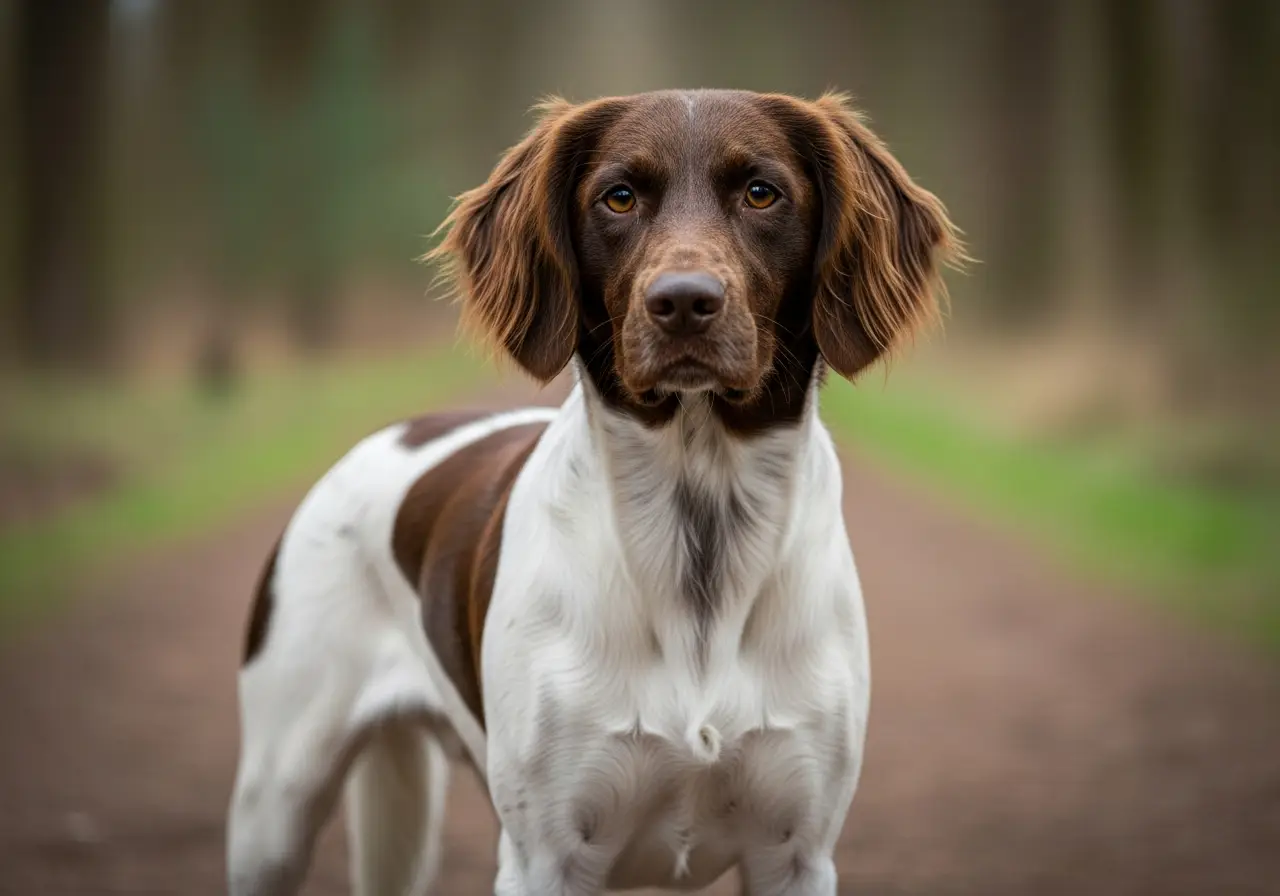
01Summary
In a paragraph
If you only have 30 seconds.
The Kleine Münsterländer is a versatile hunting pointer from the Münsterland, bred for field, forest and water for over 150 years. Its strengths (pronounced nose, endurance, close bond with the handler) are simultaneously its demands. Anyone who keeps this dog without hunting or equivalent sporting activity underestimates it. The result is not a relaxed companion dog, but a frustrated working dog.
02Introduction
What makes the Kleiner Münsterländer special
The Kleiner Münsterländer is a versatile German hunting pointer, FCI Group 7, suitable as a family dog and eager to learn, withers height 50–56 cm.
03Profile
Key facts and suitability
- Origin
- Deutschland
- Original purpose
- Versatile hunting dog (pointing, searching, retrieving)
- FCI
- No. 102 · Group 7 · Section 1.2
- height at the withers
- 50–56 cm
- Weight
- 15–20 kg
- Life expectancy
- 12–14 Years
- Coat type
- Long-haired
- Minimum exercise
- 90 min/day
- Puppy price
- 1'200–2'000 CHF
- Waiting period
- 9 months
- Sports
- Hunting · Field trials · Agility · Retrieving · Tracking
04Temperament
How the Kleiner Münsterländer shows up in everyday life
The following happens during the morning run in the forest: the Kleine Münsterländer paces in front of you, nose close to the ground, and reacts to every change in wind direction. It does not work beside you, it works with you, but with its own head. As soon as it picks up a scent trail, recall without prior training is not a given.
This is the internal axis: this dog needs tasks. Its need for social contact is high; it seeks closeness to its primary caregiver, wants to be included and reacts to exclusion with restlessness. Mental work and movement at level 4 out of 5 mean: an evening on the sofa after a short walk is not a balance for it, but pent-up energy.
The external axis looks different: towards strangers it shows a friendly, attentive attitude; friendliness-strangers is at 4 out of 5. This means it is not a guard dog and not suspicious. Visitors are registered, but not repelled. However, this openness must not be confused with indifference: the Kleine Münsterländer is attentive, not passive.
In everyday family life, it seeks connection. It follows you through the apartment, lies down near you and observes what happens next. Boredom is its biggest stressor. Anyone who offers it structured nose work, fetching sequences or search games daily receives a balanced, cooperative dog. Anyone who does not do this receives a dog that finds its own enrichment, in the garden, on the walk or in the apartment.
05Needs
What this breed needs daily
The Kleine Münsterländer needs at least 90 to 120 minutes of intensive physical activity daily. This does not mean leisurely walking the dog, but movement with demands: cross-country runs, swimming, fetching sequences or hunting work.
In addition to physical stimulation, it needs structured mental enrichment daily. Nose work, Mantrailing, dummy training or tracking work cover this need. Pure walks without a task are not enough; the dog is designed for cooperation with the handler, not for passive accompaniment.
Being left alone is possible, but must be built up gradually. A maximum of four hours daily is considered a realistic guideline. Anyone planning longer absences needs a reliable care solution.
Its need for social contact is pronounced: the Kleine Münsterländer is strongly oriented towards the handler and actively seeks contact. Isolation or consistent exclusion from family life leads to stress behaviour.
For keeping without hunting use, the following alternatives are suitable: Mantrailing, scent work, dummy sport or search and rescue dog work. These activities cover both the need for movement and mental work in a structured way. Keeping in an apartment is possible with consistent daily stimulation, but requires disciplined routines. A garden or direct access to open land considerably facilitates keeping.
Exercise
High
mental work
A lot
Social needs
High
training
Medium
06Sport & Mental and Physical Stimulation
What sports the Kleiner Münsterländer is suited for
Realistic in terms of physiology and genetics – not every breed suits every sport.
Structurally and physiologically suitable: Suitable for mantrailing, dummy work and tracking · CaniCross / bikejoring possible.
07Quick Check
08Suitability
Who this breed is suitable for – and who it isn't
✓Matches
The Kleine Münsterländer suits active people who can plan at least two hours daily for intensive movement and structured enrichment. Hunters looking for a versatile hunting working dog will find in it a high-performance partner for field, forest and water.
It is also suitable for dog sportspeople interested in Mantrailing, dummy sport or scent work, provided that the stimulation concept is consistent and can be implemented daily. Families with children of school age are an option if at least one adult person takes on the leadership role and actively channels the dog’s hunting traits.
Owners with prior experience in working with hunting or pointing dogs have an advantage. Anyone who has already handled a dog with pronounced prey drive knows the demands on impulse control and recall reliability. Access to open land, forest or water bodies considerably facilitates keeping. A supporting dog training school with experience in working with hunting dogs is particularly recommended during the puppy phase.
×Doesn't match
The Kleine Münsterländer is not suitable for people who are away from home for more than four hours a day and cannot arrange reliable dog care. Anyone who restricts exercise to short walks fundamentally underestimates the needs of this breed.
Households keeping a dog for the first time and lacking the willingness to engage in regular, structured training are overwhelmed by this breed. Its pronounced prey drive requires consistent impulse control training; this is not an optional add-on but a basic prerequisite for a safe everyday life.
Anyone who equates the friendliness of the Kleine Münsterländer towards strangers with general sociability and concludes from this that it is an uncomplicated companion dog is mistaken. The external openness does not change its internal need for tasks and guidance. Quiet, low-activity households, such as seniors without an active lifestyle or people with limited mobility, should consider another breed.
10Line reality
Show line, working line, breeder market
In Switzerland, the Kleine Münsterländer is bred exclusively as a working dog in Germany and Switzerland. A separation into show and working lines, as exists for other breeds, is structurally not established for the Kleine Münsterländer. The breeding association requires a passed working test for breeding approval; dogs without proof of testing generally do not receive breeding approval.
This means in practice: puppies from reputable breeding come from parent animals that have been tested for hunting. The performance traits are thus selected over generations and correspondingly pronounced. A “calmer” Kleine Münsterländer from hobby breeding without testing requirements is possible, but not the breeding standard.
Regional differences exist in the expression of individual hunting traits, such as love of water, tracking work or pointing behaviour. However, these differences are not defined lines, but the result of selection by individual breeders. Anyone with specific requirements, such as exclusively water work or field work, should look specifically for breeding kennels that test and select in this area.
11Health · Reality
What you need to plan for medically with your Kleiner Münsterländer
The life expectancy of the Kleine Münsterländer is 12 to 14 years. This places it among the longer-lived medium-sized dog breeds.
Hip dysplasia (HD) is a known issue in pointer dogs. Reputable breeders X-ray both parent dogs before approving them for breeding. The Verband für Kleine Münsterländer e.V. mandates HD examinations as a prerequisite for breeding. According to data from the OFA (Orthopedic Foundation for Animals, status 2023), approximately 10–15 % of examined Kleine Münsterländers show HD findings, a value that is kept stable through consistent breeding selection.
Eye diseases, particularly Progressive Retinal Atrophy (PRA), occur in a breed-typical manner. Before purchase, an up-to-date eye examination report for both parent dogs should be available. Genetic tests for known PRA variants are standard with reputable breeders.
Ears: The drooping, densely haired ears of the Kleine Münsterländer predispose them to ear infections, especially after water work or field use. Regular ear checks and cleaning reduce the risk.
Coat: The medium-length, dense coat requires thorough checking for ticks, burrs and injuries after field use. Regular brushing prevents matting, especially around the ears and legs.
Overweight is rarely a problem in sufficiently stimulated individuals. In dogs that are not used for hunting and receive less exercise, the risk increases. Weight should be monitored regularly.
12Structured data
Health by the numbers
Prone to diseases
Hip dysplasia, generally robust
Recommended health tests
Hip X-ray
13Myths ↔ Reality
What is often said incorrectly about this breed
Five myths, five realities, five sources.
"The Kleiner Münsterländer is a family dog that can be kept well even without hunting.
The Kleiner Münsterländer is suitable for families, which is also stated in the FCI standard. However, being suitable for families does not mean it gets by without hunting-related or equivalent stimulation. Its prey drive is genetically anchored. Anyone keeping it exclusively as a companion dog, without offering nose work, retrieving training or comparable enrichment, risks behavioural problems such as uncontrolled hunting, hyperactivity and destructiveness.
"Because it is friendly, it is well suited for first-time owners.
The Kleiner Münsterländer shows an attentive, friendly basic attitude towards people; this is a characteristic trait according to the FCI standard. However, this friendliness says nothing about its training demands. It reacts sensitively to inconsistent guidance and requires a structured, experienced primary caregiver. First-time owners without prior experience with hunting dogs are quickly overwhelmed without accompanying dog training school and a clear stimulation concept.
"A long walk daily is enough for this medium-sized dog.
The Kleiner Münsterländer needs at least 90 to 120 minutes of intensive exercise daily, and that is only the physical component. Structured nose, retrieving or search work is added. Pure walks without mental stimulation do not cover its needs. Under-stimulation often manifests in undesirable hunting behaviour, restlessness and displacement activities in everyday life.
"Kleiner Münsterländers are easy to train because they are so cooperative.
The Kleine Münsterländer is trainable and enjoys working, which facilitates training. However, willingness to cooperate does not mean that it regulates itself. Its pronounced prey drive requires consistent impulse control training, clear boundaries when off-lead, and a primary caregiver who actively steers training progress. Without this structure, it develops independent solutions, usually at the expense of recall reliability.
“As a hunting dog, it is aggressive towards other dogs.
According to the FCI standard, the Kleine Münsterländer is temperamental and balanced with stable nerve strength. Aggression towards conspecifics is not a breed characteristic. With good socialisation, it shows tolerance in dealing with other dogs. Wildschärfe (i.e. the readiness to point game) is a hunting characteristic and must not be confused with social intolerance.
14animal welfare
The animal welfare perspective
Breeder market, designer versions, animal shelter reality — what no one writes in the puppy ad.
The Kleine Münsterländer is not a fashion breed, and this is an advantage. Demand is predominantly driven by hunters and dog sports enthusiasts, which limits the market for backyard breeders. Nevertheless, offers exist outside the club structures where neither working tests nor health examinations of the parent dogs are documented. Puppies from such sources are cheaper but carry a higher risk of health and character deviations from the breed standard.
Designer versions or hybrids of the Kleine Münsterländer are hardly prevalent on the market. The risk lies less in crossbreeding trends than in misjudging the breed itself: The Kleine Münsterländer appears friendly, cooperative and family-friendly, and is therefore occasionally acquired by owners looking for an uncomplicated companion dog. This misjudgement is the most common reason for surrenders.
Animal welfare organisations in Germany and Switzerland regularly place Kleine Münsterländers. The typical reasons for surrender are: uncontrolled hunting behaviour in everyday life, hyperactivity due to lack of stimulation, and owners being overwhelmed by the training demands. These dogs are not "broken"; they were misjudged. With an experienced primary caregiver and a clear concept for mental and physical stimulation, they settle in well.
Anyone taking on a Kleine Münsterländer from animal welfare should know the dog's background and be prepared to invest time in building trust and structure. The placement organisations usually actively support this process. An animal welfare option is not a compromise solution; it is an equally valid decision with different framework conditions.
15Costs · Transparency
What this breed realistically costs
A puppy from reputable club breeding costs between 1,200 and 1,800 EUR or CHF in Germany and Switzerland. Offers significantly below this often come from breeders without club affiliation and without health documentation for the parent dogs.
Annual living costs range from 1,500 to 2,500 EUR depending on the type of keeping. This includes food (400–700 EUR/year depending on quality and size of the dog), care requirements (brushing, ear cleaning, occasional grooming visits: 100–200 EUR/year) as well as basic equipment and accessories.
Veterinary costs vary considerably. Annual preventive examinations, vaccinations and parasite prevention cost an average of 200–400 EUR. If used for hunting, there is an additional risk of injury; cuts, the removal of awns or tick bites can drive individual treatments to 100–500 EUR.
Pet health insurance costs between 40 and 100 EUR per month for a Kleiner Münsterländer, depending on the provider and scope of benefits. If used for hunting, additional liability insurance for hunting is recommended. Dog schools and training sessions for the puppy phase should be budgeted at 300–600 EUR per year.
16Puppy search
What you need to consider when choosing a breeder
- Reputable breeders of the Kleine Münsterländer are generally members of the Verband für Kleine Münsterländer e.V.
- or the Schweizerischer Klub für Kleine Münsterländer-Vorstehhunde (SKMV).
- They provide proof of working tests for the parent dogs and carry out health examinations for hip dysplasia and eye diseases.
- Characteristics of reputable breeding: The puppies grow up in a family environment, the breeder asks questions about the planned keeping and use, and they are available as a contact person after the purchase.
- Puppy placement without the possibility of viewing, without proof regarding the parent dogs, and at prices significantly below market value is a warning sign.
- Placement through animal welfare organisations is an equally valid option.
- Kleine Münsterländers often end up in animal welfare when their hunting needs have been underestimated.
- Animal welfare dogs require an experienced primary caregiver with a clear concept for mental and physical stimulation, but they offer the chance to give a dog a second chance.
- No named breeder recommendations; contacts to tested breeding facilities are provided by the official breed clubs.
FAQ
Frequently asked questions about the Kleiner Münsterländer
Is Kleiner Münsterländer suitable for beginners?
Kleiner Münsterländer is considered suitable for first-time dog owners.
Is Kleiner Münsterländer a family dog?
Kleiner Münsterländer is considered suitable for families with good socialisation and species-appropriate care.
How much exercise does Kleiner Münsterländer need?
At least around 90 minutes of exercise per day. As an active breed, more so — plus mental stimulation.
What is the size and weight of Kleiner Münsterländer?
Fully grown, Kleiner Münsterländer reaches about 50–56 cm at the withers and weighs around 15–20 kg.
What is the life expectancy of Kleiner Münsterländer?
The life expectancy of Kleiner Münsterländer is approximately 12–14 years.
Which diseases are common in Kleiner Münsterländer?
Hip dysplasia, generally robust
17Breed clubs
Official breed clubs in DACH
19Related
Similar breeds – and their differences
You might also be interested in

Participate
Do you have a good photo of your Kleiner Münsterländer?
We are looking for expressive images for our breed profiles. Submit yours; the editorial team reviews every submission before publication.
Does this breed suit you?
Versatile, family-dog-suitable hunting spaniel. Very popular in Germany. Brown-and-white markings.